-5% on your 1st eSIM
WELCOME5
Loading...
Everything you need to pick the right Uzbekistan eSIM in 2026: how Beeline, Ucell and Mobiuz compare, coverage from Tashkent to Samarkand and Bukhara, install steps, and how much data a Silk Road trip needs.
 Dimitri MorvanAugust 20, 20267 min
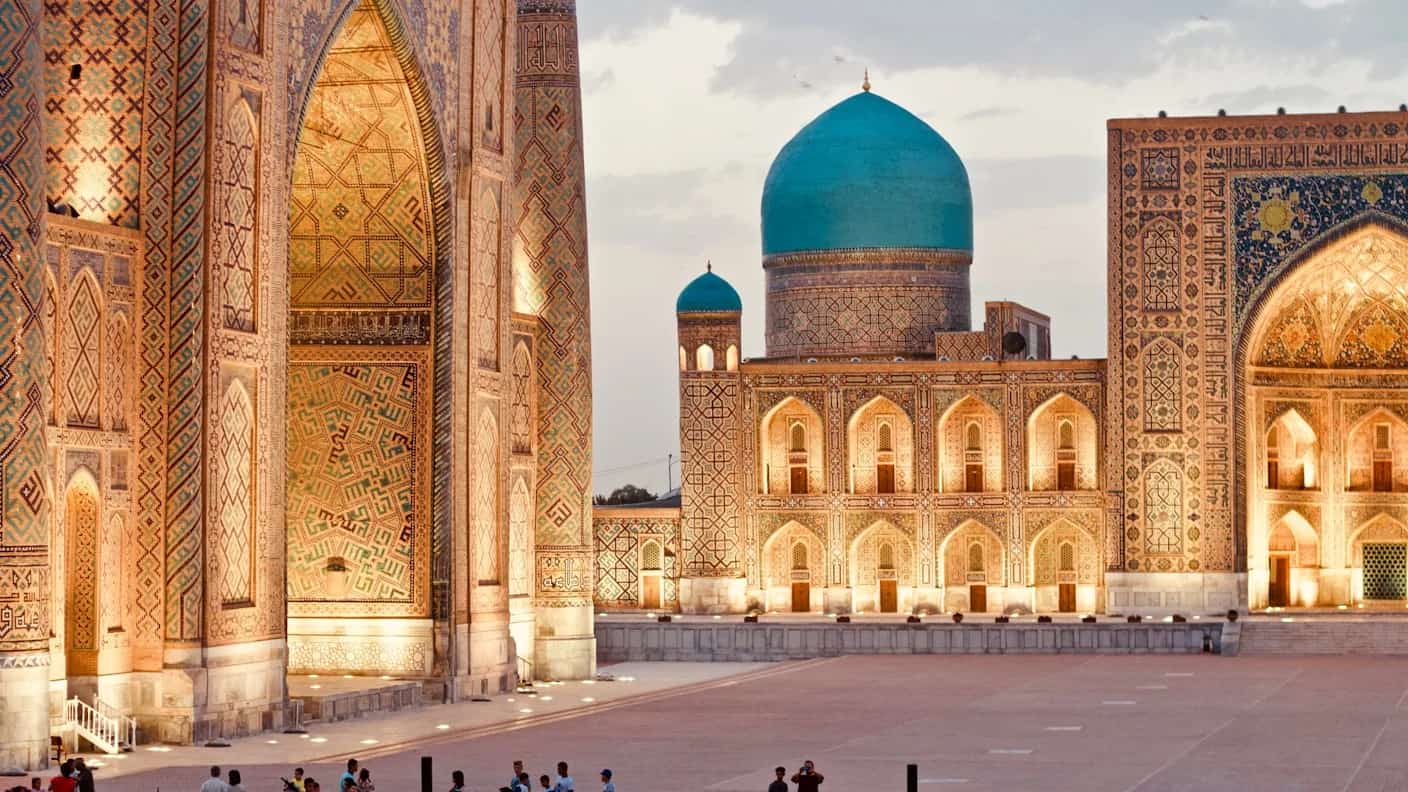
Beeline, Ucell and Mobiuz all run 4G in Tashkent, Samarkand, Bukhara and Khiva, and the signal follows the main routes between the Silk Road cities before thinning out in the Kyzylkum desert. Uzbekistan is the jewel of the Silk Road, from the madrasas and domes of Samarkand and Bukhara to the walled old city of Khiva and the buzz of Tashkent. Getting around the great sights runs on good data for maps and messaging, and an eSIM is the cleanest way to get it, sidestepping a local SIM purchase. Install before you fly, land at Tashkent or Samarkand, and your phone connects when it finds a local network.
Uzbekistan's networks are closely matched and modest in speed. In the nPerf 2025 mobile barometer, covering the whole of 2025, Beeline came first with about 39,200 nPoints and a median download speed of about 20.4 Mbps, ahead of Ucell (37,388 nPoints, 18.64 Mbps) and the state-owned UzMobile (36,334 nPoints, 18.66 Mbps).
Around 20 Mbps is plenty for maps, messaging and photo sharing, but large uploads and video calls are slower than in Europe, especially in the evening. The networks used by each Simsima Uzbekistan plan are listed in its details.
Uzbekistan registers every phone used on its networks by its IMEI number through the UZIMEI system. According to the official UZIMEI tariff page, registering a device used with an Uzbek SIM costs individuals 88,000 to 110,000 som from 1 August 2025, counted from the phone's first connection to the network, while the fee for non-residents is zero when they use a foreign SIM in roaming.
A travel eSIM from Simsima connects as a roaming line, so it falls in the second case. A local Beeline or Ucell SIM, by contrast, means a registration step and a fee on top of the SIM itself, in addition to the passport registration that operators carry out in store.
Uzbekistan is an affordable data market, so eSIM prices are reasonable and allowances go a long way. Simsima runs on the local networks with transparent pricing. Here is how a light 1 GB pack compares across eSIM providers:
If you would rather not track your usage, Uzbekistan also has unlimited-data eSIMs, with speed reduced after a daily high-speed allowance until the next day. Here is how the unlimited plans compare:
Simsima's full Uzbekistan lineup runs from small packs up to larger monthly allowances on the local networks. For a week or two touring the Silk Road cities with daily social media, 3 GB is comfortable, since hotels have Wi-Fi; heavier users or anyone tethering should look at 5 GB or more.
Tashkent has the densest 4G and the first 5G, and Samarkand's Registan, Bukhara's old town around Lyabi-Hauz and the walled Itchan Kala in Khiva all have usable 4G. The Afrosiyob high-speed line between Tashkent, Samarkand and Bukhara keeps a signal for most of the journey, with drops between towns.
Distances grow in the west. The road from Bukhara to Khiva crosses the Kyzylkum desert for hours with long gaps, and the trip from Nukus to Moynaq and the Aral Sea has little coverage beyond the towns. In the Chimgan and Nuratau mountains, signal is patchy away from the villages. Download offline maps and save train tickets before leaving a city.
A classic first trip spends two nights in Tashkent, takes the Afrosiyob to Samarkand for three nights, continues to Bukhara for three, and ends with two nights in Khiva, often with a flight back to Tashkent from Urgench. Maps, taxi apps, translation and photo sharing are the main uses; hotels have Wi-Fi, though it can be slow.
Installation takes a couple of minutes and is best done at home on Wi-Fi before you fly. The plan activates on its own when it connects to a local network on arrival, so the validity window does not start early.
The SIM and data packs from Beeline, Ucell, Mobiuz or UzMobile are inexpensive, but a local SIM also brings IMEI registration: UZIMEI charges individuals 88,000 to 110,000 som from August 2025 for a phone used with an Uzbek SIM. With a travel eSIM in roaming, the non-resident fee is zero.
You do not get an Uzbek number, so a few local apps and payments are harder to use, speeds are modest, and desert areas are offline as with any SIM. Your phone must also be eSIM-compatible and unlocked before you leave for Uzbekistan.
No fee applies: the UZIMEI tariff for non-residents using a foreign SIM in roaming is zero. Registration and its fee concern phones used with an Uzbek SIM.
Beeline ranked first in the nPerf 2025 barometer, with Ucell and UzMobile close behind. In the Silk Road cities the difference is small; the networks used by each Simsima plan are listed in its details.
For ten days across Tashkent, Samarkand, Bukhara and Khiva, 3 to 5 GB covers maps, taxi apps and messaging. Heavy photo and video sharing or remote work needs more.
Get a multi-country plan and save on your mobile data.
Or choose another country:
Uzbekistan eSIM plans — Browse and compare all available Uzbekistan eSIM plans on Simsima
eSIM-supported devices — Check whether your phone supports eSIM before you buy an Uzbekistan plan
How Simsima works — Learn how to buy and install an eSIM in a few minutes, and how it activates on arrival
Founder of Simsima. A passionate traveler based in Barcelona, he helps travelers stay connected without breaking the bank on roaming fees.
LinkedIn