-5% on your 1st eSIM
WELCOME5
Loading...
Plan 2 weeks in Vietnam with a day-by-day itinerary covering Hanoi, Hoi An, and Ho Chi Minh City. Includes transport, budget, visa, and eSIM tips.
 Dimitri Morvan
You probably have the same problem most travelers have with 2 weeks in Vietnam. Your saved list is too long, the map is bigger than you expected, and every itinerary online tells you to “see it all” without admitting what gets ugly fast: wasted transfer days, bad weather in the wrong region, and too many one-night stops.
My advice is simple. Treat 14 days as a hard constraint, not a loose idea. Vietnam is absolutely worth two weeks, but only if you build the route around distance, flight logic, and season first. If you start with your wishlist, you'll end up with a rushed trip that looks good on paper and feels exhausting in real life.
For most first-time travelers, the cleanest route is Hanoi → Ha Long Bay → Hue → Hoi An → Da Nang → Ho Chi Minh City → Mekong Delta. It works because it follows Vietnam's geography, cuts down backtracking, and gives each stop a clear role. Hanoi gives you the historic north, Hue gives you imperial history, Hoi An gives you atmosphere, Da Nang gives you a soft landing between transfers, and Ho Chi Minh City closes the trip with urban energy and easy international departures.
Use this day split: 3 nights Hanoi, 1 night Ha Long Bay or a long day trip, 2 nights Hue, 3 nights Hoi An, 1 night Da Nang, 3 nights Ho Chi Minh City, 1 day for the Mekong and departure buffer. That is enough. Adding Sapa, Ha Giang, Phong Nha, Nha Trang, or Phu Quoc to this exact framework usually makes the trip worse, not better.
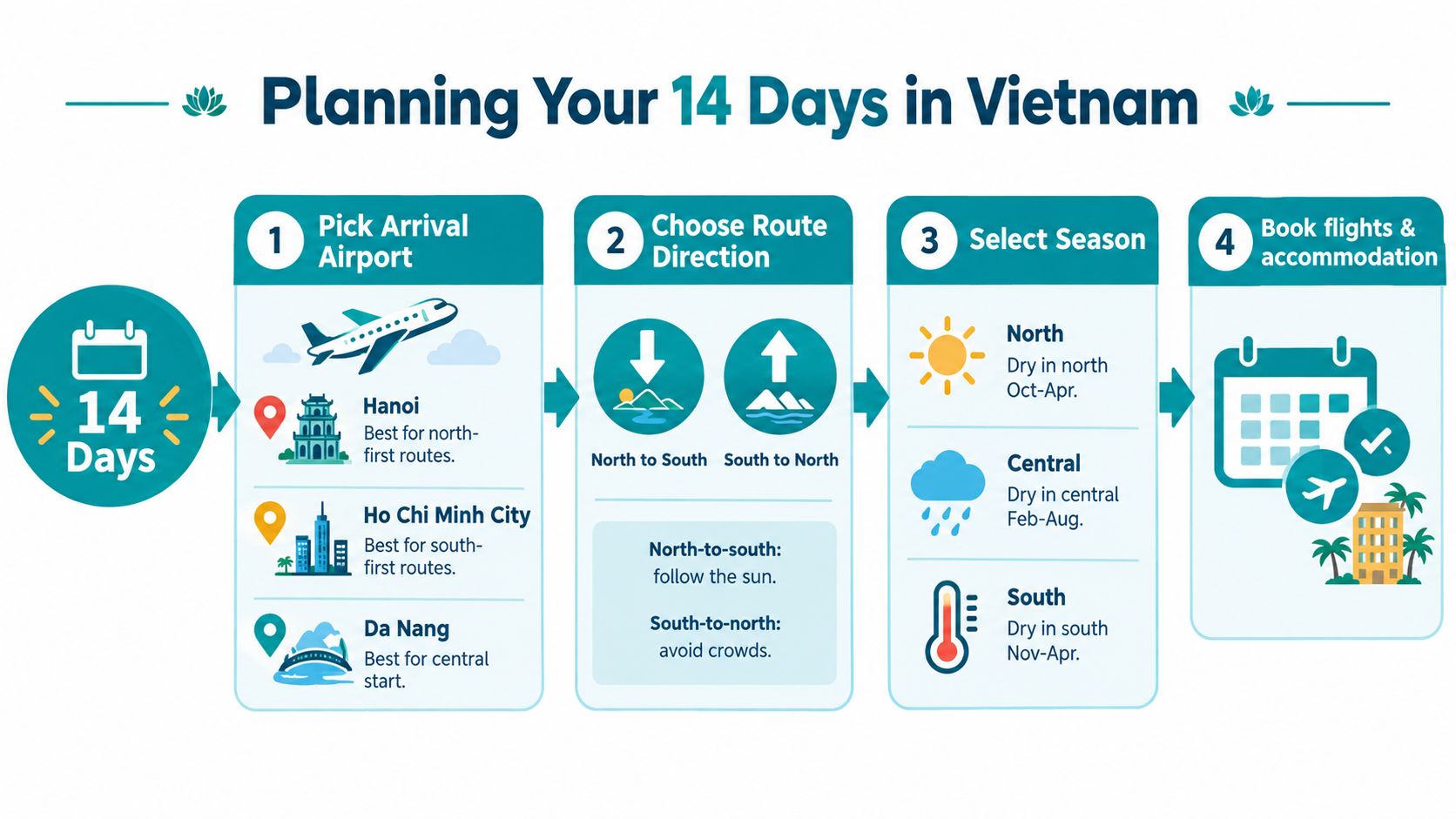
Pick the direction North to south is my default recommendation. It gives first-timers a strong cultural arc and usually feels smoother.
Book open-jaw flights Fly into Hanoi and out of Ho Chi Minh City if you can. Don't buy a round-trip ticket that forces you to return to your entry city unless the fare difference is impossible to ignore.
Match the route to the season This matters more than people admit. Vietnam doesn't have one travel season. It has different weather windows by region, and your route should reflect that.
If your travel dates fall badly for one region, or you hate moving hotels every few nights, choose a regional trip instead. Spend two weeks in the north only, or two weeks in central Vietnam only. That is often smarter than forcing a full-country trip through poor weather.
Practical rule: In Vietnam, the right route beats the longer checklist every time.
Vietnam is not an emerging backpacker secret anymore. It's operating at scale. The country recorded more than 17.5 million international visitor arrivals in 2024, up 39.5% from 2023 and reaching about 97.6% of the 2019 level, according to the Vietnam National Authority of Tourism update on 2024 arrivals. Most visitors arrived by air, which matters because it tells you where crowd pressure starts: major airport gateways and the big city corridors.
That scale is good news for a 14-day trip. Hotels, flights, transfer services, and tourist logistics are built to handle heavy demand. The problem is not whether Vietnam can support an independent route. It can. The problem is whether you leave enough breathing room in the itinerary.
| Metric | Figure | What It Means for You |
|---|---|---|
| International visitor arrivals in 2024 | More than 17.5 million | Major destinations are busy, popular hotels and tours don't stay empty for long |
| Change from 2023 | 39.5% higher | Demand has rebounded hard, especially on classic routes |
| Recovery vs 2019 | About 97.6% of pre-pandemic level | Core tourism infrastructure is back at full working scale |
| Arrivals by air | More than 14.8 million or 84.4% | Most travelers enter through big airports, then continue by domestic transport |
| Land arrivals | About 2.5 million or 14.2% | Border entries matter, but most first-timers still fly in |
| Sea arrivals | 248,100 or 1.4% | Cruise entry exists, but it's not the main planning scenario |
| Mobile base-layer coverage | Roughly 99.8% of the population | 4G is the reliability layer you should care about most for a moving trip |
Vietnam's mobile side is strong too. Independent coverage data cited by Vietnam's Ministry of Information and Communications says the mobile base layer covers roughly 99.8% of the population, while 5G is still concentrated in major cities, as noted in this Vietnam 5G coverage overview. Translation: maps, ride-hailing, messaging, and bookings usually work well across the standard tourist route.
Infrastructure isn't the limiting factor on a two-week Vietnam trip. Your pacing is.
This is the 14-day route I'd give most first-time travelers. It covers Vietnam's major highlights without turning every second day into a transfer.
Day 1: Arrive in Hanoi, stay in the Old Quarter, and keep the day light. Walk Hoan Kiem Lake, get your bearings, and eat early.
Day 2: Give Hanoi a full day. Do the Old Quarter properly, stop by Train Street if access is open and managed, and end with a water-puppet show.
Day 3: Go to Ha Long Bay. If you care about the scenery more than speed, do an overnight cruise. If you hate repacking, take a day trip and return to Hanoi late.
Day 4: Fly from Hanoi to Hue. Don't take a long overland transfer here on a 14-day trip unless train travel is one of your trip priorities.
Day 5: See the Imperial Citadel, visit Thien Mu Pagoda, and take a Perfume River boat ride. Hue deserves a slower pace than people give it.
Day 6: Transfer south toward Hoi An. If you want the scenic option, do the Hai Van Pass by private car or guided motorbike transfer. Check into Hoi An and keep the evening free.
Day 7: Hoi An day. Old Town, tailor appointments if you want clothes made, and a lantern-making class if that appeals to you.
Day 8: Another Hoi An day. Use it for cafés, riverside wandering, the night market, or a beach break if you need a reset.
Hue and Hoi An work because they feel different. Don't collapse them into one rushed stop.
Day 9: Shift to Da Nang or day-trip in from Hoi An. Focus on Marble Mountains and the beach. Don't try to cram Ba Na Hills into this schedule unless you're willing to drop something else.
Day 10: Fly to Ho Chi Minh City. After check-in, keep it local and walk District 1.
Day 11: Do the War Remnants Museum and central city sights. Saigon is best explored on foot in short bursts, broken by coffee and food stops.
Day 12: Take a Cu Chi Tunnels trip if you want wartime history. If you don't, stay in the city and dig deeper into neighborhoods instead of collecting another bus ride.
Day 13: Mekong Delta day trip. Pick Ben Tre or My Tho and return to Ho Chi Minh City at night.
Day 14: Keep this open. Shop at Ben Thanh Market, eat one last long lunch, and leave for your international flight without stress.
A lot of bad itineraries look “packed” but are mostly vans, check-ins, and waiting around.
Transport is where good Vietnam itineraries go bad. You can absolutely move around cheaply. That doesn't mean you should choose the cheapest option every time. On a 2 weeks in Vietnam trip, every half-day matters.
| Route | Best Option | Travel Time | Cost Range (USD) | When to Choose |
|---|---|---|---|---|
| Hanoi to Hue | Flight | Shortest practical option | Varies | Choose this if you want to protect sightseeing time |
| Hanoi to Hue | Train | Long | Varies | Choose this only if the train experience is part of the trip |
| Hue to Hoi An | Private car via Hai Van Pass | Moderate | Varies | Choose this for scenery and a comfortable daytime transfer |
| Da Nang to Hoi An | Grab or car transfer | Short | Varies | Best for simplicity and flexible hotel-to-hotel movement |
| Da Nang to Ho Chi Minh City | Flight | Shortest practical option | Varies | Best choice for nearly every 14-day itinerary |
| Nha Trang to Ho Chi Minh City | Flight | Shortest practical option | Varies | Only relevant if you swap Da Nang or Hoi An for Nha Trang |
| Long overland city hops | Sleeper bus | Long and tiring | Varies | Choose only if budget matters more than comfort |
Hanoi to Hue: Fly. The train is romantic in theory and time-hungry in reality. For a longer trip, fine. For two weeks, not worth the cost in energy unless you love rail travel.
Hue to Hoi An: Use a private car across the Hai Van Pass if your budget allows it. It turns a transfer day into a scenic day instead of dead time.
Da Nang to Hoi An: Use Grab. It's the cleanest, least stressful option. If you rely heavily on ride-hailing abroad, it's worth reading how to protect yourself during a rideshare so you build good habits before the trip.
If you're stitching together flights, trains, and road transfers across several stops, this guide on how to plan a multi-destination trip is a useful way to keep the logistics from getting sloppy.
Most guides push a default north-to-south itinerary. That's lazy advice. Vietnam is long enough that weather should decide the route, not habit.
A useful planning gap in many Vietnam guides is seasonality by region. One source breaks out better shoulder windows as May to early June and late September to mid-October for the north, February to April and August with typhoon caution for central Vietnam, and November to early December and March to April for the south, as summarized in this regional seasonality breakdown for a Vietnam itinerary. That's the right way to think about the country. Not as one weather system, but as separate planning zones.
If your best weather lines up with the south and central coast, fly into Ho Chi Minh City and move north. Don't force a Hanoi start just because online itineraries do.
If you land in Saigon, don't double back north and then return south again. That is how travelers waste two days pretending they're being efficient.
Skip a region when it creates a detour that doesn't pay you back.
Ask one question: Will this stop force me to spend more time moving than experiencing?
If yes, cut it.
The smartest Vietnam itineraries aren't the ones with the most pins on the map. They're the ones that know what to leave out.
Your budget in Vietnam depends less on sightseeing and more on how you move between cities and where you sleep. Accommodation and internal transport shape the trip more than almost anything else.
| Traveler Type | Nightly Budget (USD) | Recommended Lodging | Recommended Simsima Plan |
|---|---|---|---|
| Backpacker | 30 to 50 | Hostel or simple guesthouse in Hanoi Old Quarter, Hoi An Riverside edges, and District 1 side streets | 5 GB if you mostly use maps, messaging, and occasional booking apps |
| Mid-range | 70 to 120 | 3-star hotel in Hanoi Old Quarter, Hoi An Riverside, and central District 1 | 15 to 20 GB for a full north-to-south trip with regular maps, media, and ride-hailing |
| Comfort | 150 to 250 | 4-star hotel with pool or river access, plus private transfers and domestic flights | 20 GB or more, especially if you hotspot or work on the move |
Hanoi: Stay in the Old Quarter. It's noisy and convenient, which is exactly what you want for a short first visit.
Hoi An: Stay near the Riverside rather than too far out. You'll get easier evening access without needing transport every time you want dinner.
Ho Chi Minh City: Stay in District 1. This is not the trip to save a little money and then commute across the city for every museum, meal, and transfer.
You don't need unlimited data for most two-week Vietnam trips. A normal traveler using maps, messaging, ride-hailing, translation, email, and regular browsing usually lands in the moderate-use range. If you stream constantly, upload video, or hotspot a laptop, you need more headroom.
Vietnam's digital environment is well suited to independent travelers. At the start of 2024, the country had 78.44 million internet users, 168.5 million cellular mobile connections, and a median mobile internet speed of 47.06 Mbps, according to the Digital 2024 Vietnam report. In practical terms, urban and high-traffic tourist corridors are set up for app-based travel.
For a Hanoi to Ho Chi Minh City trip, I'd pick a Vietnam eSIM plan with 15 to 20 GB unless you're extremely light on data. That gives room for maps, ride-hailing, hotel confirmations, messaging, and the usual travel-day usage without constantly checking your balance. If you want to compare destination-specific options, look at the Vietnam eSIM plans and match the validity to your exact travel dates.
Pocket Wi-Fi is usually more annoying than helpful on this route. It's another device to carry, charge, and return.
Entry rules matter more now than many older Vietnam guides suggest. One recent travel summary notes that 2025 policy changes expanded visa-free stays to 45 days for 12 additional European markets starting 15 Aug 2025, while earlier 12-country exemptions were extended to 2028, and it also notes 12.2 million international arrivals in the first seven months of 2025 and 21.2 million for the full year, a record, according to this Vietnam itinerary and visa update summary. For a 14-day trip, that means one thing: check your passport's exact eligibility before booking flights.
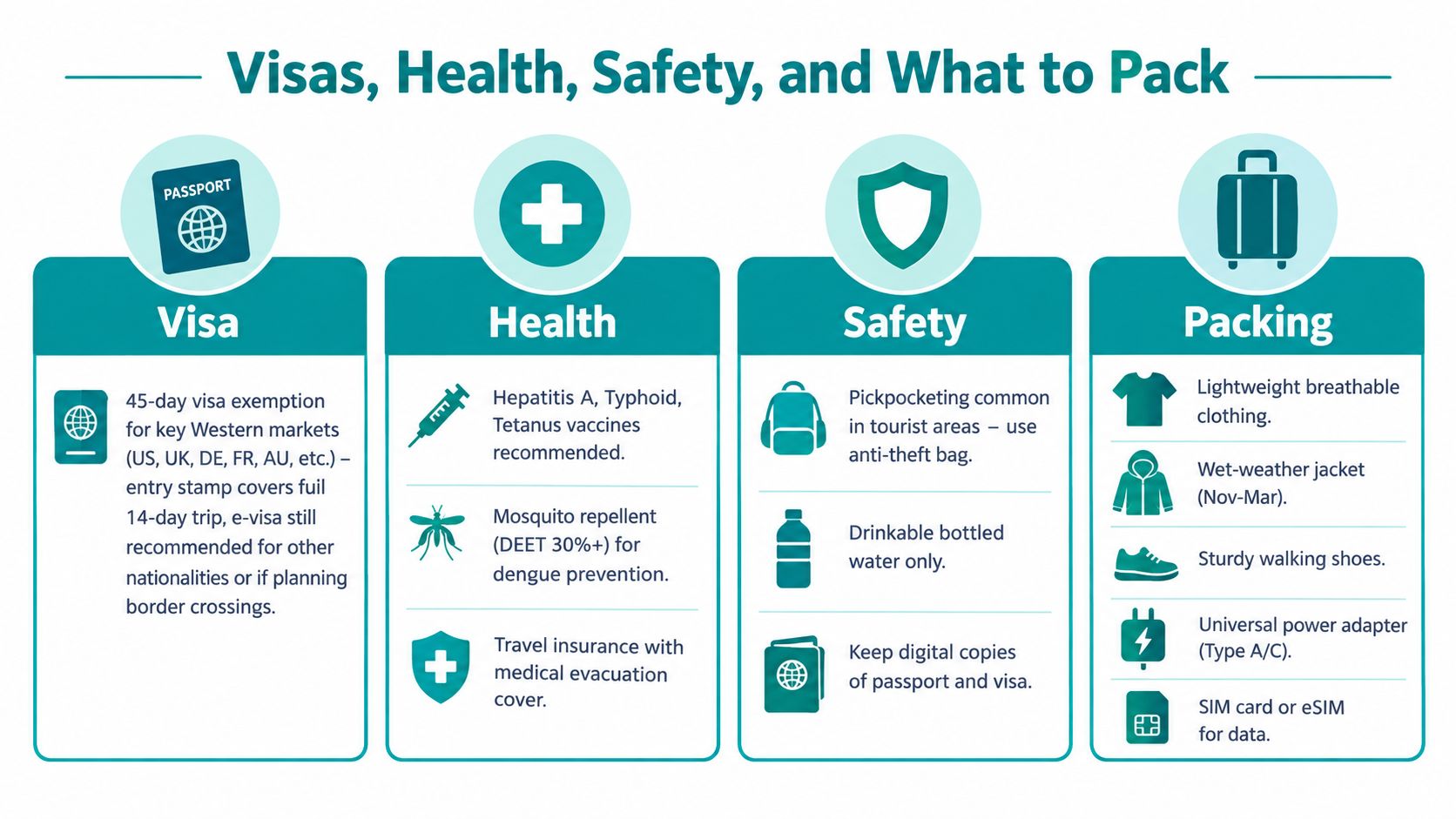
A quick visual primer helps if you want the essentials in one place:
Bag-snatching is the tourist risk people notice most in Ho Chi Minh City, especially near traffic. Don't walk at the street edge with your phone hanging out into scooter lanes.
If you rent or ride on a scooter, take helmet quality seriously. If the strap is bad, refuse it.
Pack for humidity first, not style first. Bring breathable clothes, one compact rain layer, shoes you can walk in and get dusty, and temple-appropriate coverage for shoulders and knees. Bring an eSIM-ready phone so you can get online on arrival and skip airport SIM stalls.
If you want one clean framework for 2 weeks in Vietnam, use this order: route first, month second, data plan third. Travelers often do it backward. They book cheap flights, then ask the weather to cooperate. That's how they end up in the wrong region at the wrong time.
Pick the trip shape that fits your dates.
Central Vietnam often carries a two-week trip beautifully when weather lines up. The south is often easiest for travelers who want warmth and low-friction city-to-coast movement. The north is strongest when you want the northern highlights, not just because Hanoi is a famous starting point.
If you're juggling multiple destinations on one longer Asia trip and comparing costs across countries before you lock your route, even something adjacent like an up-to-date Singapore mobile price list can help you sense how your connectivity budget changes from stop to stop.
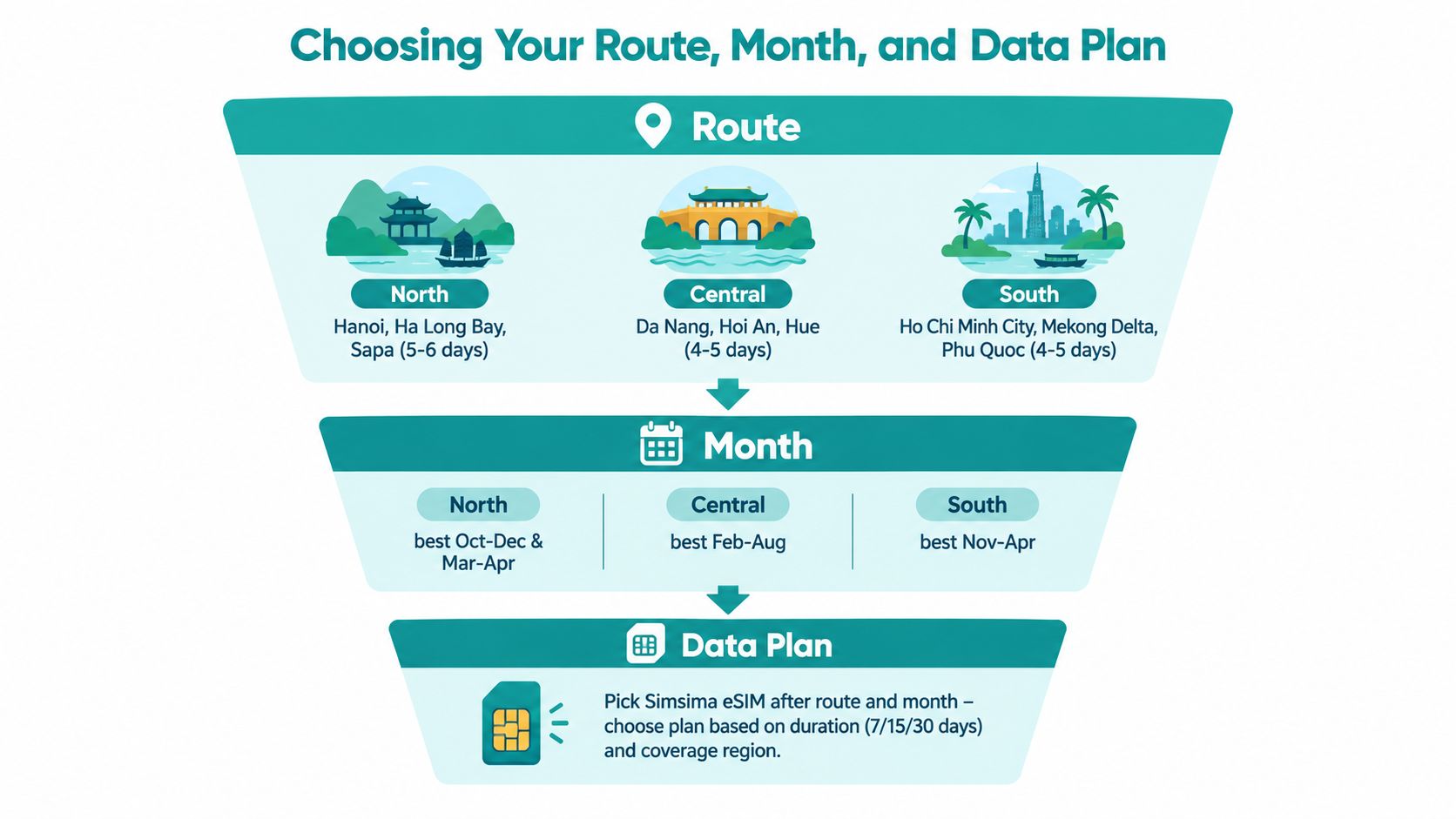
Once the route is fixed, estimate your usage. A short, lighter-use trip can fit a 5 GB plan. A standard north-to-south two-week trip usually fits 15 to 20 GB. Heavy hotspot users should jump to 30 GB and stop worrying about it.
If you're unsure where you land, use a mobile data usage calculator for travel before you buy.
Book the route that fits the season, not the itinerary that looks most ambitious. For most first-timers, that means an open-jaw flight, one domestic hop in the middle, and enough data to navigate without thinking about it.
If you're planning 2 weeks in Vietnam, mobile data is one of the few things you should sort before takeoff. Simsima offers prepaid travel eSIMs for Vietnam that you can install digitally before arrival, which makes a multi-city route much easier once you land. Pick the route first, match the plan to your usage, and keep the trip moving.

Founder of Simsima. A passionate traveler based in Barcelona, he helps travelers stay connected without breaking the bank on roaming fees.
LinkedIn