-5% on your 1st eSIM
WELCOME5
Loading...
Singapore is covered end to end by Singtel, StarHub, M1 and SIMBA, MRT tunnels included. Compare unlimited and capped plans, see setup steps, and decide whether you need data at all.
 Dimitri MorvanFebruary 24, 20269 min
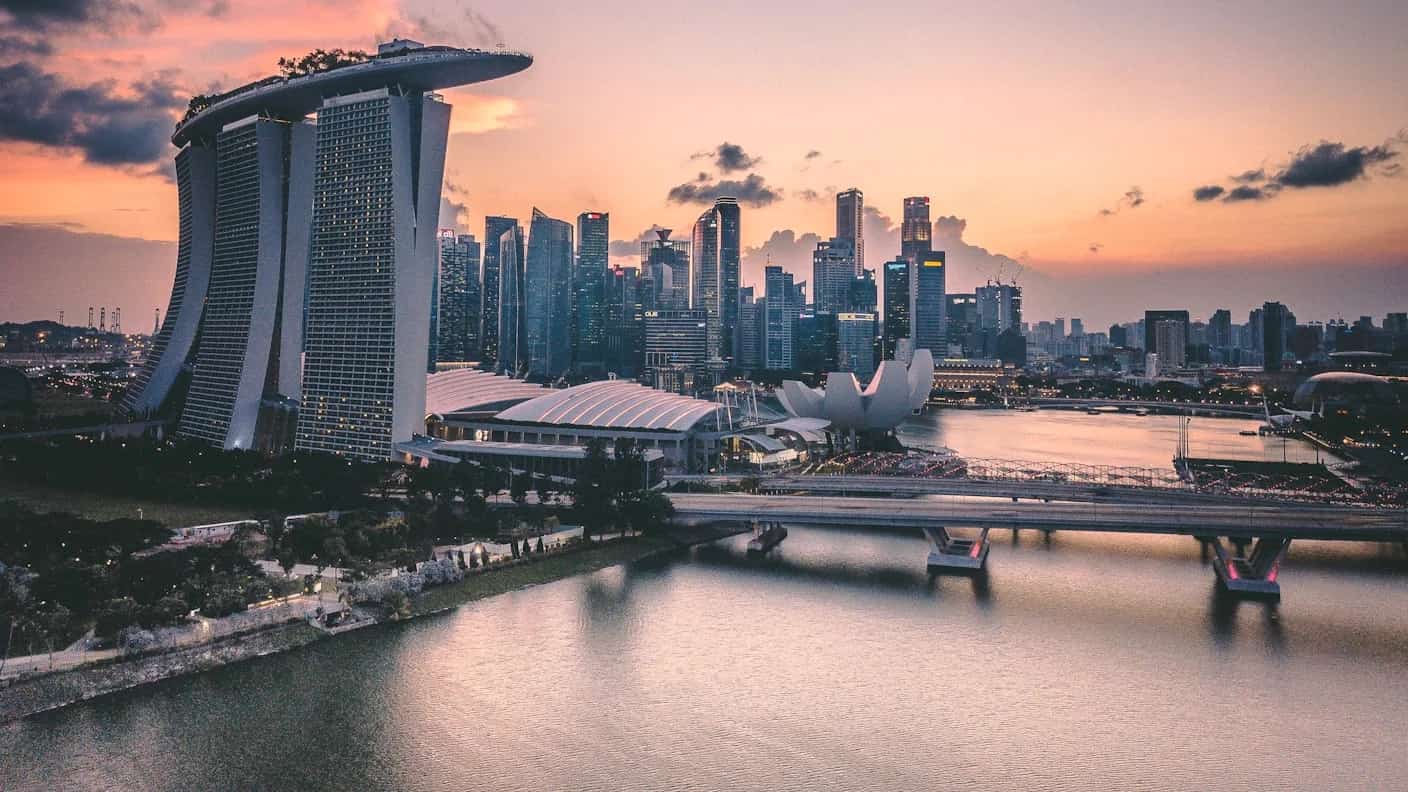
In Singapore, Singtel, StarHub, M1 and SIMBA cover the whole island on 4G and 5G, MRT tunnels and high-rise interiors included, so the choice comes down to price and plan length. SingTel took the top overall position in nPerf's 2026 barometer (nPerf, 2026), and Singtel's standalone 5G passed 95% nationwide coverage in 2022 (Singtel, 2022). That makes Singapore one of the easiest countries in the world to stay connected in — and a travel eSIM is the fastest way to get online the moment you clear customs at Changi Airport. With the best eSIM for Singapore, you skip the SIM card counters entirely: purchase before your flight, scan a QR code, and you have mobile data before you reach baggage claim.
Singapore's four networks are fast by any standard. The nPerf 2026 barometer for Singapore, measured from April 2025 to March 2026, ranks Singtel first with 106,722 nPoints and a download speed of 275.68 Mbps. StarHub is second at 200.24 Mbps and M1 third at 186.67 Mbps, with the lowest latency of the four at 22.26 ms. SIMBA, the former TPG network, comes fourth at 33.2 Mbps.
In practice, all four cover the whole island, including MRT tunnels, Changi's terminals and the interiors of malls and office towers, so a visitor rarely notices the difference. If you plan heavy video calls or uploads, a plan on Singtel, StarHub or M1 gives you the most headroom. Each Simsima plan for Singapore names its network in the plan details.
Singapore's operators sell prepaid SIMs for visitors at Changi Airport, registered with your passport. Singtel's hi!Tourist offer (checked October 2026) starts at S$10 for 7 days with a large 5G data allowance that also works in Malaysia, Indonesia, Thailand and Hong Kong, plus local calls and SMS, and it is available as an eSIM too. Longer 30-day versions add roaming in more countries.
Those local offers are strong value and come with a Singapore number. A travel eSIM bought before you leave saves the counter visit and is working when you land, and it can be part of a regional plan if Singapore is one stop among several. Compare the tables above with the local offers for your dates.
Every traveler entering Singapore, apart from some transit passengers, must submit the SG Arrival Card with an electronic health declaration. According to the Immigration and Checkpoints Authority, it is free and must be done within three days before arrival, including the arrival day, on the ICA website or in the MyICA app. Do it at home, or on Wi-Fi before boarding, at the same time as you install your eSIM; avoid paid third-party sites that charge for the same form.
Free Wi-Fi is everywhere in Singapore: across Changi Airport, in malls such as ION Orchard, VivoCity and Jewel, in many hawker centers, and through the government-backed Wireless@SG network at thousands of public hotspots. On a short layover spent at Changi, airport Wi-Fi is enough.
Data earns its keep once you move around: Google Maps walking directions between Chinatown and Tiong Bahru, booking a Grab when an afternoon storm hits, or checking Gardens by the Bay's opening times from the street. A private connection is also safer than public Wi-Fi for banking apps.
A typical three-day stopover covers Marina Bay and Gardens by the Bay, Chinatown and Little India's hawker centers, Sentosa or the Singapore Zoo, and an evening on Orchard Road. The MRT and buses accept contactless bank cards through SimplyGo, so you don't need a transport app, and Grab, Gojek and TADA handle rides. Data goes on maps, ride-hailing, restaurant searches and photos.
Expect 300 to 600 MB a day, or 1 to 2 GB for three days, since you are often on Wi-Fi. A small capped plan from the table above covers it. Long stays and heavy streamers are better served by an unlimited plan.
Singapore eSIM pricing splits into two distinct categories: unlimited data plans (sold by duration) and capped plans (sold by total data allowance). Below are two comparison tables covering both types, with prices verified as of 2026-10-17. All prices are in USD.
Unlimited plans are ideal if you stream video or simply prefer not to monitor your data usage. Prices vary significantly across providers for the same duration.
Capped plans work well for travelers who mainly use maps, messaging apps, and light social media browsing. They cost less than unlimited options and are a good match for Singapore, where free Wi-Fi supplements your mobile data at most indoor locations.
Simsima provides instant digital delivery with no registration or ID verification required — you receive your eSIM QR code immediately after purchase. For travelers heading to multiple countries, Simsima’s multi-country Trip Packs cover several Southeast Asian destinations under a single eSIM profile, which eliminates the need to buy separate plans for each stop.
Setting up a travel eSIM takes a few minutes. Complete these steps before your flight so you have data the moment you land at Changi. Most providers, including Simsima, deliver the QR code instantly via email, so you can set everything up the night before departure.
If you run into issues during installation, contact Simsima support, which usually replies within 24 hours. The most common fix is to ensure your phone’s software is up to date and that your device is connected to Wi-Fi while scanning the QR code.
Singapore is a starting point for many Southeast Asia trips. Overland, the Woodlands Causeway and the Second Link lead to Johor Bahru in Malaysia; by ferry, Batam and Bintan in Indonesia are about an hour away; and Changi has direct flights to Bangkok, Kuala Lumpur, Bali, Ho Chi Minh City and Manila. A Singapore plan stops working at the border.
If Singapore is one stop among several, a regional plan that covers all your countries saves installing a new eSIM at each border. For a trip spent entirely in Singapore, a single-country plan is the simpler choice.
Asia eSIM: The Complete Guide to Multi-Country Travel in 2026
Any plan on Singtel, StarHub or M1 is fast across the island, so choose by data and duration, or by whether you need other countries too. The tables above compare providers, and each Simsima plan lists its network in its details.
Yes. Singtel's hi!Tourist prepaid offer is available as an eSIM, registered to a foreign passport, alongside its physical tourist SIM sold at Changi. Travel eSIMs from international providers are another option, bought before you leave.
Look for a plan that includes 5G on Singtel, StarHub or M1, the three fastest networks in nPerf's 2026 barometer, and a phone that supports Singapore's 5G bands. Whether you get 5G depends on the plan, the phone and local coverage.
Yes. You buy a travel eSIM online, receive a QR code or install link by email and install it on Wi-Fi before you fly. It activates when it connects to a Singapore network at Changi, and you can get a refund within 14 days if it has not been activated.
An eSIM is a digital SIM profile downloaded to a chip already in your phone. You add it as a second line next to your home SIM, use it for data while traveling, and keep your usual number for calls and texts.
A travel eSIM carries data only, so you get no Singapore number for local SMS checks. Local tourist SIMs can offer more data for the price, hotspot use depends on the plan, and your phone must be eSIM-compatible and unlocked.
Get eSIM coverage for your next Southeast Asian destination.
Singapore eSIM plans — Browse all available eSIM plans for Singapore with activation on arrival
multi-country Trip Packs — Cover Singapore and neighboring countries with a single eSIM
eSIM-compatible devices — Check if your phone supports eSIM before purchasing
Founder of Simsima. A passionate traveler based in Barcelona, he helps travelers stay connected without breaking the bank on roaming fees.
LinkedIn