-5% on your 1st eSIM
WELCOME5
Loading...
Discover the best time to visit europe for budget travel, beaches, skiing, or festivals. Month-by-month regional guide with practical tips.
 Dimitri Morvan
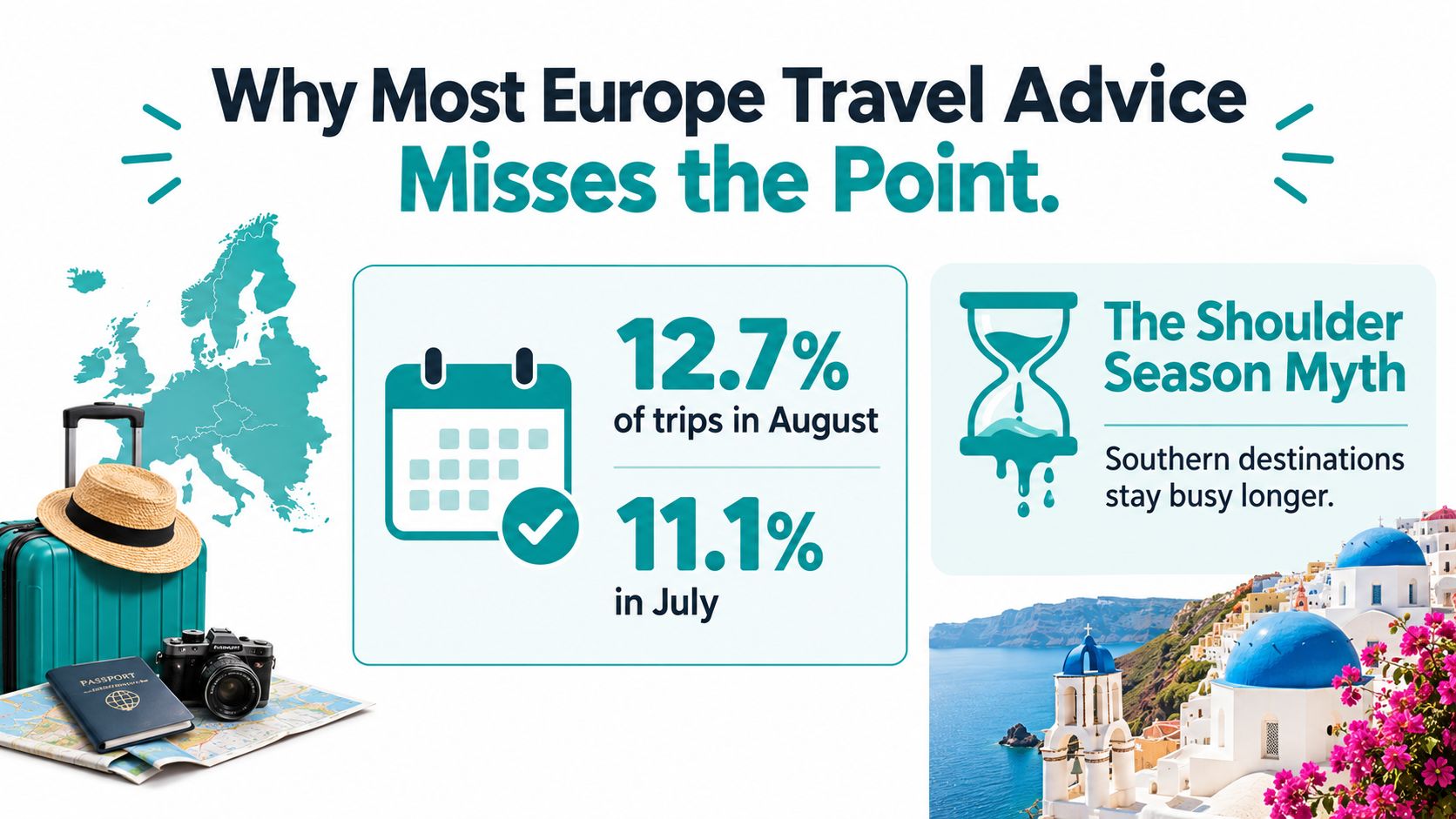
The best time to visit Europe is late April to June or September to October. In 2024, August accounted for 12.7% of annual trips by EU residents, compared with 11.1% in July, so the smartest choice depends less on “summer versus shoulder season” than on the exact region and week.
That distinction matters because Europe isn't one travel market. April in Amsterdam can feel calm and fresh, while April in Rome may already behave like a busy season. Southern beaches, northern capitals, Alpine routes, island ferries, and Christmas markets all follow different calendars.
Generic advice gets you only halfway there. A seasoned itinerary planner starts with latitude, climate, and demand, then matches the month to the trip you want.
Europe's peak season isn't spread evenly across the calendar. It clusters hard in midsummer. Eurostat reports that 12.7% of all annual trips by EU residents took place in August in 2024, while July accounted for 11.1%. Half of all long trips made from June through September occurred during those four months, and one-third of tourism nights were spent in July and August. Eurostat's tourism seasonality report makes the central planning point clear: July and August aren't merely popular months, they're the pressure point of European travel.
The regional picture is even sharper. August is the busiest month in 174 of 244 EU regions, while July leads in another 48. In Calabria, Italy, 64.9% of annual tourism nights are concentrated in July and August, according to Eurostat's regional tourism data. A traveler who treats April, May, September, and October as interchangeable across the continent will eventually book the wrong week for the wrong place.
For most travelers, late April through June and September through October is the strongest starting window. This period usually gives you a workable balance of warmth, access, crowds, and pricing. Mediterranean destinations can still reach roughly 23°C to 27°C during this broader window, while transport and accommodation demand is generally less intense than in July and August, as outlined by Jacada Travel's Europe timing guide.
But don't interpret “shoulder season” as a guarantee of empty streets or bargain rates. Rome, Athens, Dubrovnik, and parts of southern France can stay busy well beyond the traditional summer core. The useful question is narrower: which destination, at which latitude, during which week?
Practical rule: Choose the broad season first, then remove the dates when your chosen region behaves like peak season.
May and September are often the safest all-purpose choices for a first multi-country itinerary. Late April and October work better when you can tolerate more variable weather and plan around specific interests, such as gardens, food, wine, museums, or hiking.
A month only makes sense after you identify the trip. Northern Europe warms later and loses daylight sooner than the Mediterranean, while coastal and Alpine destinations have their own operating rhythms. That creates several “best times,” not one universal answer.
| Traveler Type | Best Months | Best Regions | Why It Works |
|---|---|---|---|
| Budget traveler | Mid-October to mid-December, January to March | Major cities, Portugal, Spain, Central Europe | Lower demand can mean lighter crowds and more flexible city itineraries |
| Beach seeker | June, September, and selected July or August routes | Greece, Croatia, southern Italy, Spain, Portugal | Coastal conditions are favorable, with September often easing after the summer rush |
| Skier | Winter months | Alps and northern mountain regions | Snow-based travel follows a different calendar from city sightseeing |
| Festival traveler | Late spring through summer, or destination-specific autumn dates | Major capitals, Mediterranean coasts, Central Europe | Outdoor events and local calendars shape the experience more than general season labels |
| Digital nomad | May, June, September, October, and late fall | Well-connected cities and longer-stay bases | Comfortable working conditions, active services, and less pressure than midsummer |
January and February suit travelers who prioritize museums, cafés, architecture, and quieter urban days. Southern Portugal, Spain, and Italy can be more comfortable for walking than colder northern routes, but winter light and operating hours still matter.
March and April are transition months. April is particularly strong for the Netherlands, Belgium, and northern city breaks, while southern Europe may already attract substantial demand. Pick northern destinations if your main goal is freshness and fewer people.
May and June are the most reliable touring months for a broad itinerary. Use May for cities and countryside, then move toward June when beaches, islands, and mountain routes become central.
July and August are for travelers who specifically want long days, beach infrastructure, nightlife, and full summer energy. Don't choose these months accidentally. Reserve them because the experience they offer justifies their pressure on price and availability. For broader summer inspiration, this guide to the best places to visit in summer is a useful starting point, but still check each destination's local demand pattern.
September and October favor food, wine, cultural touring, and a more manageable pace. September remains strong for the Mediterranean, while October increasingly suits Central Europe and city-focused routes.
November and December split in two. Late fall is useful for flexible urban travelers, while December belongs to Christmas markets, festive events, and destinations that deliberately embrace winter atmosphere.
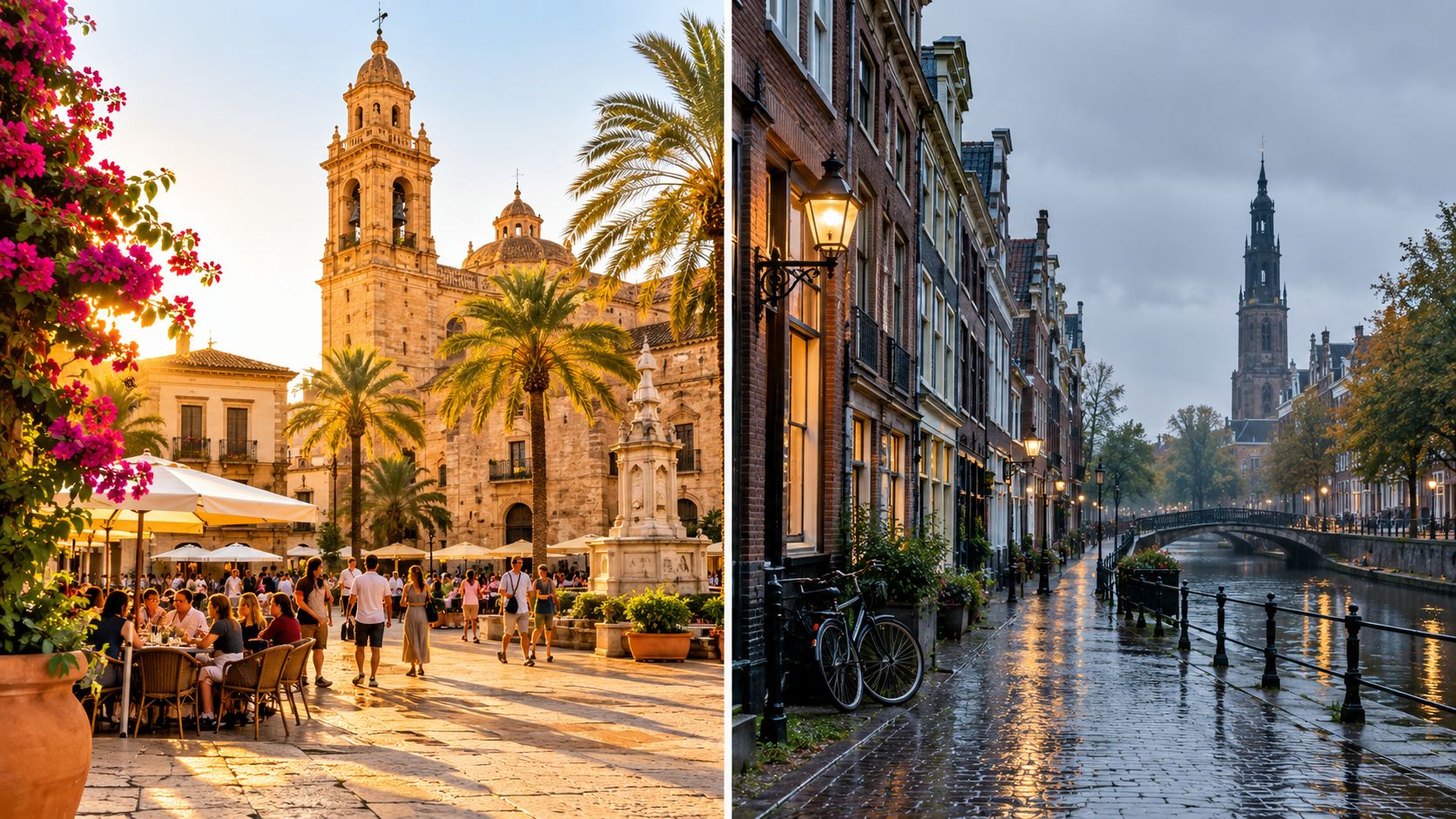
The phrase “shoulder season” hides a north-south problem. Amsterdam in April and Rome in April may share a calendar, but they don't offer the same crowd conditions, temperatures, or booking pressure. Northern Europe often enters its attractive travel window earlier in the spring, while popular Mediterranean destinations can remain busy and expensive later into spring and earlier into autumn.
Northern Europe is the better April bet when you want spring scenery, walkable capitals, and a break from midsummer intensity. The Netherlands, Belgium, parts of the United Kingdom, and Scandinavia can still bring cool or wet days, so pack for conditions rather than for the word “spring.”
Central Europe generally performs best from late spring through early autumn for broad sightseeing. May, June, September, and October are strong choices for cities, rail routes, lakes, and cultural itineraries, with October increasingly valuable for fall scenery.
The western Mediterranean often stays active through May and into September. Italy, southern France, Spain, Croatia, and Greece can feel close to peak during popular dates, especially where beaches, historic centers, ferries, and famous viewpoints concentrate visitors.
The eastern and southern Mediterranean rewards travelers who distinguish coast from city. Athens, Rome, and inland cultural routes can work well in spring, but an island or beach itinerary needs warmer water and dependable services. September is usually a more practical compromise than early autumn assumptions suggest, while October is better for touring than for guaranteed beach conditions.
This is why April can be excellent for Amsterdam but a poor choice for someone expecting Rome to feel quiet. In Amsterdam, the main trade-off may be rain and cool evenings. In Rome, the trade-off can be demand, reservations, and the sheer number of visitors already moving through the historic core.
A useful correction: “Shoulder season” describes a market pattern, not a promise of solitude.
Check school holidays, major festivals, cruise schedules, and local events before booking. A destination-specific calendar matters more than a Europe-wide label, particularly in Italy, Greece, Croatia, Spain, and southern France.
If your route combines north and south, let the southern destination set the constraint. You can travel through Amsterdam in April and continue to Rome later, but don't assume the whole itinerary will deliver the same crowd profile.
Seasonal planning only saves money when you convert it into booking behavior. Summer requires defensive planning because popular trains, ferries, hotels, and attractions fill in the same period. Shoulder travel gives you more flexibility, but famous museums, festivals, and limited-capacity experiences can still sell out.
For July and August, book the critical elements first. That usually means accommodation in compact historic centers, island transport, overnight trains, and timed-entry attractions. Build the route around those fixed points instead of assuming you'll find a convenient replacement later.
For late April through June and September through October, preserve flexibility where the destination allows it. Book your first and last nights, secure any event-driven accommodation, and leave room to adjust day trips around weather. Flexibility is more valuable than forcing every day into a rigid sequence.
For late fall and winter, verify opening calendars before you pay. Smaller towns, seasonal attractions, and outdoor activities may operate on reduced schedules, even when major cities remain active.
| Season | Flight Booking Window | Accommodation Strategy | Price Expectation |
|---|---|---|---|
| July and August | Plan early for fixed dates and high-demand routes | Reserve central hotels, islands, and family-friendly rooms first | Highest pressure and least flexibility |
| Late April to June | Book key transport early, keep non-essential nights adjustable | Mix advance reservations with flexible rates | Usually more balanced than midsummer |
| September and October | Secure festivals and popular cities early, especially on weekends | Choose refundable options where weather affects the route | Often a strong value and comfort compromise |
| Mid-October to mid-December | Compare dates closely and watch for fare changes | Confirm seasonal opening dates before booking remote areas | Frequently lighter demand than summer |
| January to March | Focus on destination operating calendars | Favor central bases and shorter commitments | Often the quietest city period |
One practical rule is simple: book around scarcity, not around habit. A ferry to an island, a major festival, or a small hotel in a famous village deserves earlier attention than an ordinary city night.
For travelers building a multi-country route, Simsima's Europe trip package guide can help organize destination changes alongside connectivity planning. Keep transport, lodging, and mobile data in the same itinerary document so a late route change doesn't create three separate emergencies.
Packing for Europe is a regional exercise. A rainy April in Amsterdam calls for a waterproof shell, comfortable shoes with grip, and layers that dry quickly. A June route through Greece or southern Italy needs breathable clothing, sun protection, and footwear that can handle stone streets without turning every walk into a negotiation.
Northern spring and autumn itineraries work best with a lightweight waterproof jacket, a warm mid-layer, compact trousers, and shoes that can handle wet pavement. Don't rely on a heavy coat if you're crossing several countries. Layering lets you adapt without filling the suitcase with one-purpose clothing.
Mediterranean summer calls for breathable fabrics, a hat, sunglasses, and a small day bag for water and sunscreen. If you're visiting religious sites, carry a light layer that covers shoulders or knees. September and October deserve a compact rain layer even when the forecast looks favorable.
Mountain routes need a separate standard. Temperatures can shift quickly with elevation, so a city outfit isn't enough for Alpine hikes or exposed viewpoints. Keep one insulating layer and weatherproof outer layer accessible, not buried under everything else.
Mobile data handles the unglamorous tasks that keep an itinerary moving: train platforms, offline map updates, digital tickets, translation, restaurant reservations, and messages to hosts. Border crossings can turn a simple route into a roaming problem if your plan doesn't cover the countries you're entering.
A regional eSIM can be practical for a multi-country trip, while a local plan may make more sense when you'll spend most of the itinerary in one country. Check whether your phone supports eSIM and whether it accepts non-carrier SIMs before departure. The Simsima eSIM Price Index is a useful planning reference because prepaid data prices vary by country and provider.
For a more detailed September packing perspective, Haute Black's Europe weather guide for luxury travel offers destination-specific context. Treat it as a supplement, not a substitute for checking the forecast close to departure.
Install your data plan before you leave, but activate it according to the provider's instructions and your arrival date. If you're concerned about unexpected roaming charges, review this guide to avoiding roaming fees before your phone connects to a foreign network.
Most Europe advice stops at spring and autumn because those seasons are easy to sell. That leaves a useful option underexplained: mid-October through mid-December can be a strategic window for flexible travelers, particularly those who care more about cost, workspace, and uncrowded cities than beach weather.
European tourism still follows a powerful summer pattern. August recorded 501 million tourism nights in the EU, and it was 3.6 times busier than January, according to European tourism performance reporting. The same source describes more off-season exploration from October 2025 to March 2026, while noting that the market remains strongly summer-led.

A budget traveler with flexible dates can use late fall to target major cities without competing for the same summer inventory. A remote worker may prefer a longer stay in Lisbon, Valencia, Rome, or another connected city, where museums, cafés, and everyday services matter more than beach access.
Winter also makes sense for travelers who want a specific experience. Christmas markets, snow sports, northern lights, and indoor cultural itineraries don't improve by being squeezed into a warm-season template. December can be expensive around major festive events, so winter isn't automatically cheap. The advantage comes from choosing the right destination and avoiding the dates when everyone else has the same idea.
The trade-off is daylight, weather, and seasonal access. Rural routes may feel quieter because some businesses reduce their schedules, and outdoor sightseeing takes more planning. Major capitals remain the safer choice when you need dependable transport, restaurants, museums, and backup plans.
One mainstream report cited airfares averaging about 40% less than June from mid-October to mid-December. Treat that as a reported market observation rather than a guarantee for your route, because prices still depend on origin, destination, dates, and demand.
Choose winter deliberately: If your trip is built around beaches and long outdoor days, winter is the wrong tool. If it's built around cities, work, markets, museums, or snow, winter may be the more rational choice.
Stop asking for the best month in Europe as if the continent were a single resort. Choose in three passes: traveler type, destination band, and crowd tolerance.
Pick the dominant objective first:
A northern itinerary can often use April or early May before the same dates become comfortable for a southern beach route. A Mediterranean cultural itinerary may work beautifully in April, but that doesn't mean the headline attractions will be quiet. For a mixed route, place the most demand-sensitive destination first and build the rest around its availability.
Then check four practical constraints:
A regional plan can simplify the last question. Review Simsima's Europe eSIM options when your route crosses several countries, and confirm coverage, validity, device compatibility, and activation requirements before departure.
The strongest default for a first European itinerary is May or September, adjusted by latitude and purpose. Choose April for northern Europe when spring atmosphere matters, June for a warmer and more active route, late October through November for flexible city travel, and winter when the trip is built around a distinctly cold-season experience.
Europe rewards specificity. Pick the region, mark the weeks when demand surges, reserve the scarce elements, and commit to the month that matches your actual priorities.
Simsima offers prepaid eSIM data plans for individual countries and Europe-wide travel, with digital activation for compatible devices and no physical SIM to carry. Before you leave, compare the coverage you need for your route and visit Simsima to arrange mobile data for the cities and borders on your itinerary.

Founder of Simsima. A passionate traveler based in Barcelona, he helps travelers stay connected without breaking the bank on roaming fees.
LinkedIn