-5% on your 1st eSIM
WELCOME5
Loading...

Find the best time to visit Turkey with month-by-month guidance on weather, crowds, prices, and activities across Istanbul, Cappadocia, and the coast.
 Dimitri Morvan
Forget the lazy advice that says there's one best time to visit Turkey. That answer is too blunt for a country where Istanbul, Cappadocia, the Aegean coast, and the ski regions all reward different months. If you pick the wrong season for the wrong place, you get heat, queues, closed services, or dead beach towns instead of the trip you wanted.
The smarter question is simple: what kind of Turkey do you want. City breaks, balloon flights, beach weeks, and ski trips all run on different clocks, and the right month follows the experience, not the calendar. For most travelers, the safest starting point is still spring or fall, but that only works if your itinerary matches those windows.
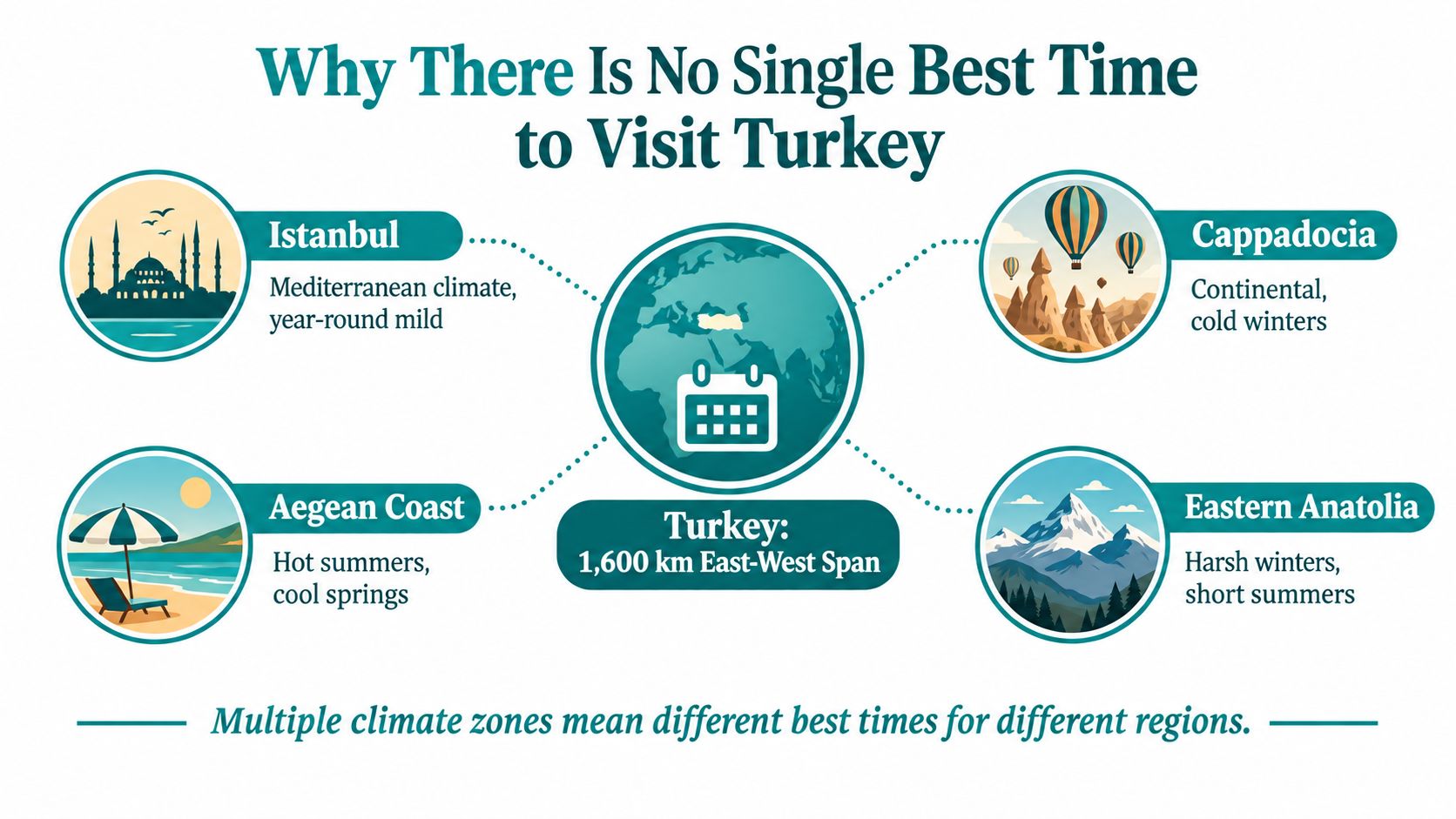
Turkey does not reward a one-season answer. Istanbul, Cappadocia, the Mediterranean coast, and the eastern ski zones run on different weather calendars, so the right month depends on where you are going and what you want to do. Pick the wrong season for the wrong region and you get heat, crowds, closed services, or empty beach towns.
The broad shoulder-season answer, April-May and September-October, works for a lot of trips because Turkey-wide conditions stay comfortable in those windows (Climates to Travel). Those months are the safe default for city walking, inland ruins, and mixed itineraries. They give you decent weather without forcing you into the worst of summer heat or peak-season pressure.
Antalya shows why a single national rule falls apart. The coast warms earlier and stays usable later than inland or highland areas, so beach timing follows a different logic from Istanbul or Cappadocia. A month that feels pleasant in Antalya can still be chilly in other parts of the country, and a month that works well for sightseeing inland can be too cold for a proper beach trip.
Practical rule: If your trip mixes cities and inland sights, choose spring or fall. If your trip is mostly beaches, choose summer. If your trip is skiing, ignore the coastal advice entirely.
That is the decisive factor. A July Antalya beach week and a January Erciyes ski trip are different holidays, not rival answers. The same goes for a first-time Istanbul-and-Cappadocia trip versus a coastal sailing route, because weather, crowd levels, and daylight all change the trip.
The country also splits cleanly by activity. Spring and fall suit Istanbul and inland sightseeing, while June to September fits the beach-heavy coast, with September often the cleaner compromise for warm sea time and fewer people than peak summer (Louda Vy Krokem). That is why the itinerary should decide the month, not the other way around.
Pick the region first, then the activity, then the season that keeps heat, crowds, and bad mountain conditions out of your way.
Spring and fall are the two windows I recommend most often, but they solve different problems. Spring gives you fresher scenery, softer crowds, and better walking weather before summer heat takes over. Fall gives you warmer sea conditions, calmer coast days, and less pressure than the peak months.
Spring is the safer choice for a first trip that mixes cities and inland sights. The country is still warming up, so you get comfortable daytime sightseeing without the drag of full summer heat. The coast is already usable in places like Antalya, but the bigger payoff is inland, where ruins, museums, and old towns feel easier to enjoy before temperatures climb.
Fall is better if the coast matters more than the monuments. Sea temperatures stay more inviting, daylight still gives you room to explore, and the mood is generally easier than in midsummer. September is the sweet spot for a mixed itinerary because you can still pair beaches with cities without fighting the worst of the crowds.
| Factor | April-May | September-October |
|---|---|---|
| Daytime comfort | Cooler and fresher, better for walking and sightseeing | Warm to mild, better for long outdoor days |
| Sea feel on the coast | Usable, but not the strongest swim season | Better for swimming, especially early in the season |
| Crowd pressure | Lower than summer, with some holiday spikes | Usually lighter than peak summer, though some coastal areas stay active |
| Best use case | First-time trips, inland sightseeing, city breaks | Mixed itineraries, coast plus cities, slower travel |
| Main tradeoff | Spring holidays can crowd Istanbul | Late-season movement can keep the Aegean busy |
Late April in Istanbul brings tulip season crowds, so do not expect empty parks or short lines. Late September along the Aegean can also be busier than the calendar suggests, since harvest travel adds movement.
My blunt advice is simple. Choose spring if you want the cleanest sightseeing weather and the easiest inland days. Choose fall if you care more about warmer water and a softer coast experience, especially if your trip includes the Mediterranean or Aegean.
The right month depends on where you're going. Istanbul wants spring and fall, Cappadocia wants the same with a narrow push toward early summer, the Mediterranean and Aegean coasts want summer, and the ski areas want winter. If you try to force one season across all of them, you'll compromise the trip.
Istanbul is best in April-May and September-October, when walking the old city doesn't feel like a chore and ferry crossings are more pleasant. Cappadocia does best in April-June or September-October, when balloon mornings are clearer and you avoid winter snow problems or the hazy heat that can flatten the valleys in July and August. If you're planning connectivity for the city stretch, the Istanbul Turkey eSIM page is the practical place to start before you fly.
The coast is a different story. The Mediterranean and Aegean are the places to lean into June-September, because those are the months when swimming and sailing make sense rather than feeling like an afterthought. If you're considering coastal property areas or just want context on the region, the travel perspective on World Property Investor is useful for understanding how Kalkan and similar resort towns fit into the broader coastline.
Ski regions like Uludağ and Erciyes are for December through March, and that's not a compromise, that's the point. Snow, not sunshine, is the product there. If your itinerary mixes these regions, sequence them logically. Do the city and inland legs first, then finish on the coast, or reverse that order depending on your flight and energy level.
| Region | Best Months | Avoid |
|---|---|---|
| Istanbul | April-May, September-October | Deep summer if you hate heat and queues, midwinter if you want more outdoor time |
| Cappadocia | April-June, September-October | Peak winter for snow disruption, midsummer for harsher daytime conditions |
| Mediterranean Coast | June-September | Cool spring weeks if swimming is the priority |
| Aegean Coast | June-September | Late winter and early spring for beach-focused trips |
| Ski Areas | December-March | Late spring through autumn |
The big tradeoff is logistics. Internal flights, ferry schedules, and transfer times matter more once you start crossing regions. Plan the route around the weather window, not the other way around.
If you know what you're going to do, the calendar gets easier. Balloons, beaches, skiing, and festivals each have a clear best window, and you should let that dictate your dates. That's the fast way to stop overthinking and start booking.
Cappadocia ballooning runs year-round, but the most reliable feel comes from late April through June and again in September to early October. Those periods give you better visibility and a more comfortable base for early starts than the extremes of winter or midsummer. Beaches on the Mediterranean and Aegean are strongest from mid-June to early September, with July and August giving the warmest water and the biggest crowd penalty.
Skiing in Uludağ, Erciyes, and Palandöken typically runs December through March, and February is usually the safest snow bet if you want the best chance of dependable coverage. For festivals, the timing is easier than the weather. The Istanbul Tulip Festival sits in April, the International Music Festival lands in June, Ephesus Festival nights happen in summer, and Republic Day is on October 29.
| Activity or Festival | Peak Window | Region | Tradeoff Note |
|---|---|---|---|
| Hot-air balloon rides | Late April to June, September to early October | Cappadocia | Better clarity, but you need to book early |
| Beach swimming | Mid-June to early September | Mediterranean and Aegean coasts | Warmest water also means more people |
| Skiing | December to March | Uludağ, Erciyes, Palandöken | Winter travel can be less flexible |
| Istanbul Tulip Festival | April | Istanbul | Great visuals, heavier local and visitor traffic |
| International Music Festival | June | Istanbul | Strong cultural payoff, summer demand begins building |
| Ephesus Festival nights | Summer | Aegean region | Evening events work best when daytime heat is manageable |
| Republic Day | October 29 | Nationwide | Good for atmosphere, but it's a public-holiday travel day |
Short version: If your trip is about sea time, go summer. If it's about balloons and ruins, go shoulder season. If it's about snow, stop looking at the coast.
The best-month verdict is blunt. Book spring or early fall for Cappadocia and cities, summer for beach travel, and winter for snow sports. Everything else is a compromise.
The weather is only half the story. Crowds and prices move with the season, and the tradeoff is obvious once you've traveled there a few times. The prettier the weather, the harder you work for space and value.
Peak summer, especially mid-June to mid-August, is the strongest weather window for the coast, but it's also when hotel demand climbs and queues get longer. The same goes for the Easter-to-late-May stretch, which can bring strong conditions but also busier city sites. If you're trying to see Topkapı Palace or Ephesus without losing half the day to lines, shoulder season is the smarter move.
The shoulder months of April, May, September, and October typically cut hotel rates 20 to 40 percent versus August and bring thinner queues. Winter is the cheapest general window outside ski resorts, and Istanbul hotels are often half off, but that bargain comes with a quieter coast and fewer operating tours in some beach towns. The key question is whether you want to save money or save energy.
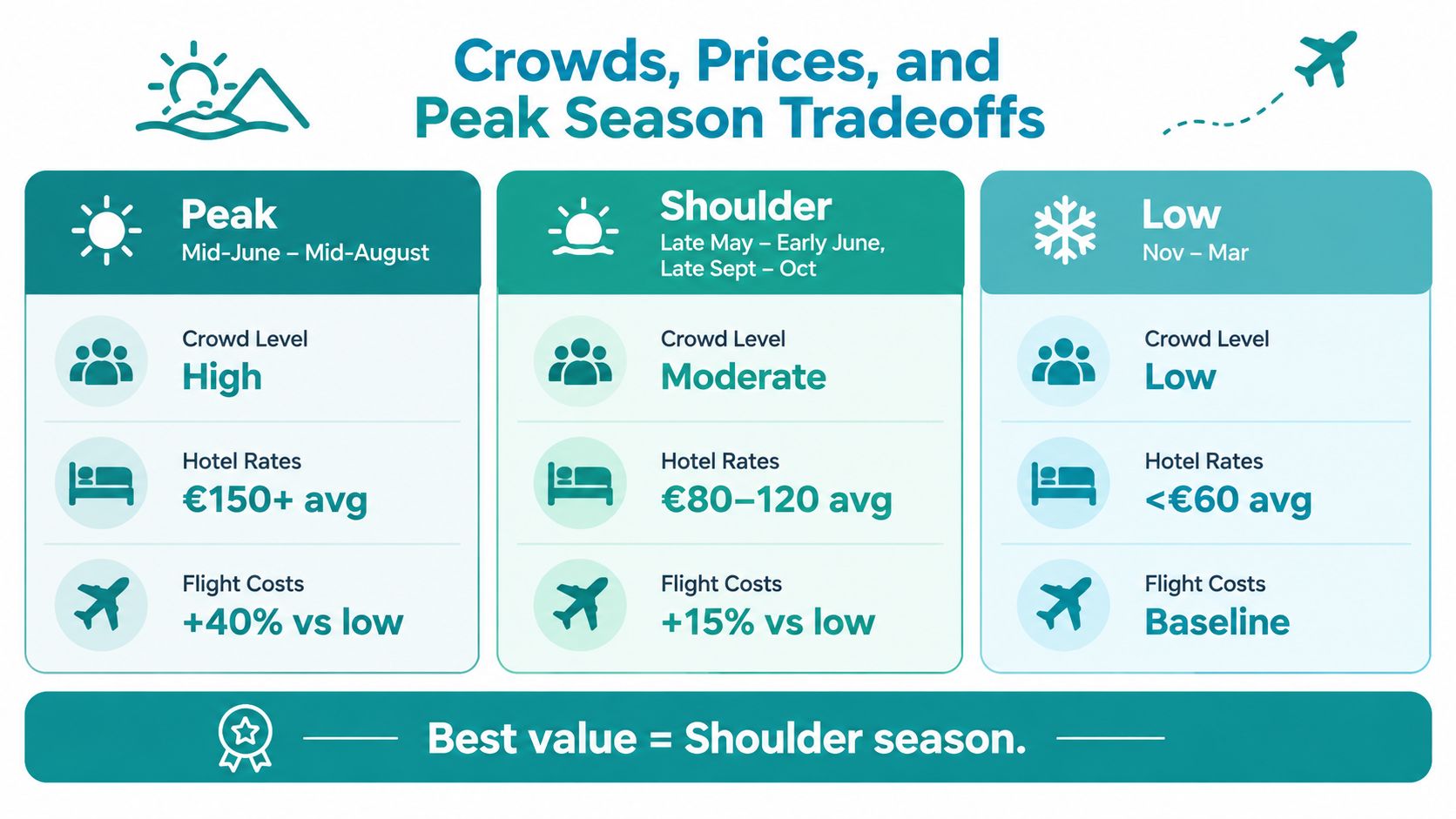
| Season | Crowd Level | Hotel Value | Flight Value | My Take |
|---|---|---|---|---|
| Peak | High | Highest cost | Most expensive | Worth it only if you need summer beach conditions |
| Shoulder | Moderate | Strong value | Better than peak | The sweet spot for most travelers |
| Low | Low | Cheapest | Often cheapest | Good for cities, weak for coast-heavy trips |
If you want the honest answer, shoulder season is the best value. Peak season buys you summer conditions, low season buys you quiet, and shoulder season usually gives you the best mix of both.
Turkey is easier when the basics are handled before you land. Get the paperwork, health prep, money, and phone sorted early, or the “right” month will still feel irritating.
Check your passport validity early. Many travelers need at least six months left to enter. Your visa or e-Visa rules depend on nationality, so do not assume the same process applies to everyone. Travel insurance should cover medical evacuation, because that is the kind of detail you want in place before anything goes wrong.
Vaccinations and pharmacy access are practical, not dramatic. Big-city pharmacies are easy to find, but smaller towns can be less convenient, so bring your basics with you. The lira can move quickly, so cash still matters in smaller towns even when cards work fine in major hubs. For language prep, the FluentPass Turkish travel module helps with the phrases you will use at airports, hotels, taxis, and restaurants.
Roaming from home is usually a waste in Turkey. Airport SIM kiosks can also mean queues and passport registration, which is a poor way to start after a long flight. An eSIM installed before departure is the cleaner option, and the best eSIM for Turkey guide is the place to compare plans before you leave.
A Simsima Turkey eSIM makes sense if you want to land connected and skip the kiosk. For a week in Istanbul and Cappadocia, a modest data plan is usually enough if you rely on maps, hotel Wi-Fi, and messaging. For a two-week coast-and-east loop, choose a larger plan so you are not rationing data every time you switch cities or book a transfer.
Turkey punishes people who wing the basics. Schedules change, drivers message at the last minute, and the best restaurants are often nowhere near your hotel. Good connectivity removes that friction fast.
The right season becomes much easier once you turn it into a route. These are not rigid schedules, they're bookable frameworks that match Turkey's weather rhythm. Use them as starting points, then adjust flight times and pace.
A spring trip should lean into Istanbul plus Cappadocia, with Ephesus folded in before the heat builds. A summer trip should move straight to the Turquoise Coast, where Fethiye, Olympos, and Kaş work well for sailing and slow beach days. For route-planning logic, the multi-destination trip guide is useful when you want to connect several stops without wasting transfer time.
Fall mirrors spring, but I'd swap in Pamukkale and the Aegean around İzmir and Bodrum for food, ruins, and warm sea conditions. Winter belongs to 3 to 4 days of skiing in Uludağ or Erciyes, then Istanbul's museums, bazaars, and hammams once you're done with snow. The only thing I'd avoid is trying to force a beach-first itinerary into winter just because the flight is cheap.
| Season | Days | Route | Anchor Booking |
|---|---|---|---|
| Spring | 8-10 | Istanbul, Cappadocia, Ephesus | Balloon ride, Topkapı tickets, boutique stay in Cappadocia |
| Summer | 8-10 | Fethiye, Olympos, Kaş, optional Cappadocia start or finish | Coastal lodging, sailing or boat day, early balloon slot if included |
| Fall | 8-10 | Istanbul, Cappadocia, Pamukkale, İzmir, Bodrum | Ephesus or Pamukkale access, sea-view hotel on the coast |
| Winter | 8-10 | Uludağ or Erciyes, Istanbul | Ski accommodation, museum timing, hammam reservation |
Booking rule: Lock the high-demand pieces first, then build the rest around them. Balloon slots, boutique hotels, and beachside stays disappear faster than the rest of the trip.
My opinion is direct. Spring and fall are the easiest seasons to build a multi-stop Turkey trip around, summer is for the coast, and winter is for people who want snow or low-season city travel.
Good timing falls apart if you book too late or pack for the wrong season. Turkey rewards people who plan in layers, because the weather can change quickly between regions and elevations. A simple countdown keeps the trip tight.
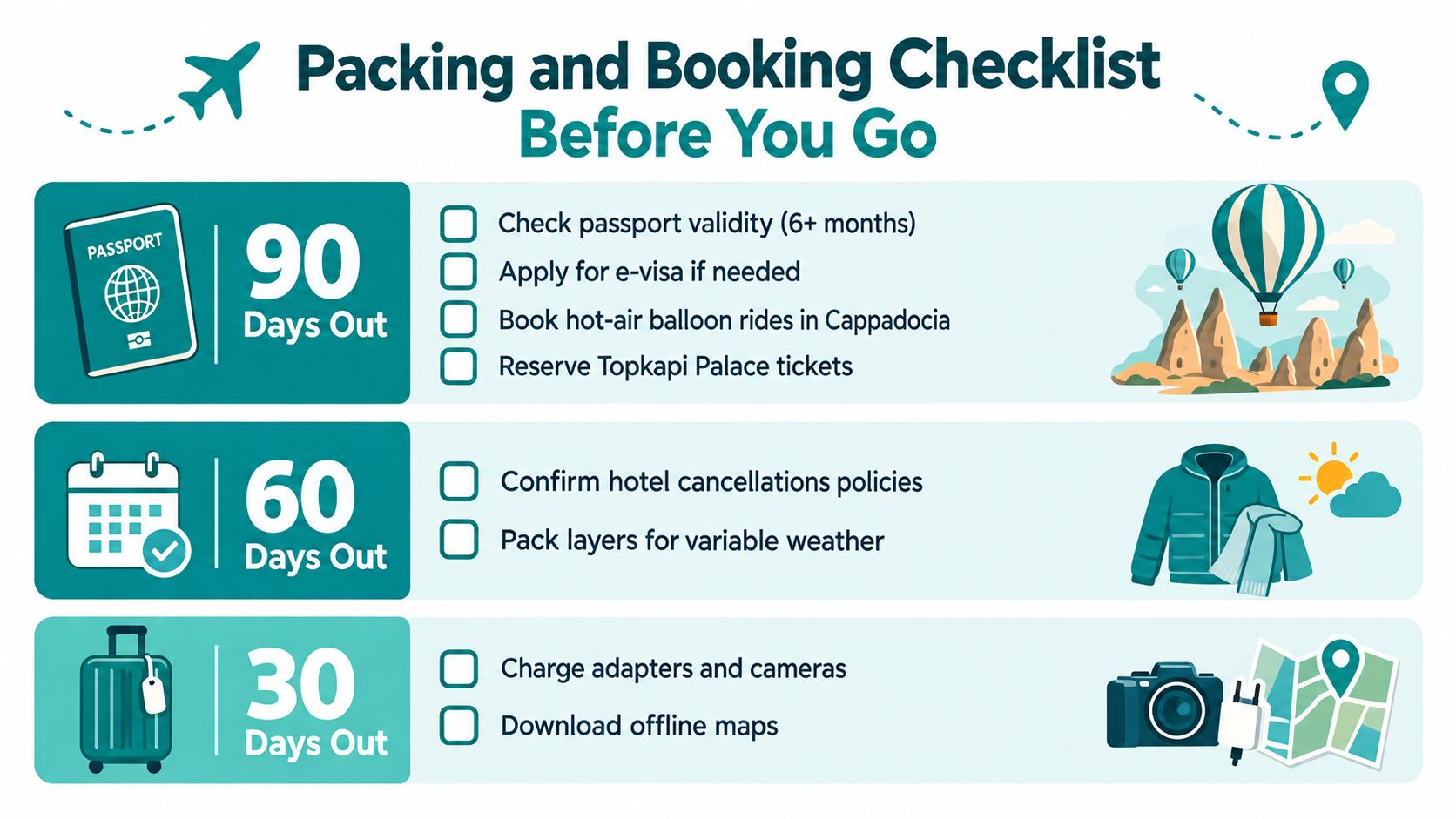
At 90 days out, check passport validity, sort your visa or e-visa if needed, and lock the hard-to-get pieces first. That means Cappadocia balloon rides and Topkapı Palace tickets if they matter to your route. If you're going in a busy season, don't leave boutique hotels to chance.
At 60 days out, confirm your international flights, travel insurance, and any ski or sailing bookings. This is also the point where cancellations policies matter, because flexible stays can save the trip if weather shifts. If you're traveling in winter, make sure your region-to-region transfers are realistic, not optimistic.
At 30 days out, pack for the actual month, not the fantasy version of it. Shoulder seasons call for layers, mosque visits call for modest clothing, the coast calls for reef-safe sunscreen, Cappadocia calls for sturdy walking shoes, and every trip benefits from a universal adapter. Download offline maps, charge your camera gear, and install your eSIM before departure so you're online the moment you land.
If you want a smoother Turkey trip, use the season that matches your route, then lock your documents, bookings, and data plan before you leave. Simsima gives travelers prepaid Turkey eSIM access they can install before departure, which means you can land with maps, messaging, and ride apps ready to go. Visit Simsima and set up the connectivity side of the trip before the rest of your booking window closes.

Founder of Simsima. A passionate traveler based in Barcelona, he helps travelers stay connected without breaking the bank on roaming fees.
LinkedIn