-5% on your 1st eSIM
WELCOME5
Loading...
Find the cheapest international roaming options compared. Learn how eSIMs, local SIMs and Wi-Fi stack up to cut roaming costs on any trip.
 Dimitri Morvan
You've just landed, switched off airplane mode, and watched your phone connect to a foreign network before you've even collected your luggage. A few background apps refresh, your maps load, and a photo backup starts using mobile data. Later, the bill makes those ordinary actions feel anything but ordinary.
The cheapest international roaming option isn't automatically the carrier with the lowest advertised daily pass. It depends on where you're going, how long you'll stay, and how much data you'll use. A light user on a short European trip may choose regulated roaming, while a traveler who needs maps, messaging, video calls, and streaming will often find a prepaid travel eSIM or local SIM more economical.
The useful way to think about the problem is simple. First understand why roaming costs more, then compare the available routes, and finally calculate the price per GB for your own trip.
At the airport, your phone doesn't know that you're trying to save money. It sees a compatible foreign network, completes the roaming connection, and begins sending data through your home carrier's arrangement with that network. Your apps behave exactly as they do at home, but the billing rules have changed.
A navigation app may download map information. Email may synchronise. Social media may refresh images. Automatic updates and cloud backups can also run in the background. None of those actions feels dramatic in isolation, yet pay-per-use roaming charges can turn routine phone activity into an expensive session.
You're effectively choosing between two systems:
Home-carrier roaming: Your existing SIM connects abroad, and your home provider bills you under a roaming pass, allowance, or pay-per-use tariff.
Local or travel data: A local SIM or prepaid eSIM supplies the data connection, so you avoid using your home line for ordinary internet access.
Wi-Fi and add-ons: You keep cellular data restricted and rely on Wi-Fi, perhaps adding a carrier pass for occasional mobile use.
The phone itself isn't the costly part. The important question is who supplies the data and how that provider prices access in the destination.
Practical rule: Never judge a roaming option by its headline price alone. Check the included data, validity period, destination coverage, and what happens when the allowance runs out.
For a weekend in a regulated roaming zone, a carrier add-on may be convenient enough. For a longer trip outside that zone, a prepaid product can give you a fixed amount of data without exposing your account to open-ended usage charges. A local SIM may be worth the extra setup if you're staying in one country and need substantial data.
This guide uses a destination-first method. You'll learn what happens behind the scenes, why wholesale agreements influence retail prices, how four alternatives compare, and how to configure your phone before departure so the wrong SIM doesn't consume your data.
International roaming is easier to understand if you treat mobile networks like landlords and hotels.
Your home network owns your mobile number and your regular plan. When you travel, it usually doesn't build a new network beside your hotel. Instead, it has an agreement with a visited network in the destination. That network provides the radio coverage your phone uses while your home operator remains responsible for your account.
The process has four practical stages:
Your home operator identifies your line and authorises roaming.
A visited network supplies temporary coverage.
The visited network records the services your phone uses and charges the home operator through wholesale settlement.
Your home operator applies its retail pricing and adds the amount to your bill or deducts it from your prepaid balance.
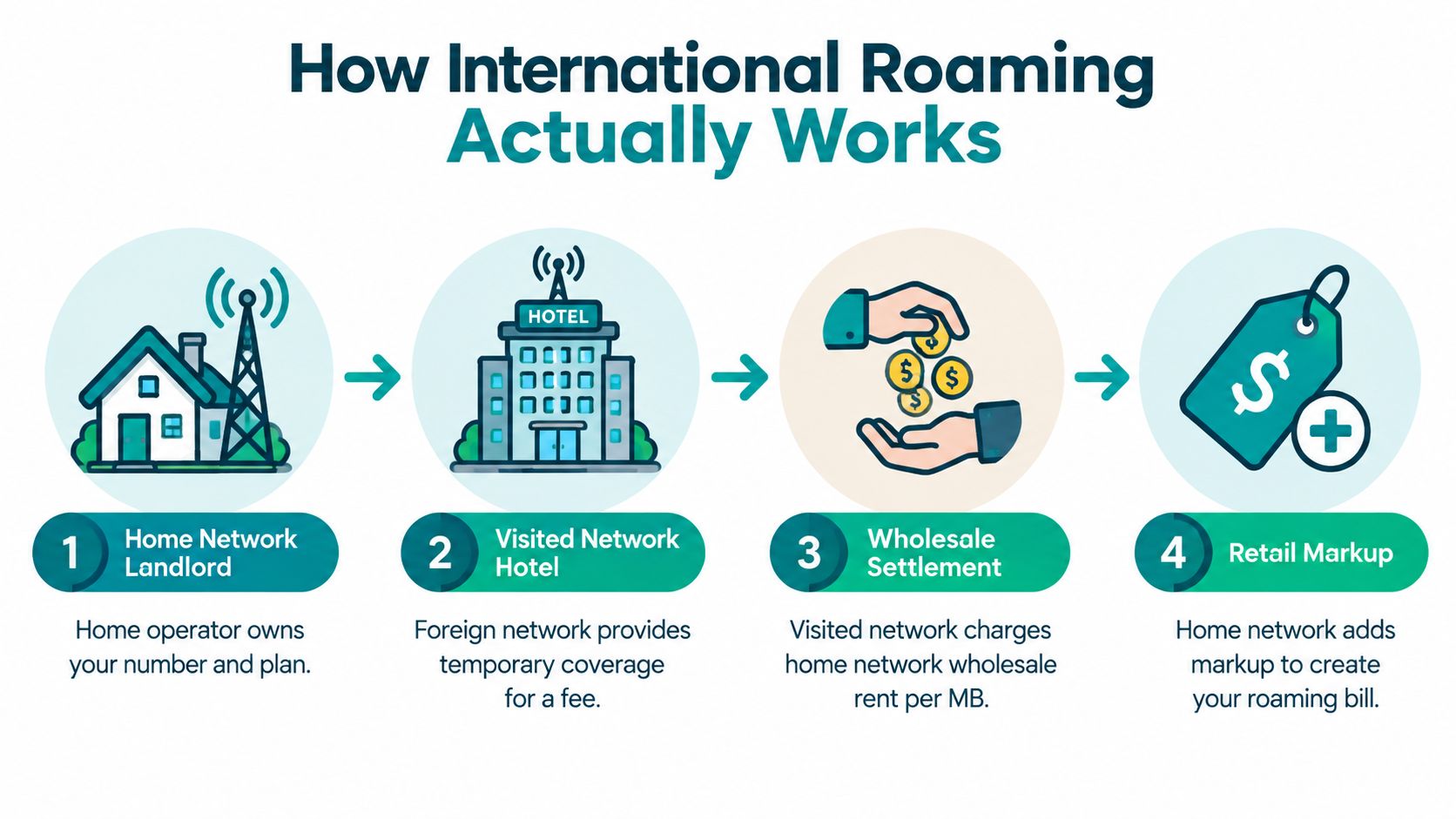
Think of your home carrier as the owner of your travel pass and the foreign carrier as a toll-road operator. Your pass gives you permission to use the road, but the road owner still charges your pass issuer for each journey. Your pass issuer then decides how much to charge you.
That arrangement explains why roaming isn't primarily a question of SIM technology. A physical SIM and an eSIM can both connect to a foreign network. The difference is usually which commercial plan controls the data session.
A travel eSIM can be provisioned as a prepaid data service for a destination or region. Instead of sending the usage back through your ordinary home-carrier tariff, the travel plan uses its own commercial arrangement. A local SIM takes the idea further by giving you service directly from a domestic provider in the country you're visiting.
Phones are designed to preserve connectivity. If your primary line is allowed to roam, the device will normally try to keep it online when a foreign network is available. It doesn't compare the price per GB of every possible option before connecting.
That's why the safest setup separates your regular number from your travel data line. You can keep the home line available for important texts, while routing cellular data through the prepaid travel eSIM. You still need to check how your carrier bills calls, texts, and background services on the primary line, but separating data removes the most common source of accidental usage.
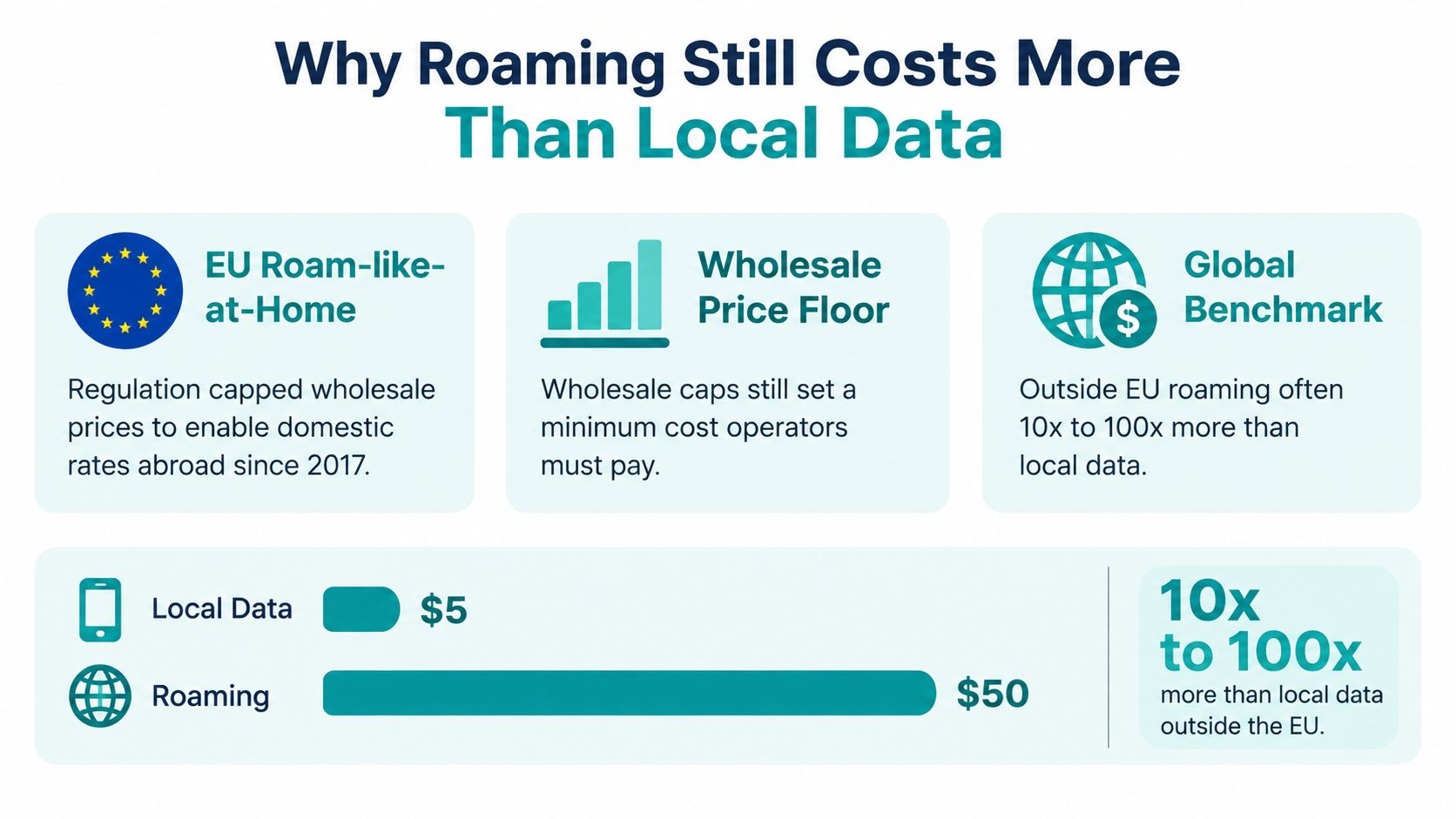
The price gap begins before a traveler opens an app. The foreign network may charge the home operator for access, and the home operator then packages that cost into a retail product. International routes also involve negotiations, traffic forecasts, technical support, taxation, and different levels of competition.
The International Telecommunication Union's roaming study describes broad agreement that international roaming prices can sit above underlying cost. Its technical material notes that wholesale roaming charges can exceed USD 2 to USD 3 per minute, sometimes passing USD 4 per minute, while bilateral routes can vary by as much as eight times and calls home can reach 20 times the comparable local international-call cost. Those figures explain why a foreign network connection can be commercially very different from buying domestic service at the destination.
The European Union provides the clearest example of what regulation can change. On 15 June 2017, the EU abolished retail roaming surcharges for travelers within the EU under the Roam-like-at-Home rule, as documented in the European Commission's roaming history.
Before that milestone, regulators had already imposed maximum retail add-ons from April 2016, including EUR 0.05 per minute for calls, EUR 0.02 per SMS, and EUR 0.05 per MB. Wholesale caps then set operator cost ceilings from June 2017 at EUR 0.032 per minute for voice, EUR 0.01 per SMS, and EUR 7.70 per GB of data. The data ceiling was scheduled to fall in stages to EUR 2.50 per GB by 1 January 2022, according to the same official source.
These figures aren't merely historical details. They show how regulators can establish a lower boundary for roaming economics. If you're learning the basics of travel eSIM pricing, this eSIM cost overview can help separate the price of the digital SIM technology from the price of the data plan itself.
Even inside the heavily regulated EU market, roaming prices continue to move. The latest BEREC benchmark records average EU data roaming tariffs of EUR 4.42 per GB in Q3 2025, down from EUR 5.05 per GB in Q2 2025. Over the same period, outgoing voice roaming increased from 26.16 eurocents per minute to 26.69 eurocents per minute, according to the BEREC international roaming benchmark%2028_32nd%20BEREC%20Report%20on%20IR%20BMK%20Data%20and%20TACR_.pdf).
That movement makes one lesson clear: the cheapest international roaming option is destination-specific and time-sensitive. Compare the total allowance and convert it into a price per GB, rather than trusting a daily label or assuming that a plan that works in Europe will work elsewhere.
There are four practical ways to stay connected overseas. Each solves a different problem, so “cheapest” needs a second word after it: cheapest for a short trip, cheapest for heavy use, or cheapest across several countries.
| Strategy | Typical Cost Logic | Setup Effort | Best For |
|---|---|---|---|
| Global travel eSIM | Prepaid data across many destinations, usually with a fixed allowance or validity period | Low, if your phone supports eSIM | Short trips with multiple stops |
| Local SIM | Domestic pricing from a provider in the country you visit | Moderate, with purchase and possible registration | Longer stays in one country |
| Regional eSIM | One prepaid plan covering several nearby countries | Low | Multi-country routes within one region |
| Wi-Fi plus carrier add-on | Low cellular use, with a pass for days or data when Wi-Fi isn't available | Low | Light users who need occasional mobile access |
A global plan is convenient when your itinerary changes or crosses several regions. You buy one digital product, install it before leaving, and avoid swapping physical cards. The trade-off is that broad coverage doesn't always produce the lowest price per GB in every destination.
If you're new to the technology, this complete eSIM overview explains how embedded SIMs work and why they can coexist with your regular line.
A local SIM can win for a long single-country stay because it uses a domestic operator's consumer pricing. It may also provide a local number, which can help with local services. The inconveniences include finding a store, completing any required registration, changing cards, and potentially losing access to your home line while the physical SIM is inserted.
Regional plans sit between local and global products. They're useful for a rail journey, road trip, or business itinerary covering several countries in the same area. You should still check the supported network list, because “regional” doesn't guarantee identical speeds, coverage, or data allowances in every country.
A prepaid eSIM guide for travelers is useful when you're deciding whether a fixed regional allowance fits your route.
This route can be sensible if you use very little data and spend most of your time in accommodation, offices, or venues with reliable Wi-Fi. It becomes less attractive when you need maps in transit, ride-hailing, payment authentication, or messaging while walking between locations.
The practical test is not just the purchase price. Compare setup time, coverage, number retention, validity, overage rules, and price per GB. A plan that costs less at checkout can become poor value if it expires before your return or stops working in a country you've added to the itinerary.
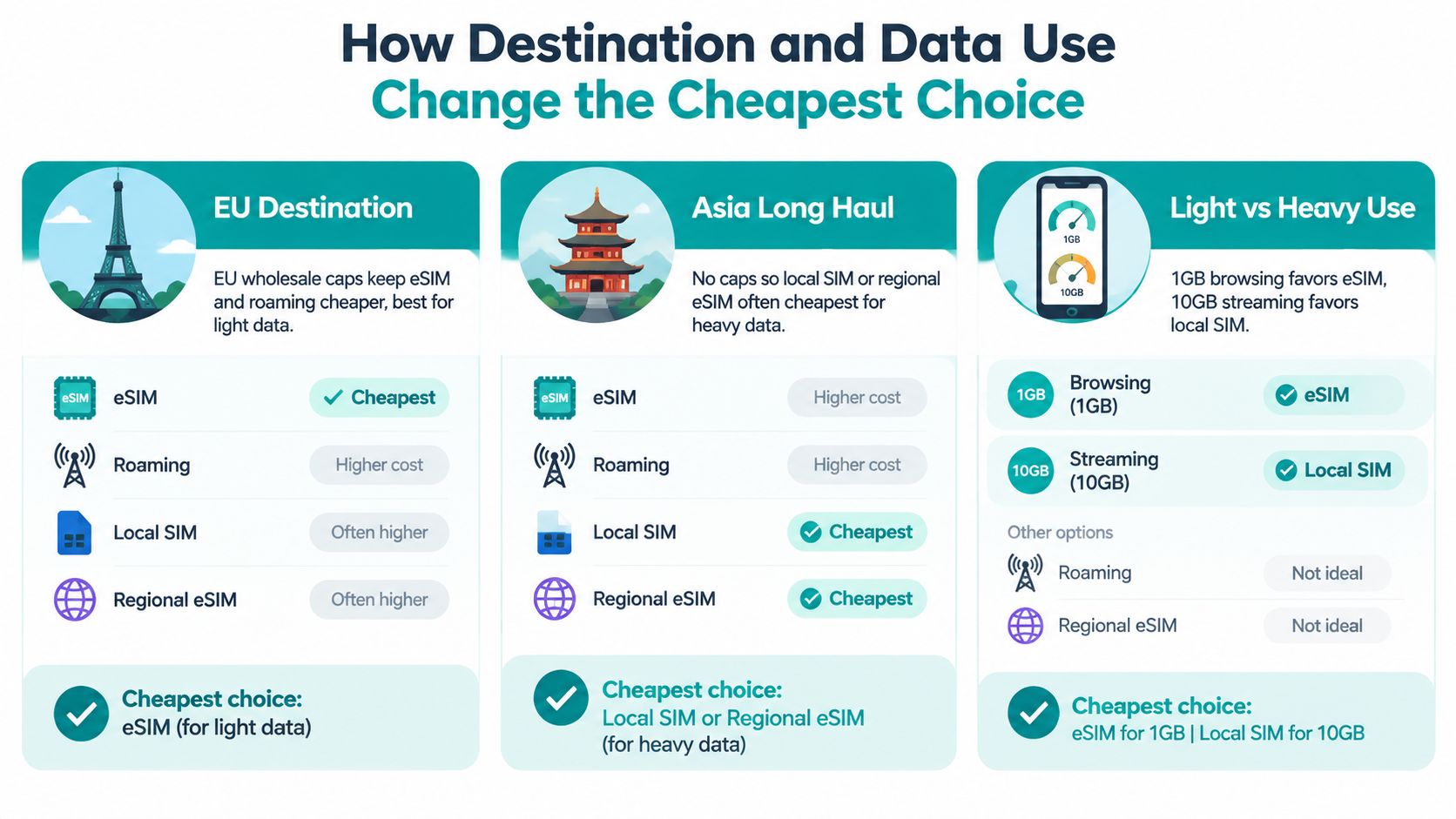
A plan can be inexpensive in one destination and poor value in another because roaming geography changes the wholesale rules. Within the EU and EEA, caps are scheduled to decline from EUR 1.30 per GB in 2025 to EUR 1.10 per GB in 2026 and EUR 1.00 per GB in 2027, according to the European Union roaming policy document. These are projected regulatory caps for the stated years, not a universal retail price.
Remote territories and long-haul destinations can have fewer competing networks and different wholesale conditions. That's why copying a European roaming strategy for a distant destination can lead to the wrong result.
Before choosing a plan, write down:
Destination: Is it one country, a regulated regional zone, or several long-haul markets?
Duration: Will the plan cover a weekend, a fortnight, or an open-ended stay?
Data profile: Are you checking messages and directions, or using video calls, work tools, uploads, and streaming?
Then compare the options using the same unit. If a plan costs a fixed amount and includes a stated allowance, divide the price by the allowance to get its price per GB. For a carrier pass, check whether the allowance resets, expires, or changes to pay-per-use billing after depletion.
A light-data traveler on a short European visit may value simplicity. If their home plan already includes regulated roaming, using it could be cheaper than buying a separate product, especially when they only need directions and occasional messages.
A heavy-data traveler spending two weeks in Asia needs a different calculation. A local SIM or regional eSIM may offer a larger prepaid allowance at a lower price per GB than an ordinary roaming tariff. The longer the stay and the more data you consume, the more important that unit price becomes.
Hidden charges still matter. Independent reporting says UK travelers paid £508 million in out-of-bundle roaming charges in 2025, as reported by Credit Connect's coverage of the figures. The safest approach is to disable pay-per-use data on your primary line and choose a product with a clearly defined allowance or a connection that stops when the prepaid data ends.
Price comparison only works if your phone uses the plan you selected. Set everything up while you're still at home, when you have stable Wi-Fi and access to your carrier account.
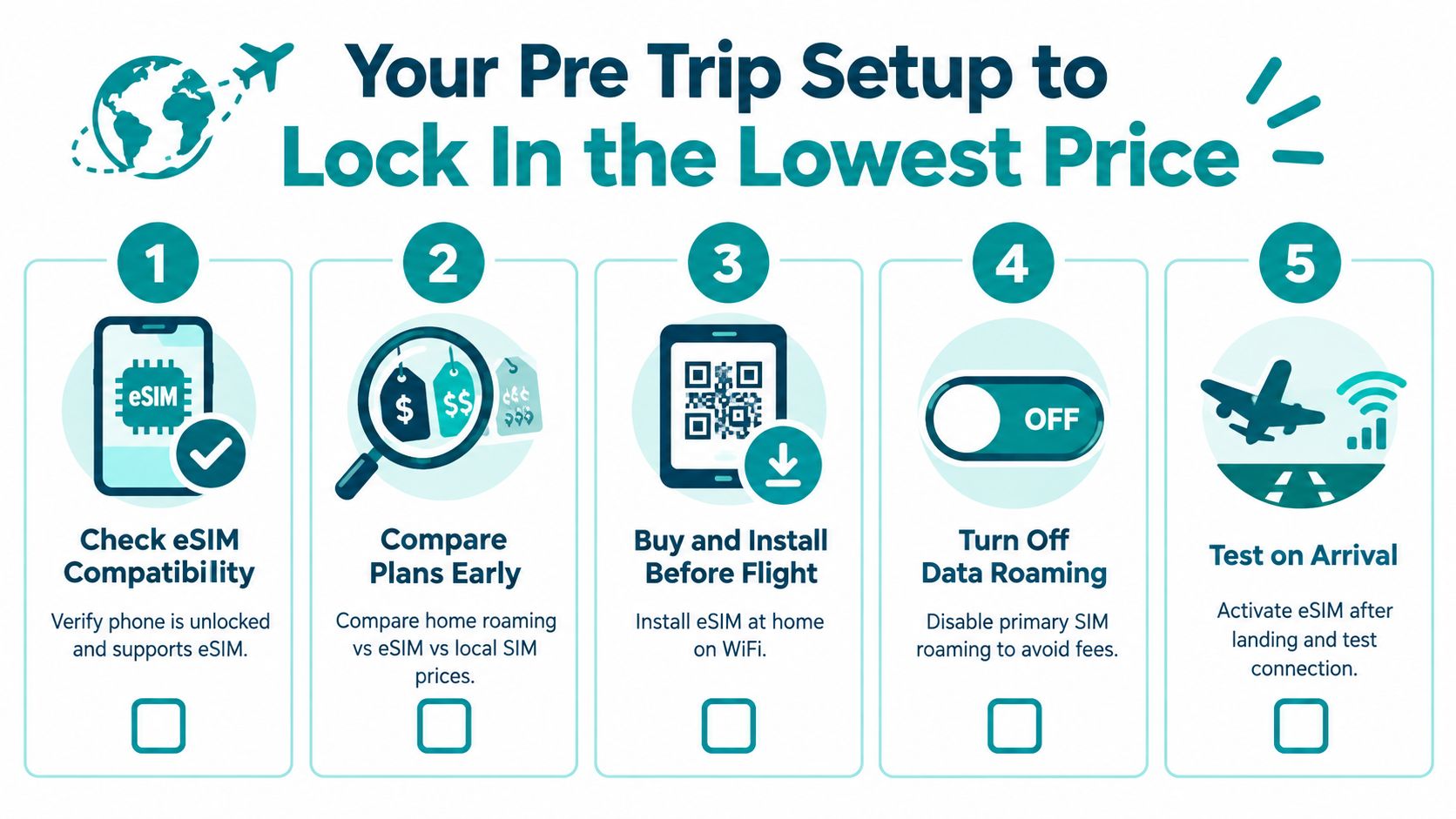
Check compatibility. Confirm that your phone supports eSIM and is unlocked for other networks. Recent iPhones, Pixel phones, and Samsung Galaxy models often support eSIM, but verify the exact model and carrier status in your device settings.
Compare before departure. Check your home-carrier roaming offer, a destination eSIM, a regional plan, and a local SIM. Record the allowance, validity, network coverage, and price per GB.
Install on Wi-Fi. Buy the plan and install it using the provider's Smart Link or QR code. Installing early avoids trying to solve activation problems in an airport with unreliable connectivity.
Choose the travel line for data. In your cellular settings, select the travel eSIM as the mobile-data line. Turn off data roaming on the primary line. If your travel eSIM requires data roaming to connect, enable it on that travel line only, then confirm the primary line remains restricted.
Test after landing. Activate the travel line when you arrive, check that the network name appears, open a webpage, and send a message. Keep automatic app updates and cloud backups controlled if your allowance is limited.
Before you fly: Save the carrier support details and activation instructions offline. A connection problem is much easier to fix when the installation information isn't trapped in your email account.
Your phone setup is only part of travel readiness. Chargers, plug types, and adapters can also cause avoidable problems, so a practical myhalo adapter for travel guide can help you check power compatibility before packing.
For a focused settings walkthrough, use this video as a visual companion:
The final safeguard is simple: keep data roaming disabled on the line that carries your expensive home tariff. This guide to avoiding roaming charges covers the settings habit that prevents an automatic connection from becoming an automatic charge.
There isn't one universal winner. The right choice comes from matching destination, duration, and data need.
Use this quick filter:
One country and a longer stay: Compare a local SIM against a destination eSIM. Local service may win on price, while the eSIM usually wins on preparation and number retention.
Several countries in one region: Compare a regional eSIM with your carrier's roaming zone. Make sure every stop is covered.
Short trip with light use: Check whether your existing plan already includes regulated roaming or whether a small carrier add-on is sufficient.
Heavy use outside a regulated zone: Start with prepaid travel eSIMs and local SIMs. Compare total data and price per GB, not just the daily fee.
Uncertain usage: Choose a prepaid option with a clear allowance and no automatic overage, then monitor your consumption.
The central lesson is straightforward. Cheapest international roaming means the lowest total cost for your particular route and usage pattern, not the lowest advertised number on a generic travel page. Compare before every trip, keep your primary line protected, and don't let your phone make the pricing decision for you.
Simsima offers prepaid travel eSIM data plans for 190+ countries and regions, including local, regional, and global options, with installation through a Smart Link or emailed QR code. Visit Simsima to compare your destination's plans and check the price per GB before you leave.

Founder of Simsima. A passionate traveler based in Barcelona, he helps travelers stay connected without breaking the bank on roaming fees.
LinkedIn