-5% on your 1st eSIM
WELCOME5
Loading...
Does WhatsApp work internationally? Yes, over Wi-Fi or data. Learn costs, roaming, calls, and travel tips to stay connected abroad.
 Dimitri Morvan
Yes, WhatsApp works internationally in 180+ countries over Wi-Fi or mobile data. Calls are free inside the app, but the data carrying them can still cost money depending on your connection.
You've just landed, switched off airplane mode, and your family is waiting for a message saying you arrived safely. Your phone shows a foreign network, your regular cellular plan is unclear, and one question comes first: does WhatsApp work internationally, or will borders stop it from connecting?
For most travelers, the answer is yes. WhatsApp has more than 3 billion monthly active users worldwide and is available in 180+ countries, with especially broad adoption in markets such as India and the United States, according to industry coverage of WhatsApp's global reach. That means your contacts are often already using the same service when you travel.
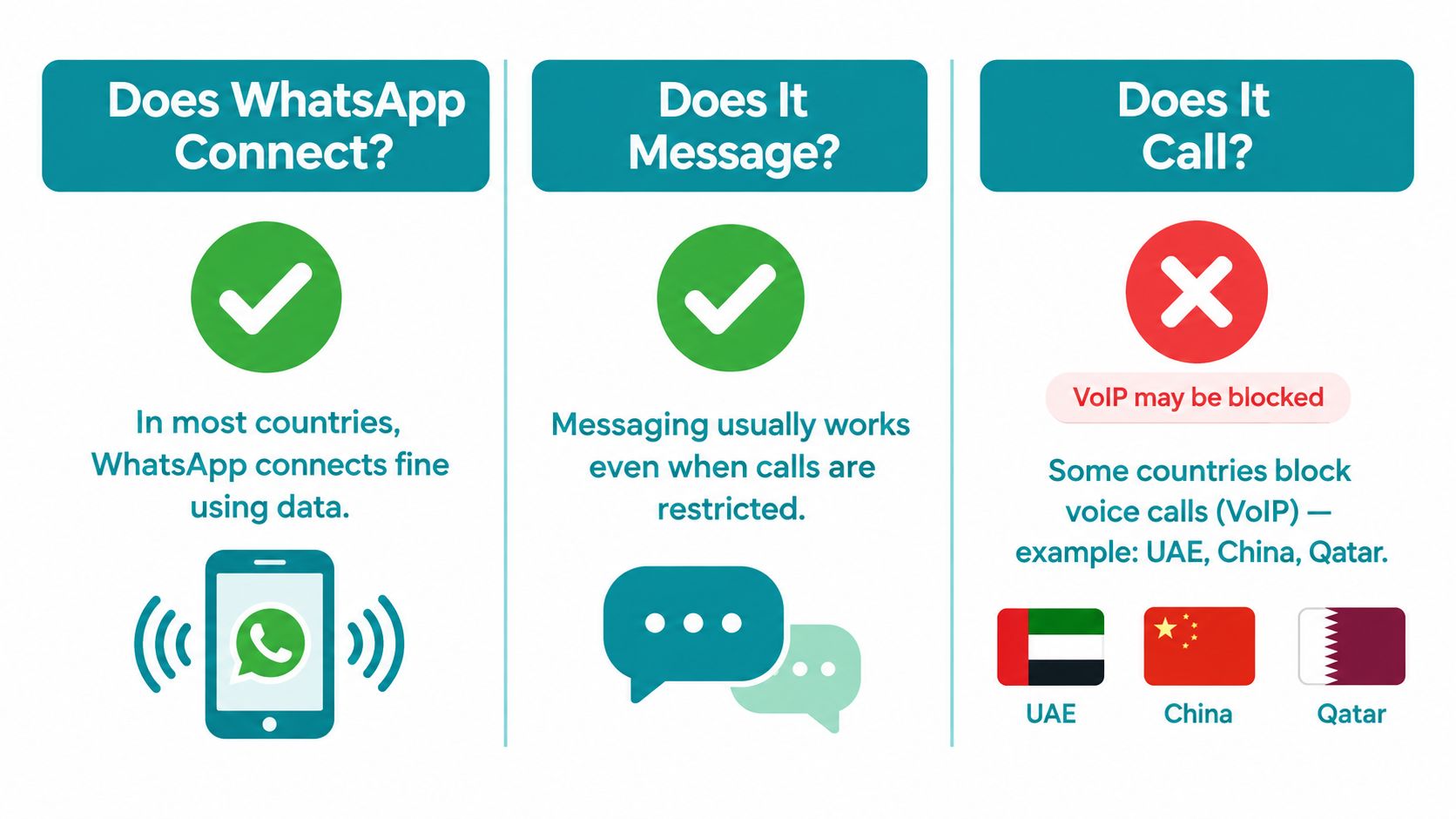
The important detail is that “works” can mean three different things:
Those distinctions affect your setup, your costs, and your backup plan.
WhatsApp doesn't care that your phone has crossed a border in the same way your cellular voice plan does. If your device reaches the internet through hotel Wi-Fi, airport Wi-Fi, mobile data, or a travel eSIM, WhatsApp can generally connect to its service and exchange messages with other WhatsApp users.
That's why a traveler can land abroad, connect to Wi-Fi, and send a message without buying an international calling package. The app uses the internet rather than charging you for a traditional international text or voice minute. Its worldwide availability and adoption make cross-border communication a normal use case, not an unusual feature, as documented in WhatsApp's international usage overview.
Still, a green WhatsApp icon on your screen doesn't guarantee that every feature will work. In some destinations, text messaging may function while voice and video calls are blocked or throttled. A country's network rules, your carrier settings, and the quality of your internet connection can all change the experience.
Practical rule: Before you fly, answer three separate questions: can WhatsApp connect, can it message, and can it call?
Your choice of internet access also matters. Wi-Fi can avoid mobile-data charges, while home-SIM roaming may create carrier fees. A prepaid travel eSIM gives you another mobile-data route, but it doesn't automatically change your WhatsApp identity or phone number. Once those pieces are clear, international WhatsApp use becomes much easier to plan.
Traditional phone calls use a carrier's voice network. WhatsApp calls use Voice over Internet Protocol, or VoIP, which turns audio and video into internet data. Messages use the same broad principle, although a text message needs far less data than a live video conversation.
Think of traditional calling as a dedicated telephone road operated by your carrier. WhatsApp sends your communication along the internet highway instead. The highway can begin with Wi-Fi, your regular mobile data, or a separate travel eSIM. WhatsApp doesn't need a special international version because the app follows the available internet connection.
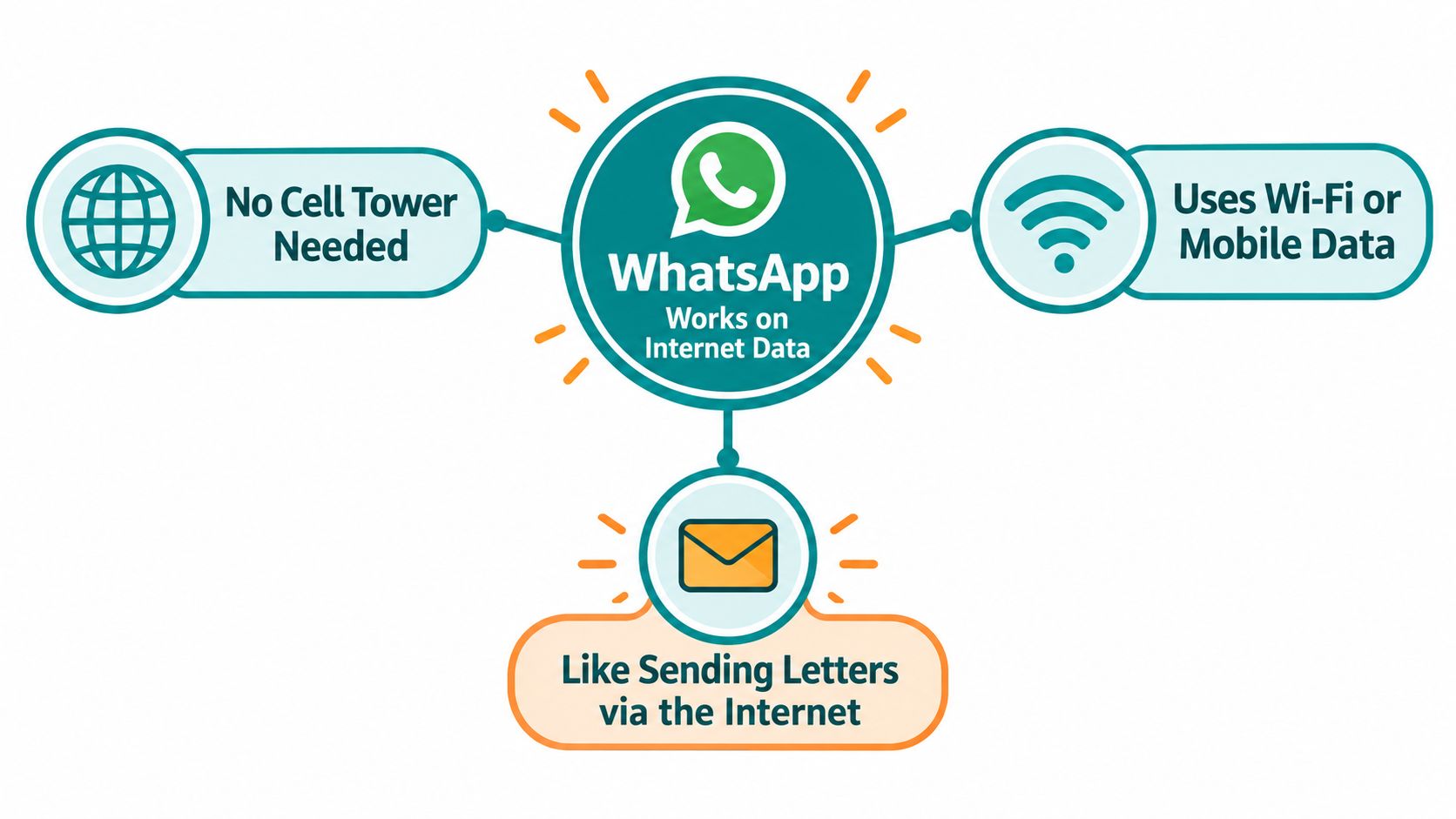
Your phone number and your data source are separate things. Switching to a travel eSIM for data doesn't automatically give you a new WhatsApp account. In many setups, you can keep WhatsApp registered to your usual number while another SIM or eSIM supplies the internet.
The main risk is assuming that “internet available” means “no charge.” If your phone uses roaming data, your mobile operator may bill you even though WhatsApp itself doesn't charge for the call. WhatsApp's help guidance on roaming makes that distinction clear.
Travelers usually choose among three internet sources. Each can make WhatsApp connect, but they differ in price control, availability, and convenience.
| Connection Type | Cost for WhatsApp | Reliability | Best For |
|---|---|---|---|
| Wi-Fi | WhatsApp doesn't charge for messages or calls. The network itself may be free or paid. | Strong where the network is stable, unavailable when you leave its coverage | Hotel stays, airport waiting, and long calls |
| Home-SIM roaming | WhatsApp doesn't charge for the call, but your carrier may charge for roaming data | Convenient wherever your home carrier has service | Short trips when your roaming terms are clear |
| Prepaid travel eSIM | WhatsApp uses the eSIM's data allowance. The price depends on the selected plan | Useful away from Wi-Fi, subject to local coverage and device compatibility | Navigation, messaging, and mobile access throughout a trip |
Wi-Fi is simple, but it can disappear as soon as you leave your accommodation. Public networks can also be crowded, unstable, or unsuitable for sensitive activity. Use networks you trust, and avoid treating every visible hotspot as a dependable travel connection.
Home-SIM roaming is the easiest option because you don't need to change your setup. It's also the option that most often causes confusion. WhatsApp can appear to work normally while your carrier counts the data in the background. Turn off data roaming if you haven't confirmed the terms.
A travel eSIM separates your internet access from your home carrier. With a data-only plan, you can keep your normal number for WhatsApp while using prepaid mobile data abroad. If you're new to eSIMs, follow this step-by-step eSIM setup guide before departure, while you still have reliable connectivity.
A practical decision is straightforward: use Wi-Fi for heavy calls, use roaming only when you understand the carrier rules, and consider a prepaid eSIM when you need predictable mobile data beyond Wi-Fi.
A destination can support WhatsApp in one sense and restrict it in another. Your phone may connect to WhatsApp, your messages may arrive, and your voice call may still fail because the local network controls VoIP traffic.
Travel reporting for 2026 identifies examples including the UAE, Qatar, China, Oman, and Iran, where WhatsApp voice or video calling may be blocked or throttled even when travelers can still use the app for messaging, as outlined in coverage of countries where WhatsApp calls are restricted. Restrictions can differ by country, network, and period, so a result on hotel Wi-Fi may not match a result on a local mobile connection.
Messaging often remains available when calling is restricted. That makes WhatsApp useful for arrival instructions, family updates, and business messages, but it may not be a dependable sole option for live conversations in every destination.
Check your destination's current telecom guidance before departure. If calls are important, prepare another legitimate communication method, such as a regular phone option or a different approved calling service. Travelers heading to China can also review this guide to VPN options for China, while remembering that local laws and network rules always apply.
The distinction matters most for remote workers and business travelers. A chat that works perfectly doesn't prove that a video meeting will work, so test the exact feature you'll depend on before you leave.
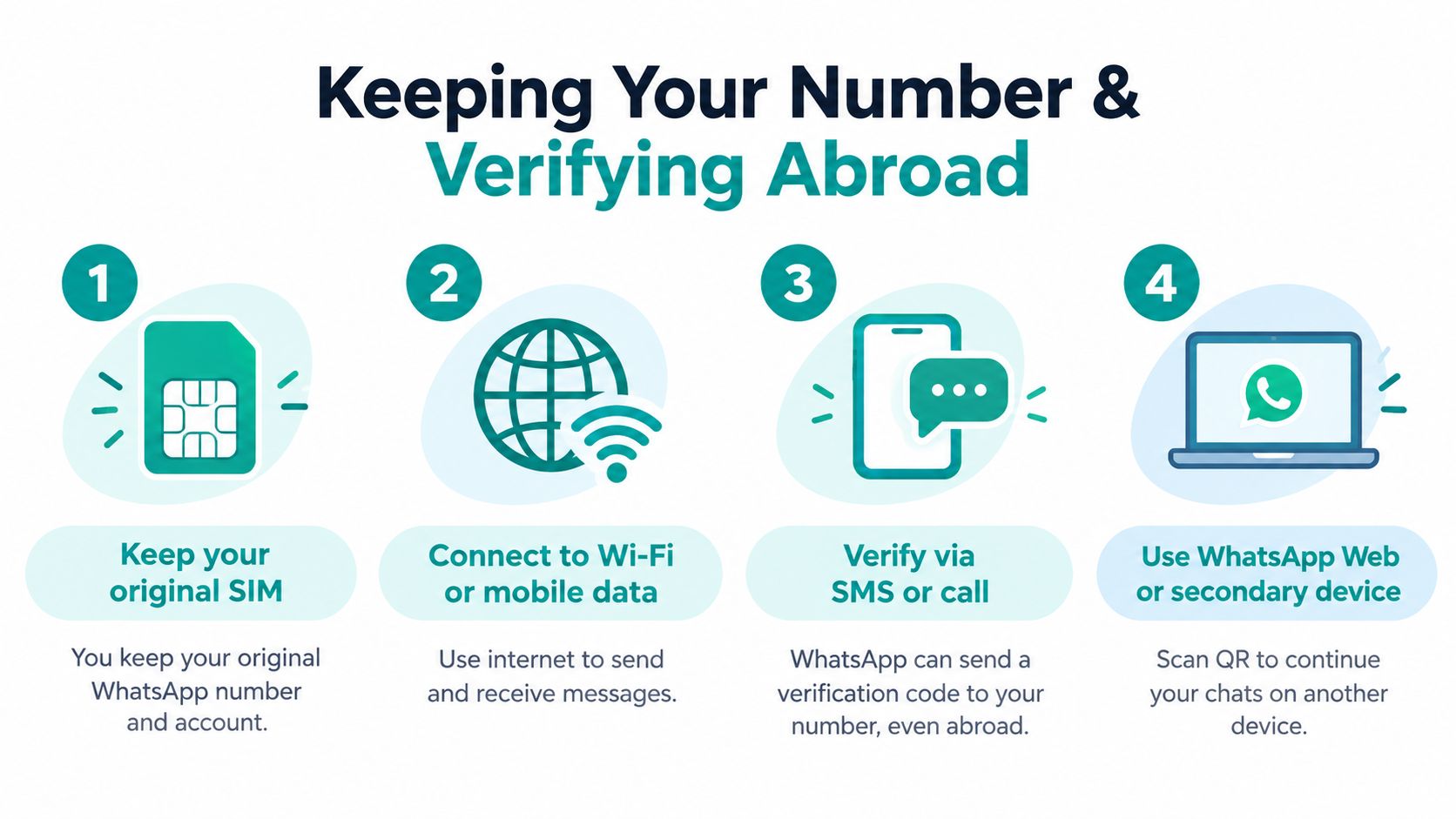
Changing the internet source doesn't necessarily change the number attached to your WhatsApp account. If you install a travel eSIM for data, WhatsApp can generally continue using the number that was verified on your account, allowing your existing chats and contacts to remain familiar.
Verification becomes important if you reinstall WhatsApp, change phones, or trigger a security check. The code goes to the phone number registered with the account, usually through SMS or a phone call. If your home SIM is removed or inactive and you can't receive that code, you may struggle to regain access.
Some travelers consider temporary numbers during account setup, but that creates an identity and recovery issue if the number expires or becomes unavailable. If you're researching that route, this resource on using a disposable number for WhatsApp can help you understand the practical trade-offs before making a decision.
The safest arrangement is usually simple: keep your original WhatsApp registration, retain a way to receive verification messages, and use Wi-Fi or a separate data line for daily internet access.
WhatsApp doesn't charge a separate international fee for its in-app calls. The expense comes from the connection carrying the call. On Wi-Fi, the call uses that network; on mobile data, it consumes your allowance; on roaming, your carrier may apply roaming data charges.
Independent travel and telecom guidance estimates WhatsApp voice calls at roughly 0.15 to 1 MB per minute and standard video calls at about 5 to 15 MB per minute, as explained in this breakdown of WhatsApp international call data use. A long video call can therefore consume much more mobile data than a short voice call.
WhatsApp says messages and calls are end-to-end encrypted by default, so their content is protected while traveling across networks and countries. You can review account visibility, privacy controls, and security options in this guide to WhatsApp privacy settings.
Cost-control habit: Treat roaming data like a meter, not like free air. Check the connection before starting a long video call.
A prepaid data plan or eSIM can make the internet cost more predictable than unplanned roaming, but you still need to monitor usage. For a clearer explanation of the difference between app charges and connection charges, read whether WhatsApp costs money.
A dependable WhatsApp setup starts before departure. Don't wait until you're standing outside an airport with no connection to discover that your home line can't receive a verification code or that your destination restricts VoIP calls.
Use this short checklist:
The core answer is still yes: WhatsApp works internationally when your phone has usable internet access and the destination permits the feature you need. The reliable approach is to manage the internet layer, test the destination-specific behavior, and preserve access to your original number.
For mobile data beyond Wi-Fi, compare a destination plan before you fly and install it while you still have a dependable connection. Simsima offers prepaid travel eSIM data plans for 190+ countries, delivered digitally, so you can use a separate data connection while keeping your regular number for WhatsApp.

Founder of Simsima. A passionate traveler based in Barcelona, he helps travelers stay connected without breaking the bank on roaming fees.
LinkedIn