-5% on your 1st eSIM
WELCOME5
Loading...
Discover what an eSIM marketplace is, how instant delivery and Smart Link work, and how to compare providers for travel data in 2026.
 Dimitri Morvan
You've just landed, your phone shows no usable data, and the memory of your last roaming bill is still unpleasantly fresh. The airport offers a SIM kiosk, a carrier shop, and expensive Wi-Fi, while your hotel address, transfer details, and messages are all waiting online. An eSIM marketplace is designed for this exact moment, but the useful question isn't which brand has the most attractive homepage. It's how the marketplace helps you compare connectivity as a price layer, based on destination, validity, coverage, and cost per gigabyte.
The category has moved well beyond a niche experiment. Trusted Connectivity Alliance members reported 503 million eSIM shipments in 2024, a 35% year-on-year increase, with consumer eSIM profile downloads rising 56% in the same year, according to market data summarized by Mordor Intelligence. Yet usage remains uneven. GSMA Intelligence put global smartphone eSIM adoption at 3% of connections in 2024, while adoption in the United States reached around 30% after eSIM-only iPhone launches, as reported by Fortune Business Insights.
That combination explains the buyer's confusion. The infrastructure is expanding quickly, but many travelers still don't know whether their phone supports eSIM, whether it's carrier-unlocked, or whether a marketplace plan is better value than roaming. This guide starts with the basic mechanics, then moves to the comparison that matters most: what you're paying for, where the price changes, and which plan structure fits your trip.
Before marketplaces, buying mobile data abroad usually meant choosing between a familiar carrier and a stressful local purchase. You could activate roaming before departure, visit a carrier store after landing, or stand at an airport kiosk comparing plans while tired, rushed, and unsure whether the advertised price included enough data.
Those options remain available, but they're fragmented. A single carrier typically shows its own plans, a local shop may promote only the network it represents, and regional bundles can be difficult to compare across providers. Travelers often make the decision without seeing the underlying difference in coverage, expiry, top-up rules, and price per GB.
An eSIM marketplace changes the shopping environment. It brings multiple offers into one catalog, so a traveler going from France to Italy and Greece can compare a local plan, a European regional bundle, and a broader multi-country option before choosing. The marketplace usually doesn't own the mobile network. It acts as a storefront and discovery layer that connects the buyer with plans supplied through carriers, mobile virtual network operators, or wholesalers.
The useful mental model: an eSIM marketplace is closer to a travel booking platform than to a mobile network. It helps you compare and purchase access, but the underlying carrier still provides the radio network.
That distinction matters when something goes wrong. A marketplace controls the catalog, checkout, delivery, and much of the support experience. The underlying network controls signal availability, local roaming relationships, and technical performance in the destination. Two marketplace plans may therefore use different networks, even if they cover the same country.
The result is a calmer buying process. You can check your phone, compare plans at home, and install the profile before departure or after landing. Instead of making a rushed airport decision, you're evaluating a set of offers on the same screen. The marketplace's core value isn't the existence of eSIM technology. It's the aggregation and comparison layer that turns scattered travel connectivity into a searchable purchase.
An eSIM marketplace is a digital storefront that sells prepaid mobile data plans from multiple underlying connectivity providers. You choose a destination, review the available offers, pay online, and receive the information needed to install a mobile profile on your phone.
The process usually has four parts.
Start by searching for a country, region, or broader destination group. A useful catalog should let you compare data allowance, validity period, network details, activation rules, and price rather than presenting one generic travel package.
A country plan can suit a one-destination trip. A regional plan may make more sense when your itinerary crosses borders. A global plan can simplify a long journey, though a wider coverage area doesn't automatically make it cheaper. Look for whether the plan covers every destination you'll visit, not merely whether the region name sounds broad.
After selecting a plan, you pay through the marketplace's checkout. Card payments and digital wallets are common, and the purchase may not require a lengthy account setup. Before paying, check the activation policy, refund conditions, whether validity begins at installation or first network connection, and whether calls and texts are included.
Most travel eSIMs are data-only. You can often keep your physical SIM active for your normal number while using the eSIM for data, but your phone's dual-SIM settings determine how calls, messages, and mobile data are routed.
Once payment clears, the marketplace delivers an activation package, commonly by email or through the purchase page. That package contains the information needed to download a remote SIM profile to the phone's eUICC, the secure component that stores eSIM profiles.
Delivery is digital, so there's no shipping delay or plastic card to collect. You still need a compatible device and a reliable internet connection during installation.
A QR code can encode the activation details, but scanning it from the same phone can be awkward. You may need a second screen, a printed page, or manual entry if the camera can't read the code.
A Smart Link reduces that friction by opening the phone's eSIM installation flow directly and carrying the activation information into the process. That's especially practical at an airport, where you may have one hand occupied by luggage and poor lighting around you.
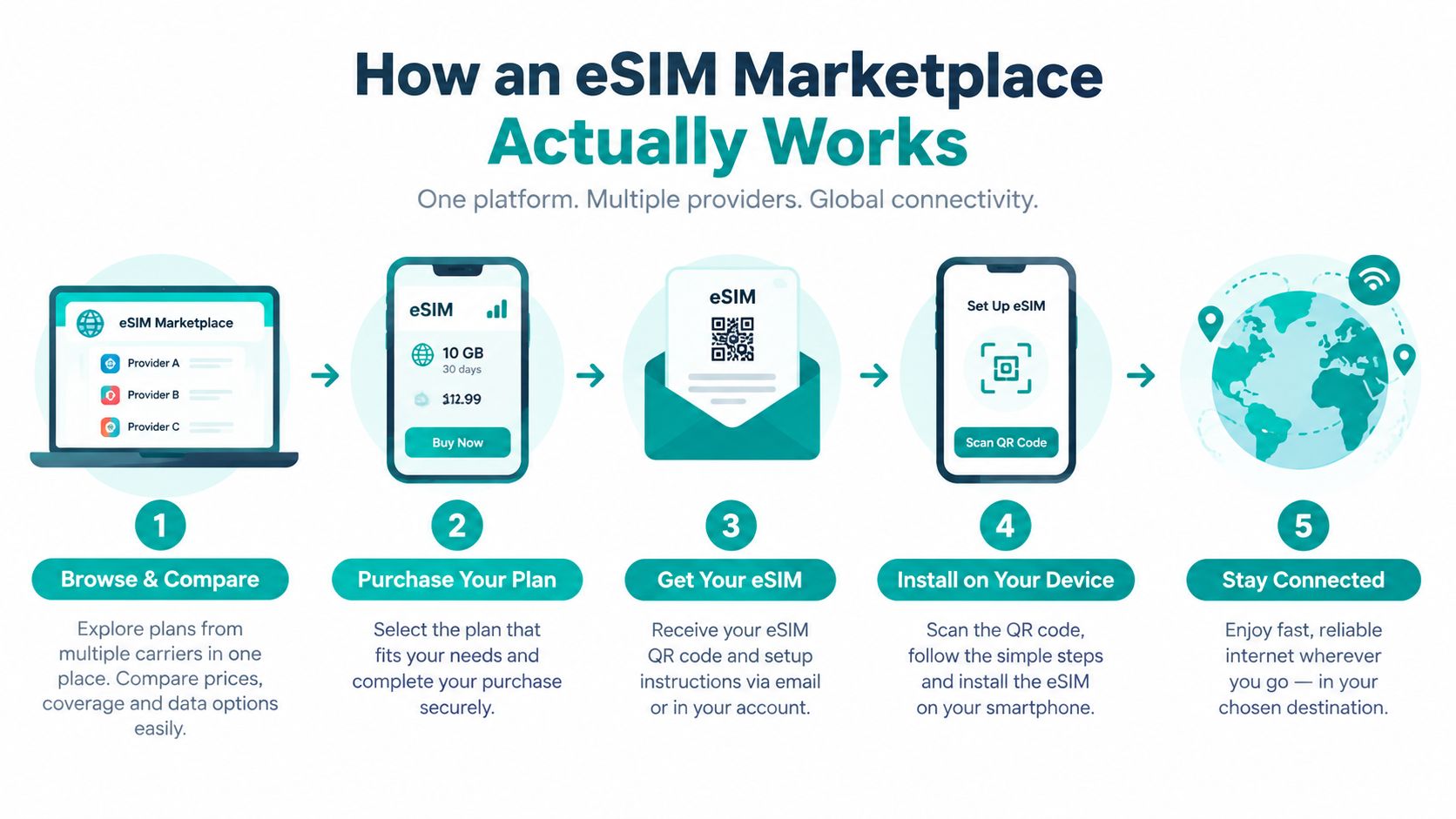
You can review the process in this guide to how an eSIM marketplace works. The important point is that the marketplace handles the retail journey, while standardized remote provisioning handles the technical handoff.
The smooth installation flow depends on GSMA Remote SIM Provisioning, commonly shortened to RSP. In plain language, RSP is the standardized exchange that lets a carrier's provisioning system deliver a mobile profile to the eSIM component inside a compatible device.
GSMA's consumer specifications divide the process into defined roles. SGP.21 describes the consumer architecture, while SGP.22 defines the protocols and application programming interfaces used to download a profile from an SM-DP+ to the eUICC. SGP.23 and SGP.24 cover testing and compliance, according to the GSMA eSIM Services document.
The buyer doesn't need to understand those document names to benefit from them. You see their result as an activation QR code, an installation prompt, or a Smart Link. The code or link carries the address and matching credentials that tell the phone where to retrieve the profile and which profile to install.
A reseller in one country can sell a plan connected to a carrier in another because the profile delivery process follows a recognized technical model. The phone doesn't need a proprietary physical component from the reseller, and you don't need to visit a carrier shop to pair hardware.
That standardization also supports competition. Multiple sellers can offer plans connected to overlapping networks, then compete through catalog selection, price, support, and activation design. The network remains essential, but the marketplace determines how clearly the buyer can see the available commercial choices.
GSMA's compliance framework covers devices, eUICCs, and subscription-management servers. It is intended to support functional interoperability and eUICC security, and the consumer provisioning protocol mandates TLS, as described in the GSMA eSIM security white paper. That doesn't eliminate every risk. Poor implementation or non-compliant partner infrastructure can still create installation and support problems.
For the traveler, the practical takeaway is simple: instant delivery isn't magic, and it isn't tied to one retailer. It's the consumer-facing result of a standards-based provisioning system that makes digital profile delivery possible.
The most useful comparison metric is price per GB, not the headline price of a plan. A plan that looks cheap may contain little data or expire quickly, while a higher-priced plan may cover several countries and avoid repeated purchases.
Simsima's open Price Index reports a global median of about $3.50 per GB, while country medians range from about $1 per GB in some destinations to several hundred dollars per GB in remote territories, according to the Simsima eSIM Price Index. Those figures describe a market with substantial destination volatility, not a universal retail rate.
| Region | Typical range | Main drivers | Volatility |
|---|---|---|---|
| Competitive regional markets | Around $1 to several dollars per GB | Multiple networks, dense infrastructure, regional competition | Usually lower |
| Popular multi-country routes | Several dollars per GB | Regional bundles, wholesale agreements, traveler demand | Moderate |
| Remote or infrastructure-limited territories | Tens to several hundred dollars per GB | Limited network access, difficult backhaul, small customer base | High |
The reason for the spread is structural. Wholesale carrier rates differ by destination, and some marketplaces depend on a single available network rather than several competing suppliers. Remote islands and territories can face expensive backhaul or limited infrastructure. Seasonal tourism can also change demand and the commercial terms available to resellers.
A low price per GB often signals a competitive regional bundle or a destination with many available providers. A very high price can reflect restricted coverage, a premium network relationship, or a market where data is costly to source. Treat outliers as information, not automatically as errors.
Comparison rule: normalize every plan to price per GB, then check coverage, expiry, network access, and top-up pricing before deciding.
The best marketplace makes this calculation visible. It should help you see why one plan costs more, whether the bundle includes all your countries, and whether the advertised data amount is usable throughout the validity period. Pricing transparency is more valuable than a bright discount label because it lets you judge the offer against the trip you're taking.
Consumer eSIM brands tend to organize their stores around a curated catalog. Airalo is widely associated with local, regional, and global travel plans. Holafly is known for plans marketed around unlimited or high-allowance usage periods. Nomad and Ubigi offer destination and regional options with different data caps, validity periods, and network arrangements. Carrier-adjacent services such as Google Fi follow a broader mobile-service model rather than functioning purely as a travel marketplace.
The differences become clearer when you compare three things: coverage model, plan structure, and pricing presentation. A curated provider may deliver a consistent interface and a relatively simple purchase decision. A marketplace can expose more variation, which is useful for price-sensitive travelers but requires closer reading.
| Provider | Coverage model | Plan structure | Pricing approach |
|---|---|---|---|
| Airalo | Local, regional, and global options | Commonly fixed-data plans with varied validity | Catalog-based comparison within its own offers |
| Holafly | Destination and regional travel coverage | Strong focus on unlimited or usage-period structures | Simplicity around duration, with fair-use terms to inspect |
| Nomad | Local and regional options | Fixed-data plans and varied validity | Data and validity comparison across its catalog |
| Ubigi | Destination and regional coverage | Fixed-data packages and recurring-service options | Structured catalog with plan-specific pricing |
| Google Fi | Carrier-adjacent international service | Mobile-service plans with international features | Broader subscription model rather than a pure marketplace |
| Simsima | Aggregated plans across 190+ countries and regions | Local, regional, and global prepaid data plans | Marketplace comparison, with Smart Link or QR delivery |
A fixed-data plan makes the cost boundary easy to understand. Unlimited wording makes duration simple, but you should read fair-use terms, speed policies, hotspot restrictions, and any daily or network-management conditions. Top-up fees also matter, particularly if a small shortage forces you to buy another full package.
The marketplace-only tier differs commercially. Brand-led stores curate their own selection, while an aggregator brings competing offers together for the same route. That can reveal a lower price or a better regional fit on a particular day, but it also means you must compare network names, activation rules, and support policies instead of choosing by brand recognition alone.
This comparison of Airalo alternatives can help frame the choice. For a short trip with predictable usage, a simple bundled plan may be easiest. For a multi-country itinerary or a tightly managed budget, an eSIM marketplace is more useful when it exposes the price spread clearly.
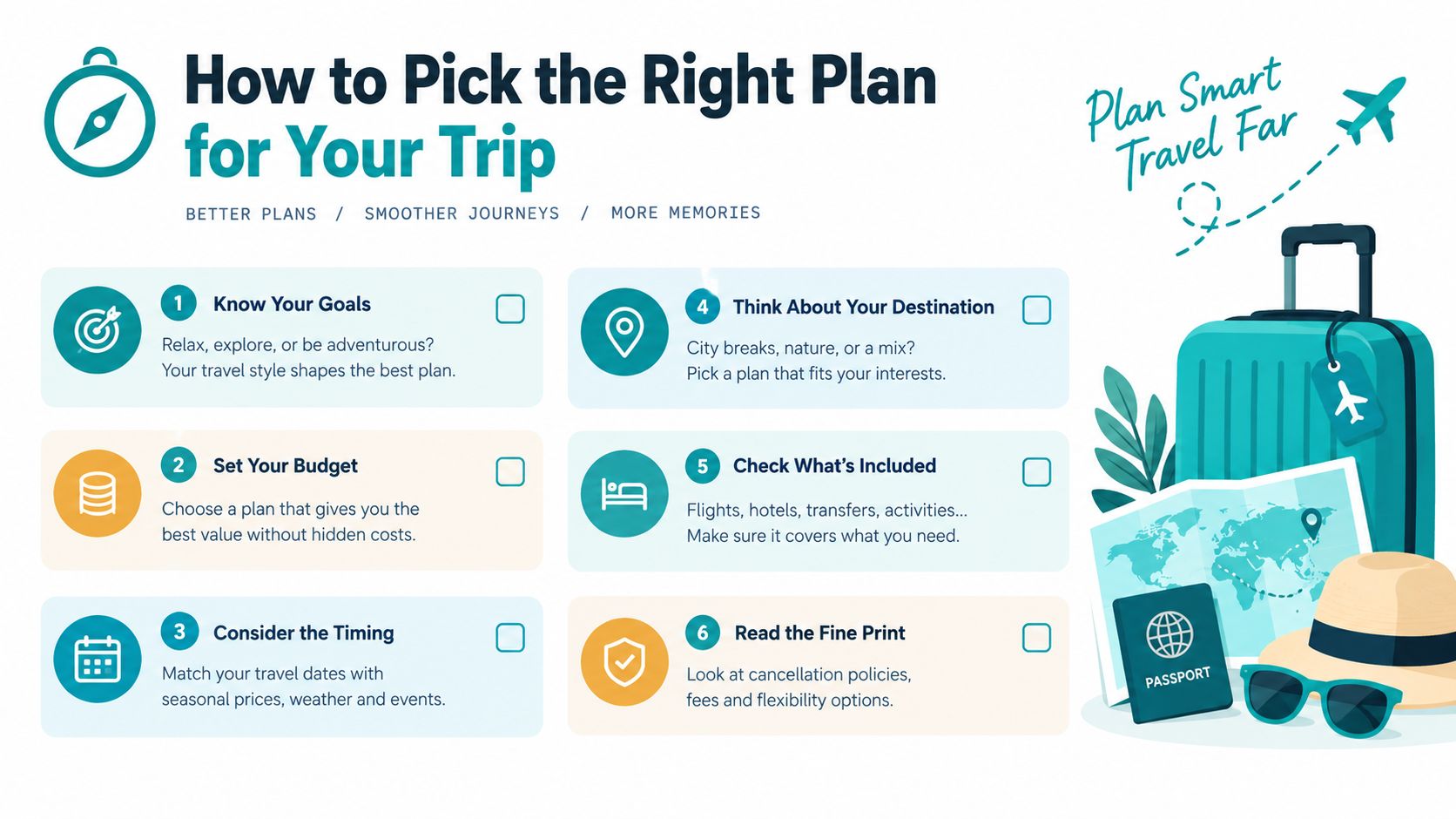
The right plan starts with your itinerary, not the provider logo. Use this five-part check before you pay.
Count your destinations. One country usually makes a local plan easy to evaluate. Several neighboring countries may justify a regional bundle. If your route spans distant regions, a global plan can reduce administration, but compare its per-GB cost and actual country list.
Match validity to the trip. A short city break can fit a fixed-data package with a clearly stated expiry. A longer stay may suit a duration-based or unlimited structure, provided you understand fair-use conditions and whether speed changes after heavy usage.
Estimate your real data use. Navigation, messaging, ride-hailing, email, and occasional browsing consume less data than constant video calls, streaming, cloud backups, or hotspot use. Disable automatic photo backups and app updates over mobile data if you want a smaller package to last.
Check the device before checkout. Hardware support isn't enough. The phone must also be carrier-free, and the destination plan must support the device's bands and network relationships. Check the exact model, especially if it was purchased through a carrier or in a market with regional hardware variations.
Normalize the price. Divide the plan price by its data allowance, then weigh that result against coverage and validity. Paying more per GB can be sensible if the plan covers several countries you'd otherwise buy separately, but a broad label is no substitute for checking the itinerary.
Before departure: install while you have dependable Wi-Fi, but confirm when the plan's validity begins. Some plans start at installation, while others begin when the eSIM connects to a supported network.
The cheapest listing can become expensive if the data expires before your return, the network is unavailable in one stop, or the plan requires a costly replacement after an early top-up. Treat price per GB as a starting point, not the final answer.
A modern marketplace should remove unnecessary friction from the purchase without hiding the technical or commercial details. The strongest difference from legacy roaming is that the traveler can compare a prepaid offer before departure instead of accepting whatever default roaming arrangement the home carrier applies.
Identity requirements illustrate the contrast. A traditional mobile contract may involve customer verification and account administration. A travel marketplace can treat prepaid data as a digital purchase, with no contract and, depending on the provider, no KYC process. That makes the transaction faster, though it also puts more responsibility on the buyer to verify the device, destination, validity, and refund terms.
| Dimension | Legacy roaming | Modern eSIM marketplace |
|---|---|---|
| Selection | Usually tied to the home carrier | Multiple plans and suppliers in one catalog |
| Pricing | Often appears later on a carrier bill | Prepaid price shown before purchase |
| Activation | Roaming settings or carrier support | Digital profile installation by QR code or Smart Link |
| Identity | May involve account or verification steps | Often designed for a quick prepaid checkout |
| Comparison | Limited to the carrier's own offer | Per-GB, validity, destination, and coverage comparison |
| Support | Carrier help desk or roaming team | Digital support channels and marketplace policies |
The marketplace model also changes when you discover that your first choice isn't suitable. A clear catalog lets you compare a local plan with a regional bundle before buying. A transparent price index can show whether a destination is unusually expensive, which helps you avoid mistaking a market-wide constraint for a retailer's arbitrary markup.
Installation should match that promise. A Smart Link can reduce manual code entry, while a QR code remains a useful fallback when installation takes place from another screen. Support should explain activation timing, data-line selection, and troubleshooting in plain language rather than sending a first-time traveler into carrier terminology.
That design turns connectivity into a normal travel purchase. You're still buying access to a mobile network, but the retail experience is closer to reserving transport or accommodation, with the important difference that network coverage and device compatibility still need your attention.
A traveler planning several countries may soon receive a connectivity option while booking a flight, hotel, or rail journey. The next phase of the eSIM marketplace will connect travel planning with clearer pricing data, wider device support, and more useful plan comparisons.
The marketplace should function as a pricing layer, not merely a larger product catalog. Travelers will be able to compare per-GB economics, validity, coverage, and regional bundles, while destination price changes reveal whether an expensive offer reflects local network conditions or a retailer's markup.
Device support will determine who can participate. GSMA Intelligence counted 271 consumer eSIM devices launched, 441 operators offering smartphone eSIM service, and 123 countries with smartphone eSIM service launched by June 2024. As eSIM support reaches more devices beyond premium phones, more travelers can shop without replacing hardware.
Forecasts indicate continued expansion, though they measure different parts of the category. One estimate valued the global eSIM market at USD 1.76 billion in 2025 and projected USD 7.62 billion by 2034, as reported by Fortune Business Insights. Another forecast estimated 1.2 billion eSIM-connected devices in 2025 and 4.9 billion by 2030. These figures are projections, not identical measurements or guarantees.
Connectivity may appear inside airline apps, hotel bookings, rail tools, and destination platforms. A traveler could receive a plan recommendation with the route, then judge it by coverage, validity, regional scope, and price per GB.
Recommendation tools can reduce the work of sorting a large catalog. A useful system would consider destination count, trip length, expected data use, device compatibility, and whether the traveler prefers a simple plan over the lowest normalized price. It should also explain the trade-off, rather than promoting one provider.
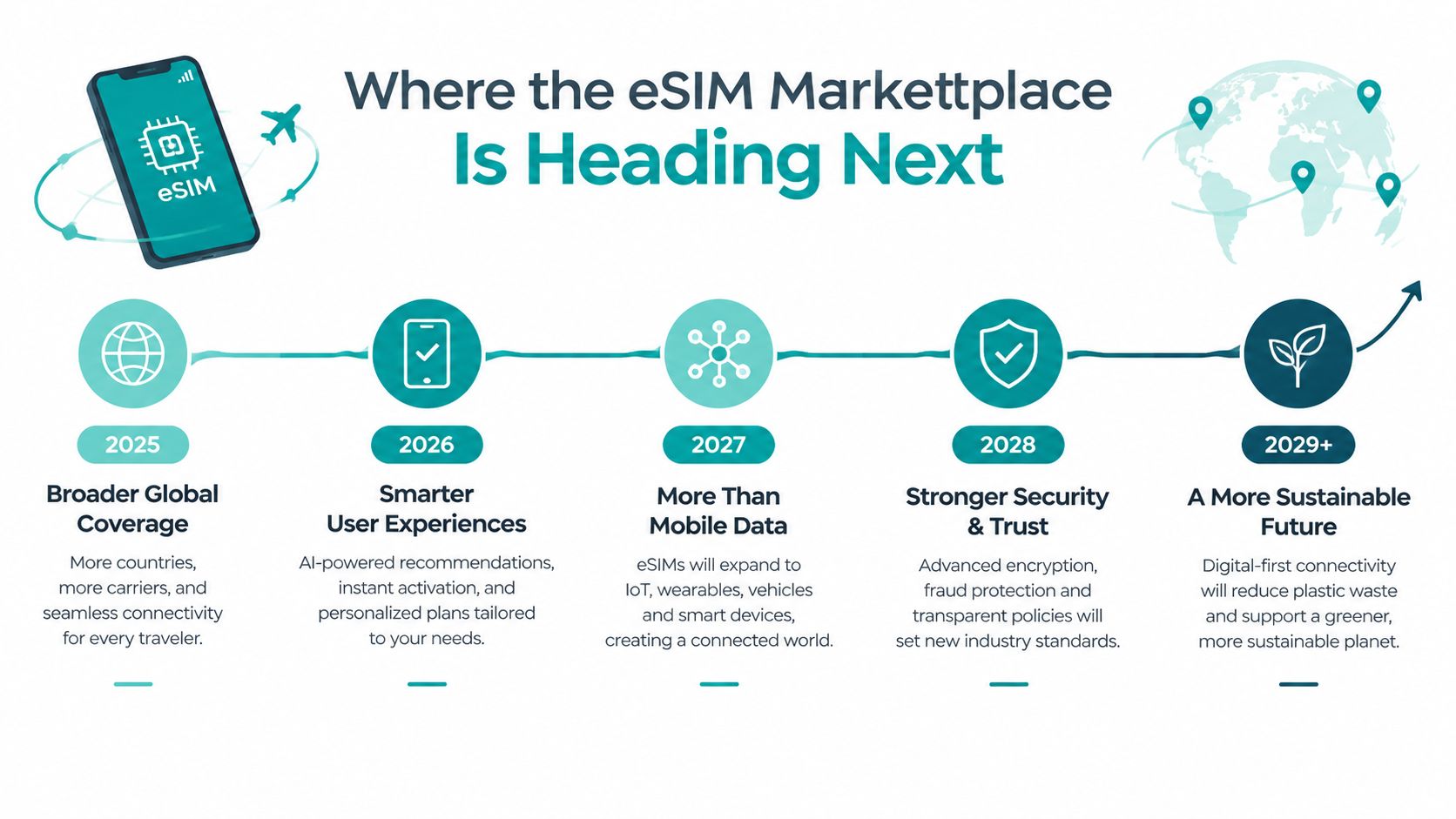
A mature marketplace will show destination volatility, the network behind each plan, installation steps, and the reason prices differ. That information helps buyers compare the economics instead of choosing by brand familiarity alone.
Simsima offers prepaid travel eSIM plans for 190+ countries and regions, including local, regional, and global options, with delivery through a Smart Link or email QR code and no app or KYC required. Compare destination coverage and plan economics on Simsima before departure.

Founder of Simsima. A passionate traveler based in Barcelona, he helps travelers stay connected without breaking the bank on roaming fees.
LinkedIn