-5% on your order in the app
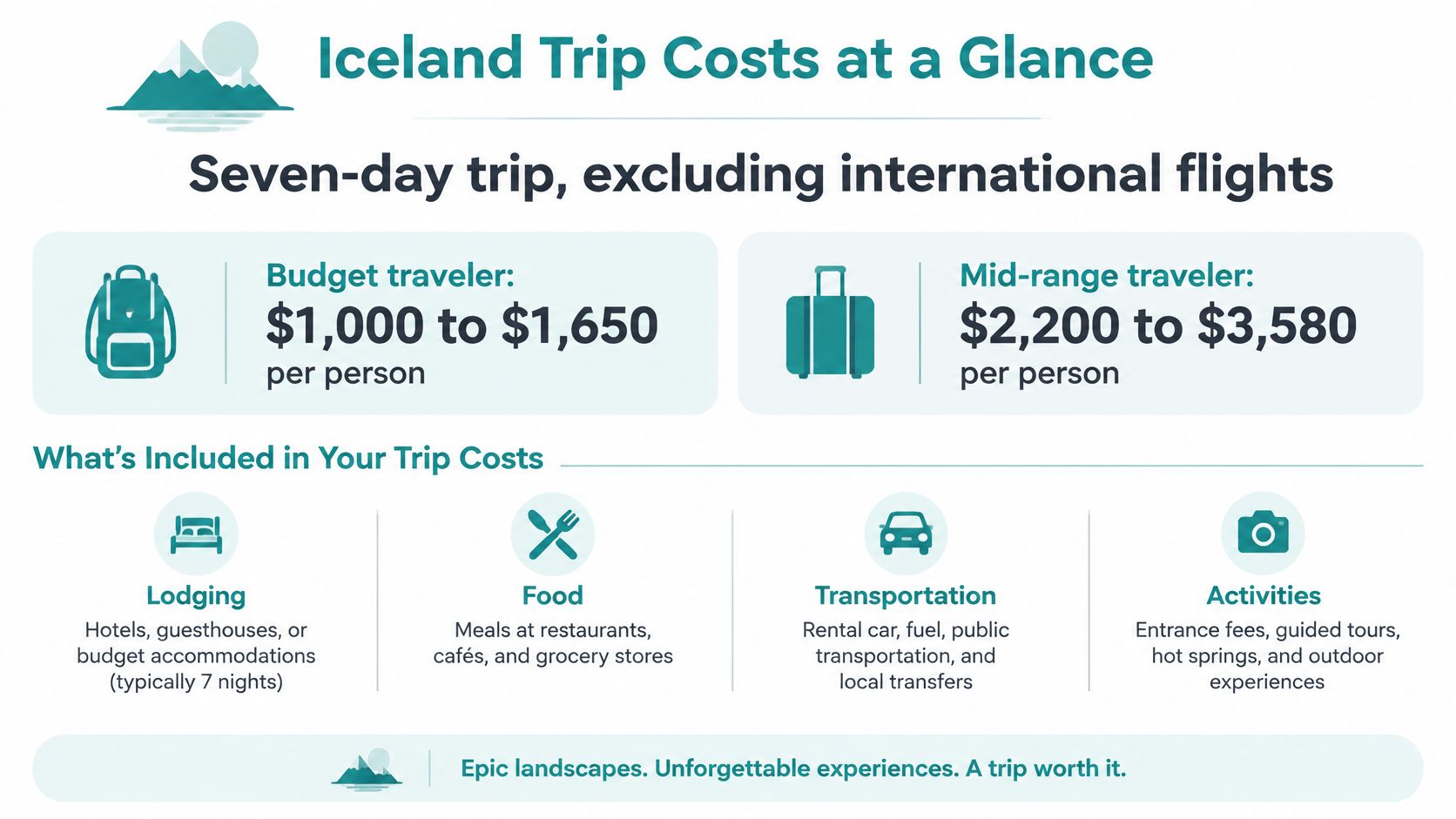
For seven days in Iceland excluding international flights, a budget traveler should plan on about 126,000 to 210,000 ISK per person, and a mid range traveler on about 280,000 to 455,000 ISK per person. The dollar figures often quoted alongside those bands come from separate published estimates, one built around two travelers sharing a self drive car, another around a higher comfort level, and they do not convert directly from the ISK ranges.
That gap is wider than it looks. The cheapest daily rental rate rarely produces the cheapest week: fuel burn, a per kilometer road use charge, and a room tax all stack onto the headline price, while seasonal swings in lodging and car hire move the total more than almost any single line item. Two travelers following the same route in different months can pay very different totals.
I would price Iceland from the fixed costs outward. Lock in the car class, the driving distance, and the type of room first, because those three decisions set most of the budget. Then decide how often you'll cook, how many paid attractions you'll add, and whether a shoulder season date buys you the same trip for less.
Iceland Trip Costs at a Glance
On the ground spending in Iceland runs about 18,000 to 30,000 ISK per person per day for a budget trip, 40,000 to 65,000 ISK for a mid range trip, and 120,000+ ISK for a luxury itinerary, according to Hertz Iceland's travel budget guide. Over seven days, excluding international flights, that comes to roughly 126,000 to 210,000 ISK per person for a budget trip and 280,000 to 455,000 ISK per person for a mid range trip.
Per Person Cost by Travel Style Excluding Flights
| Travel style | Per person per day (ISK) | Seven days per person (ISK) | Seven days per person (USD) |
|---|---|---|---|
| Budget | 18,000 to 30,000 | 126,000 to 210,000 | $1,050 to $1,575 (shared self drive estimate) |
| Mid range | 40,000 to 65,000 | 280,000 to 455,000 | No separate USD estimate published |
| Luxury | 120,000+ | 840,000+ | No separate USD estimate published |
The dollar figure in the budget row reflects a shared self drive estimate, so read it as a cross check against the ISK band rather than a straight conversion. The ISK bands themselves cover lodging, food, and ground transport. Airfare sits outside every figure in the table.
What Each Tier Buys You
Budget means hostels or guesthouses, groceries for most meals, and a small 2WD rental shared where possible. Mid range usually means sharing an SUV, eating at least one restaurant meal a day, and paying for selected attractions. Luxury means hotels and organized tours, with comfort and convenience priced into every day.
A tier is a starting point, not a locked price. Two travelers in the same tier can finish with different totals because ground transport scales with distance: fuel burn and the per kilometer road use charge rise on longer routes, so a week of heavy driving costs more than a week of short hops at the identical daily rental rate. Season works the same way on the room and vehicle lines, which is why the same itinerary can sit near the top of a band in one month and the bottom in another.
Practical rule: Count how many nights you want in hotels versus guesthouses and how many restaurant meals you plan each day. Those two answers choose your tier faster than any calculator.
Multiply the daily band by your trip length to price other itineraries; the results below are scaled figures, not separate estimates. A three night budget trip runs about 54,000 to 90,000 ISK per person, ten nights about 180,000 to 300,000 ISK, and fourteen nights about 252,000 to 420,000 ISK. Mid range over ten nights lands at roughly 400,000 to 650,000 ISK.
Where the Money Goes on Lodging and Food
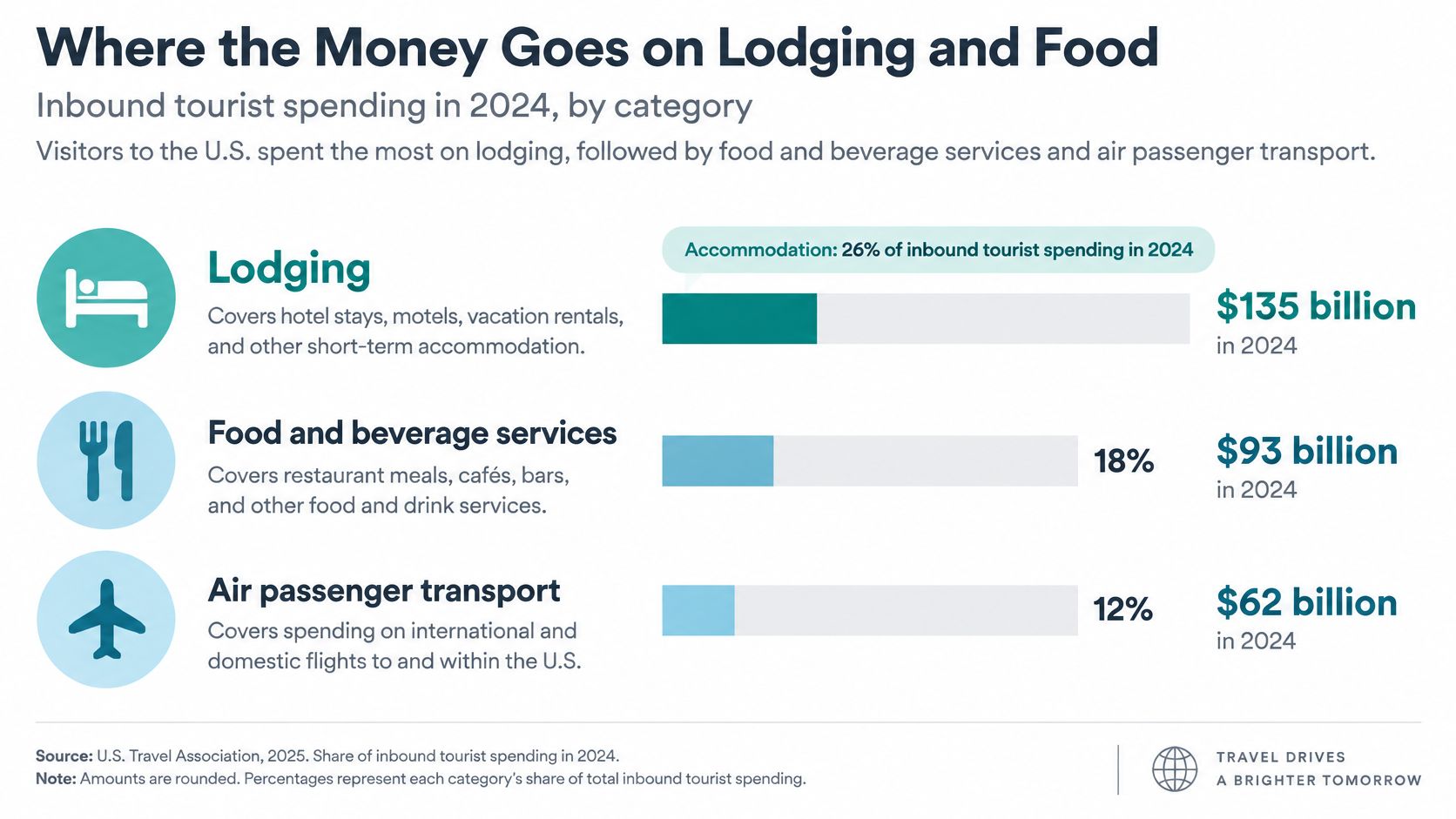
Lodging is the line to price first. Statistics Iceland's tourism satellite accounts reported that inbound tourists spent nearly 519 billion ISK in 2024, accommodation was the largest category at approximately 26% of inbound expenditure, about 135 billion ISK, and food and beverage services plus air passenger transportation together accounted for roughly 29% of inbound tourist spending. Transport and food matter, but your room choice sets the shape of the budget before you have bought a single meal.
Where the Money Goes on an Iceland Trip
| Cost category | What it covers | Share of inbound spending (2024) | Planning note |
|---|---|---|---|
| Accommodation | Hotels, guesthouses, campsites | About 26% (about 135 billion ISK) | Largest single line, shared rooms lower per person cost |
| Food and beverage plus air passenger transport | Restaurants, cafes, domestic and international air | About 29% combined | Groceries cut food costs, flights are booked separately |
| Car rental and fuel | Vehicle hire, fuel, road use charge | Not published as a share | Set by vehicle class, kilometers driven, and season |
| International airfare | Round trip flight to Iceland | Not published as a share | Check current fares on airline sites and note the month and year checked |
| Tours and activities | Guided tours, paid attractions | Not published as a share | Plan a line sized to the number of paid sights |
| Mobile data | eSIM or local SIM | Not published as a share | Set up before departure to avoid roaming charges |
Grey's Iceland cost guide puts a seven night stay at approximately $700 to $1,200 per person in a broad budget estimate and mid range guesthouses and hotels outside Reykjavík at roughly 15,000 to 35,000 ISK per room per night. That per room figure is the lever. Rooms price by the room, not by the bed, so two travelers splitting one room each pay half of what a solo traveler pays for the same night. Hotels and guesthouses also add an accommodation tax on top of the room rate, so check whether a quoted price includes it before you compare options.
Food is where discipline pays. A mostly grocery based budget works if you are willing to cook, while a single restaurant meal typically runs several times the cost of the same meal assembled from supermarket ingredients. Eat out once a day instead of self catering and the weekly food line climbs fast. The shared self drive example later in this article uses a higher daily food figure because it includes occasional cafe meals, and that is the honest way to plan. Few travelers cook every meal for a week, and a budget that assumes otherwise falls apart by day three.
Four Ways to Cut Lodging and Food Costs
- Cook breakfast and lunch: Keep restaurant spending for one meal, not three.
- Shop in larger towns: Supermarkets there are better stocked and easier to plan around.
- Choose guesthouses with kitchens: A kitchen turns groceries into real savings.
- Consider campsites only with gear in hand: They add fuel, gear, and logistics time that can eat the saving.
Price lodging and getting around first. Then fill in food and extras with what is left.
A Seven Day Self Drive Budget Line by Line
Two travelers sharing a room and a car is the most common way to make Iceland affordable, and it's the model worth pricing in detail. Follow Alice's 2026 Iceland trip cost breakdown estimates a seven day self drive trip, excluding international airfare, at approximately $1,050 to $1,575 per person when two travelers share a rental car and accommodation and combine hostels or other budget lodging with self catering and occasional cafe meals. Its breakdown puts shared accommodation at about $40 to $55 per person per night, food at $40 to $60 per day, the shared car rental and kilometer charge at $35 to $50 per day, and fuel at $15 to $25 per day.
Seven Day Shared Self Drive Budget Per Person
| Cost line | Per day (USD) | Seven days (USD) | Notes |
|---|---|---|---|
| Shared accommodation | 40 to 55 per night | 280 to 385 | Shared room, per person |
| Food | 40 to 60 | 280 to 420 | Mostly self catering with occasional cafe meals |
| Shared rental car and kilometer charges | 35 to 50 | 245 to 350 | Split between two travelers |
| Fuel | 15 to 25 | 105 to 175 | Based on a roughly 1,500 km loop |
| Line item sum | 130 to 190 | 910 to 1,330 | Published total is 1,050 to 1,575, the gap is not itemized in the source |
Multiply the daily lines by seven and you get about $910 to $1,330 per person. The published total for the same plan is $1,050 to $1,575, and the source doesn't itemize the difference. I would treat the gap as a required buffer of about $140 to $245 for parking, tolls, and incidentals rather than pretend the table is complete. A budget with no buffer fails on the first paid car park or rescheduled day.
Reconcile the fuel line with the corrected fuel burn in the car section below before you book. If your route burns more fuel than the daily figure assumes, the weekly total moves with it. Use one exchange rate for every USD and ISK figure in your own spreadsheet, and write down the month and year you checked it so later price checks stay comparable.
How to Use This Table for Your Own Trip
- List your nights and lodging type: This fixes your largest daily cost and shows whether you're sharing it.
- Set a daily food figure: Base it on how many meals you'll realistically cook, not how many you hope to cook.
- Price the car class: Use the rental ranges in the next section instead of a headline deal.
- Estimate kilometers and fuel: Distance drives both the fuel bill and the road charge.
- Add the buffer: Keep the unexplained gap in the published estimate as your contingency.
The higher comfort version of this same week reaches roughly $1,855 per person, driven by more mid range hotels, more restaurant meals, and a larger vehicle. Nothing exotic causes that jump. Each upgrade is small, but they stack across seven days.
Rental Cars, Fuel and the Road Use Charge
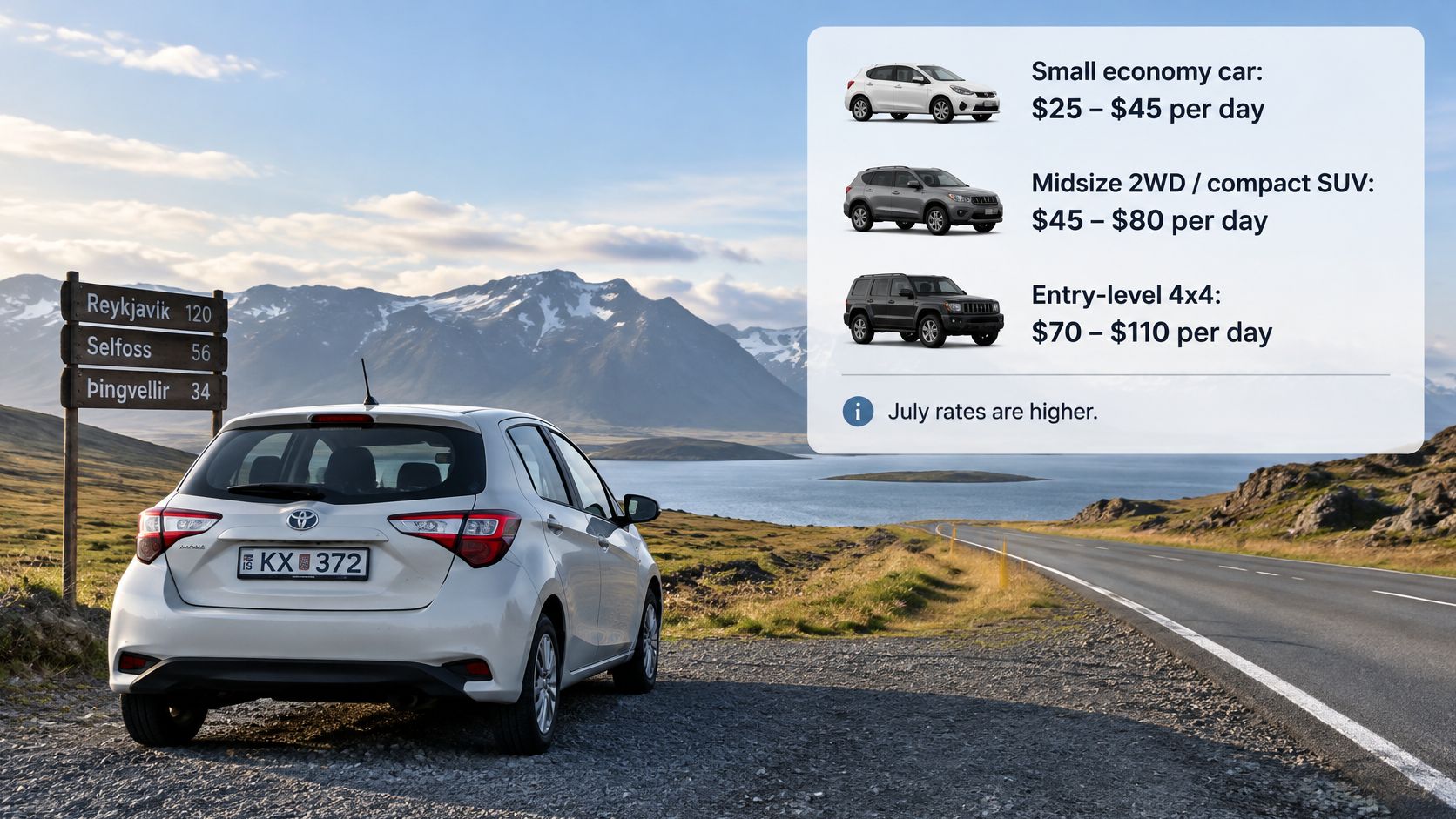
Start with the vehicle, then challenge the daily rate mindset. Blue Car Rental's guide to car hire costs gives indicative shoulder season prices of about €25 to €45 per day for a small economy car, €45 to €80 for a midsize 2WD or compact SUV, and €70 to €110 for an entry level 4x4, with July and August generally costing more. For a paved Ring Road week, most travelers land in one of the first two classes; the 4x4 only earns its premium once the route demands it.
Rental Car Classes and Indicative Daily Prices
| Vehicle class | Indicative daily price | Best for | Notes |
|---|---|---|---|
| Small economy car | 25 to 45 euros per day | Two travelers on paved summer routes | July and August cost more |
| Midsize 2WD or compact SUV | 45 to 80 euros per day | Extra luggage and comfort on longer days | Check the rental terms for gravel roads |
| Entry level 4x4 | 70 to 110 euros per day | F roads and highland routes | Needed where the route requires it |
Why Mileage Matters More Than the Daily Rate
A cheap daily rate on a thirsty vehicle driven a long way isn't cheap. The Discoveries Of Iceland cost guide notes that a compact camper typically consumes about 10 to 12 liters per 100 km, while a 4x4 uses approximately 11 to 14 liters per 100 km, and the Ring Road alone may require 130 to 190 liters before detours. Run the camper figure over a loop of roughly 1,300 to 1,500 km and you need about 150 to 180 liters, well above the 75 to 90 liters some shorter quotes imply.
Do the cost math at the pump price behind those shorter quotes. Paying about 22,000 to 30,000 ISK for 75 to 90 liters works out to roughly 290 to 330 ISK per liter. At that rate, 150 to 180 liters costs about 44,000 to 60,000 ISK in fuel for the trip. That's the corrected figure I'd carry into a seven day budget, and it's why the fuel line in any published daily estimate deserves a second look before you trust it.
The road charge is the newest variable. Iceland applies a distance-based road charge to driving, and rental companies pass it on in different ways: some bill per kilometer, others apply a flat daily amount to the invoice. Confirm which method your rental company uses and at what rate before you sign, because the better structure depends on your total distance. Per kilometer billing favors a short itinerary around the southwest, while a daily charge can suit a full loop where the kilometers stack up fast.
This short video shows what the driving distances and road conditions feel like once you're out there.
Picking the Right Vehicle
- Small car: Suits two people on paved summer routes with modest luggage.
- Compact SUV: Buys comfort and space, and burns more fuel doing it.
- 4x4: Needed once F roads or highland routes are on the plan, and priced accordingly.
Cutting detours saves more than switching rental companies, because every kilometer you drop reduces both the fuel bill and the road charge.
Price the trip by itinerary length and driving distance; the daily rate on a booking page is only the starting point. A campervan that looks cheaper can become the expensive option once fuel, mileage charges, campsite fees, and paid activities are included.
How Season Changes the Price of Your Trip
How much a trip to Iceland costs depends heavily on the month you travel, and a single annual average hides that decision. Reykjavik Tours research on tourists visiting Iceland reports that Reykjavik accommodation rates can roughly double between January and July, with rental car prices following a similar seasonal pattern, and that 2025 departures were spread across summer at 37.4%, spring and fall at 32.4%, and winter at 30.2%. Nearly two thirds of travelers, in other words, went outside the June to August peak.
How the Season Shifts Lodging, Car Costs and Driving Conditions
| Season | Lodging and car rental prices | Weather and daylight | Booking note |
|---|---|---|---|
| Winter (January to March) | Lowest, Reykjavik rates roughly half of July levels | Short days, snow and ice, possible road closures | Check road conditions daily before driving |
| Shoulder (April to May, September to October) | Mid-range, between the January floor and the July peak | Longer days than winter, changeable weather, some highland routes limited | Compare two dates to find the best rate |
| Summer (June to August) | Highest, accommodation roughly double January rates | Long days and open highland roads | Book lodging and car early |
Price Saving Versus Feasibility
Winter can cut hotel and car hire costs, but you trade money for constraints. Snow, ice, and short days compress what you can safely cover in a day, which pulls the total back down through fewer kilometers driven and less fuel burned. A cheaper week that loses two days to weather, though, isn't cheaper per day of actual travel.
Shoulder season is where I'd look first. Rates sit between the January floor and the July peak, daylight is workable, and most of the country stays accessible. Summer buys long days and open highland roads at the year's highest prices, and lodging near major sights fills early. If your dates are fixed in summer, book the room and the car before anything else, and use our guide to things to do in Iceland to decide which paid sights deserve a place in the budget.
One cost applies in every season. Hotels and guesthouses add a small accommodation tax per room per night on top of the room rate, and booking sites don't always display it the same way. Over seven nights it becomes a real line, and cheaper rooms feel it proportionally more. Check whether a quoted price already includes the tax before you compare two properties.
Price the same seven day route in two seasons before you book. The comparison takes an hour and can move the total more than any other single decision.
Connectivity, Activities and Hidden Extras
The extras that surprise first time visitors are rarely large. They're small, frequent, and easy to leave out of a spreadsheet. Group them by type and give each one a single practical action.
Mobile Data
You'll use your phone constantly in Iceland, for navigation between stops, road and weather checks, booking changes, and finding fuel in small towns. An eSIM installed before your flight avoids roaming charges and means you're connected when you land. I'd arrange a Simsima travel eSIM for Iceland before departure and confirm the plan you want on that page, since plan prices move and a figure quoted in an older article may be out of date. The Simsima app takes Apple Pay and Google Pay, which keeps checkout quick when you're buying from your phone. For a plain-terms look at setup and what to compare, our overview of eSIM choices for Iceland walks through the decision.
The same habit applies to any carrier or airline price you use while planning. Note the month and year you checked it, then confirm the current price on the official site before you pay. A screenshot from last season isn't a quote.
Activities
Activity prices vary by operator and season, so list the paid attractions and tours you want, check each price on the operator's site, and give activities their own budget line sized to that count. Free natural sights carry much of an Iceland trip, which means your activity total is mostly a choice, not a surprise.
A two-person week changes the math here. Tours priced per person double fast, so decide as a pair which experiences justify the cost and which stops stay free.
Extras to Budget For
- Tours and paid attractions: One line, sized to the number you've chosen.
- Parking where charged: Small per stop, real over a week of popular sights.
- The road use charge: Applies if your rental company bills a flat daily amount instead of charging per kilometer, so ask which method your quote uses before you compare totals.
- Fuel price gaps between stations: Self-serve pumps and staffed stations price differently, and filling up before you leave a larger town keeps both cost and risk lower on remote stretches.
- Accommodation tax: Charged per room per night at hotels and guesthouses.
- Souvenirs and shopping: Set a cap before you go, because wool goods and outdoor gear add up.
Build Your Own Iceland Budget Before You Book
A workable Iceland budget comes from five inputs, and you can price every one of them before you commit to dates. Run through the self drive steps in order: list your nights and lodging type, set a food figure, price the car class, estimate kilometers and fuel burn, then add a buffer. Three more items sit outside that table, and each one moves the total.
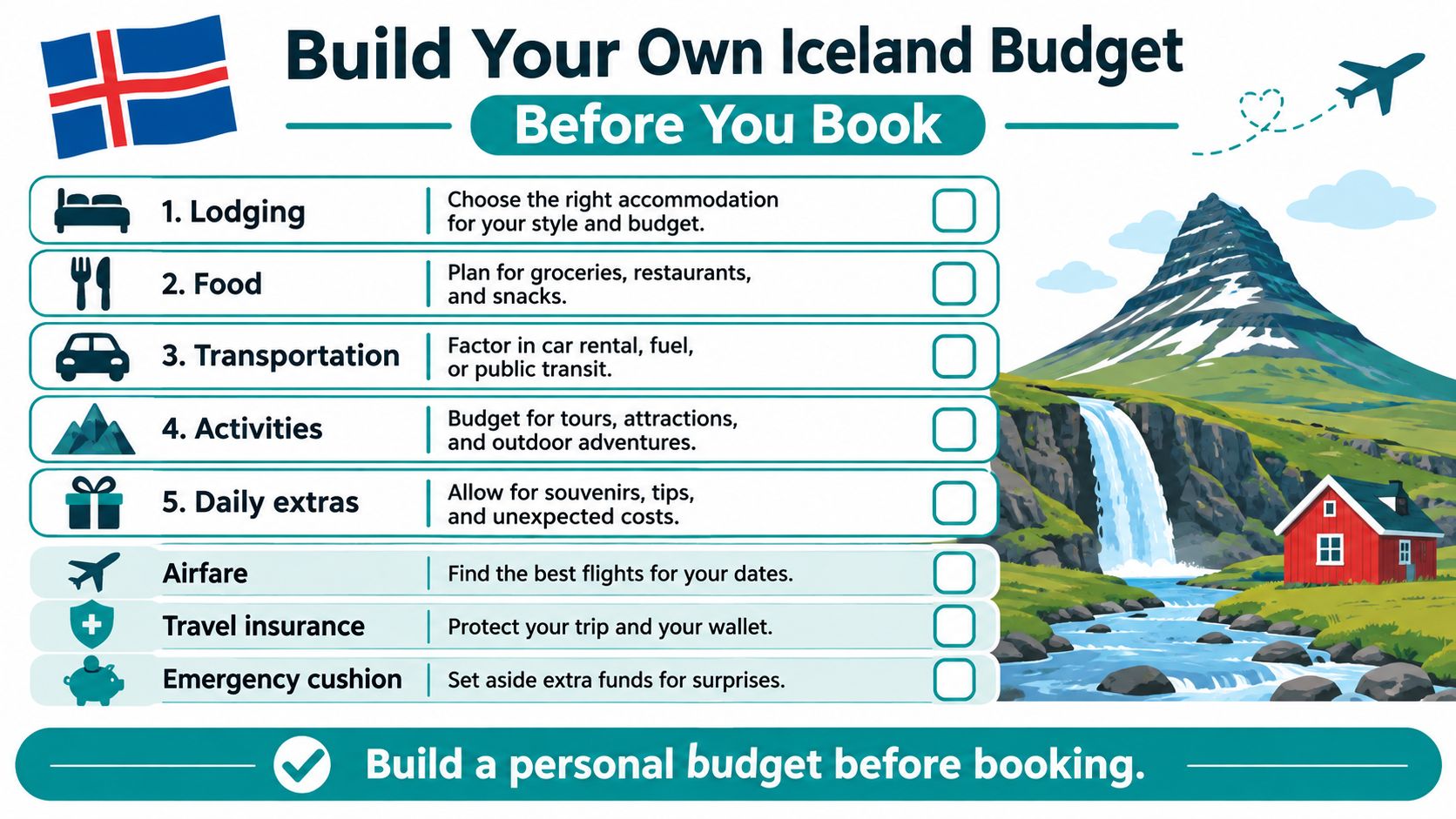
- Airfare: Fares swing with departure city, season, and booking window, so price your actual dates on airline sites rather than borrowing anyone else's number.
- Mobile data: Estimate what maps, bookings, and photo uploads will use with a data usage calculator, then set up the eSIM before you fly.
- Activities: Size the line to the number of paid sights you've picked, priced on operator sites.
Before you commit to dates, price the same route in two seasons. A structured worksheet helps here, and the Canadian travel budgeting guide for 2026 from Fintrack lays out a sensible framework for turning a trip wishlist into a monthly savings plan. Apply that discipline to Iceland and the seasonal difference becomes a number you can act on.
Show the result as two totals. The first is a two person week sharing a car and a room, where lodging and vehicle costs split in half. The second is a solo total, checked against the $700 to $1,200 per person estimate cited for a seven-day trip: that figure describes the whole stay, while your solo version carries the full car, fuel, and road charge bill alone. The gap between the two totals tells you how much of your budget is really a sharing assumption.
Then compare your total with what you can spend and pull one lever. Shorten the route to cut fuel and per kilometer road charges, shift dates to a cheaper season to cut lodging and car hire, or move from hotels to guesthouses to lower the nightly rate. Each lever works. Guessing doesn't.
Once your route, car, and rooms are priced, sort your mobile data before you fly so maps, road updates, and bookings work from the moment you land. Simsima offers prepaid travel eSIM plans you can install in advance without swapping a physical SIM, so you keep your regular number and skip roaming charges. Visit Simsima to pick an Iceland plan that matches your trip length and data needs.
#Iceland trip cost#Iceland travel budget#Iceland car rental#Iceland road trip#Iceland travel tips

Dimitri MorvanFounder
Founder of Simsima. A passionate traveler based in Barcelona, he helps travelers stay connected without breaking the bank on roaming fees.
LinkedIn