-5% on your 1st eSIMuntil October 31
Instagram is blocked on ordinary mainland China internet connections. The question is not whether you have installed the app, but which network you are using when you open it.
You can land in Shanghai, switch on hotel Wi-Fi, and watch the feed spin forever. That doesn't mean your account is broken. It means the connection path you're on can't reach Instagram, and that distinction is the whole game.
The Moment Instagram Stops Working in Mainland China
The first sign is boringly familiar. You clear immigration, connect to the hotel Wi-Fi, tap Instagram, and wait. The app may open, but the feed doesn't refresh, Stories stall, or nothing loads at all. That's the moment most travelers realize this is not an account problem, it's a connection problem.
A lot of people waste time reinstalling the app, checking passwords, or blaming their phone. That's the wrong diagnosis. Instagram is blocked on ordinary mainland China internet connections, so the issue sits in the network path, not your profile or device.
That changes what matters next. You need to decide which connection to trust, whether a VPN is worth the friction, and what local apps to install before you fly. If you wait until you're already in the arrivals hall, you may find the sites you need to set things up are already harder to reach.
Practical rule: if Instagram works on one connection and fails on another, the app isn't the problem. The network is.
A traveler who understands that difference stops troubleshooting the wrong thing. Install the app if you want, but don't confuse installation with access. The useful question is whether your SIM, eSIM, roaming plan, or Wi-Fi route can reach Instagram once you're on the ground.
How China's Great Firewall Blocks Instagram
The blocking happens at the network path. Your Instagram app can be installed and your account can be fine, yet the request still gets stopped before it reaches the service.
The route matters more than the app
A mailroom can reject the envelope even when the sender and contents are perfectly normal. That is how this works for travelers. Installing Instagram before you fly does nothing if the connection you use in China cannot carry the traffic.
The deciding factor is the route your phone takes. Hotel Wi-Fi, local mobile data, and most ordinary domestic networks are all poor bets for Instagram in mainland China. The app may open, the login screen may appear, and the feed can still stall when it tries to refresh.
What a normal app block looks like
A standard app block usually means the service itself is removed or disabled on the platform side. Instagram in mainland China is handled differently. The app can stay on your device while the traffic it needs is filtered at the network boundary. That is why this is a connectivity planning problem, not an account troubleshooting problem.
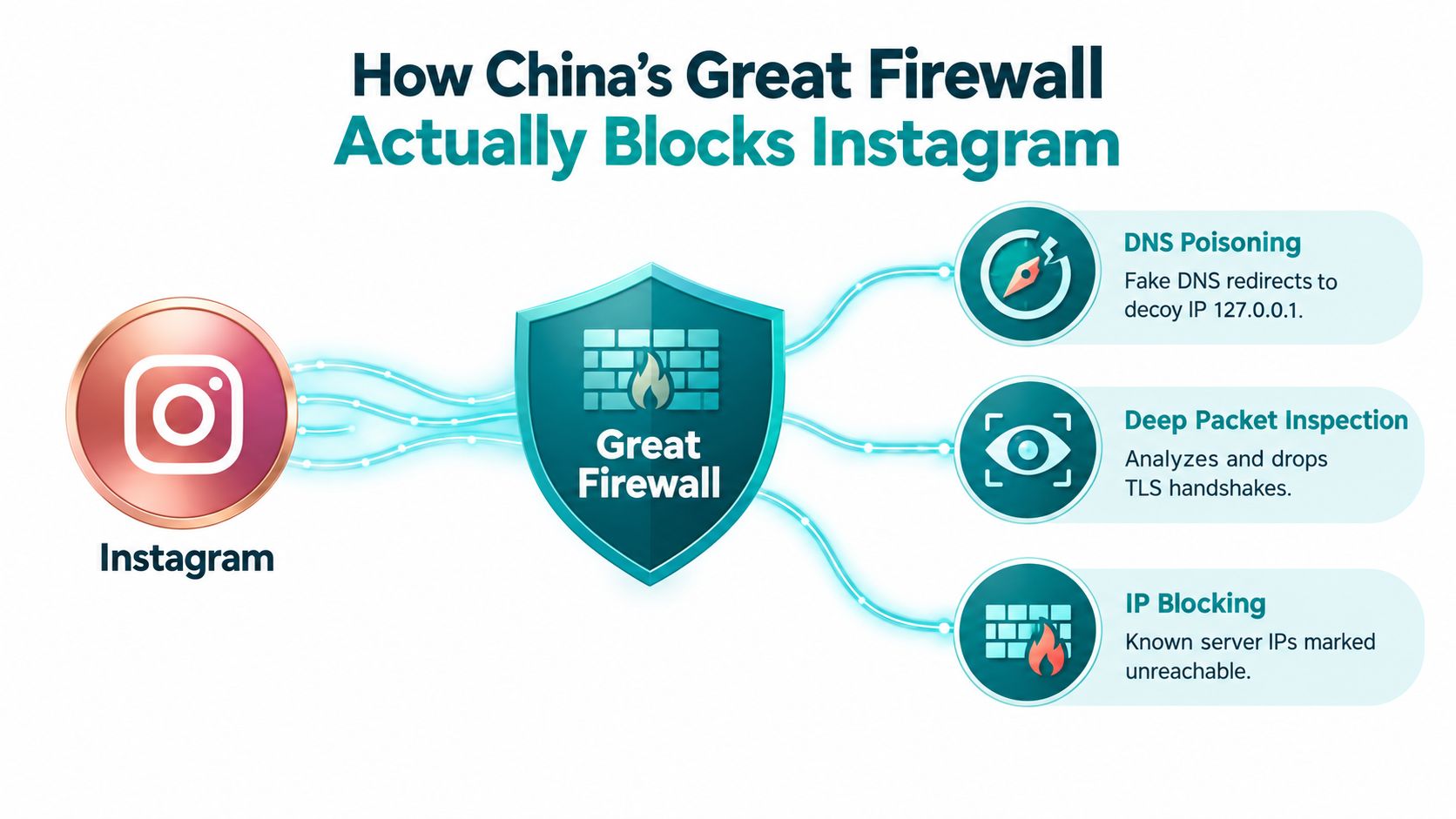
The mechanics are straightforward. The Great Firewall can interfere with DNS lookups, inspect traffic patterns, and block IP addresses that belong to services it wants to stop. For a traveler, the practical result is simple: one SIM may fail, another may work differently, and hotel Wi-Fi may fail outright. If you are asking is Instagram allowed in China, the answer depends on the connection you choose.
The 2014 Block and Why It Has Stuck
Instagram's mainland block didn't appear out of nowhere. Reuters reported that access was restricted across mainland China in September 2014, during the Hong Kong pro-democracy demonstrations, after users circulated protest photos and videos, including images of police deploying tear gas. The timing mattered, because visual content was moving too quickly for domestic controls to catch up. Reuters reported the mainland restriction and the protest context.
Why this wasn't a temporary glitch
The same reporting tied the restriction to the rapid spread of protest-related material, and the hashtag “Occupy Central” was also blocked on Weibo after having been searchable earlier that day. Instagram stayed available in Hong Kong, which meant the restriction was about mainland filtering, not a universal shutdown everywhere in the Chinese sphere. That distinction still matters for travelers today because it explains why borders and networks don't behave the same way.
The block also put Instagram in the same family as other blocked foreign services. Once a platform lands on that list, it tends to stay there unless the broader filtering posture changes. There's no public signal that ordinary mainland access is about to return, so hoping it will “sort itself out” isn't a plan.
A traveler should treat the block as durable, not seasonal. If you need Instagram in mainland China, you prepare for it before boarding. If you don't, you'll spend your first evening figuring out why the feed is dead while everyone else is ordering dinner on local apps.
Instagram didn't break in China. It was cut off, and the cut has stayed in place.
Mainland China Versus Hong Kong and Macau
That's where most travel guides get sloppy. They say “China” as if it's one digital zone, then leave you guessing once you cross a border or land in a different jurisdiction. For Instagram, that shorthand is wrong in the only way that matters to you.
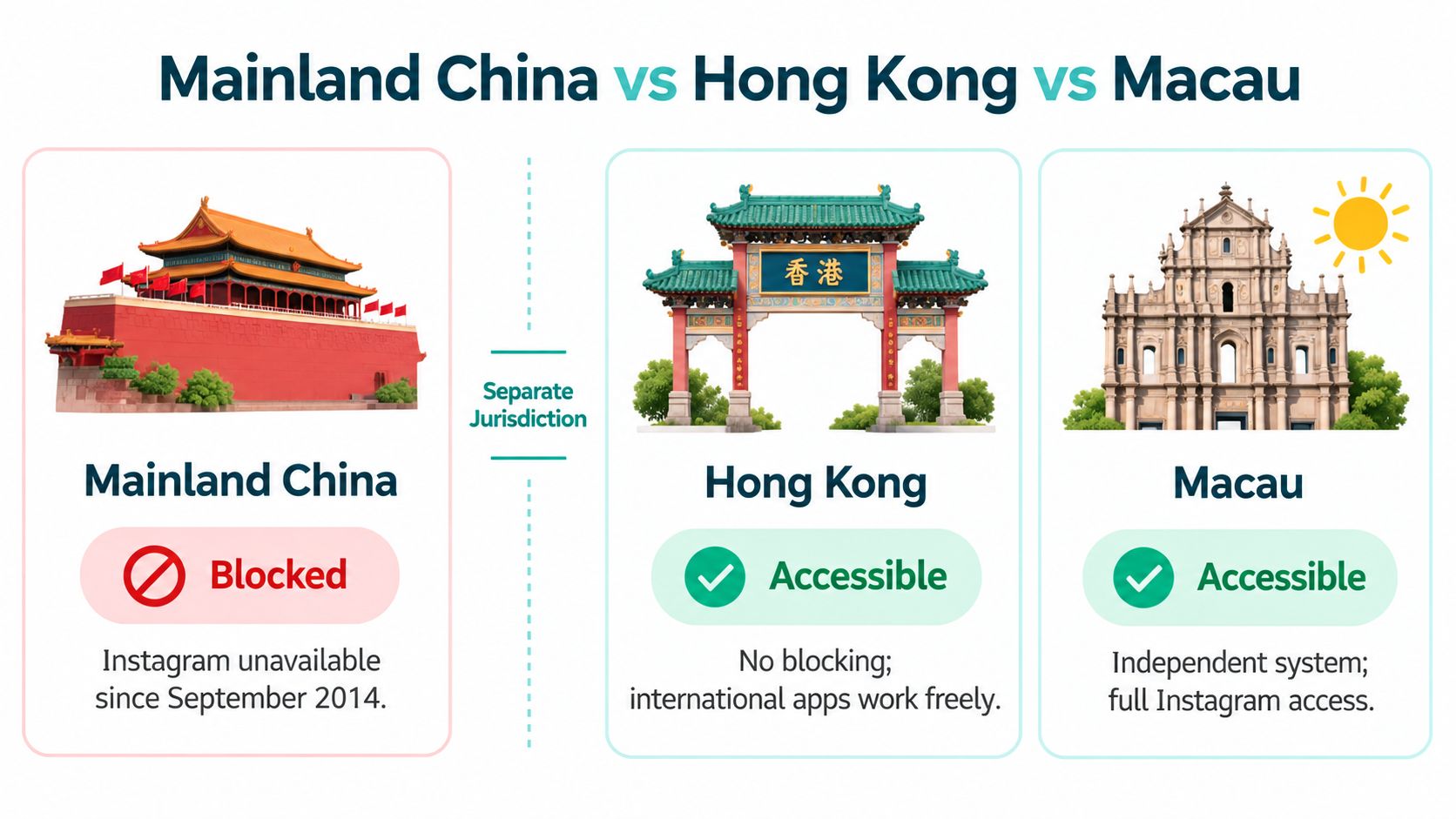
Mainland China is the blocked zone. Hong Kong has historically remained accessible, and Macau has also remained accessible. That means a traveler can be on one side of a trip and post normally, then cross into the mainland and lose the feed immediately.
Why that matters for routing
If you're flying through Hong Kong, taking a cruise, or adding a stopover, don't assume your mainland experience will match your first leg. A mainland Chinese visa doesn't automatically tell you anything useful about how Instagram will behave in Hong Kong or Macau. The digital rules diverge even when the borders feel smooth in the airport.
For practical planning, that's enough to change your itinerary choices. If you need to upload content, check DMs, or keep a brand account alive, the safest assumption is that Hong Kong and Macau are not the same problem as mainland China. Treat them separately, because the network does.
If you're looking for nearby connectivity planning, the same logic that applies to Instagram also applies to local data choices. A useful reference for Hong Kong trip planning is this guide on the best eSIM for Hong Kong, since the region follows a different access pattern from the mainland.
Your Real Options for Reaching Instagram in China
The question isn't “Can I install Instagram?” The question is “Which connection path will reach it?” That's the decision travelers need to make, and the honest answer is that some paths are much more dependable than others.
The options, ranked by how much friction they cause
International roaming on your home SIM usually works because the traffic exits through your home carrier before hitting mainland filtering. A travel eSIM can do the same thing if it routes through a non-mainland carrier. A VPN can help on mainland networks, but reliability changes, setup can be fiddly, and it's the option most likely to frustrate you at the worst moment. A local Chinese SIM is fine for local services, but it won't make Instagram usable on its own.
| Connection type | Setup before trip | Reliability for Instagram | Typical trade-off |
|---|---|---|---|
| International roaming on home SIM | Yes | Strong | Can be expensive |
| Travel eSIM routed outside the mainland | Yes | Strong | Requires an eSIM-compatible phone |
| VPN over mainland Wi-Fi or local SIM | Yes, ideally | Mixed | Setup friction and variable reliability |
| Local Chinese SIM only | No special setup | Poor | Good for local apps, not for Instagram |
A lot of travelers also confuse account access with network access. They're not the same thing. If the route can't leave the mainland filtering layer, your login screen won't save you.
That's why a travel eSIM is often easier to live with than a VPN. It changes the network path before you ever touch the app. If you want to understand the mechanics of a routed connection, the best analogy is the way what residential proxies do, where the traffic exits through a different visible path instead of trying to force its way through the blocked one.
If you want a single practical place to buy data before you land, Simsima offers travel eSIMs for many destinations, including China, and the point is simple, it gives you a data path that can be set up before arrival instead of hoping hotel Wi-Fi cooperates.
For travelers comparing workarounds, a useful starting point is this guide to the best VPN for China, because it helps you think about backup access without pretending every option is equally smooth.
VPN Legality Without the Panic or the Reassurance
The VPN question gets mangled online because people want a clean yes or no. That's not how reality works. China requires VPN services to be government-approved, and unauthorized providers can face regulatory action. At the same time, travel guidance commonly treats individual foreign tourist use as a gray area rather than a guaranteed crackdown.
Separate the rule from the experience
That distinction matters. A rule on paper is not the same thing as what a traveler will encounter at the border or in a hotel room. You should not assume personal use is officially blessed, and you also shouldn't assume every foreign visitor gets stopped for checking messages. The uncertainty is operational, not theoretical.
The bigger problem is reliability. Filtering systems change, VPN websites can be hard to reach from mainland networks, and not every service survives long enough to be useful on a given trip. So no, I wouldn't plan a trip around “I'll just grab any VPN when I land.” That's exactly how people lose the first afternoon to setup problems.
Bottom line: a VPN can be a backup, but it's not the one thing I'd bet my trip on.
Use a VPN only if you've already tested it before departure and you understand that it may stop working or behave inconsistently. If Instagram matters to your trip, a connectivity path that doesn't depend on last-minute problem solving is the smarter move.
A Pre-Trip Checklist and Local Apps Worth Installing
The night before a flight is when you fix this problem. Not in the taxi from the airport, not after baggage claim, and definitely not after you discover the VPN site won't load on the hotel Wi-Fi. Prepare while your home connection still works.
What to do before boarding
- Download and test a VPN now. Don't wait until you land to find out whether it connects on your phone. If it's going to be part of your plan, verify it at home first.
- Install WeChat. It's the local communication layer most travelers end up needing anyway, especially for messages and day-to-day coordination.
- Set up offline maps in Amap or Baidu Maps. You don't want to rely on a blocked service for getting around a city you've never visited.
- Pre-load a translation app. Hotel staff, drivers, and restaurant menus won't wait while you troubleshoot connectivity.
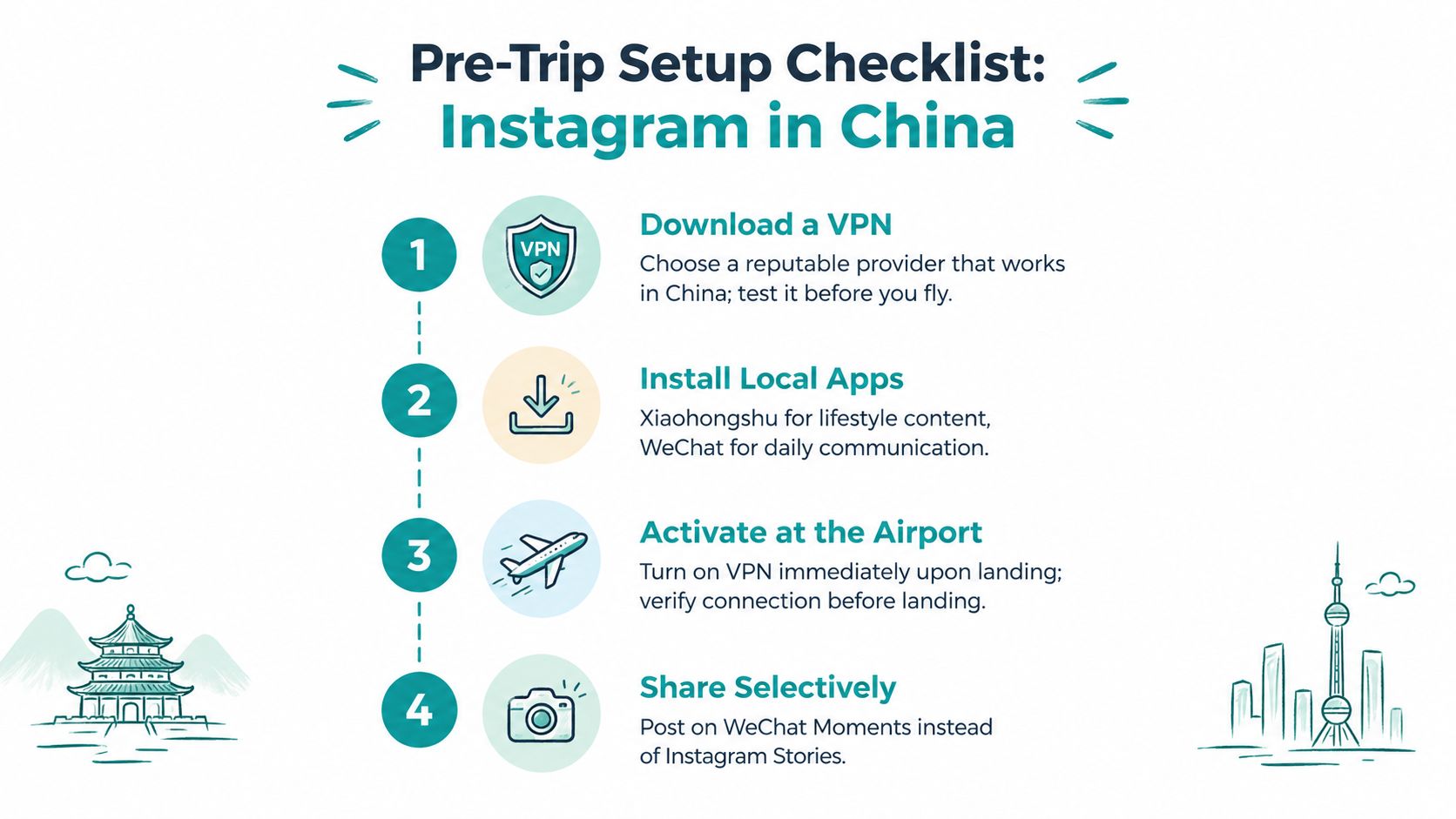
Some of these are hard to sort out after landing because the websites and app listings you'd normally use can be awkward to reach on mainland networks. That's why the prep has to happen before departure, not once you're already dependent on airport Wi-Fi.
If you're using a travel eSIM, install it before you fly so the phone is ready the moment you land. The point of a routed connection is that it removes the need to scramble for a workaround later. If you want a clean setup guide, use this note on how to activate eSIM before travel so the data line is live before your plane touches down.
What locals and travelers actually use
WeChat fills a lot of the gap for everyday communication. Xiaohongshu is often the local substitute people reach for when they want lifestyle or discovery content. That doesn't replace Instagram, but it does keep you functional while your Instagram connection depends on the network you chose.
What to Remember at the Airport
Here's the part worth carrying into the arrivals hall. Instagram is blocked on ordinary mainland networks, so the app itself isn't your problem, the connection is. Hong Kong and Macau have historically followed different rules, so don't treat them like the mainland.
If Instagram matters on day one, install and test your VPN before you fly, or use a travel eSIM or roaming path that exits outside the mainland. Don't assume hotel Wi-Fi will behave, and don't plan to solve this after landing. Also, install WeChat now, because that's the app you'll use when Instagram isn't cooperating.
The clean mental model is simple. App installed doesn't mean app reachable. Once you remember that, you stop guessing and start choosing the right network.
Simsima helps travelers set up mobile data before they land, which is exactly the kind of planning this trip needs. If you want to avoid the dead-feed surprise and keep your connection sorted in advance, visit Simsima and check the eSIM options before your flight.
#instagram in china#great firewall#china vpn#travel esim china#blocked apps china

Dimitri MorvanFounder
Founder of Simsima. A passionate traveler based in Barcelona, he helps travelers stay connected without breaking the bank on roaming fees.
LinkedIn