-5% on your 1st eSIMuntil October 31
You're staring at a map of Ireland, one hand over Dublin and the other hovering between Donegal, Kerry, and Belfast. Two weeks sounds generous until you start adding the Wild Atlantic Way, the Causeway Coast, ancient sites, and the time it takes to collect a car, find parking, and wind through narrow rural roads. The first decision isn't where to go. It's what to leave out.
A 2-week Ireland itinerary works best when you treat it as a paced journey rather than a checklist. Ireland's foreign visitors stayed an average of 7.9 nights in July 2025 and 8.6 nights in August 2025, according to the Central Statistics Office. Fourteen days gives you more room than the typical peak-season visit, but not enough to sleep somewhere new every night and still enjoy the country.
Planning a 2 Weeks in Ireland Trip That Actually Works
The planning rule I'd use after driving the Irish loop twice is simple: choose five or six base regions, give the important ones two nights, and keep daily driving below roughly three hours whenever the route includes coastal roads. You can cover a great deal of Ireland in fourteen days, but you can't experience Dublin, Galway, Kerry, Donegal, Belfast, and every scenic peninsula at full depth.
That's where first-time itineraries go wrong. They treat the map as if every line represents a fast motorway, then discover that a short-looking coastal leg can consume most of a day once you stop for viewpoints, sheep, ruins, weather, and lunch. A route that looks efficient on paper can leave you arriving at your accommodation too late to enjoy the town you chose.

Make the big decisions first
Start with four choices:
- Route direction: Clockwise is my default recommendation for first-time drivers who want Northern Ireland. Counterclockwise makes the early days gentler if you're tired after a long flight.
- Northern Ireland or more time in the Republic: The Causeway Coast is visually distinctive, but including it creates a longer loop and more border logistics. Skipping it gives you extra space for Kerry, Connemara, or the Burren.
- Car or no car: A car opens up peninsulas, small beaches, mountain roads, and impromptu stops. A no-car route works better when you accept that some remote areas need organised tours.
- Season: Ireland's tourism demand is strongly seasonal. Forty-two percent of overseas arrivals are concentrated between June and September, according to Fáilte Ireland's Business of Tourism report.
Ireland is a mature destination with recurring visitor demand. The country received just over 6.4 million overseas overnight visitors in 2025, so summer accommodation and transport pressure aren't unusual surprises. They're part of the planning environment.
My rule: Two nights in one good base is worth more than two extra attractions reached through a rushed transfer.
If you're travelling with children, use these family travel destination tips to shape the pace around breaks, food, and shorter sightseeing blocks. For everyone else, make the same adjustment: cut one region before you cut sleep.
Three 14-Day Route Options for Ireland
There are three sensible ways to structure fourteen days. I wouldn't try to combine pieces from all three unless you're happy to spend the trip checking in and out.
The clockwise all-island loop runs from Dublin to the Boyne Valley, Belfast, the Causeway Coast, Donegal, Galway, the Burren, Kerry, and back through the south or midlands. It gives you the most variety, especially if dramatic northern coastlines matter to you. Its weakness is the extra one-night stops and the temptation to turn long transfers into sightseeing marathons.
The counterclockwise all-island loop sends you from Dublin toward Cork and Kerry first, then west to Galway and north toward Donegal and Belfast. I prefer this for travellers arriving after an overnight flight because the first regional move can be relatively straightforward, while the most demanding scenic drives come once you've settled into the car.
The Republic-only loop replaces Belfast and the Causeway Coast with deeper time in Kerry, Connemara, Sligo, the Burren, or Cork. It's the best route for slow travellers and the one I'd choose if scenery, walks, pubs, and small towns matter more than collecting another country border.
| Route Option | Total Drive Time | One-Night Stops | Est. Fuel + Tolls | Best For |
|---|---|---|---|---|
| Clockwise all-island loop | Highest, with a long northern arc | Several | Highest of the three | First-timers, photographers, Northern Ireland highlights |
| Counterclockwise all-island loop | High, with the longest transfer near the end | Several | High | Travellers easing into driving after arrival |
| Republic-only loop | Moderate to high, depending on Kerry and Donegal choices | Fewer | Moderate | Families, slow travellers, deeper west-coast time |
These are planning comparisons rather than fixed quotations. Your total changes with airport, car type, parking, fuel prices, detours, and whether you return the car in the same place.
Pick according to your travel style
Photographers should choose clockwise in the brighter summer months if the Causeway Coast is a must. The longer northern daylight makes early starts and late golden-hour stops more practical, but you'll need to protect time for weather delays.
Families should choose the Republic-only loop unless everyone is enthusiastic about long drives. Two nights in Killarney, Galway, or Connemara will feel more rewarding than squeezing in Belfast and a northern transfer.
Slow travellers should skip Northern Ireland on this trip. You'll lose the Causeway Coast, but you'll gain the freedom to wait for clear weather, linger over the Slea Head Drive, or take an extra walk in Connemara.
The no-car version deserves equal respect. Independent itinerary guidance notes that a full-island loop is possible in two weeks, but remote regions can be frustrating without a car, making day tours a practical substitute for some areas. That trade-off is covered in this guide to planning a multi-destination trip. My verdict is clear: choose clockwise for variety, counterclockwise for a softer start, and Republic-only for the best overall pace.
Day-by-Day Itinerary for the Classic Loop
This is the route I'd give a friend who wants Dublin, Northern Ireland, the west coast, Kerry, and a proper return to Dublin without changing hotels every night. It's still ambitious. Protect the two-night bases and don't treat the long transfer days as normal sightseeing days.
Days 1 and 2 in Dublin
Arrive in Dublin and don't collect the rental car immediately if you're staying in the city. Use the first day for a gentle walk, a museum, Trinity College, or an early dinner. Driving on the left while jet-lagged, then navigating city traffic, is a poor introduction to Ireland.
Use the second day for Dublin's central sights. Keep the itinerary loose because the city is better explored on foot than attacked as a list. Stay near the route you'll use to leave the city, or plan to collect the car on the morning you depart.
Day 3 from Dublin through the Boyne Valley to Belfast
Leave Dublin early and head toward the Boyne Valley. Brú na Bóinne is the anchor stop if ancient sites interest you, and it deserves advance planning rather than a casual drive-by. Continue to Belfast for the night.
This is a useful transition day because it combines history with a manageable change of base. Don't add a long detour into the Wicklow Mountains here. Wicklow is excellent, but it belongs in a Republic-only itinerary or a slower southern loop.
Day 4 on the Causeway Coast
Use Belfast as your starting point, then follow the coast toward the Giant's Causeway. Build the day around the coastline rather than treating each attraction as mandatory. The Giant's Causeway, Carrick-a-Rede, Dunluce Castle, and the Dark Hedges can fill the day quickly.
Stay near Bushmills, Portrush, or another coastal base. That gives you a chance to see the major geological sites before or after the busiest arrival periods, rather than driving back to Belfast after dark.
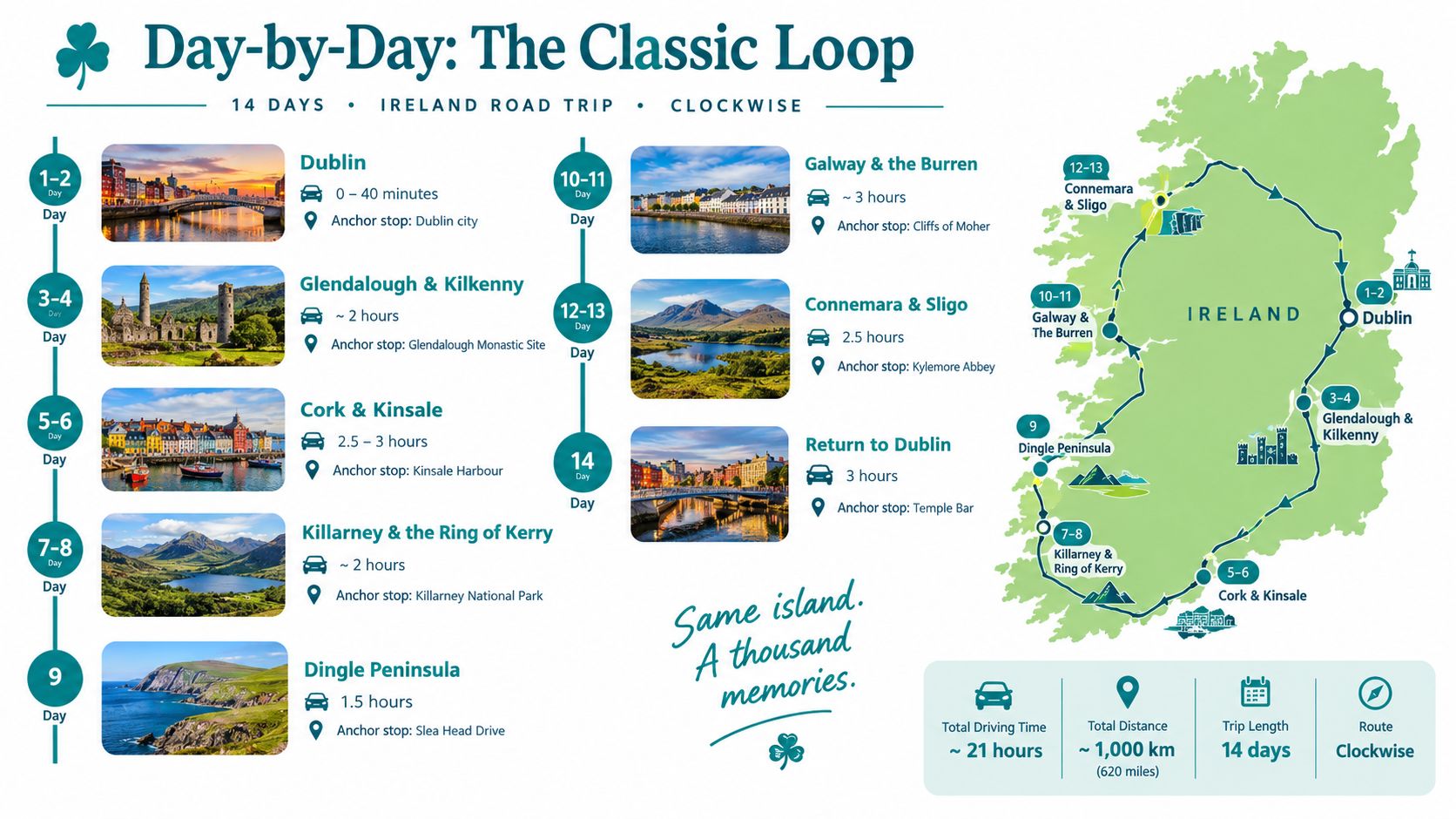
Day 5 toward Donegal
This is one of the longer transfer days. Drive west toward Donegal and resist the temptation to add every viewpoint on the way. The reward is a quieter, wilder region that feels different from the Causeway Coast.
Stay in or near Donegal town, depending on whether you want a restaurant base or a rural setting. If you're already tired, make the town your priority and save the scenery for the following morning.
Day 6 at Slieve League
Spend the day around Slieve League and the surrounding coast. The cliffs are the main reason to come this far, but the road experience and open Atlantic scenery are just as important. Leave room for walking, weather changes, and a slow lunch.
This is exactly why I don't recommend squeezing Donegal into a single overnight stop if it's central to your trip. The long drive to reach it is only worthwhile when you give the region enough time to breathe.
Day 7 in Sligo or Yeats Country
Move south toward Sligo and use the day to explore Yeats Country, a beach, a short walk, or a scenic inland route. Sligo makes a practical overnight base between Donegal and Galway.
Keep this day flexible. If Donegal weather has been poor, use the clearer part of the day there and arrive in Sligo later. A rigid schedule is especially fragile on the Atlantic coast.
Days 8 and 9 in Galway and Connemara
Settle into Galway for two nights. Spend one day in the city, then choose between a Connemara excursion and the Aran Islands. Don't attempt both in one day.
Galway works best as a base rather than a box to tick. Walk the centre, eat early, and book dinner on busy weekends. For a quieter alternative, stay outside the city and use Galway as a daytime visit.
Day 10 through the Burren and the Cliffs of Moher to Doolin
Leave Galway through the Burren and continue toward the Cliffs of Moher. The limestone terrain is the point, so take the slower route where conditions allow. Stop at the cliffs, then sleep in Doolin rather than rushing onward to Kerry.
This is a full day, but the driving itself isn't the only issue. Wind, visibility, walks, and queues can alter the rhythm. Doolin gives you a better evening and an easier start for the next leg.
Days 11 and 12 in Dingle
Drive toward Dingle and give yourself two nights. The Slea Head Drive deserves a dedicated day, with stops for beehive huts, beaches, archaeological sites, and viewpoints. The drive from Dingle to Killarney is relatively short, so there's no reason to leave the peninsula prematurely.
Dingle is one of the best places on this route for an evening. Reserve dinner on weekends and leave time for music, harbour walks, and the simple pleasure of not getting back into the car.
Day 13 in Killarney
Move to Killarney and spend the day in or around the national park. Choose the Ring of Kerry, the Gap of Dunloe, or a shorter park walk. Trying to complete every nearby attraction will turn a beautiful day into a parking exercise.
Killarney is also a sensible place to adjust the route. If bad weather has disrupted the west coast, use the area as a recovery base. If everything has gone smoothly, enjoy the scenery without adding another ambitious detour.
Day 14 through the south toward Dublin
If your flight is the following day, drive toward Dublin and stay near the airport. Depending on your energy and flight time, choose one stop such as Kilkenny, the Rock of Cashel, or a brief visit to Cork or Kinsale. Don't attempt all three.
This is the day to return the car, check fuel and toll arrangements, and remove the stress from departure morning. The itinerary works because the final night is practical, not glamorous.
Getting Around Ireland Without Losing a Day
A rental car is the right tool for the classic loop, but it isn't automatically the right choice for every traveller. It gives you access to the Wild Atlantic Way and lets you stop at ruins, beaches, viewpoints, and villages that public transport doesn't connect efficiently. It also makes you responsible for narrow roads, left-side driving, parking, tolls, and long transfers.
A train is more comfortable between major cities. Dublin to Galway is a straightforward rail journey, while the bus can be slower but useful when the timetable or destination suits. Neither option replaces a car on the most scenic peninsulas, so combine rail with organised day tours instead of pretending the entire west coast works like a city network.
| Option | 14-Day Cost Per Person | Flexibility | Best For |
|---|---|---|---|
| Rental car | Variable, often lower per person when shared | Highest | Three or more travellers, photographers, families |
| Public bus | Variable, generally budget-oriented | Limited on rural legs | Strictly budget-conscious travellers |
| Train plus local transport | Variable, efficient between major hubs | Moderate | Solo travellers and first-time visitors |
| Guided day tours | Variable by region and operator | Low, but simple | No-car travellers targeting major sights |
The car makes sense for a clockwise or Republic-only loop when at least three people can share the vehicle. Rent the smallest automatic that fits your luggage. American travellers often prefer automatic transmission, but it usually costs more and availability can tighten during peak periods.
Check whether your licence is accepted before booking. US and UK licences are commonly usable, although some suppliers may require an International Driving Permit. Insurance deserves equal attention. Excess-reduction cover can materially change the rental price, but declining it without understanding the liability terms is a false saving.
Choose transport by region
Use trains for Dublin, Cork, Galway, Limerick, and other major hubs. Use buses where they connect your specific towns well. Use day tours for remote attractions when the alternative is spending a full day managing transfers.
A no-car itinerary should be designed around bases, not around a map of every famous place. Dublin and Galway are the easiest anchors for organised excursions, while Kerry can work with a mixture of local transport and tours. Donegal and Connemara require more care, so decide whether the region is worth the logistical compromise before booking accommodation.
Practical rule: If a transport option saves navigation but removes the coastal stop you travelled for, it isn't saving time. It's changing the trip.
Budget Breakdown for 14 Days in Ireland
Ireland's cost problem isn't one spectacular expense. It's the accumulation of accommodation, parking, meals, fuel, admissions, and last-minute changes when a scenic day runs long. A two-week stay is long enough for one expensive region to affect the whole trip, especially when you're booking in peak summer.
Accommodation should drive the first budget decision. Hostels suit solo travellers who accept shared facilities. B&Bs can be a strong middle ground, while hotels are easiest for families and travellers who want predictable parking and reception hours. Rural properties may look cheaper until you add the cost of reaching them and eating away from a town.
| Profile | Accommodation | Transport | Food and Activities | Total Per Person |
|---|---|---|---|---|
| Backpacker | Hostels and occasional budget rooms | Bus, selected trains, limited tours | Groceries, casual meals, selected admissions | Lowest |
| Solo mid-range | B&Bs or simple hotels | Rail, buses, and organised tours | Regular restaurant meals and paid sights | High because costs aren't shared |
| Couple with car | Shared hotels or B&Bs | Rental car, fuel, tolls, parking | Mixed dining and regional attractions | Moderate to high |
| Family with car | Family rooms or apartments | Rental car and parking | Meals, attractions, and flexibility costs | Highest total, lower per person than solo travel |
The hidden costs catch people out. Heritage sites, castle admissions, distillery visits, parking in cities, and single-room supplements can all push the final total above the initial booking estimate. A solo traveller also carries the full cost of the car and room, while a couple can divide those expenses.
Peak summer puts further pressure on accommodation. The Ireland tourism market report from Fáilte Ireland describes a market where visitor demand is concentrated into the warmer months, while February 2025 saw overseas visitors, overnight stays, and spending fall sharply compared with the previous year. That's why the same route can feel financially different outside summer.
Keep the budget under control
Book the expensive nights first, especially in Galway, Dingle, Killarney, and the Causeway Coast. Choose one or two paid headline attractions, then fill the rest of the itinerary with walks, viewpoints, public scenery, town exploring, and historic places that don't require a major ticket.
For a realistic self-check, ask three questions before booking:
- Are you paying for a car on days it sits outside a city hotel? If so, delay collection or return it before Dublin.
- Are you changing base because the map looks empty? A second night is often cheaper than an extra transfer.
- Are you treating every meal as a restaurant meal? Mix cafés, pubs, supermarkets, and accommodation breakfasts.
My opinionated budget advice is to spend on location, not luxury. A modest room near Dingle or Killarney can save more time and transport hassle than an upgraded room in a distant town.
Best Time to Visit and Seasonal Trade-Offs
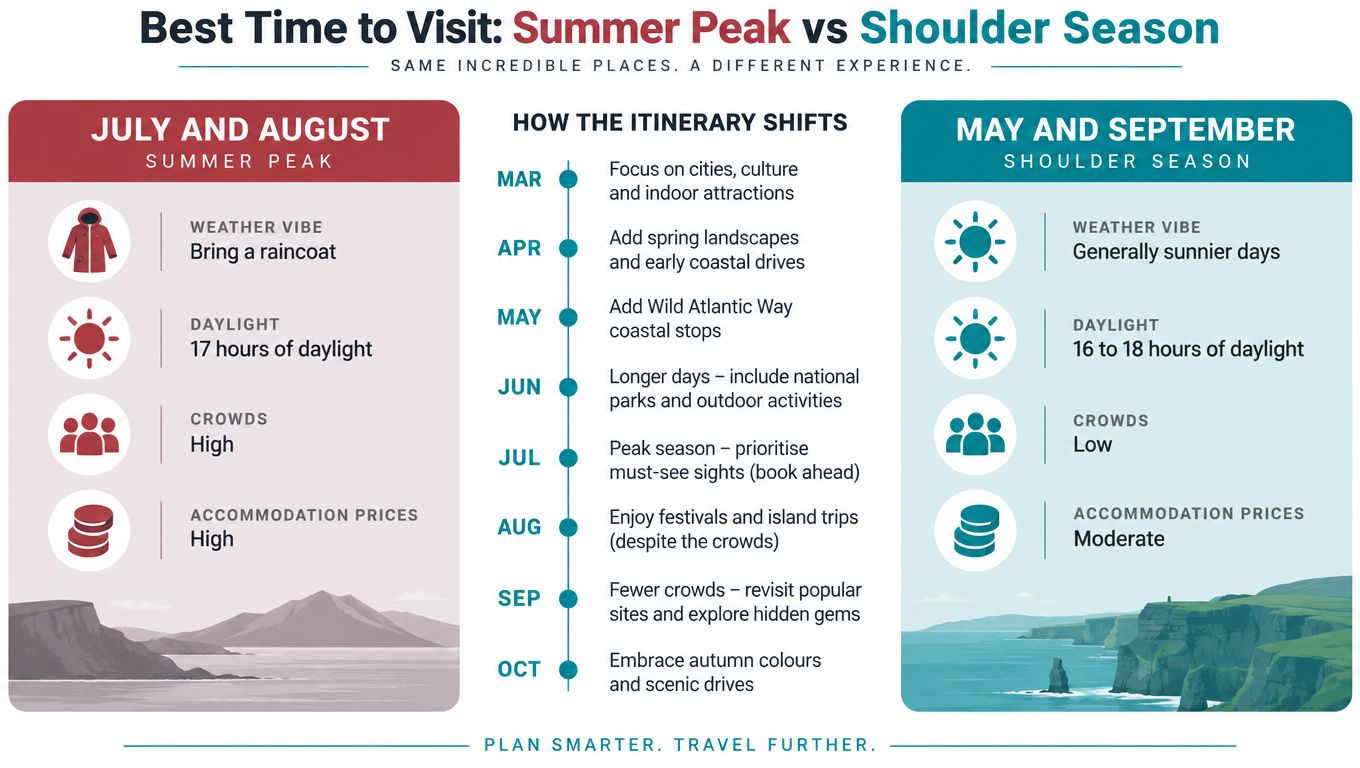
July and August are not automatically the best months for Ireland. They offer long days and a lively atmosphere, but they also bring the strongest demand, fuller car parks, tighter accommodation availability, and more pressure on the famous sights.
The smarter choice for most first-timers is May or September. You still have enough daylight for scenic drives, while the route generally feels less compressed than it does at the height of summer. Shoulder season also makes it easier to find a good base rather than accepting whatever room remains.
Match the month to the route
May is ideal for a car-based first visit. Put more emphasis on the Wild Atlantic Way, Connemara, and Kerry, while keeping a weather backup for outdoor days.
June suits families tied to school schedules and travellers who want long days without making every stop at peak summer intensity. Use the extra light for scenic drives, not for adding another region.
July and August work for travellers who need the most predictable access to seasonal attractions, but book accommodation well ahead and expect popular stops to demand patience. The Central Statistics Office's summer inbound tourism figures show how much visitor spending and overnight activity concentrates in these months.
September is my favourite compromise. Keep the same route as a summer trip, but leave room for strong Atlantic weather and earlier evenings toward the end of the month.
March and April can be rewarding when you're flexible. Use towns, historic sites, and shorter walks as anchors, then let clear weather determine the coastal drives.
November through February requires a different itinerary. Shorter daylight, seasonal closures, and weather-related ferry disruption make the Aran Islands and remote coastlines less dependable. Dublin, Galway, Cork, museums, pubs, and dramatic storm watching become more important.
Photographer's choice: Take the shoulder-season route and keep one flexible west-coast day. A clear morning is worth more than a rigid promise to visit a landmark in poor visibility.
Surfers and nature photographers should favour the shoulder months, when the Atlantic has more personality and the itinerary doesn't need to revolve around peak-season crowds. Families should choose the school-holiday window only if the longer days and open seasonal attractions justify the added pressure.
Connectivity, Packing, and Local Logistics
The small practical decisions determine whether Ireland feels effortless or irritating. Set up mobile data before landing, download the island for offline navigation, and assume that rural connectivity will vary by operator and terrain.
ComReg reports that 99% of households have outdoor 3G coverage and 97% have access to 4G, while a national operator reports 99.9% population coverage and 99% 5G coverage in its own figures. Those headlines don't guarantee identical service on every coastal road, so keep your phone on automatic network selection and make sure your plan can fall back to 4G or 3G. The ComReg connectivity report is the useful reference point for understanding why national coverage figures don't equal uninterrupted rural service.
For a moderate two-week trip, plan around 15 to 30 GB of data, then increase that allowance if you'll work remotely or use hotspotting. ComReg's Q1 2026 market data reports average Irish mobile use of about 21 GB per user, but that reflects local subscribers rather than tourists navigating unfamiliar roads and uploading travel photos. The same report shows that 4G accounted for 34.67% of mobile subscriptions and 5G for 29.28% at that point, which is another reason not to plan around 5G alone. See the ComReg quarterly key data report before you choose a data plan.
Set up your phone before the flight
Install your eSIM while you still have reliable Wi-Fi, but keep your home line available for authentication texts if needed. Download Google Maps offline for the whole island, save accommodation addresses, and store ferry, tour, and booking confirmations in your phone's offline files.
A local roaming plan from Three UK, Vodafone, or eir may suit some visitors. An Ireland or Europe eSIM is more convenient for travellers who don't want to swap a physical SIM. Simsima's guide to Ireland eSIM options is useful for comparing the setup before departure. Simsima offers prepaid data plans for Ireland and Europe, delivered digitally for compatible devices.
Keep data usage under control by downloading maps, playlists, and media during the first day. Avoid automatic cloud photo backups over mobile data, and use accommodation Wi-Fi for large uploads. If you'll be working, test hotspotting before you depend on it for a meeting.
Pack for roads, rain, and walking
Bring fewer clothes and better layers. You'll want:
- A waterproof shell: A proper rain jacket is more useful than a heavy coat.
- Two pairs of walking shoes: Alternate them when one pair gets soaked.
- Merino or quick-drying socks: Cold, wet feet can ruin an otherwise excellent day.
- A warm mid-layer: Atlantic weather can change quickly.
- A Type G adapter: The Republic of Ireland uses the UK-style three-pin plug.
- A small dry bag: Protect your phone and camera during coastal walks.
- A compact umbrella: Useful in towns, although wind often makes a jacket better outdoors.
Pack basic medication, plasters, blister treatment, and any prescriptions in your hand luggage. Pharmacies are available in towns, but you don't want to reorganise a remote driving day around something you could have packed at home.
Handle money and driving details
The Republic of Ireland uses euros. Northern Ireland uses pounds sterling, so an all-island itinerary involves two currencies even though cards are widely useful. Carry a small amount of cash for rural businesses, small purchases, or places where contactless payment isn't convenient.
Tolls and city parking deserve attention before you set off. Check how your rental company handles toll charges, especially around Dublin, and ask whether parking is included at every accommodation. The cheapest-looking city hotel can become poor value when you add overnight parking and the inconvenience of moving a large car.
If you're comparing alternative payment methods for travel spending, these Irish crypto card tips from NomadCards provide extra context. Don't make a new payment method your only option, though. Keep a regular card and a backup payment method separate from your wallet.
Book the parts that can sell out
Book July and August accommodation several months ahead. For May, June, and September, a shorter lead time is often workable, but the best two-night bases still disappear first. Reserve the Cliffs of Moher, Giant's Causeway experiences, and Skellig Michael landings as soon as your dates are firm.
Rent the smallest automatic car that fits your luggage. Choose one west-coast base for two nights instead of moving every evening. Pre-book dinner in Dingle, Kinsale, and Galway on busy weekends, and carry a paper map as a backup even after downloading offline navigation.
Do this, not that:
- Do this: Collect the car outside central Dublin if possible. Not that: Start a road trip in city traffic after a long flight.
- Do this: Protect two-night stays in Kerry and Galway. Not that: Add another region because it looks close on the map.
- Do this: Leave a weather buffer for coastal walks and ferries. Not that: Treat every outdoor booking as guaranteed.
- Do this: Use automatic network selection and offline maps. Not that: Assume 5G or live navigation will work on every rural road.
- Do this: Carry layers and waterproof footwear. Not that: Pack for the calendar instead of the Atlantic.
Ireland rewards slower pacing over checklist speed.
For an Ireland trip, Simsima lets you compare prepaid eSIM data plans and install a compatible plan digitally before you fly, so maps, bookings, and roadside navigation are ready when you land. Visit Simsima to choose an Ireland or Europe plan and keep your regular number available for calls and messages.
#2 weeks in ireland#ireland itinerary#ireland travel#eSIM ireland#ireland road trip

Dimitri MorvanFounder
Founder of Simsima. A passionate traveler based in Barcelona, he helps travelers stay connected without breaking the bank on roaming fees.
LinkedIn