-5% on your 1st eSIM
WELCOME5
Loading...

Plan your 2 weeks in Thailand with a day-by-day 14-day itinerary, budgets, transport tips, seasonal advice and eSIM data guidance for seamless travel.
 Dimitri Morvan
You've got 14 days on the calendar, a flight to Thailand in mind, and a tab full of route ideas that all sound good until you try to fit them into one trip. Bangkok, Chiang Mai, and the islands can absolutely work together, but the question is whether you want a sprint that leaves you tired or a route that feels smooth from the first temple to the last beach sunset. The sweet spot for a 2 weeks in Thailand trip is simple, it gives you enough time to see the country's contrasts without turning every transfer into a packing exercise.
That's why this guide starts with timing, then route choice, then the day-by-day plan. If you're a first-time visitor, a family traveler, a backpacker, or someone planning a higher-comfort trip, the logic stays the same, but the pace changes. A traveler combining sightseeing with volunteering might also find useful context in Thailand volunteer projects for UK travellers, especially if you're trying to decide how much of your trip should be structured versus free.
The goal is to help you choose fewer, better stops when that's the smarter move. Thailand rewards travelers who match the route to the season, the region, and their own energy level, not just the list of places they can name from memory. By the end, you'll have a clear, unhurried itinerary that balances culture, nature, and beach time without forcing the classic Bangkok-Chiang Mai-islands loop on every traveler.
A lot of travelers start by stacking Thailand's big names like puzzle pieces, Bangkok, Chiang Mai, Phuket, Krabi, and maybe one more island. On a map, that looks tidy. On the ground, it can feel like changing trains at every stop, with flights, ferries, and check-ins taking time away from the trip itself.
A 2 weeks in Thailand trip sits in the middle ground. It gives you room for a city, a cultural inland stop, and a beach segment, while still forcing choices that keep the route clear. Thailand's visitor patterns show that 9 to 14 days is a common stay window for American visitors, and the average international stay is 9+ days, so two weeks fits comfortably within normal planning Thailand climate and travel guide.
The simplest way to plan is to treat the trip like three connected scenes, city, north, then sea. Families often like that structure because it reduces decision fatigue. Backpackers can use it as a base and add day trips. Luxury travelers can keep the same route and swap transport and stays for more comfort.
Practical rule: if a stop does not change the feel of the trip, it probably does not deserve a hotel switch.
Season and route should also shape the plan. Arrival patterns in 2025 show Thailand remains a major draw for international visitors, so the busiest corridors can feel crowded when everyone follows the same classic loop. That is why fewer stops often work better than more stops, especially if you want a calmer pace and less time in transit. The same logic helps first-time visitors decide between a packed Bangkok-Chiang Mai-islands circuit and a route that leaves out one layer when the weather, crowds, or travel style call for it.
If you are comparing options, use the itinerary below as the main plan and keep alternatives as backups, not extra obligations. If your trip includes a period of structured travel and free time, Thailand volunteer projects for UK travellers can also help you judge how much of the trip should stay fixed. That is the cleanest way to build a memorable 2 weeks in Thailand without overfilling the schedule.
Thailand's weather makes more sense once you stop treating it as one national pattern. The country usually moves through three broad periods, a hot season from roughly March to May, a rainy season from mid-May to October, and a cooler, drier season from November to February Thailand rainy season guide. For a two-week trip, that matters because the weather can shift by region as much as by month.
The main idea is the monsoon calendar. Thai government guidance places the rainy season from mid-May through mid-October, with the wettest stretch often falling in August and September. That does not make travel a dead end. It means the route should match the weather, the same way you would choose the right shoes for different ground.
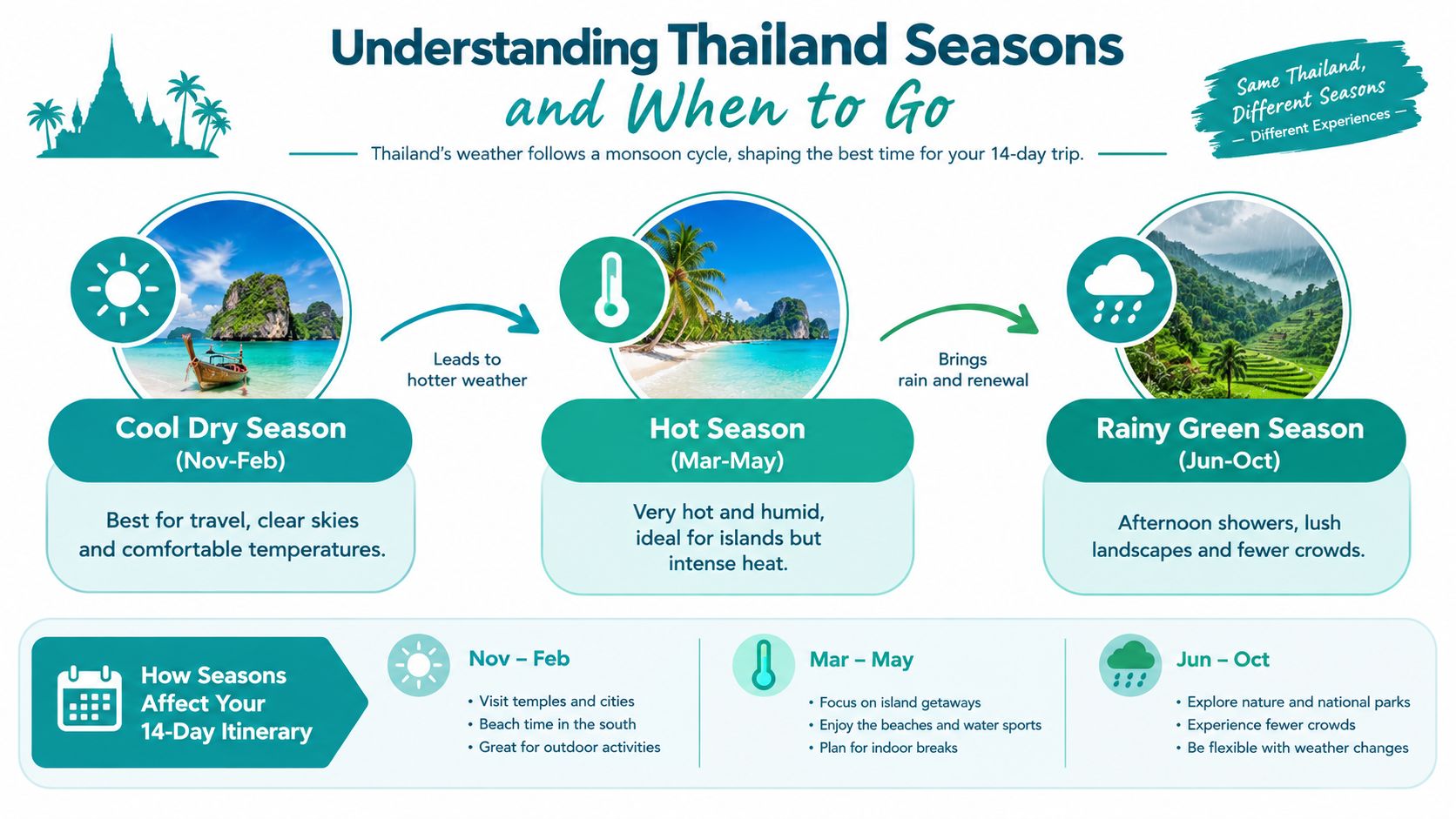
Bangkok and much of central Thailand usually follow the mainland rainy calendar, so wet-season planning there is fairly straightforward. The twist is the Gulf islands, Koh Samui, Koh Phangan, and Koh Tao, which often see their wettest months from October to December instead. That regional split is one reason Thailand works year-round, but it also means the “best time” question depends on where you go, not just when you travel Thailand rainy season guide.
A simple route check helps. If one region is entering its wetter stretch, another part of the country may still be a better fit for beaches, ferries, or long sightseeing days. For a 2 weeks in Thailand plan, that makes the country feel less like one fixed season and more like a set of weather zones you can pair wisely.
Weather affects more than comfort. It changes ferry reliability, island-hopping visibility, and how pleasant long transfer days feel. Dry season makes the classic north-and-south route easier to manage. In rainy season, fewer bases usually work better, because they reduce the chance that bad weather turns a packed schedule into a missed connection.
The 2025 arrival picture also matters. Thailand remains a major draw for international visitors, so the busiest corridors can feel crowded when everyone follows the same classic loop. That is why fewer stops often work better than more stops, especially if you want a calmer pace and less time in transit. A packed Bangkok-Chiang Mai-islands circuit can still work, but a route with one less layer often fits better when the weather, crowds, or your travel style point that way.
If your dates fall in the cooler dry period, a mixed city, culture, and beach trip is easy to justify. If your dates fall in the wet season, choose fewer bases and add buffer time so weather does not control the whole holiday.
Most first-time planners start with the same idea, one big loop with Bangkok, Chiang Mai, and the southern islands. That route works, but it isn't always the best route. Recent official data shows international arrivals fell to 32.97 million in 2025, down 7.23% year on year, while domestic trips rose 2.70% to 202.37 million Thailand PRD tourism update. In plain terms, the popular places can feel busier and more uneven than a neat postcard map suggests.
The smarter question is not how many places you can add. It's which route gives you the best version of your own trip. A slower route with fewer changes often beats a crowded checklist, especially when internal travel and peak-season congestion start competing with beach time and sightseeing.
| Route Archetype | Best For | Pace and Highlights |
|---|---|---|
| Classic Bangkok, north, and islands loop | First-time visitors who want the full mix | Fast but balanced, city first, culture in the north, then beach time in the south |
| Slower cultural route | Travelers who prefer museums, temples, and local neighborhoods | Fewer moves, deeper stays, better for people who dislike airport hopping |
| Beach-focused southern route | Families, couples, and travelers who want more downtime | Less inland travel, more coast time, best when the point is rest, not coverage |
If you like structure, the classic loop still earns its place. If you like breathing room, the cultural route is often the better choice. If your main goal is sun and sea, the beach-focused version keeps the trip from being padded with stops you don't really want.
Useful filter: choose the route that matches your energy, not the route that looks best in a shared spreadsheet.
For travelers coordinating multiple legs, this multi-destination planning guide is a practical reference for sequencing stops without building a route that fights itself. The biggest mistake is assuming every extra city adds value. In Thailand, each new base adds a packing reset, a transit window, and another chance for weather or crowds to interrupt the day.
The rest of this plan follows the classic north-and-south arc because it gives first-time visitors the broadest experience. But the lesson stays the same, fewer stops can mean a better trip.
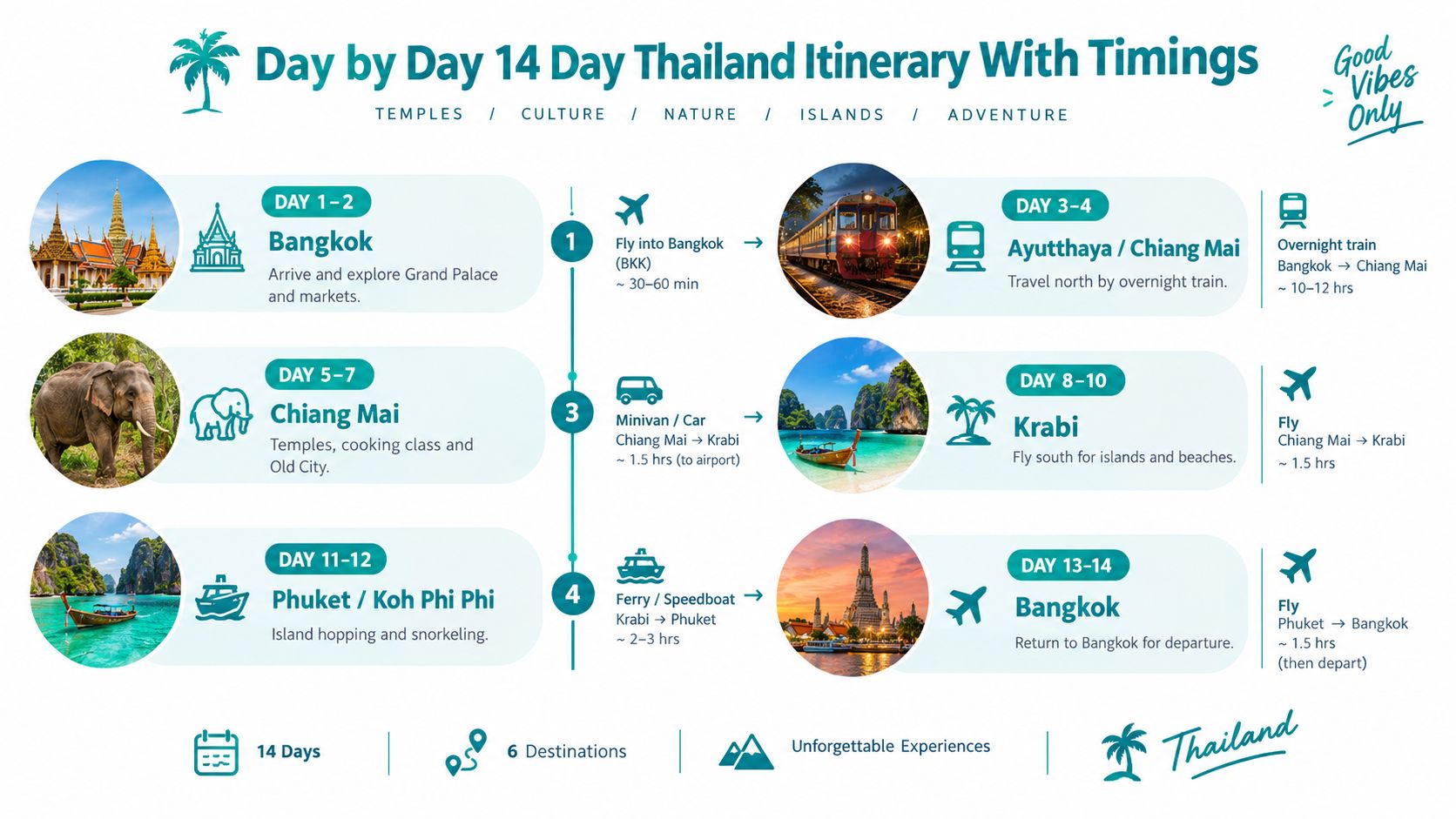
A clean 14-day plan works best when the first half is ground-based and the second half uses a flight to save time. Bangkok gives you the arrival buffer, Chiang Mai gives you culture and slower rhythm, and the south gives you the beach finish. That sequence avoids the classic mistake of starting with too many transfers before you've adjusted to the time zone and humidity.
Day 1 should be about landing well, not seeing everything. Arrive, check in, drink water, and keep the afternoon light with one temple or river stop, then an easy dinner near your hotel. Day 2 is the stronger sightseeing day, with the Grand Palace, Wat Pho, and Wat Arun fitting naturally into a loop if you start early and leave room for a slow lunch.
Day 3 can be your market and neighborhood day, which is where Bangkok starts feeling less like a checklist and more like a city. If you want a day trip, Ayutthaya works well here because it gives you a historical contrast without forcing a hotel move. Day 4 is the buffer. Use it for whatever Bangkok still feels unfinished, a rooftop view, a mall break, or one last street-food crawl before heading north.
Bangkok is where many travelers first learn that pacing matters more than ambition. The city rewards people who leave space in the plan.
Fly north on Day 5 rather than spending a full day on overland travel. Chiang Mai gives you a completely different rhythm, calmer streets, more temple time, and easier day-trip planning. On Day 6, keep the Old City simple, one or two major temples, coffee breaks, and an evening market if your energy holds.
Day 7 works well for a cooking class or a nature outing. Day 8 is your flexible day, and that flexibility matters because Chiang Mai is where many travelers either try to do too much or discover they like the slower pace more than expected. If weather changes, this is the place to swap a mountain trip for a city day without disrupting the whole itinerary.
For readers planning a north-south comparison, this Vietnam 2-week itinerary is a useful contrast in how different countries handle multi-stop travel. Thailand is easier when you keep the number of base changes controlled.
Use Day 9 to fly south to Krabi and settle near your beach base. Day 10 and Day 11 are best for sea time, boat trips, and enough downtime that the trip stops feeling like an airport exercise. If you're island-hopping, keep the transfers tight and the expectations realistic, because boats add charm, but they also add timing risk.
Day 12 and Day 13 are ideal for a second coastal stop, like Phuket or Phi Phi, depending on whether you want more activity or more scenery. Day 14 should not be a full sightseeing day. Leave room to return to Bangkok, spend one last night near the airport or central transit, and protect your departure from ferry delays, traffic, or a late domestic connection.
The easiest itinerary is not always the one with the most destinations. It's the one that still feels good on the last day.
Money and movement are tied together in Thailand. Once you decide whether to fly, take trains, or connect by ferry, your hotel choices become much easier. A traveler who saves time with domestic flights can usually afford a nicer stay in one or two bases, while someone who prefers slower transport may want simpler rooms and fewer transfers.
Domestic flights are the cleanest way to protect time on a 2 weeks in Thailand trip, especially on the Bangkok-to-north and north-to-south legs. Overnight trains make sense when the journey itself is part of the experience, but they work best if you're comfortable with an informal schedule. Ferries and buses are essential for island links, yet they're also the least forgiving when weather or traffic shifts.
Budget rule: pay more for transport when it prevents you from losing a day.
Accommodation follows the same logic. Bangkok and Phuket usually reward travelers who stay in a connected neighborhood rather than the cheapest possible address far from the action. Chiang Mai is easier to enjoy from the Old City or nearby central areas. On the islands, staying close to the ferry or your main beach cluster keeps the trip from becoming a daily shuttle.
A useful planning model is to match your hotel tier to your transport style. Backpacker trips work well with hostels, guesthouses, and buses. Mid-range travelers can mix boutique hotels with domestic flights and good restaurants. Luxury travelers get the most value when they use private transfers, well-located resorts, and one or two extra comfort upgrades instead of spreading the budget too thin.
For travelers comparing data plans or trip logistics, Simsima offers Thailand eSIM plans and a regional Asia option, which can help keep navigation and booking apps working across stops. That matters more on a multi-city itinerary than on a single-resort holiday.
The right hotel location saves more energy than almost any other booking choice. A well-placed mid-range room often beats a cheaper room that steals an hour from every day.
A two-week Thailand trip usually uses more data than people expect. Navigation, restaurant searches, messaging, ride apps, and quick photo uploads all add up, even when you plan to lean on Wi-Fi. For a 14-day trip, a practical budget is 10 to 20 GB for a regular tourist and 25 GB+ for heavy use, with a simple buffer formula of daily use × 14 × 1.2 to avoid running short mid-trip Thailand data guide.
Maps and transport apps are the most underestimated drain, especially when you're moving between cities. Social media uploads and video calls can push usage up quickly, and a Wi-Fi-only plan tends to break the moment you're in a taxi, on a ferry, or checking a train platform. That's why many travelers do better with a prepaid eSIM than with a patchwork of café logins.
Thailand's mobile performance also depends on where you are. Bangkok, Chiang Mai, Phuket, and Pattaya usually have strong 4G and 5G, with reported 5G speeds around 50 to 150 Mbps in Bangkok and 30 to 80 Mbps in Phuket, while mountains, cliffs, and some islands can weaken coverage Thailand network coverage guide. If you work remotely or tether a laptop, the practical move is to prioritize strong 4G fallback rather than treating 5G as guaranteed everywhere.
Connectivity rule: if your route includes boats, hills, or small islands, plan for weaker signal before you leave the city.
A good setup should be easy to install before departure and simple to activate on arrival. That matters more than most travelers expect, because the first hour in a new country is usually when you need maps, hotel check-in details, and transfer confirmation most.
If you prefer a scan-based setup, scan-first forwarding for expats is a useful example of how people streamline routine travel admin before they even leave home. The same mindset works for trip connectivity, reduce friction before you fly, and your arrival feels calmer.
For readers comparing providers and plan sizes, this Thailand eSIM guide helps narrow down what to look for in coverage, data volume, and activation style.
Thailand is straightforward for most visitors, but a smart itinerary still keeps risk in view. The current U.S. travel advisory says to exercise increased caution in Thailand, specifically warns against travel near the Thai-Cambodian border because of armed conflict, and flags the southern provinces of Yala, Pattani, and Narathiwat due to ongoing insurgent violence Thailand travel advisory. For a first trip, that means keeping your route focused on the main tourist corridors and avoiding unnecessary border-adjacent detours.
Health prep is simpler than many travelers think. Hydration, sun protection, and a travel insurance policy that covers medical care are the core basics. If you want a pre-trip medical review, GP travel vaccine options is a practical place to start the conversation with a clinician.
The best packing list is the one that keeps you adaptable. If the weather shifts or a transfer takes longer than expected, you'll still have what you need without hauling a heavy bag across the country.
Simsima gives travelers prepaid Thailand eSIM options that are meant for exactly this kind of trip, where you move between cities, islands, and transport hubs and need data that works without fuss. If you want to compare travel eSIM plans before you fly, visit Simsima and choose the setup that fits your route, your device, and your 2 weeks in Thailand.

Founder of Simsima. A passionate traveler based in Barcelona, he helps travelers stay connected without breaking the bank on roaming fees.
LinkedIn