-5% on your 1st eSIM
WELCOME5
Loading...
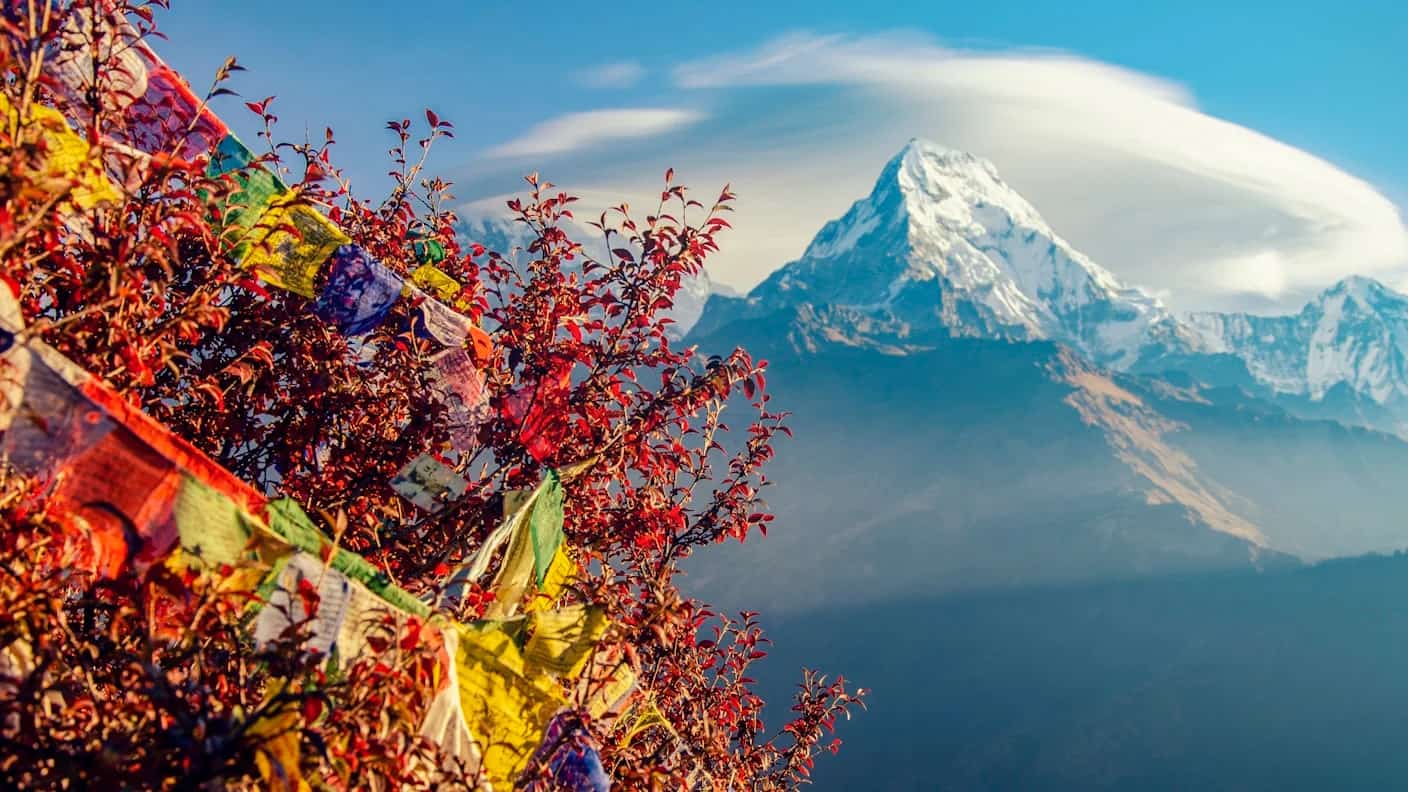
Everything a traveler needs to pick the right eSIM for Nepal in 2026: NTC vs Ncell coverage, 4G reality in Kathmandu and Pokhara, connectivity on the Everest and Annapurna trails, and how to skip the passport-photo SIM registration queue entirely.
 Dimitri Morvan
Looking for the best eSIM for Nepal? This guide compares the top providers, plans and prices. Nepal is one of the most rewarding destinations in Asia, but it is also one of the trickiest when it comes to staying connected. Between Kathmandu's dense but overloaded 4G, the surprising pockets of signal at 4,000 meters on the Everest Base Camp trail, and the multi-day dead zones on the higher passes, the phrase "best eSIM for Nepal" means very different things depending on where you are going. This guide breaks down what actually works in 2026 for travelers, trekkers, and long-stay digital nomads, and how to avoid the passport-photo queue that still greets anyone buying a physical SIM at Tribhuvan International Airport.
The traditional way of getting connected in Nepal has not changed much in a decade. You land at Tribhuvan International Airport (KTM), queue at an NTC or Ncell kiosk, hand over your passport, a printed passport-size photo, and a paper form, and wait for the SIM to be activated on the operator's side. In peak season the queue can easily eat an hour, and if you arrive after 10 p.m., the counters may already be closed. An eSIM sidesteps every step of that process: you install the profile from your device before boarding, and the moment your plane lands and you disable airplane mode, mobile data is already working.
There is a second, less obvious benefit. Nepal enforces SIM registration under a Know Your Customer regime, which is why the passport photo requirement still exists. A travel eSIM is issued by an international carrier and roams onto NTC and Ncell towers as a foreign device, which means you never appear in the local KYC database and never have to unregister anything when you leave. For a two-week trek that is a trivial convenience. For a longer stay across several countries, it is a genuine time-saver.
See Simsima's Nepal eSIM plans — Compare data allowances and validity periods for Nepal.
Nepal is served by two dominant mobile operators. Nepal Telecom, universally called NTC, is the state-owned incumbent. Ncell is the private challenger, majority-owned by a local group after Axiata's exit in 2023. Both offer 4G LTE, and both have limited 5G pilots in central Kathmandu, but they optimize for different footprints. Understanding the split is the single most useful thing you can know before buying a Nepal eSIM.
NTC has spent two decades pushing towers into the middle hills and along the main trekking corridors. On the Everest Base Camp trail you will find NTC coverage in Lukla, Phakding, Namche Bazaar, Tengboche, Dingboche, and, on a clear day, at Gorak Shep. On the Annapurna Circuit, NTC covers Besisahar, Chame, Manang, and reaches into Muktinath. In the Langtang valley, NTC is often the only network that works past Syabru Besi. If your trip involves multi-day walking above 2,500 meters, an eSIM that roams onto NTC is almost always the safer bet.
Ncell has invested aggressively in urban capacity. In Kathmandu, Bhaktapur, Lalitpur, Pokhara, Chitwan, and Lumbini, Ncell 4G typically delivers faster real-world download speeds than NTC, particularly during evening peak hours when NTC congests. For a traveler who spends most of the trip in cities, temples, and lakeside cafés, Ncell is often the more pleasant network. Most travel eSIMs, including Simsima's, automatically prefer the network with the strongest signal at your location, so you usually do not have to choose manually.
Truly unlimited eSIMs are rare in Nepal because the underlying operators still meter international roaming aggressively. The plans marketed as "unlimited" are usually high-daily-cap plans with a fair-use throttle after a certain volume, most commonly 1 GB or 2 GB per day at full 4G speed, followed by throttled speeds for the rest of the day. For a trekker sending photos to family every evening from a teahouse in Namche, that structure is more than enough. For someone who wants to hotspot a laptop and stream video for eight hours from a Pokhara café, it is worth reading the fine print before assuming the plan will keep up.
Capped plans are usually the better value for most Nepal itineraries. A one-week visit that includes Kathmandu, Pokhara, and a short Chitwan safari rarely exceeds 3 to 5 GB of real usage. A two-week trekking trip on the Everest Base Camp or Annapurna Circuit trails, where you are offline for large chunks of the day and mostly using messaging apps in the evenings, tends to land between 5 and 10 GB. Buying a capped plan sized to your itinerary is almost always cheaper than a daily-unlimited plan and gives you clear visibility on remaining data through your device settings.
One of the most surprising facts about Nepal is that you can get a 4G signal at 4,300 meters. NTC's tower at Dingboche, on the Everest Base Camp route, regularly delivers a usable data connection, and the tower installed a few years ago near Gorak Shep occasionally reaches base camp itself on clear days with a line of sight. That does not mean you should trust it. Weather, tower power outages, and network congestion during the October and April high seasons all conspire to make coverage unpredictable above Namche Bazaar. The honest rule of thumb is this: assume you will have decent coverage up to and including Namche, patchy coverage up to Dingboche, and effectively no coverage above 5,000 meters.
On the Annapurna Circuit, NTC has good coverage up to Manang at 3,540 meters, and Ncell reaches Chame and, weakly, Pisang. The Thorong La pass at 5,416 meters is a communications blackhole, as is much of the descent to Muktinath before you drop below roughly 4,000 meters. Trekkers on Manaslu Circuit, Upper Mustang, and Dolpo should plan for multi-day dead zones and treat any cellular signal as a bonus rather than a plan.
Most Everest treks still begin with the short mountain flight from either Kathmandu or Ramechhap to Lukla. Cellular is fine at Ramechhap and adequate at Lukla, so you can send a "landed safely" message either side. However, Lukla flights are notoriously weather-dependent and are frequently cancelled or diverted with little notice. If your trip is time-sensitive, plan for a ground alternative via Salleri and Phaplu — cellular coverage on that road is patchy but present on NTC. An eSIM that connects immediately on landing at either airport is a small but real quality-of-life upgrade when schedules go sideways.
No travel eSIM, and no local SIM either, will save you if you have a serious medical incident above 5,000 meters and no cellular signal. This is the point where the honest answer stops being "buy more data" and starts being "bring the right hardware". Anyone attempting Everest Base Camp, Thorong La, Kala Patthar, the Three Passes trek, Mera Peak, Island Peak, or any of the higher circuits should carry either a Personal Locator Beacon (PLB) or a two-way satellite messenger such as a Garmin inReach or a modern iPhone with Emergency SOS via satellite. These devices do not replace a Nepal eSIM for day-to-day communication in villages, but they are the layer of safety that the cellular network cannot provide.
In Kathmandu you can expect solid 4G throughout Thamel, Durbar Square, Boudhanath, Swayambhunath, and Patan. Coverage inside the older temple complexes can dip because of thick masonry, but you will not lose data for long. The ring road and the highway to Bhaktapur are reliably covered on both networks. Pokhara is even friendlier: Lakeside, the World Peace Pagoda, Sarangkot, and the paragliding zones all have strong 4G on Ncell, with NTC as a solid fallback. Chitwan National Park, home to the classic jungle safari, is well covered along the Sauraha strip, though signal fades quickly once you are on a jeep safari or a canoe on the Rapti river.
Monsoon season, roughly mid-June to mid-September, brings its own quirks. Heavy rain saturates the air and reduces high-band signal reach, and the frequent landslides that cut Nepal's roads occasionally also take out fiber backhaul, which can degrade a local cell tower for hours. If you travel during monsoon, do not rely on live navigation for the last leg of any long drive — download offline maps of Nepal in advance.
Check whether your phone supports eSIM in Nepal — Device compatibility matters — some older Android models still ship without eSIM support.
Installing a Nepal eSIM on a modern iPhone or Android device takes about two minutes. You buy the plan from your provider, receive a QR code by email, open your device's mobile plan settings, and scan the code. The profile installs, and you label it something obvious like "Nepal" so you do not confuse it with your home line. Leave your home SIM as the default for calls and iMessage, and set the Nepal eSIM as the default for cellular data. Do not enable data roaming on your home line unless you want a surprise bill.
Read the full eSIM activation walkthrough — Step-by-step onboarding for first-time eSIM users.
Nepal's local currency is the Nepalese Rupee (NPR), and it is essentially unconvertible outside the country. ATMs in Kathmandu and Pokhara are plentiful but often cap withdrawals at 35,000 NPR per transaction with fees around 500 NPR. Card payments are increasingly accepted in mid-range hotels, trekking agencies, and larger restaurants, but street food, teahouses on the trail, and most transport are cash-only. If you run out of eSIM data during your trip, most providers let you top up the same profile through their app or website, which is a far smoother experience than trying to buy an Ncell or NTC data pack in cash from a small shop in Namche.
Nepal is often the anchor of a longer Himalayan itinerary. Travelers frequently combine it with a few days in northern India, a Bhutan add-on, or an overland stretch into Tibet via the Rasuwagadhi border. If that is your plan, look at regional eSIMs that cover Nepal together with its neighbors — you avoid buying a new profile every time you cross a border.
One eSIM for Nepal and neighboring countries.
No. The passport-photo requirement applies to local SIM cards issued in Nepal under the operator KYC rules. A travel eSIM roams onto NTC and Ncell as a foreign device, so you do not register locally and you do not need a passport photo.
NTC. It has significantly better coverage above Namche Bazaar, and it is the only network you will see in most Khumbu villages beyond Tengboche. A good travel eSIM will attach to NTC automatically when Ncell is unavailable.
Sometimes. There is an NTC tower near Gorak Shep that occasionally reaches base camp on a clear day, but coverage is not guaranteed. Treat any signal at 5,000 m or above as a bonus, not a plan, and carry a satellite messenger if you need reliable emergency communication.
Yes. Most travel eSIMs, including Simsima's Nepal plans, allow tethering. In Kathmandu and Pokhara you will get usable video-call speeds on Ncell. On the trail, hotspotting works in the main villages but is slower and more battery-hungry — expect it to be adequate for email and messaging, not for streaming.
Most travelers use between 5 and 10 GB over two weeks if they mostly rely on messaging apps, occasional maps, and social media. Digital nomads working remotely from Pokhara or Kathmandu should budget 20 GB or more per week, or plan around teahouse Wi-Fi during trekking days.
Only in limited pilot zones in central Kathmandu on both NTC and Ncell as of 2026. Nationwide 5G is not a realistic expectation yet, and no serious trekking area is covered. Any Nepal eSIM sold as "5G" will fall back to 4G LTE across virtually the entire country, which is fine for practical use.
Here is a comparison of the main Nepal eSIM plans against the leading international providers. Simsima offers competitive pricing thanks to direct deals with local carriers.
On the configurations shown above, Simsima delivers the most competitive rates against the leading international providers. You also benefit from instant activation and reliable network coverage in Nepal.
Nepal rewards travelers who plan for both connection and disconnection. An eSIM is the cleanest way to handle the connected part — no counter queue, no passport photo, no paperwork, and a plan that starts the second your plane touches down at Tribhuvan. Combine it with sensible offline maps and, above 5,000 meters, a satellite messenger, and you have the setup that experienced Himalayan travelers have quietly converged on over the last few years.

Founder of Simsima. A passionate traveler based in Barcelona, he helps travelers stay connected without breaking the bank on roaming fees.
LinkedIn Destinations
 Destinations
 Destinations