-5% on your 1st eSIMuntil October 31
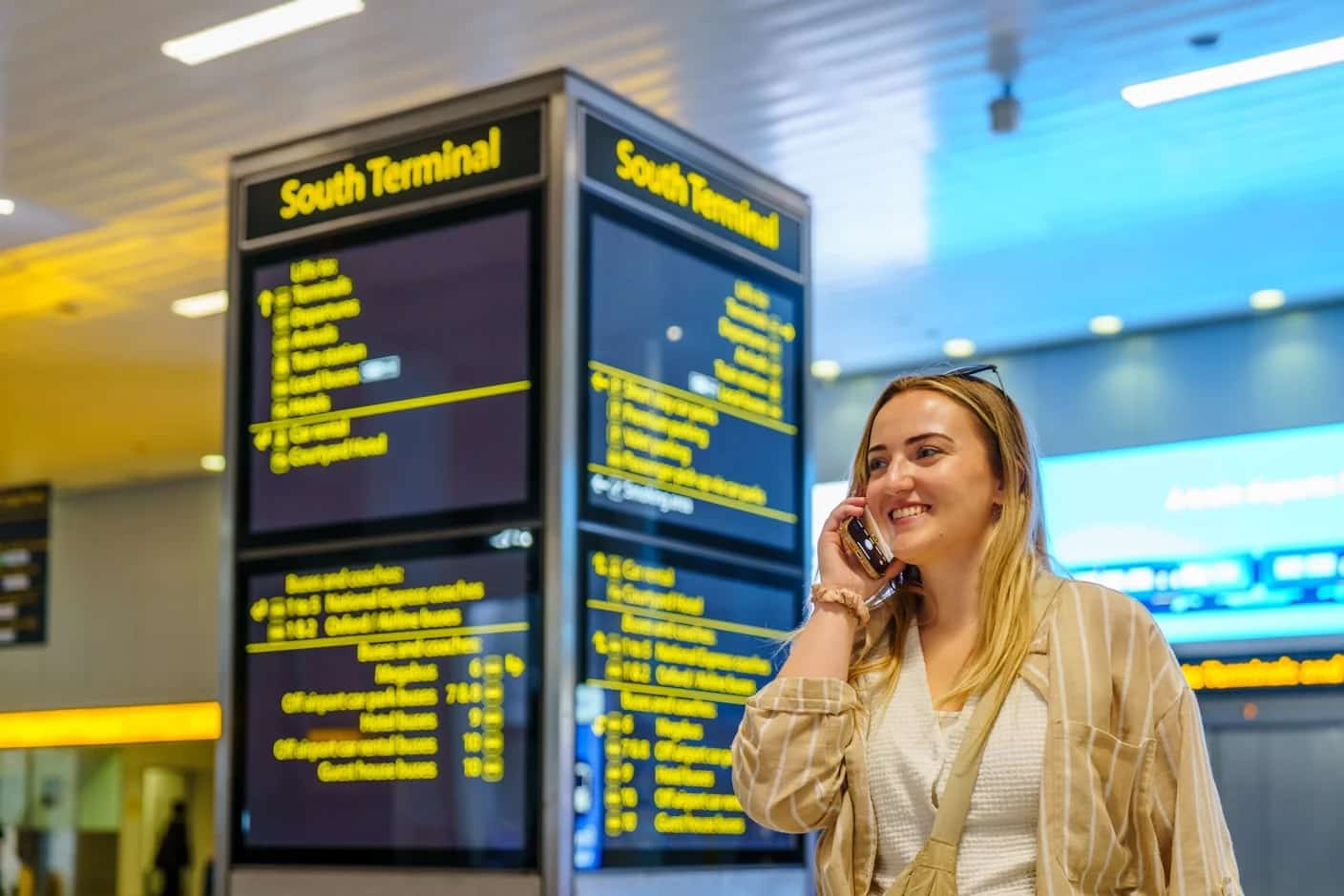
For most trips abroad, the best setup is your current plan for calls and texts plus a prepaid travel eSIM for data. AT&T and Verizon day passes cost $12 a day in most countries (October 2026): fine for a two- or three-day trip, but $168 per line over two weeks.
Key takeaways
- AT&T International Day Pass and Verizon TravelPass both cost $12 a day in 210+ locations, and $6 a day in Canada and Mexico on Verizon
- Verizon's TravelPass includes 5 GB of high-speed data per day, then 3G speeds; AT&T's Day Pass uses the allowances of your Unlimited plan
- A local SIM can mean showing a passport, and it replaces your home number unless your phone takes two SIMs
- A travel eSIM installs before you leave and keeps your home line on the phone, as long as the phone is eSIM-compatible and carrier-unlocked
- Pocket Wi-Fi only makes sense when several people or devices share one connection
Carrier roaming: what AT&T, Verizon and T-Mobile charge
Your own carrier is the zero-effort option: roaming switches on by itself and your number keeps working. The price is the catch. AT&T's International Day Pass costs $12 per day on land in 210+ locations, plus $6 for each additional line used on the same day, and starts a 24-hour session the first time you use data, call or text in an included country. It is added to an AT&T Unlimited plan and uses its talk, text and data allowances.
Verizon's TravelPass also costs $12 per day, or $6 per day in Canada and Mexico, and includes 5 GB of high-speed data per day before speeds drop to 3G for the rest of the session. For stays of nine days or more, Verizon also sells a $100 International Monthly Plan. T-Mobile includes some international data on several of its plans; check what your exact plan includes before paying for anything extra.
- Weekend trip: two or three day passes cost $24 to $36 per line
- One week: seven day passes come to $84 per line
- Two weeks: fourteen day passes come to $168 per line
- A family of three on AT&T for a week: $12 + $6 + $6 per day, or $168
Buying a local SIM card after you land
A prepaid SIM from a local carrier gives you local rates, and in some countries a phone number from that country for ride-hailing or restaurant bookings. Getting one takes time on arrival: an airport kiosk or a carrier shop, opening hours, and, depending on local regulations, identification such as your passport (Apple Support). Inserting it means removing your home SIM unless your phone has room for two lines, so codes sent by your bank to your usual number stop arriving.
Inside Europe, a SIM bought in one EU country works in the others under the roam like at home rules, which also cover Iceland, Liechtenstein, Norway, Moldova and Ukraine (Your Europe). Outside the EU, a local SIM generally works in one country only, so a route through several countries means one SIM per border.
Pocket Wi-Fi: one connection shared by a group
A pocket Wi-Fi router, rented at the airport or delivered before your trip, creates a hotspot that several phones, tablets and laptops can use at once. Splitting one daily rental between four people can make sense; for one person, it is an extra device to charge, carry and return, and everyone has to stay within Wi-Fi range of whoever holds it.
Travel eSIM: data abroad, home number unchanged
A travel eSIM is a prepaid data plan that you download to your phone as a second line. You install it at home on Wi-Fi, and it activates on its own when it connects to a supported network at your destination. Your home SIM stays in place for calls and texts, and you set the eSIM as the line for mobile data, with data roaming on for the eSIM and off for your home line so your carrier does not bill a day pass.
Simsima recommendation
Ready to skip the international roaming charges?
Browse Simsima eSIM plans — activation on arrival, local networks, no contract.






Two conditions apply: the phone must support eSIM and be carrier-unlocked. Every iPhone from the XS and XR onward supports eSIM (Apple Support), as do Google Pixel 4 and later and Samsung Galaxy S20 and later; check yours on the supported devices list. Travel eSIMs are data-only, so calls go through WhatsApp, FaceTime or another app over data.
How Simsima handles a trip abroad
- Smart Link installation. After you buy, you receive a Smart Link by email. Tap it on an iPhone (iOS 17.4 or later) or an Android phone and the eSIM installs without a QR code; otherwise, scan the QR code from the same email. APN settings are applied automatically on most plans; if data does not start, our support team can give you the right APN.
- 190+ destinations. Plans cover single countries, regions and multi-country Trip Packs for routes that cross borders. Browse them in the eSIM catalog.
- No passport scan. Simsima does not ask for identity documents to buy an eSIM.
- Top up instead of buying again. If you run low, you top up the eSIM already on your phone.
- Support by email. Simsima support usually replies within 24 hours. A deleted eSIM cannot be reinstalled on your own, so contact support if that happens.
- Refunds. An eSIM that has not been activated can be refunded within 14 days.
Picking by trip length and travel style
- Two or three days, already on an Unlimited carrier plan: a carrier day pass costs little more than a travel eSIM and needs no setup.
- A week or more in one country: a travel eSIM sized to your data use, installed before you fly.
- Several countries on one trip: a regional plan or a Trip Pack covers every country on its list with one eSIM, with no swap at each border.
- Several months in one country: a local SIM, or a local eSIM, starts to make sense, especially if you need a phone number from that country.
- A family or group: individual eSIMs if every phone supports eSIM; a pocket Wi-Fi if some do not.
- Frequent travel: compare your carrier's monthly international plan with a travel eSIM per trip, based on how many days a year you spend abroad.
Google Fi: a full plan, not a travel add-on
Google Fi's Unlimited Premium plan includes data abroad in more than 200 locations, which makes it attractive for people who travel often. It is a full phone plan, though: using it means moving your number to Fi rather than adding something for one trip. If you want to keep your current carrier, a travel eSIM gives you data abroad without changing anything else. Use the data usage calculator to size a plan.
Setting up a travel eSIM before your flight
- Check that your phone supports eSIM and is carrier-unlocked; on iPhone, Settings > General > About must show No SIM restrictions next to Carrier Lock.
- Choose a plan for your destination in the eSIM catalog, or a Trip Pack for a multi-country route.
- At home, on Wi-Fi, tap the Smart Link from your email on your phone to install the eSIM.
- When you land, set the eSIM as your mobile data line and turn on data roaming for that line only; it connects to a supported local network on its own.
roaming across several countries on one trip — when a regional plan beats stacking country plans
Frequently Asked Questions
If your plan is from an EU country, roam like at home lets you use it across the EU, Iceland, Liechtenstein, Norway, Moldova and Ukraine at no extra charge, within your operator's fair use policy. From the US or elsewhere, compare your carrier's daily or monthly roaming price with a Europe travel eSIM, which covers every country on its list with one plan.
Any affordable phone that supports eSIM and is sold unlocked. Google says every Pixel from the Pixel 4 onward works with eSIM, including the lower-priced a-series, and Samsung lists eSIM on Galaxy A models such as the A56 and A36 in Europe and North America. On iPhone, every model from the XS and XR onward supports eSIM.
Yes. The travel eSIM is added as a second line, so your home SIM stays active for calls and texts. Turn off data roaming on the home line to avoid charges, and use the eSIM for mobile data.
Yes. A phone locked to your carrier will not connect to another network. Phones bought outright from Apple, Google or Samsung are usually sold unlocked; if you bought yours through a carrier, ask that carrier to unlock it before your trip.
It depends far more on video than on anything else. Maps, messaging and browsing use little; video calls, streaming and photo backups use most of a plan. The Simsima data usage calculator gives an estimate from your own habits, and you can top up the same eSIM if you run low.
Simsima's travel eSIMs are data-only, with no phone number. You can call and message through WhatsApp, FaceTime or Telegram over the eSIM's data, while your home SIM keeps receiving regular calls and SMS.
Browse eSIM plans for 190+ countries — Find affordable travel eSIM plans for any destination worldwide
Multi-country Trip Packs — Get a single eSIM that works across multiple countries in the same region
How Simsima works — Learn about Smart Link installation, activation, and managing your eSIM
eSIM for international travel: complete guide — A deeper look at how travel eSIMs work and which providers offer the best plans
#comparison#international travel#eSIM#roaming#travel connectivity

Dimitri MorvanFounder
Founder of Simsima. A passionate traveler based in Barcelona, he helps travelers stay connected without breaking the bank on roaming fees.
LinkedIn