-5% on your 1st eSIM
WELCOME5
Loading...
What is a data only SIM card, how it works for travel, and data-only SIM vs eSIM. Learn benefits, limits and when to choose one.
 Dimitri Morvan
You land after a long flight, switch off airplane mode, and your phone lights up. Maps loads. WhatsApp messages arrive. Your airline app updates your gate change. Then you tap the green phone icon to call a hotel and nothing behaves the way you expected.
That moment confuses a lot of travelers.
You are online, but you don't have a normal mobile line in the old sense. You have data. You don't necessarily have carrier voice or carrier SMS. A data only SIM card feels familiar because it sits in the same settings menu as any other mobile plan, but it works more like an internet pipe than a full phone line.
That difference matters most when you're tired, in a new country, and trying to do practical things fast. Call a driver. Receive a bank code. Keep your usual number reachable. Share internet with a laptop. Work out whether the cheap-looking plan is good value for your trip.
Travelers love data-only plans because they solve the biggest need first: getting online quickly. They also create edge cases that many people only discover after purchase, especially around OTPs, banking, and number-based services. The good news is that once you understand the model, it becomes much easier to choose the right setup.
A common travel day now looks like this. You land in Tokyo, Barcelona, or Bangkok, install a plan in the airport queue, and your phone starts working for everything that runs on internet access. Google Maps finds your hotel. Uber or Bolt opens. Telegram pings. FaceTime rings if someone else uses Apple devices.
Then a family member sends a normal SMS to your travel line, or your bank tries to send a one-time verification code, and nothing arrives.

That isn't your phone “failing.” It's doing exactly what a data-only plan is built to do.
People often assume a SIM always means three things bundled together: mobile data, phone calls, and SMS. With many travel products, that bundle gets split. The travel plan gives you internet access, while your regular home line still handles your number, voice service, and text messages.
That split can be very useful.
It lets you use app-based communication for almost everything while keeping your home number for the things that still depend on it. If your phone supports dual SIM, that setup can be smooth once you know which line is doing what.
A data-only travel plan is easiest to understand when you stop asking, “What phone number do I get?” and start asking, “What kind of internet access do I get?”
A few years ago, travel connectivity still felt awkward and improvised. Today it's becoming standard infrastructure. GSMA Intelligence reported that by June 2024, 271 consumer eSIM device models had launched cumulatively, while 123 countries and 441 operators had launched smartphone eSIM service, according to GSMA Intelligence's global eSIM scaling report.
So if you keep seeing travel eSIMs and data-only plans everywhere, that's not a niche trend. It's the direction the market is moving.
Instead of treating this like a technical glossary, it helps to think in practical travel questions:
By the end, you'll know how to think about a data-only SIM card, how physical SIMs and eSIMs differ, when data-only is the right tool, and when you should keep your home line active as backup.
A data only SIM card is best understood as internet access without a native phone line attached.
Think of two products that happen to live inside the same phone:
A data-only SIM is the second one.
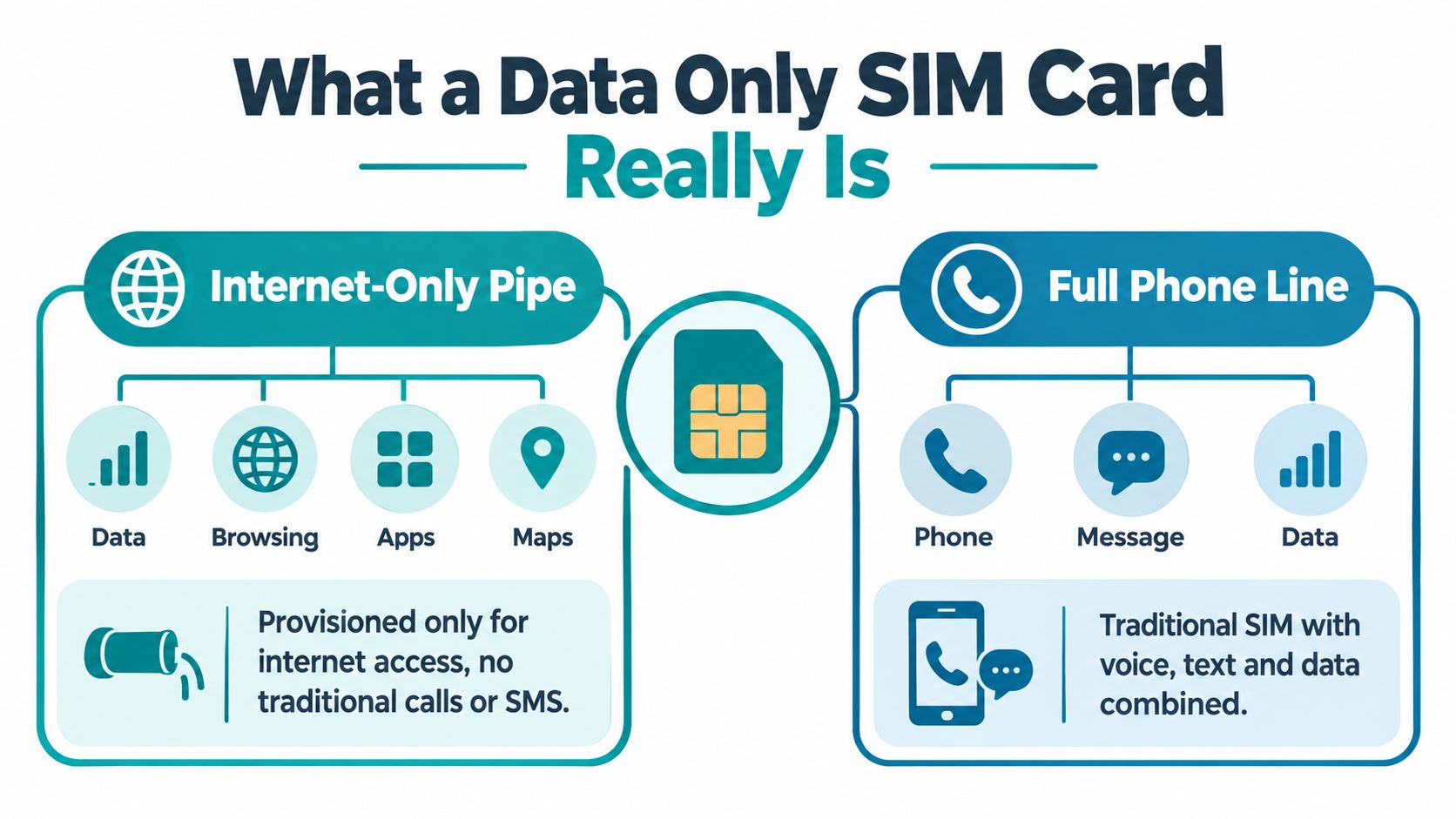
Core idea: A data-only SIM card gives your phone a route to the internet. It usually does not give that line a normal carrier phone number for voice calls and SMS.
If an app works over internet, a data-only SIM usually handles it well.
That includes things like:
This is why many travelers barely notice the difference at first. Their daily communication already happens through IP apps, not through old carrier SMS.
Data-only SIM cards are provisioned for internet access without a native voice or SMS profile. They typically have no assigned phone number, so standard carrier calls and SMS don't terminate on that line. Voice and messaging happen through apps like WhatsApp, FaceTime, Telegram, or iMessage over the data connection, as explained by Sakura Mobile's travel eSIM support guide.
That sentence explains the biggest source of confusion. Your phone can still make “calls,” but they are app calls, not normal carrier calls on that travel line.
You may see the term APN during setup. That sounds technical, but the plain-language version is simple: it's the network doorway your device uses to get online.
If the service profile exposes only an IP data connection, your phone can browse the web and run apps. But it still won't have the carrier signaling needed for traditional telephony and SMS on that line.
A good analogy is this:
| Part | Simple meaning |
|---|---|
| SIM profile | The permissions your mobile line gets |
| APN | The doorway into the carrier's data network |
| Data-only service | Internet traffic allowed |
| Full phone service | Internet plus standard calls and SMS |
Most travel tasks need internet, not a phone number. That's why data-only products are so popular.
But some tasks still depend on number-based mobile service. If your bank sends login codes by SMS, or a service insists on verifying by text to your normal number, a data-only line alone may not be enough. That's why experienced travelers often treat the travel plan as the internet pipe, and keep another line active for number-dependent tasks.
Once you understand the service type, the next question is form factor. A data-only plan can arrive as a physical SIM or an eSIM.
The service idea is similar. The delivery method is different.
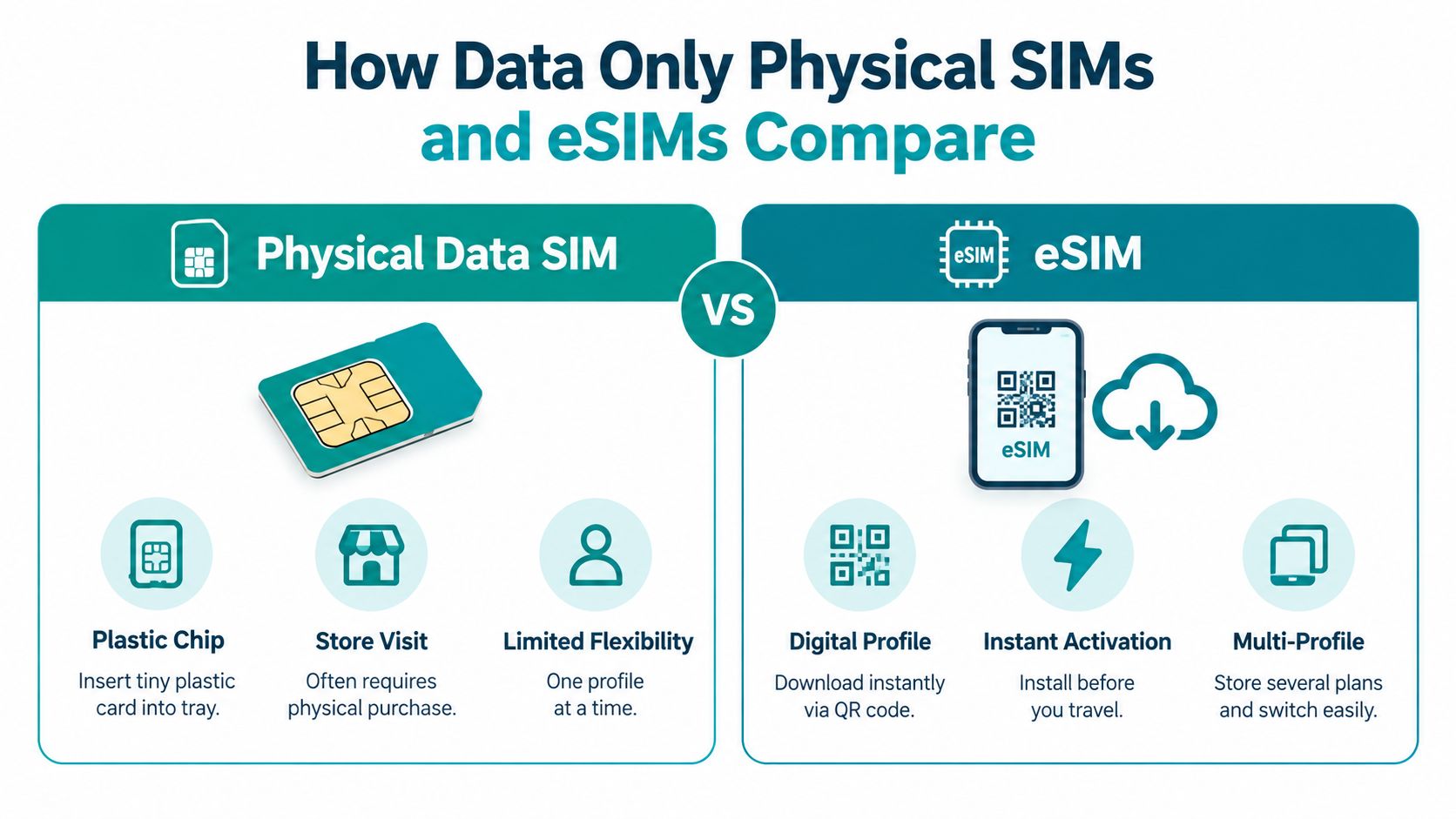
A physical SIM is the tiny plastic card you insert into a tray. An eSIM is a digital profile you install on a compatible device. If you want a broader look at the general tradeoffs, this guide on eSIM vs SIM card differences is a useful companion.
With a physical SIM, you usually need to buy or receive the card first. That may mean shipping before departure, pickup at the airport, or visiting a shop after arrival. You also need an open SIM tray and, in many cases, you remove your home SIM unless your phone has room for more than one line setup.
With an eSIM, installation is digital. You typically scan a QR code or use a one-tap install flow. That means you can set it up before departure and activate it when needed.
Here's a quick setup explainer before the table:
| Feature | Physical Data Only SIM | Data Only eSIM |
|---|---|---|
| Form | Plastic card inserted into SIM tray | Digital profile installed in device |
| Delivery | Usually bought in person or shipped | Usually delivered online |
| Setup | Insert card, then configure if needed | Scan QR or install digitally |
| Best for | Older devices or travelers who prefer a physical backup | Compatible phones and travelers who want faster setup |
| Home SIM handling | May require swapping cards | Often easier to keep home line active alongside travel data |
| Flexibility | Less convenient to switch quickly | Easier to store and switch between profiles |
This isn't just marketing momentum. The infrastructure has expanded fast.
GSMA Intelligence said the number of eSIM smartphone connections doubled in 2023 versus 2022 and was expected to double again in 2024, with around 1 billion eSIM smartphone connections forecast globally by the end of 2025 and 6.9 billion by 2030. The same presentation noted 3% of global smartphone connections in 2024 were eSIM, rising to about 30% in the US, helped by eSIM-only iPhone launches in 2022, according to GSMA Intelligence's US eSIM market presentation.
That scale is why travelers now encounter data-only eSIMs so often. For many devices, they're becoming the default travel format.
Choose a physical SIM if your device isn't eSIM-compatible, or if you prefer a removable card.
Choose an eSIM if convenience matters more. It's especially useful when you want to arrive with data ready, keep your main number active, or avoid finding a mobile shop after landing.
The appeal of data-only travel plans becomes obvious once you watch how people use their phones abroad.
A budget backpacker needs maps, hostel messages, and train tickets. A business traveler needs email, calendar, Slack, Teams, and ride apps the minute the plane lands. A digital nomad needs laptop tethering, cloud tools, and stable app communication across several countries.
None of those people starts by saying, “I need carrier SMS on a second travel number.”
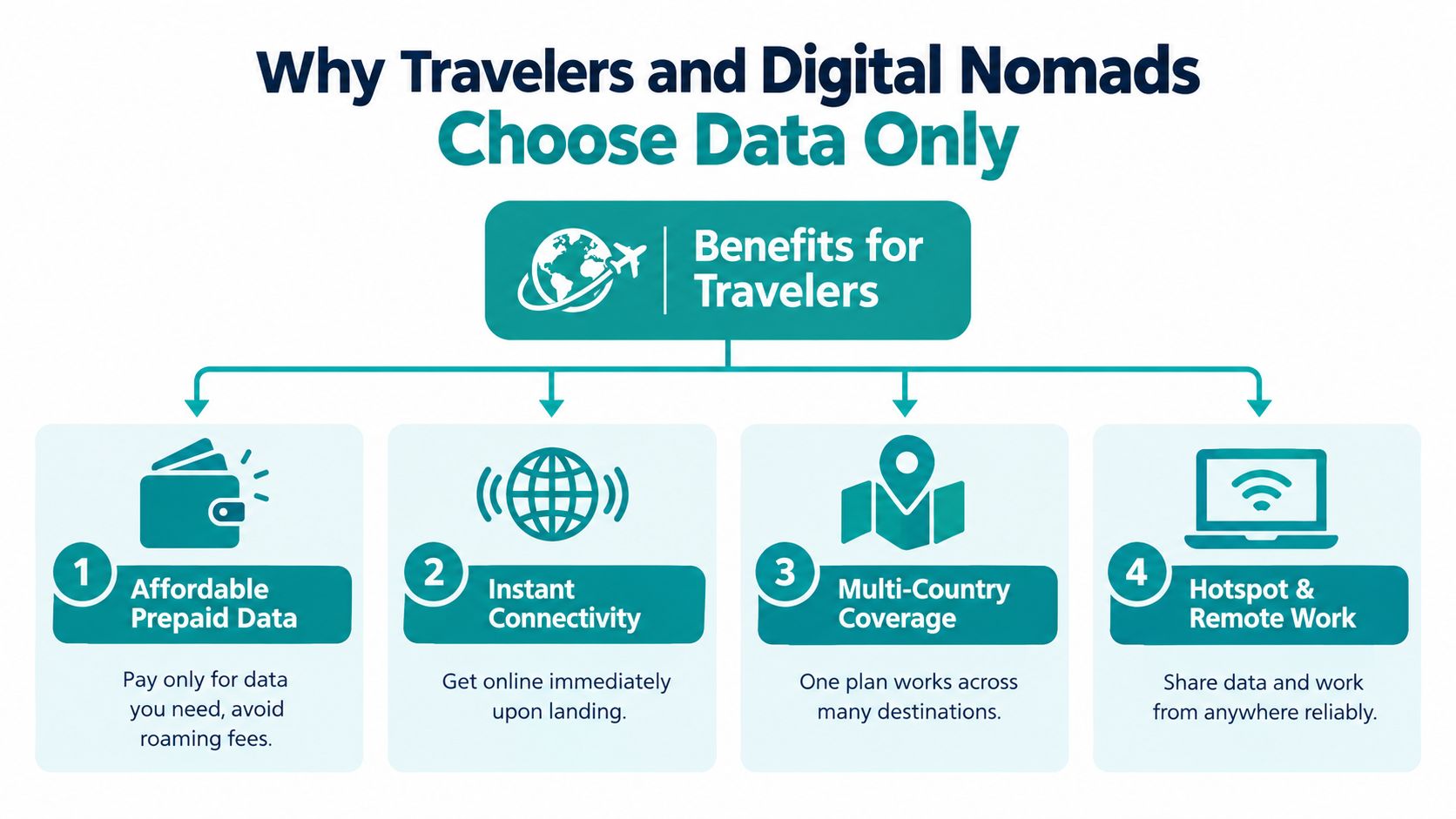
Take the backpacker first. She lands, opens Google Maps, messages her host on WhatsApp, and uses a translation app at a late-night convenience store. For her, internet access solves almost everything.
Now the business traveler. He keeps his home number reachable for familiar contacts, but uses travel data so his work apps, two-factor authenticator apps, and transport tools stay live. He cares less about having a local number than about not losing time.
Then the digital nomad. He may spend a month moving between countries, working from apartments and cafés. He needs one thing above all: a dependable internet layer on his phone that can also feed a laptop hotspot when Wi-Fi is poor. If he's choosing locations, lists like Approved Experiences Traveler's top picks can help narrow where this kind of setup matters most.
Most travelers already live inside app-based communication. Family members call on WhatsApp. Colleagues use Slack or Teams. Friends share live locations in Telegram or iMessage. Boarding passes sit in email or airline apps.
That makes data-only a natural fit. It strips the travel product down to the part people use most.
Travel demand also reflects that shift. One 2025 study estimated data-only eSIMs account for 62.4% of the eSIM-for-travel market, according to DataIntelo's travel eSIM market report. That doesn't mean data-only is perfect for everyone. It does show that internet-first travel connectivity has become a mainstream habit.
People don't choose data-only because they stopped needing communication. They choose it because most communication now runs through apps.
The most misleading advice about travel connectivity is also the shortest: “Data is enough.”
Sometimes it is. Sometimes it absolutely isn't.
The limit usually isn't the radio network. It's the service profile. Many travel or data-only eSIM implementations expose only an IP data APN, which is enough for browsing and app traffic but not for carrier SMS or telephony signaling. That's why customers who rely on bank OTPs should keep a separate voice/SMS SIM active for verification flows, as explained by eSIMX's travel eSIM article on calls and SMS.
The classic problem is banking.
You open your bank app from a hotel lobby, enter your password, and the bank sends a verification code to your normal number by SMS. Your travel data works perfectly, but the code still goes to the line that handles your regular mobile number. If that line is off, removed, or not receiving properly, you're stuck.
Other common trouble spots include:
The most practical setup for many travelers is simple:
That setup reduces surprises. It also matches the way many people travel now, with one line acting as identity and the other acting as connectivity.
Practical rule: If a service in your life still depends on SMS codes or normal voice calls, don't replace your home line with a data-only plan. Add the data-only plan alongside it if your device allows it.
A data-only SIM card may be the wrong choice if any of these are true:
| Situation | Why it matters |
|---|---|
| You need a new local phone number | Data-only plans usually aren't built for that |
| Your bank sends critical OTPs only by SMS | You need your number-bearing line available |
| You expect traditional calling to work on the travel line | App calls and carrier calls are different services |
| Your device doesn't support dual SIM well | Managing home and travel lines may be awkward |
The point isn't that data-only is flawed. The point is that it solves one problem very well: internet access. It doesn't automatically solve every number-related task that rides alongside modern travel.
A lot of travelers ask one simple question: which data-only SIM card is cheapest?
That sounds straightforward, but the market doesn't really behave that way anymore. A “best plan” answer can change fast depending on country, trip length, and how plan rules are packaged.
Start with the basics:
Independent market research describes a moving market rather than a stable one. One forecast put travel eSIM revenue at US$2.24 billion in 2025 and US$345.32 billion by 2035, while another said travel eSIM revenue reaches $8.7 billion in 2025. The same source notes Juniper Research said average revenue per gigabyte fell from $3.20 in 2023 to $2.78 in 2025, which helps explain why buyers face constant plan fragmentation and shifting value, according to DataM Intelligence's travel eSIM market research.
That doesn't give you a neat universal winner. It gives you a buying method.
Use these questions in order:
How long is the trip?
A weekend city break and a six-week itinerary should not be priced the same way in your head.
Will you stay in one country or cross borders?
For one country, a local plan may fit better. For several countries, a regional plan may save hassle even if the raw per-GB math looks different.
Do you need your home number for OTPs or calls?
If yes, check your phone's dual-SIM behavior before buying.
Will you hotspot another device?
Remote workers should verify that this matches their plan habits and device settings.
Is the destination a pricing outlier?
Japan, Europe-wide travel, and remote island destinations can produce very different value judgments even if the data amount looks similar on paper.
For a rough estimate of how much data you'll need, a tool like this travel data usage calculator helps turn vague habits into a more realistic plan size.
You can also compare offers by building a short note with four columns: destination, total data, validity, and whether you need number backup. That sounds basic, but it prevents the most common mistake, which is buying by price alone and ignoring trip shape.
One marketplace option in this space is Simsima, which offers prepaid data plans for 190+ countries. If you're comparing data-only travel options, that kind of catalog is most useful when you already know whether you need a local, regional, or global setup.
Cheap isn't a property of the plan alone. It depends on where you're going, how long you're staying, and whether the plan fits the way you actually use your phone.
A data only SIM card makes sense when you treat it for what it is: your travel internet pipe.
That framing clears up most confusion. If your priority is getting maps, messages, booking apps, translation tools, and work apps online fast, data-only is often a clean solution. If your life still depends on a reachable number, bank OTPs, or old-fashioned calling, keep your home line active alongside it when your device supports that setup.
Before you fly, check these items:
A quick setup walkthrough like this how to set up an eSIM guide can help you avoid last-minute settings confusion.
Don't ask a travel data plan to behave like a full local mobile contract if it wasn't sold that way.
Ask a simpler question instead: will this give me the internet access I need, in the places I'm going, for the length of trip I'm taking, without cutting me off from important number-based services? When you answer that clearly, choosing gets much easier.
Install early. Test calmly. Leave with both connectivity and backup sorted.
Simsima offers prepaid travel eSIM plans for 190+ countries, built around the data-only model covered here. If you want to keep your regular number while adding travel data through QR code or one-tap installation, you can compare options directly on Simsima.

Founder of Simsima. A passionate traveler based in Barcelona, he helps travelers stay connected without breaking the bank on roaming fees.
LinkedIn