Guides & news
Blog
Discover our latest guides, travel tips, and mobile tech news.
How it works
Learn how to install and use your travel eSIM in a few steps.
Loading...
Guides & news
Blog
Discover our latest guides, travel tips, and mobile tech news.
How it works
Learn how to install and use your travel eSIM in a few steps.
eSIM for 190+ destinations
Online when you land · 14-day refund if not activated
eSIM for 190+ destinations
Travel eSIM
How much does a trip to Dubai cost? See 2026 budgets for 5- and 7-day trips, from backpacker to luxury, plus hotel fees, transport fares and hidden costs.
 Dimitri MorvanNovember 17, 202616 min

A five-day trip to Dubai costs roughly $1,300 to $2,500 per person on a budget, $2,700 to $5,000 or more mid-range, and $6,000 to $14,000 in luxury, with international flights excluded. Seven days pushes those same bands to about $1,800 to $3,200, $3,500 to $6,500 or more, and $8,000 to $20,000 or more.
Those figures are a starting line, not a quote. When people ask how much does a trip to Dubai cost, the honest answer is that almost every budget goes wrong in the same two places: travelers multiply a headline room rate by the number of nights and never add the fee stack, and they price a peak-season hotel at an off-season rate. Get those two right, add the connectivity and transfer costs most guides skip, and the ranges stop being vague and turn into a number you can book against.
Here's how the bands break down by style and length, from a published Dubai trip cost breakdown that sets five days at about $1,300–$2,500 per person for budget travel, $2,700–$5,000 or more mid-range and $6,000–$14,000 for luxury, and seven days at roughly $1,800–$3,200, $3,500–$6,500 or more and $8,000–$20,000 or more (The Pricer).
| Travel style | 5 days per person | 7 days per person | What it covers |
|---|---|---|---|
| Budget | $1,300–$2,500 | $1,800–$3,200 | Hostel or budget hotel, food courts and shawarma stands, metro and bus, free beaches and souks |
| Mid-range | $2,700–$5,000+ | $3,500–$6,500+ | 3–4-star hotel, casual restaurants, metro plus occasional taxis, Burj Khalifa, desert safari |
| Luxury | $6,000–$14,000 | $8,000–$20,000+ | 5-star or beachfront resort, fine dining, private transfers, premium experiences |
Treat every cell as a planning range rather than a price. A published band bundles assumptions about hotel tier, meal style, paid attractions, local transport and whether flights are inside or outside the total, so two guides quoting the same city can differ by a thousand dollars without either one being wrong. Read the row that matches your comfort level, then rebuild it line by line.
Four variables do almost all the work, and only one of them is a hotel decision.
The lever travelers underestimate: a Dubai budget is decided by the dates on the booking, not by the star rating. A well-located three-star room in a hot month can undercut a budget room in a peak week.
Several Dubai expenses are shared rather than per person, which is exactly why per-person averages mislead. Accommodation, airport transfers, taxis and some tours are priced per room or per vehicle, so two travelers at the same comfort level each pay materially less than one traveler alone. A family complicates the math again, because child tickets, room configurations and baggage allowances all change the total.
Dubai's 2025 average stay was 3.7 nights, and a 2026 spending estimate cited in the department's release attributes about 32% of visitor spending to accommodation, 28% to shopping and 20% to food (Dubai Department of Economy and Tourism). Lodging and shopping together decide most of your total, and both respond to planning rather than luck.
That has a practical consequence: a short Dubai break is usually a room-and-shopping problem, not an attractions problem. Cap the shopping and share the room, and you land near the bottom of your band without skipping the desert safari. Start with the row that matches your style, then price the room, the transport and the data line before you book anything.
An advertised AED 500 room is the base for Dubai's fee stack. Once the percentage charges and the flat Tourism Dirham are applied, the payable figure lands closer to AED 717–750 before any seasonal premium.
Use the citywide benchmark to keep the room choice honest. Dubai's 2024 average daily rate was AED 538 per occupied room night, about $146, with average hotel occupancy of 78.2%, and the first quarter ran roughly 18.6% above the full-year rate, which is the number to remember if your dates fall in peak season (Dubai Department of Economy and Tourism 2024 annual visitor report). High occupancy means the market clears near that rate and discounting below it is limited.
Rates then moved up. The 2025 citywide average daily rate was AED 579, up 8% from AED 538, while occupancy reached 80.7% across 154,264 rooms in 827 establishments (2025 annual visitor report). Deep supply has not produced weak prices; location and dates decide what you pay.
I'd budget roughly $40–$90 a night for hostels and budget rooms away from the beach, $100–$250 for a 3 or 4-star city hotel, and $300 and up for beachfront and 5-star properties. Spend for location when the trip is short and every transfer costs time; spend for the beach only if you will use it.
Dubai hotels may add a 10% room tax, a 10% service charge, a 10% municipality fee, a 6–10% city tax and a 6% tourism fee, plus the Tourism Dirham at AED 7–20 per room per night depending on hotel category, per the UAE government tax guide.
| Charge | Typical rate | On a AED 500 room |
|---|---|---|
| Room tax | 10% | AED 50 |
| Service charge | 10% | AED 50 |
| Municipality fee | 10% | AED 50 |
| City tax | 6–10% | AED 30–50 |
| Tourism fee | 6% | AED 30 |
| Tourism Dirham | AED 7–20 per room per night | AED 7–20 |
| Typical total added | Sum of the lines above | AED 217–250 |
| Total payable | Headline rate plus fees | AED 717–750 |
A nominal AED 500 room therefore bills at roughly AED 717–750 a night. Across seven nights, the fee load alone reaches about AED 1,519–1,750, before any peak-date markup.
Compare the total payable, not the headline rate. Two hotels advertising AED 480 and AED 520 can land 100 dirhams apart once the fee mix and Tourism Dirham are applied.
Use the 2025 average of AED 579 as your midpoint and move deliberately from it. If a first-quarter premium similar to 2024 returns, that midpoint trends toward roughly AED 687 before fees. Winter and major-event dates sit above midpoint; summer is the discount window because demand drops. Midweek usually beats weekends across the city.
Book refundable rooms early for peak dates, then recheck the rate a few weeks out. A refundable booking costs nothing to hold and lets you reprice if supply loosens; the saving goes to the traveler who compares payable totals, not glossy nightly rates.
Transport is one of the few Dubai costs you can control, because the metro, tram and bus network runs on zone-based fares. A regular single journey costs AED 4 within one zone, AED 6 across two zones and AED 8.50 across more than two zones, and a regular one-day ticket costs AED 20 with unlimited travel that day, per the Roads and Transport Authority fare schedule.
| Option | Fare | Best for |
|---|---|---|
| Metro, tram or bus, one zone | AED 4 | Short hops in a single zone |
| Metro, tram or bus, two zones | AED 6 | Cross-town journeys |
| Metro, tram or bus, three or more zones | AED 8.50 | The longest end-to-end rides |
| Day ticket | AED 20 | Unlimited travel, cheaper than three max-fare rides (AED 25.50) |
| Nol card issuing fee | AED 2 | One-time cost for your first card or ticket |
| Taxi or ride-hailing | AED 7–28 | Door-to-door trips, luggage, late nights |
| Premium RTA services | AED 15–70 | Water crossings and special services |
Taxi and premium service ranges come from the RTA's Dubai Connector guide, and they're the figures to check when you're deciding between a cab and the metro at 11pm.
Three maximum-distance rides cost AED 25.50, which is more than the AED 20 day ticket. So the break-even is simple: if your day involves three or more long journeys, buy the day ticket. Two long rides and you should pay per trip. Airport arrival plus hotel plus two attractions in one day is exactly the pattern that justifies the day pass.
Don't forget the AED 2 issuing cost for your first card or ticket. It's trivial, but it belongs in the day-one estimate so your first total isn't wrong without you noticing.
The cheapest transport strategy is an itinerary one, not a ticket one. Group each day by area, Downtown and Business Bay together, Marina and JBR together, Old Dubai and the creek together, and most days need only one or two zones.
A working figure I'd use for planning: about AED 20–50 per day covers most itineraries that mix metro rides with one or two short taxi hops.
Repeated cross-city taxi trips will beat that number quickly, and they're also slower. Maps, ride-hailing and transit apps all need mobile data, which is the one transport cost travelers forget to price.
Ranges are useful for choosing a band. Worked examples are what you book against.
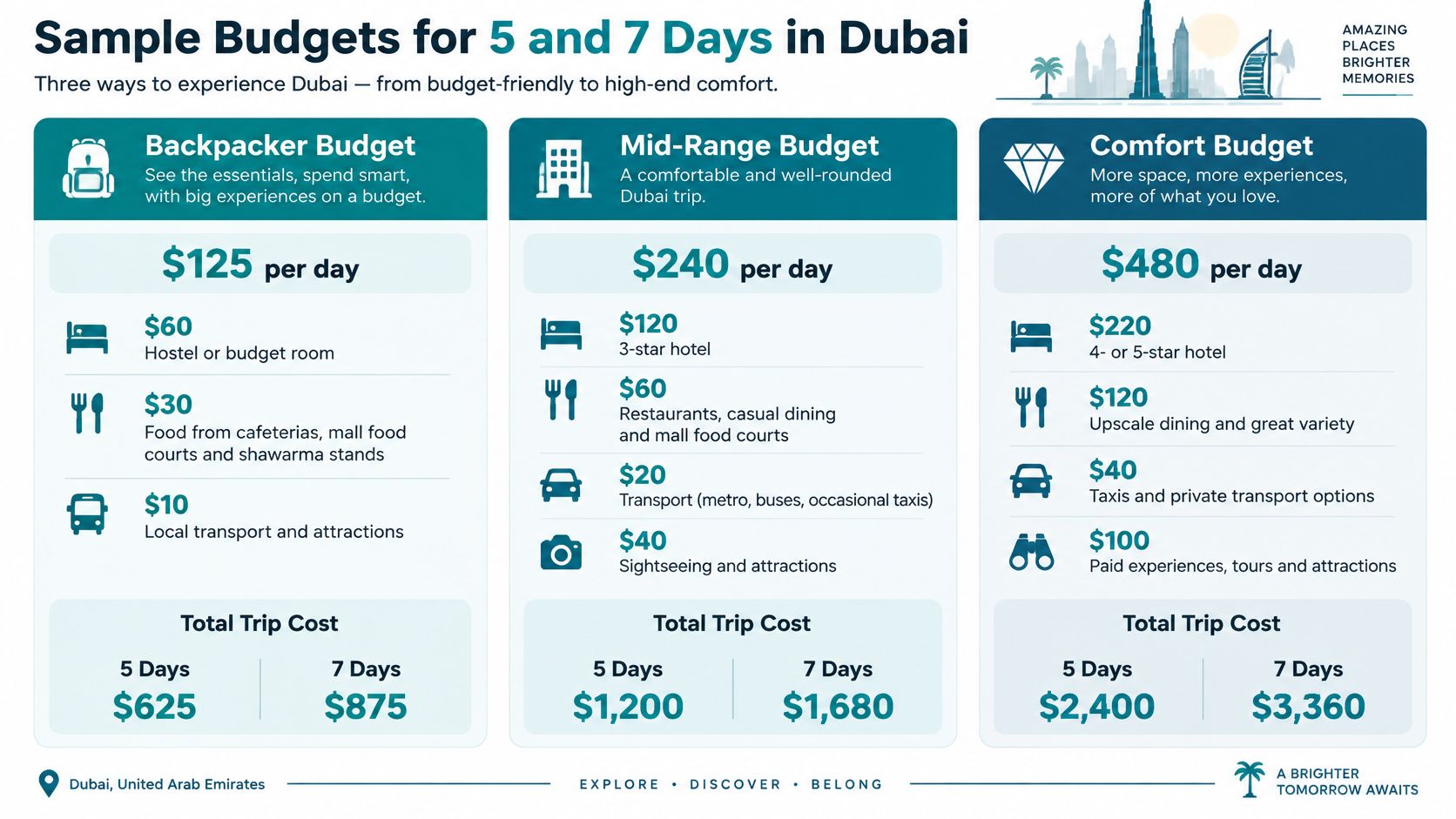
A published Dubai cost estimate puts backpacker spending at about $125 per person per day, split roughly into $60 for accommodation, $30 for food, $10 for local transport and $25 for activities, per My Trip Money's Dubai breakdown. Treat every daily rate below as a floor. It excludes the taxes and fees stacked onto each night's room rate, ignores peak-season pricing, and assumes shopping stays near zero. The totals that follow add those back in, which is why they land well above the raw multiplication.
That daily rate assumes cafeterias, mall food courts and shawarma stands rather than sit-down restaurants, plus one modest paid attraction a day. Add the hotel fee stack on the room, a seasonal premium on the bed and a small allowance for souvenirs, and a realistic backpacker spend lands around $1,300–$2,500 for five days and $1,800–$3,200 for seven, before international airfare. A metro-adjacent neighborhood in a shoulder month sits near the bottom of that range. A bed near the beach in February pushes the top.
A mid-range traveler should allow roughly $360 per day as a base: a 3 or 4-star hotel, restaurant meals mixed with casual eats, metro rides with the occasional taxi, and two or three paid highlights such as Burj Khalifa and a desert safari. With room taxes, seasonal pricing and a shopping line included, the payable total runs $2,700–$5,000+ for five days and $3,500–$6,500+ for seven, with peak weeks driving the upper end.
A luxury traveler using four or five-star hotels, fine dining, private transfers and premium activities starts around $960 per day before extras. The premium sits mostly in the room and the transfers rather than the attractions, and both inflate fast in high season. A realistic luxury budget runs $6,000–$14,000 for five days and $8,000–$20,000+ for seven.
Here's how that trip structure plays out across a week of spending and where the fixed costs land.
Airfare sits outside all three lines. The same breakdown places a typical round-trip flight from the United States at roughly $1,100 as of January 2026, though fares move with origin, season and booking date, so confirm current prices on the airline's official site for the month you're flying.
Some extras never appear in a daily average at all, which is why booking a Dubai dhow dinner belongs in the plan as its own line rather than buried in "activities". If you want to see the same method applied elsewhere, our Thailand trip cost breakdown prices a two-week itinerary the same way.
Mobile data is the most consistently forgotten line, and the most annoying to fix on arrival. Airport SIM queues eat an hour of your first evening, roaming passes surprise you at the end of the month, and hotel Wi-Fi is patchy exactly when you need maps and a ride-hailing app. A travel eSIM installed before departure solves all three: you land connected, and your regular number stays active for calls and texts.
For Dubai specifically, the Simsima UAE eSIM covers the whole country including Abu Dhabi on the same plan and price, supports Low Data Mode to stretch the allowance, and lets you top up an existing plan if you run low before the trip ends. Buy it while you're still at home and it's one less thing to queue for at the airport. If you've been burned by roaming before, how to avoid roaming charges covers the settings to check first.
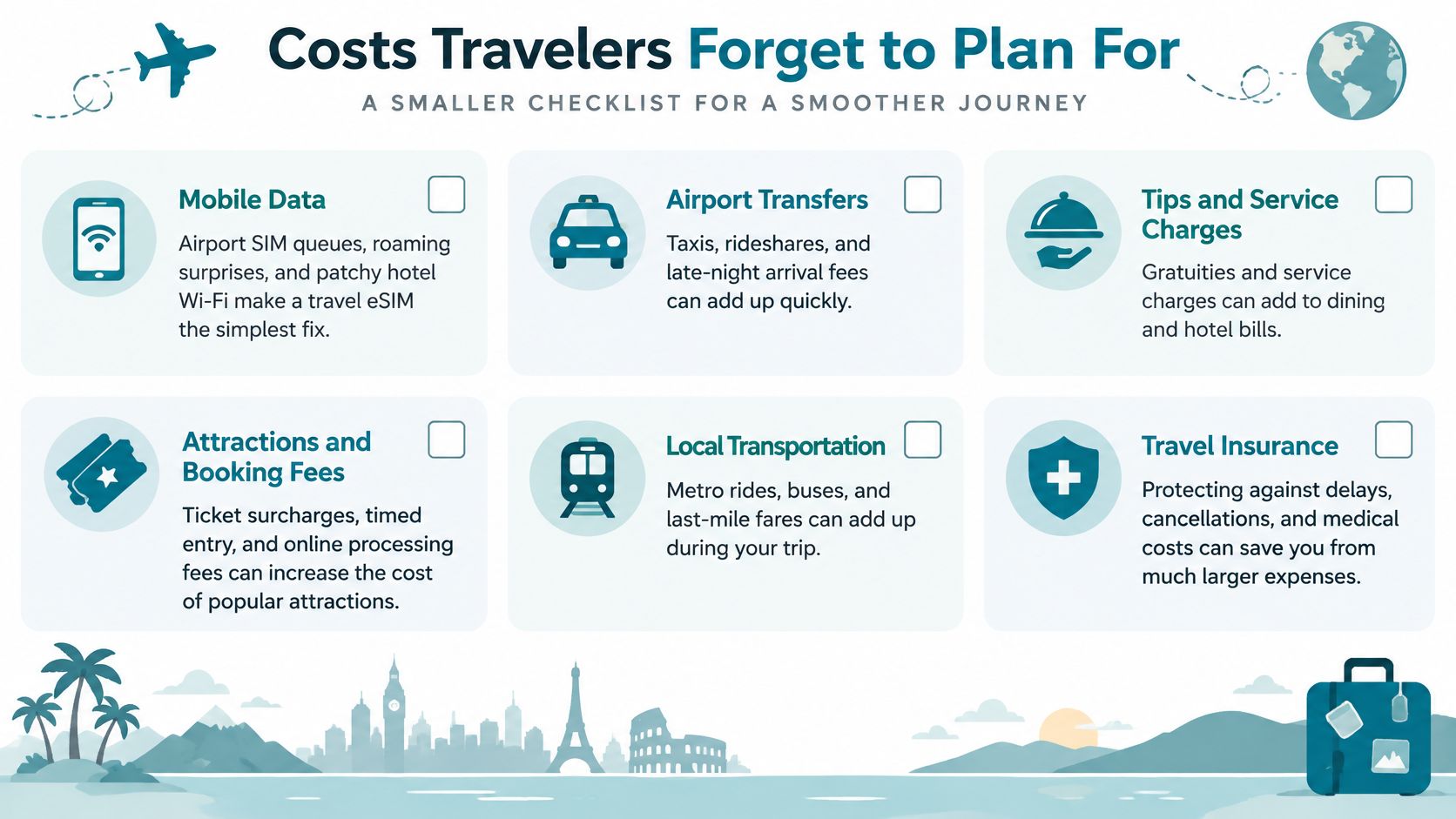
None of these are large individually. Together they typically increase the cost of a week-long trip by a noticeable margin, and they're the reason a 10–15% buffer belongs in every Dubai budget. The same discipline applies anywhere: our Ireland trip cost guide breaks a week down into the same line items so you can compare destinations accurately.
Stop collecting averages and build one number. The formula is daily style budget × nights + flights + a 10–15% buffer. Everything else is refinement.
The order matters. Travelers who book a hotel first and then discover the fee stack, the peak-season premium and the data cost end up revising the whole trip downward. Travelers who fix dates, compare payable totals and cap the discretionary spend stay at the bottom of the band they picked, and a realistic seven-day trip lands near the low end of whichever range they chose, with flights on top.
Simsima sells prepaid travel data for Dubai and the rest of the UAE, installed by QR code or one-tap link before you leave home, so your maps, ride-hailing and translation apps work the moment you land. One plan covers the whole country, top-ups are there if you run low, and your regular number keeps working for calls and texts. Take a look at Simsima and price your data line into the budget alongside the room.
Founder of Simsima. A passionate traveler based in Barcelona, he helps travelers stay connected without breaking the bank on roaming fees.
LinkedIn