-5% on your order in the app
A budget-to-mid-range Thailand trip costs about THB 11,900-23,100 per person for seven days or THB 23,800-46,200 for 14 days, before international flights. A separate seven-night estimate puts budget travel at $345-$615 and mid-range travel at $790-$1,440, also before international airfare.
Those ranges aren't interchangeable currency conversions. They describe different spending assumptions, which is why asking how much does a trip to Thailand cost works best when you also specify your route, room type, and paid activities. A cheap guesthouse and street-food habit won't necessarily produce a cheap vacation if you keep adding flights, checked bags, and island transfers.
What a Thailand Trip Costs per Day and per Week
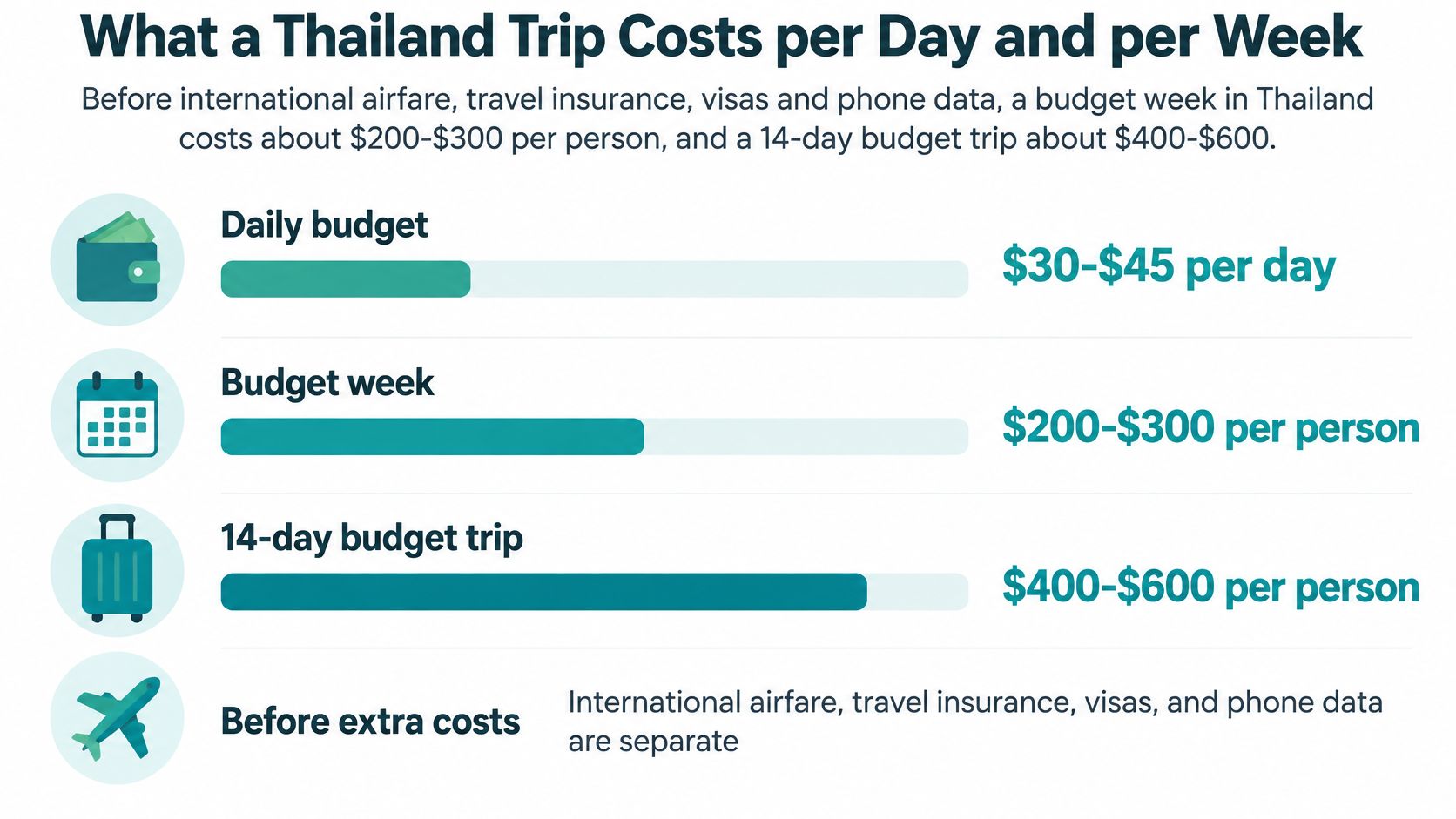
Before international airfare, travel insurance, visas, and phone data, a budget week costs approximately THB 7,000-10,500 per person, while a 14-day budget trip costs THB 14,000-21,000, according to the Visit Thailand Today budget guide. Its broader budget-to-mid-range allowance is THB 1,700-3,300 per day.
The comparison below uses that guide's budget and budget-to-mid-range ranges alongside backpacker and mid-range estimates from Orange Travel's Thailand budget guide. Weekly and fortnightly amounts are calculated by multiplying each daily range by the trip length.
Thailand trip cost per person before flights
| Travel style | Per day (THB) | 7 days (THB) | 14 days (THB) |
|---|---|---|---|
| Backpacker, hostel, street food, local transport | 900-1,800 | 6,300-12,600 | 12,600-25,200 |
| Budget, guesthouse, street food, some activities | 1,000-1,500 | 7,000-10,500 | 14,000-21,000 |
| Budget to mid-range, private room, sit-down meals, taxis | 1,700-3,300 | 11,900-23,100 | 23,800-46,200 |
| Mid-range, air-conditioned room, restaurants, one or two tours | 2,150-3,600 | 15,050-25,200 | 30,100-50,400 |
These are starting allowances, not complete door-to-door vacation prices. International flights, insurance, visas, and phone data remain separate, and an ambitious domestic route needs its own transport calculation.
The visual below summarizes the lower-budget approach.
Choose habits, not a travel label
The published baselines don't fully agree. The backpacker range even overlaps the private-room budget range, so “backpacker” doesn't automatically mean the cheapest possible trip.
Choose the row that resembles how you'll travel. If you want air conditioning, restaurant dinners, and private rides when you're tired, don't build your budget around dorm beds and buses.
At the lower end, you need to make deliberate choices about lodging and paid experiences. At the upper end, you have more room for convenience, but not an unlimited allowance for tours, nightlife, or shopping.
Practical rule: Budget for your tired-day habits, not just your ideal cheap day.
Keep the trip calendar consistent, too. Count hotel nights separately from spending days, especially when an overnight flight means you arrive in the morning but don't leave until late on your final day.
Where the Money Goes on a Seven-Night Trip
A seven-night budget trip runs approximately $345-$615 per person, or $49-$88 per day, while mid-range travel runs $790-$1,440, or $113-$206 per day, in Grey's Thailand trip-cost estimate. Its category breakdown shows what those totals buy.
Seven-night budget by category in US dollars
| Category | Budget (USD) | Mid-range (USD) |
|---|---|---|
| Accommodation | $140-$245 | $350-$630 |
| Food and drinks | $105-$175 | $210-$350 |
| Local transport and entry fees | $70-$105 | $140-$210 |
| Intercity transfers | $30-$90 | $90-$250 |
| Total before international flights | $345-$615 | $790-$1,440 |
The category endpoints sum to the displayed totals. That makes this a useful worksheet, but it doesn't mean every destination will offer the same combination of cheap rooms, convenient transport, and inexpensive attractions.
Accommodation is the largest line in both columns. A simple guesthouse leaves more money for experiences; a hotel upgrade increases what you spend every night, including days when you barely use the room.
Price rooms by destination and occupancy
The hotel benchmarks accompanying Thailand's 2025 economic indicators put the nationwide average daily room rate at approximately THB 1,832, with occupancy near 71%. The accompanying market figures place Bangkok's Q3 2025 average around THB 3,535, with selected Bangkok and Phuket markets around THB 4,182 and THB 5,788, respectively.
Using those room-rate benchmarks, seven nights calculate to approximately THB 12,824 at the nationwide average, versus THB 40,516 at the selected Phuket-market rate. Those aren't budget-hotel quotes, but they illustrate why applying a countrywide hotel average to a resort itinerary doesn't work.
Room rates are per room, not per person. Travelers sharing can divide the room bill; solo travelers should compare guesthouse private rooms with hostel beds rather than assuming a published couple's accommodation allowance will work unchanged.
What each remaining category needs to cover
The food line needs to include drinks and snacks, not just your main meals. A traveler who eats cheaply but orders café drinks and cocktails should record those separately instead of assuming street food makes the whole day inexpensive.
Local transport and entry fees cover movement within your destination and access to attractions. Check whether a tour already includes transport or admission before adding both again.
Intercity transfers cover movement between destinations. Treat that allowance as provisional until you've priced the actual bus, train, ferry, or flight, including connections to your hotel.
Phuket, Koh Samui, and Koh Phi Phi require more caution during the November-February high season, while Chiang Mai generally offers lower prices in the same independent estimate. Confirm lodging by destination first, then convert your total at the exchange rate available when you book.
Domestic Routes That Raise the Total
One domestic flight leg can cost more than several days of street meals. Routing, more than daily spending, is where a Thailand budget swings.
Domestic routes and their added cost
| Route | Typical cost (THB) | Added cost |
|---|---|---|
| Bangkok to Chiang Mai, Krabi or Phuket, flight | 1,000-2,000 | 400-660 for a checked bag |
| Bangkok to Koh Samui, flight | From 2,300 | Date-sensitive fare increases; add baggage and ground transfers |
| Bangkok to Chiang Mai, overnight second-class sleeper train | 800-1,050 | Replaces one night of lodging |
The Thai Travel Guide budget guide puts Bangkok-origin domestic flights at THB 1,000-2,000 plus THB 400-660 for a checked bag, and published transport ranges place the second-class sleeper at THB 800-1,050. Treat the Koh Samui figure as a floor rather than a typical fare: prices there climb with your dates, before baggage and the transfers on each end. Confirm flights on the airline's official site and trains with the rail operator for the month you're traveling.
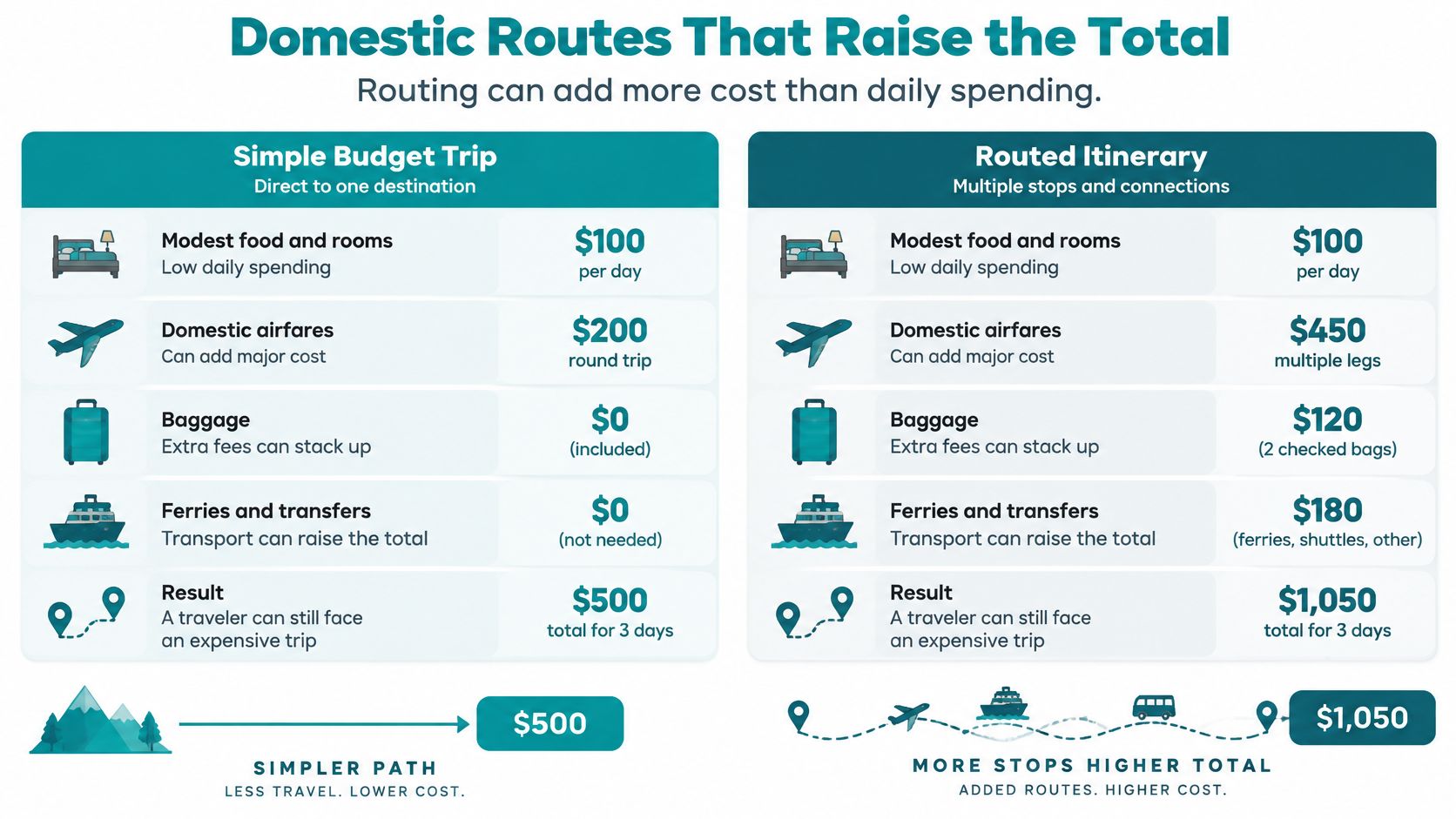
The comparison below shows why a low daily allowance can coexist with an expensive route.
Compare the complete journey
Using the published flight and baggage ranges, one flight leg calculates to THB 1,400-2,660 with a checked bag. Applied to two domestic legs, that produces THB 2,800-5,320 before ground transfers.
For a Bangkok, Chiang Mai, and Phuket itinerary, price each actual route separately. A Bangkok-origin fare doesn't quote Chiang Mai to Phuket, and a forced connection can change the total.
Compare a sleeper train with a flight plus the hotel night it replaces, not just the airfare. The cheaper ticket can still cost more once you count the night of sleep you get, or lose, before the next day.
Dropping the checked bag removes a recurring fee on every leg. If your fare includes a workable cabin allowance, a tighter clothing rotation does the job; HYDAWAY's guide to minimalist wardrobes for overseas travel covers building one that repeats across a multi-stop trip.
For a visual companion to route planning, watch the video below.
Fixed commitments, including flights, transfers, entry charges, and connectivity, belong in a separate column from daily rooms, meals, and activities. Each added transport leg moves the total more than trimming a day's spending does; a national daily average gives you a baseline, and the route map decides the rest. Plan the fewest transport legs that still cover the places you want to visit.
Food and Local Transport Prices, Item by Item
Street food, trains, and boats look inexpensive line by line. The daily total changes when sit-down meals and repeated taxis become the default.
The street-food and public-transit figures below come from Traveldojo's Thailand cost guide, which gives a practical food allowance of THB 300-500 daily and a local-transport allowance of THB 100-200 daily, totaling THB 2,100-3,500 and THB 700-1,400 for seven days or THB 4,200-7,000 and THB 1,400-2,800 for 14 days. Treat the restaurant and metered-taxi rows as broad planning comparisons because venue and distance change the outcome.
Common food and transit prices
| Item | Typical planning range (THB) | Use it to estimate |
|---|---|---|
| Street dish, pad Thai, boat noodles or chicken rice | 50-80 | A lunch or dinner baseline |
| Som tam, green papaya salad | 40-60 | A cheap lunch |
| Mango sticky rice | 60-100 | A dessert or snack line |
| Mid-range restaurant meal | 150-350 | A sit-down dinner |
| Metered Bangkok taxi ride | 80-150 | A typical short city trip |
| BTS Skytrain or MRT ride | 17-62 | Fare rises with distance |
| Airport Rail Link, full journey to Phaya Thai | 45 | An airport transfer |
| Chao Phraya Express boat, orange flag | 16 | A flat fare |
The food allowance covers more than three street dishes. Leave room for breakfast, drinks, snacks, and meals priced above the lowest table entries; one restaurant dinner can absorb much of the lowest daily allowance.
Save on the journey, not just the meal
Choosing a mid-range restaurant meal instead of a street dish adds roughly THB 70-300 across the range. Choosing a metered taxi instead of a train adds about THB 20-130 per ride.
The exact saving depends on the venue, distance, and whether the fare is shared. A taxi can make sense when several people split it, luggage makes rail awkward, or a destination is difficult to reach by train or boat.
Cluster nearby stops before booking private rides. Repeated cross-city journeys are an avoidable expense.
Before choosing a private ride to a saved café or attraction, check a route-specific resource such as the directions to Little Zoo Garden, then compare its endpoint with the nearest train, boat, walking route, or taxi.
Use the same check for every attraction: find the closest public stop, inspect the final connection, and group nearby places. For itinerary sequencing and related planning decisions, our Thailand travel tips can help. Plan by geography so saved map pins do not send you back across the city.
Phone Data and Fixed Costs to Budget Separately
Phone data is a fixed line item, and it can move the trip total more than a few meal upgrades. For a seven-day trip, look for a plan that stays valid through departure; for a 14-day trip, choose enough validity to avoid buying another short package. Validity, usable data, and hotspot access matter more than the headline daily price.
The official AIS tourist-plan page lists unlimited tourist plans at THB 399 for five days, THB 499 for eight days, THB 699 for 15 days, and THB 1,199 for 30 days, plus a 60-day unlimited option at THB 1,599. Confirm current plan details on the AIS site before buying, then match validity to your route so you do not pay twice for overlapping days.
That makes the eight-day option a possible fit for a seven-day visit and the 15-day option a possible fit for a fortnight. Check when validity begins, especially if you're installing before departure, because an early activation can leave the last day uncovered.
Check what unlimited actually delivers
Unlimited data does not always mean unlimited maximum-speed data. Read the terms for fair-use thresholds, reduced speeds, hotspot restrictions, activation requirements, and whether the package supports the tasks you need.
A remote worker should check tethering before relying on phone data for a laptop. Download offline maps and keep hotel addresses available offline so an activation problem doesn't force an unnecessary taxi or airport purchase.
For data without swapping a physical SIM, consider our prepaid Simsima Thailand travel eSIM, after checking device compatibility and the selected plan's terms. Simsima serves travelers to the United States, Japan, Thailand, Turkey, Spain, Italy, the United Kingdom, the United Arab Emirates, Mexico, and Europe.
Add costs that aren't daily spending
- International airfare: Get an actual quote for your departure city and dates, including baggage and connections.
- Travel insurance: Price coverage for your itinerary and intended activities, not just the cheapest available policy.
- Entry requirements: Check official immigration or embassy information for your nationality.
- Payment and emergency costs: Leave money available for exchange-rate changes, payment charges, or an unexpected change of plans.
Phone data is a separate commitment rather than a reason to inflate every daily category. Choose it once, record it clearly, and avoid paying for overlapping validity.
Build Your Own 14-Day Budget Before You Book
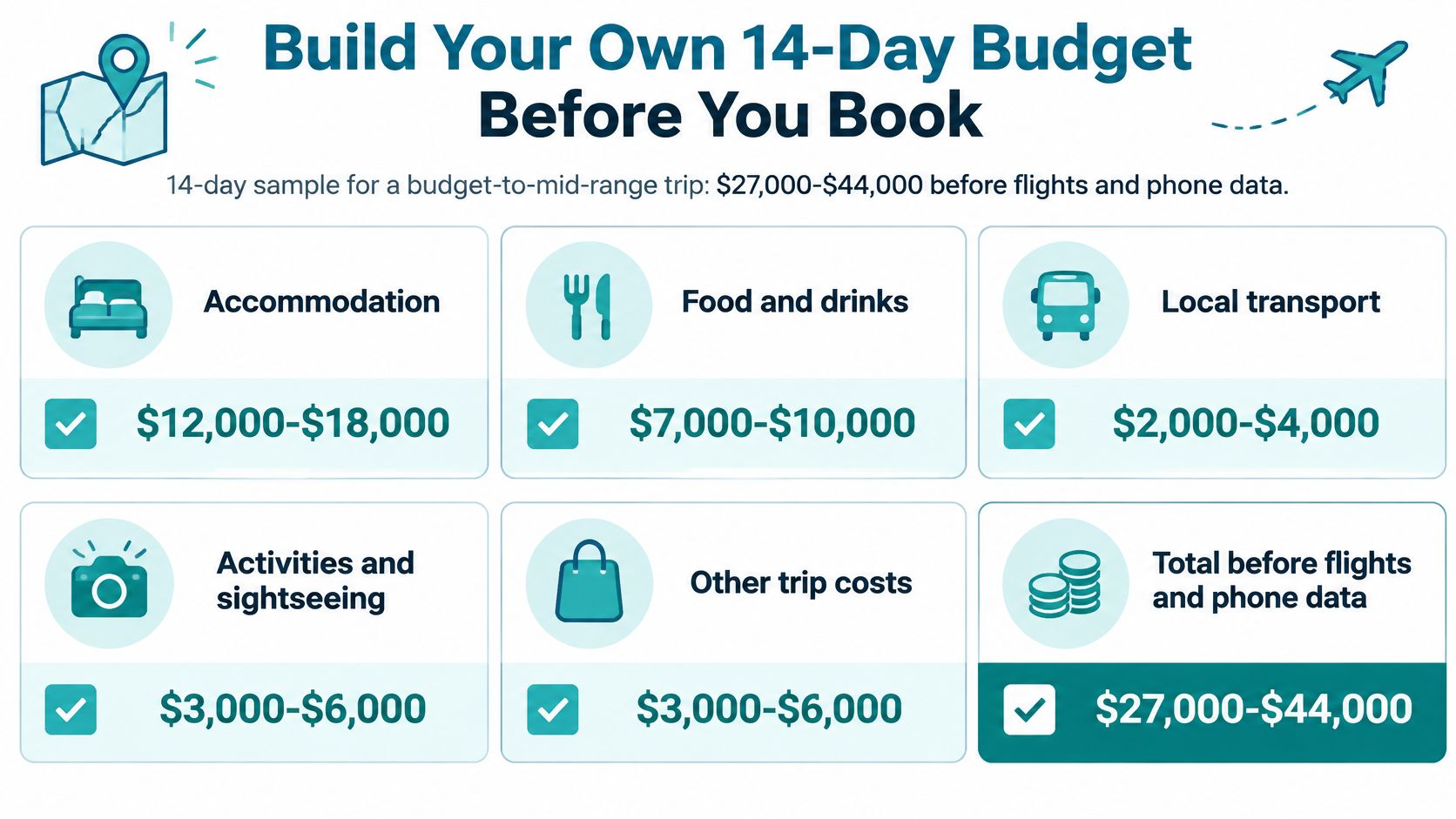
A published budget-to-mid-range example totals THB 27,000-44,000 before international flights and phone data, using Visit Thailand Today's accommodation, food, internal-transport, and activity allowances. The breakdown is THB 12,000-18,000 for accommodation, THB 7,000-10,000 for food and drinks, THB 4,000-8,000 for internal transportation, and THB 4,000-8,000 for activities and entry fees.
Internal transportation is already included, so don't automatically add every domestic journey again. Replace that allowance with your actual route total, or add only costs it doesn't cover.
The planning visual below accompanies the worksheet. Use THB for your calculations, rather than treating dollar symbols in a graphic as a currency conversion.
Why the national average isn't your target
A 2025 tourism-spending estimate reported by Travel and Tour World puts international visitor spending around THB 4,865 per day, with an average stay of 9.89 days, implying approximately THB 48,135 per trip before international airfare, insurance, and visa-related costs. That's a tourism-receipts benchmark covering accommodation, dining, shopping, entertainment, transport, and other spending, not a required personal allowance.
A Finansia Syrus tourism analysis separately estimates average foreign-tourist spending around THB 46,000 per trip, compared with roughly THB 20,000 for visitors from Malaysia. Different trip lengths and visitor mixes help explain why national totals don't tell you what your own vacation should cost.
Turn the estimate into a booking budget
- Choose your travel style. Start with the daily allowance closest to your actual habits.
- Count nights and spending days. Use the daily allowance for days and actual room quotes for nights.
- Price each destination. Replace a generic lodging estimate with rooms you'd book.
- Build the route total. Include baggage, airport transfers, ferry connections, and any overnight accommodation saved.
- Add fixed commitments. Enter the phone plan, insurance, applicable entry costs, and international airfare. Record the month and year of official-site fare checks.
- Choose your buffer. Keep exchange-rate and emergency money separate from planned spending.
If you prefer firm category limits, The Money Maniac's envelope budgeting pros and cons can help you decide whether separate spending pots suit you. Then match your numbers to the destinations and pacing in our two weeks in Thailand guide.
Simsima offers prepaid travel eSIM data plans you can budget separately from flights, hotels, and daily spending. Visit Simsima to compare Thailand options, check validity and device compatibility, and choose your connectivity before departure.
#Thailand trip cost#Thailand travel budget#Thailand itinerary costs#Thailand phone data

Dimitri MorvanFounder
Founder of Simsima. A passionate traveler based in Barcelona, he helps travelers stay connected without breaking the bank on roaming fees.
LinkedIn