-5% on your 1st eSIM
WELCOME5
Loading...
Understand roaming charges international and learn how to avoid expensive fees on your 2026 travels. Simple tips for worry-free connectivity abroad.
 Dimitri Morvan
You land, switch off airplane mode, and your phone wakes up before you do. Maps refresh. Email syncs. Your ride app checks your location. A weather widget updates in the background. Nothing feels dramatic.
Then the bill arrives weeks later.
That's why roaming charges international still catch smart travelers off guard. The problem usually isn't one giant mistake. It's a series of tiny automatic handoffs your phone makes while you're dragging a suitcase through arrivals, crossing a land border, or sitting on a plane that connected to the wrong network for a moment.
Most guides treat roaming like a simple price list. They tell you to compare day passes, local SIMs, and eSIMs. That helps, but it misses the deeper issue. Roaming is a pass-through cost stack. Your carrier is buying access from another carrier, then passing that cost to you through its own retail rules. If you understand that chain, roaming stops feeling random.
It also helps explain why some of the worst surprises have nothing to do with heavy usage. A phone can roam without an active call. It can roam while sitting in your pocket. It can roam by accident near borders, on ferries, or during multi-country trips when automatic network selection grabs the wrong signal.
This guide is for the traveler who wants control without telecom jargon. Maybe you're planning a Europe trip with several train crossings. Maybe you're flying long-haul and want to avoid inflight surprises. Maybe you've heard eSIMs can help but aren't fully sure how they fit with your regular number.
By the end, you'll know what your phone is doing abroad, why roaming prices get inflated, where regional rules protect you and where they don't, and how to choose a setup that won't leave you guessing at baggage claim.
A familiar scene: you land after a long flight, turn your phone back on, and see signal bars almost instantly. That feels reassuring. It also starts the meter if your device connects through a foreign network under your home carrier's roaming terms.
The ugly part is that roaming charges international rarely announce themselves clearly. You may get a welcome text from your carrier, but the expensive activity often starts before you've read it. Your phone doesn't wait for you to open a browser. It starts behaving like a phone that has just regained internet access.
Think about the first half hour of a trip. You check the gate, message family, open Google Maps, maybe order a car. Meanwhile, cloud photo backup, app updates, email sync, and messaging apps may all be active behind the scenes.
That's why people say, “I barely used my phone,” and still end up confused. They're often telling the truth.
What matters most is not just what you do on your phone, but what your phone does on its own.
Another source of confusion is that travelers often assume “roaming” means making calls abroad. It doesn't. Data roaming is often the bigger trap because so many apps depend on it constantly. Voice, SMS, and data all roam differently, but they start from the same basic event: your phone is no longer on its home network.
Single-destination vacations are simpler. Multi-country travel is where mistakes pile up. A train ride across borders, a layover in a different region, a ferry, or a quick airport connection can all trigger a new network relationship.
Common trouble spots include:
Once you see roaming as a chain of invisible handoffs instead of a simple travel fee, the rest starts to make sense.
Your phone works abroad because it borrows access. That's the core idea.
When you leave your home country, your carrier usually doesn't own towers where you've arrived. So your phone searches for a visited network, and that foreign carrier checks whether it has an agreement with your home operator. If the answer is yes, your phone is allowed onto the network.
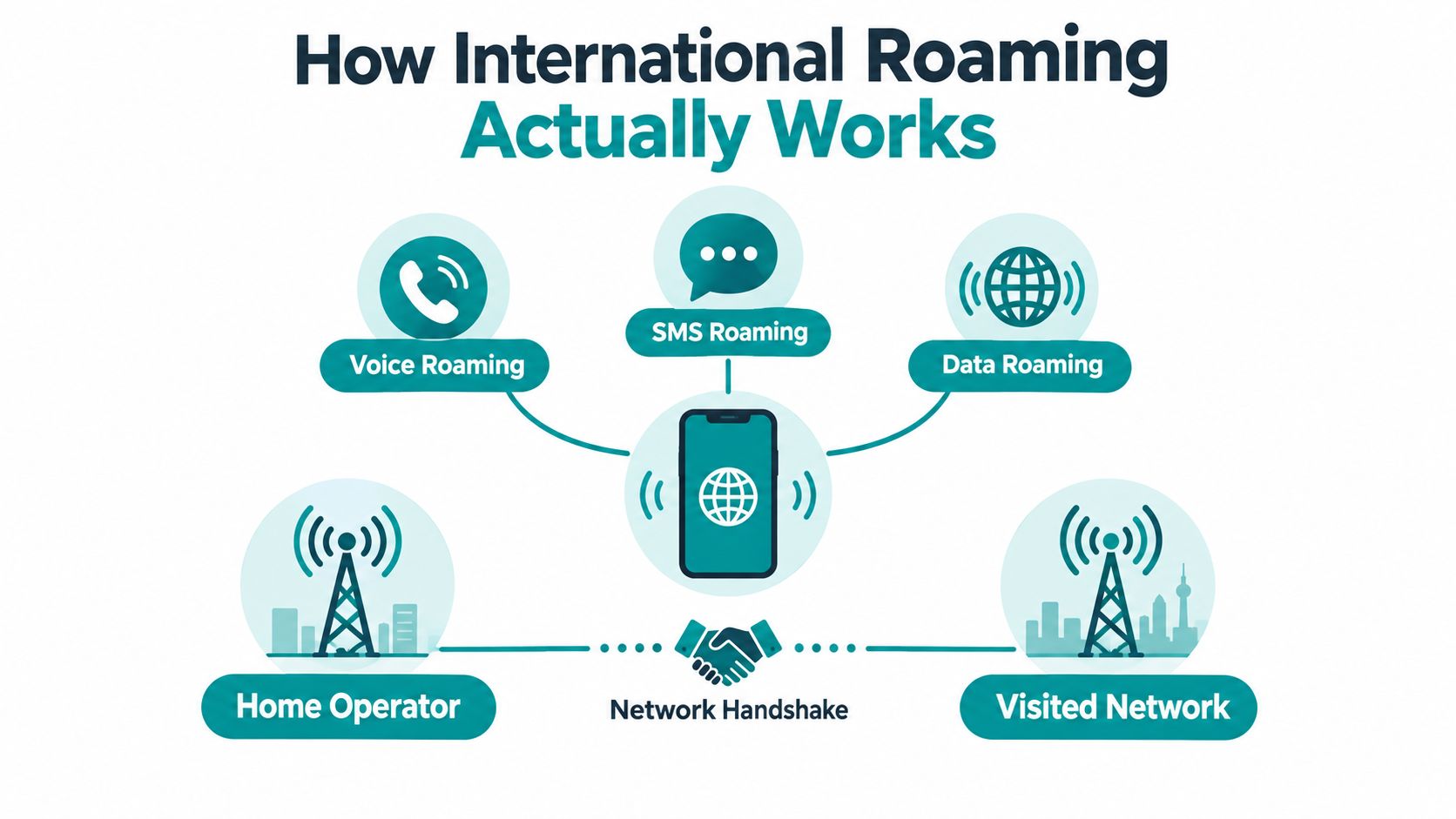
Your home carrier is like the company that issued your driver's pass. The visited network owns the roads where you're currently traveling. Your phone asks, “Can I drive here?” The visited network says, “Yes, but I'm charging your carrier for every trip.”
That borrowed access can cover three different services:
Data tends to feel invisible because there's no obvious action attached to it. You notice a call. You don't notice your weather app checking in.
A lot of travelers think roaming begins only when they open an app. In reality, the connection starts when the phone joins the foreign network and mobile data is available.
That means these quiet actions can trigger usage:
Your phone doesn't distinguish between “important travel use” and “routine housekeeping.” If mobile data is allowed, both can happen on a roaming connection.
Phones usually choose networks automatically. That's convenient in most places, but near borders it can become messy. You may be standing in one country while your phone connects to a stronger signal from another.
That's one reason roaming charges international can feel unfair. From the user's point of view, nothing changed. From the network's point of view, everything changed. Your phone crossed from home access to borrowed access, and billing followed that shift.
If you remember one thing, make it this: roaming is not a special app or a one-time fee. It's your phone using somebody else's network under a commercial agreement you usually don't see.
Your roaming charge is usually a passed-through stack of costs, not a simple price for data, calls, or texts.
A useful way to picture it is a travel toll system. Your phone's home carrier does not own the road in the country you are visiting. It pays the local carrier for access, then adds its own billing rules, risk buffer, and margin on top. By the time that charge reaches your bill, the number can look strangely high compared with what local residents pay for the same network.
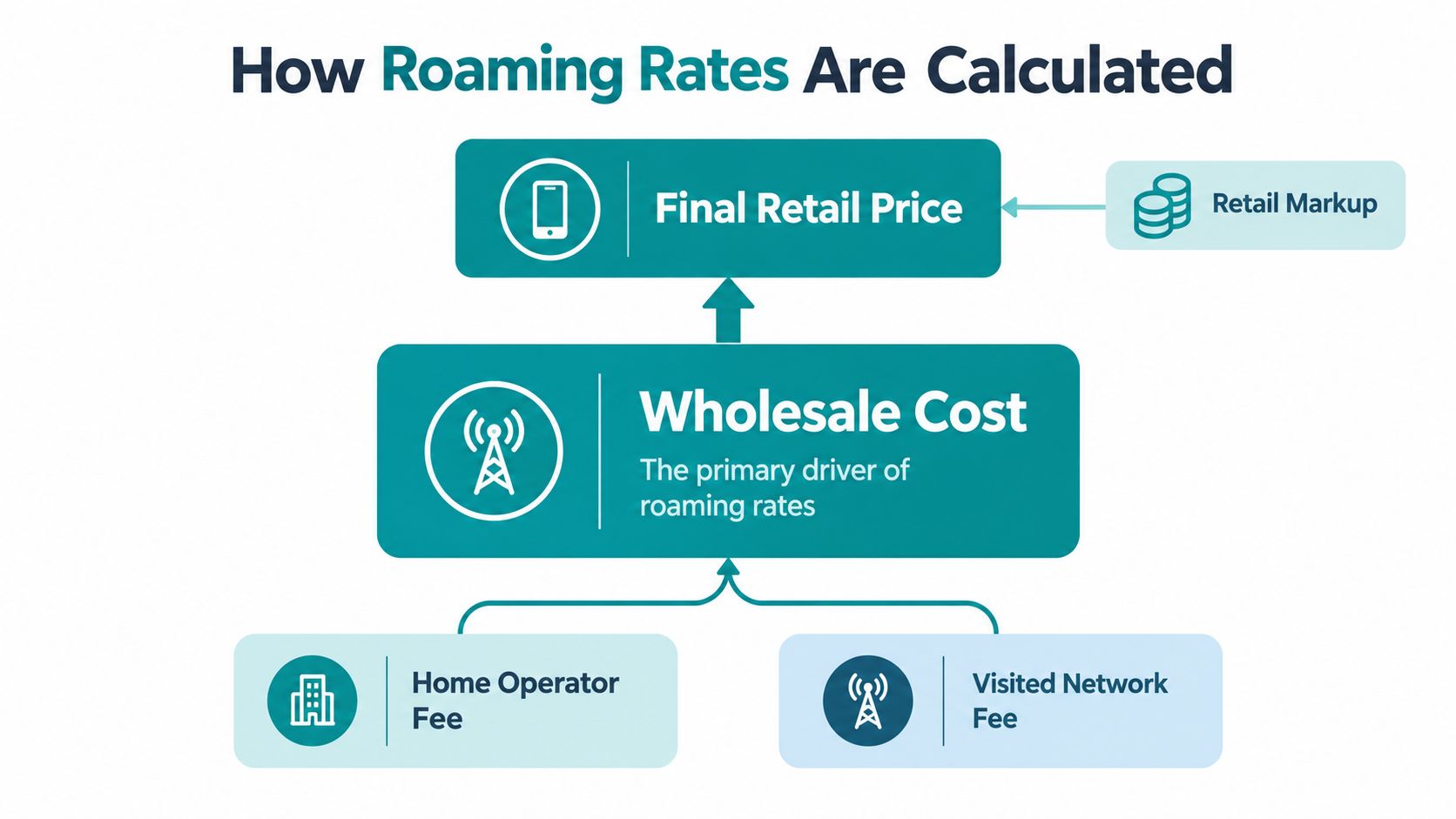
An ITU roaming analysis says the wholesale rate can account for around three quarters of the retail rate, and wholesale roaming charges have frequently exceeded USD 2 to 3 per minute, sometimes more than USD 4 per minute.
That changes how you should read roaming offers. If the underlying access fee is already expensive, a retail plan can look overpriced even before your carrier adds anything. The sticker shock often begins upstream.
Roaming did not grow out of the same pricing logic as local mobile service. The OECD's work on international mobile roaming describes roaming as a long-running high-cost issue across OECD countries, and notes that until 1998 wholesale charges were calculated using the visited operator's normal network tariff plus additional margins.
That history still matters. Local data prices in your destination might be cheap because domestic competition pushed them down. Your roaming price can stay high because it sits on older inter-carrier charging rules that were built separately.
This also explains a common traveler misunderstanding. A carrier may advertise a low per-GB roaming add-on in one country, then charge much more in the next one because the wholesale agreement underneath changed. On a multi-country trip, the trap is often the country transition, not the first day of use.
Europe is the clearest example of that. The EU roaming history summary notes that roam-like-at-home took effect on 15 June 2017 and was extended by the 2022 roaming regulation, which is scheduled to apply through 30 June 2032. It also lists declining wholesale data caps at EUR 2.00 per GB from 2022, EUR 1.80 in 2023, EUR 1.55 in 2024, EUR 1.30 in 2025, EUR 1.10 in 2026, and EUR 1.00 from 2027 onward, as scheduled.
The lesson is simple. Retail prices abroad usually come down only when regulators or market pressure push down the wholesale fee first. If your carrier must pay a high access charge to a foreign network, low retail roaming is harder to offer consistently.
One earlier EU example shows the stack clearly. The OECD's detailed review of the EU roaming regulation notes that the EU's 2007 rules set a maximum average wholesale charge of EUR 0.30 per minute for outgoing intra-Community calls, while retail Eurotariff ceilings were EUR 0.49 per minute for calls made and EUR 0.24 per minute for calls received.
Practical rule: The cheapest roaming option is often the one that cuts your exposure to wholesale pass-through costs, especially on border crossings and multi-country itineraries, not the one with the nicest headline rate.
That is why roaming charges international can feel arbitrary to travelers. They are often paying for a chain of carrier-to-carrier charges they never see, plus the risk of connecting to the wrong partner network at the wrong moment. Once you view roaming as a wholesale cost stack, those odd jumps in price start to make sense.
You land in Vienna, take a train, and an hour later your phone grabs a tower across the border. Nothing about your trip feels dramatic. Your bill may disagree.
That is why carrier policy matters as much as the posted rate. Roaming charges international are shaped by regional rules, partner deals, and the exact networks your phone touches for a few seconds at a time.
The European Union changed the traveler experience by limiting extra roaming surcharges for ordinary travel use under roam-like-at-home. That made the bill easier to predict for many trips inside the bloc.
Confusion did not disappear. A BEREC input on the EU roaming regulation%2048%20BEREC%20input%20to%20the%20EC%20on%20the%20Roaming%20Regulation.pdf) says inadvertent roaming is the most common consumer complaint, and insufficient information about tariffs and conditions is another major source of complaints. The pattern makes sense. Lower prices help, but your phone still makes automatic network choices in the background.
A useful comparison is a rental car crossing toll roads. Even if many roads are covered, the expensive mistakes happen at the edges, at handoffs, and when the billing rules change without a clear warning.
Beyond Europe, carriers usually sort countries into zones and rely on partner agreements that are not visible to travelers. Two neighboring countries can sit in different pricing buckets. One airport stop can trigger a day pass. One ferry, cruise, or inflight connection can push your phone onto a completely different billing path.
That is the part many price guides miss. The risk is not only the advertised per-GB rate. The risk is the hidden cost stack behind the network your carrier chooses to buy from in that place, at that moment.
| Situation | What usually changes | Why it catches travelers off guard |
|---|---|---|
| EU travel | Broad consumer protections apply in many common travel cases, with the framework scheduled to apply through 30 June 2032 under current EU rules | Travelers assume that means all border areas are safe, but accidental network attachment can still happen |
| Non-EU country pairs | Pricing may depend on separate carrier-to-carrier agreements | Neighboring countries can produce very different charges even on one itinerary |
| Border zones | Your phone may attach to the strongest signal, not the country you believe you are in | A hotel, train, or roadside stop near a border can trigger unintended roaming |
| Layovers, ferries, and flights | Service may switch away from normal ground networks | A short connection can create charges before you notice the network name changed |
| Multi-country trips | One plan may cover some stops but not others | Travelers often compare one headline rate and miss the uncovered country in the middle |
For the full rate history and wholesale cap background, see the earlier section. Here, the practical point is simpler. Coverage maps and rate cards do not tell you much about handoff risk.
Some of the highest roaming bills come from moments that feel too brief to matter.
A Council of the European Union document discussing BEREC findings also notes ongoing bill shock risk outside the EU and references disputes involving unusual roaming situations, including inflight use. That is a good reminder that the trouble spots are often the least visible ones.
The practical question is not “what is the roaming rate?” The better question is “which networks could my phone attach to on this exact route?” That is how you spot the trap before the bill does.
Once you understand the cost stack, the choice becomes less about fear and more about fit. You're deciding how much control you want, how many countries you're visiting, and whether keeping your home number matters.
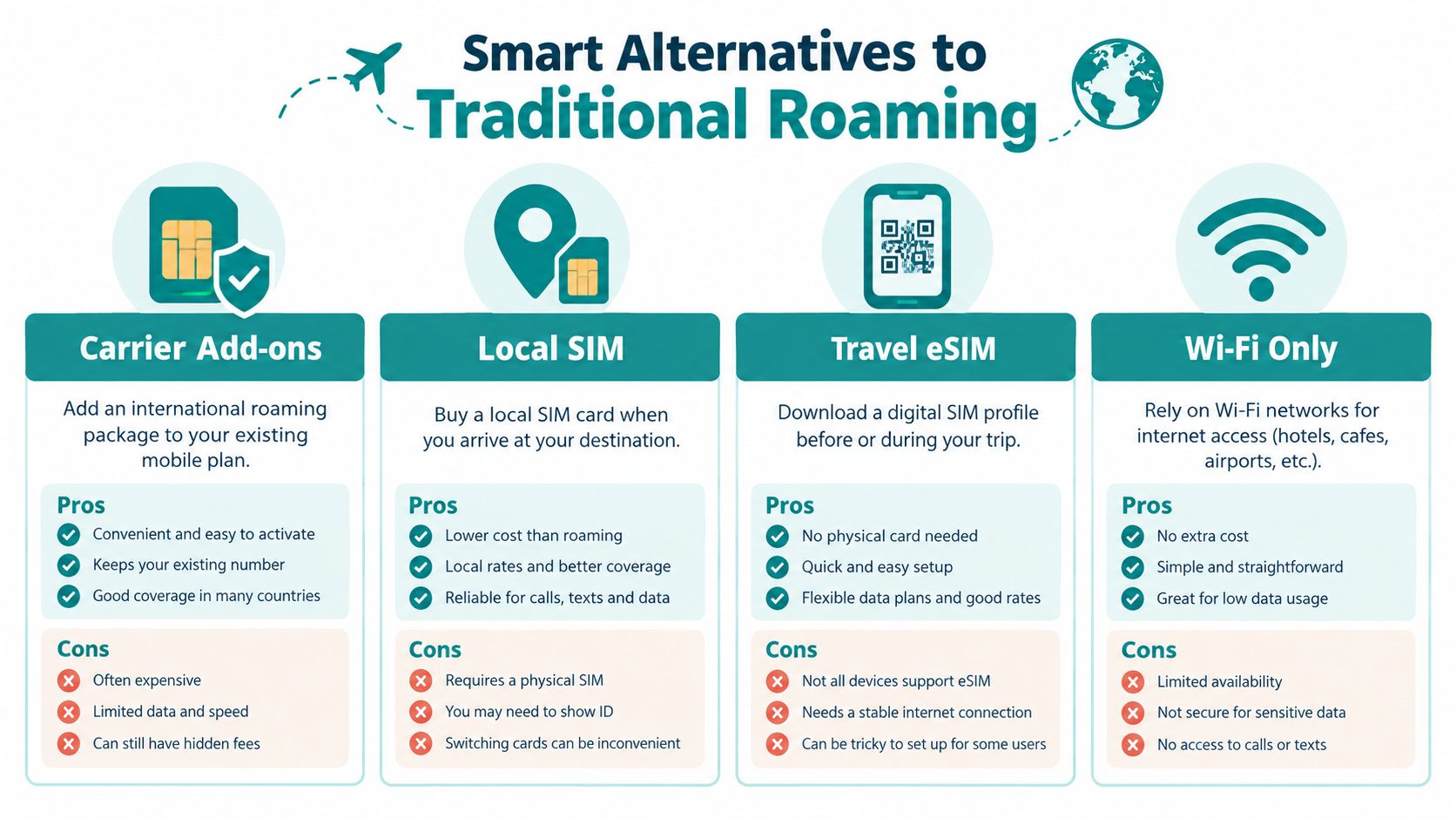
Here's the practical comparison.
| Option | Best for | What you gain | What to watch |
|---|---|---|---|
| Carrier add-ons | Short trips, minimal setup | Familiar billing, no SIM change | Can still be tied to carrier roaming rules and zone complexity |
| Local SIM | Longer stays in one country | Local pricing logic, often simple once installed | Requires swapping SIMs and may interrupt access to your regular number |
| Travel eSIM | Multi-country travelers, people who want setup before arrival | Prepaid data, digital setup, easy to keep primary number active on many phones | Requires eSIM-compatible and usually unlocked devices |
| Wi-Fi only | Light users, backup strategy | No mobile data billing when cellular stays off | Unreliable outside hotels, airports, and cafés |
A lot of travelers end up comparing eSIM vs roaming for international travel because those two options preserve the feeling of using your own phone normally, without hunting for a kiosk after landing.
A single-country beach vacation is different from a rail trip across Europe.
Later in the decision process, some travelers look at marketplaces such as Simsima, which offers prepaid travel eSIM plans for 190+ countries and regional options, including data-only plans that let you keep your regular number for calls and SMS.
A quick visual walkthrough can help if you're weighing those trade-offs in real time:
The best option isn't universal. It depends on whether you care most about predictability, convenience, or flexibility across borders.
If your main goal is no surprise billing, prepaid options usually feel calmer because spending is bounded upfront. If your main goal is zero setup friction, your carrier's add-on may still be worth it. If your trip crosses several countries in quick succession, that's where traditional roaming often becomes the least elegant choice.
Good roaming control starts before the airport. The best time to fix settings is while you're still at home, rested, and on trusted Wi-Fi.
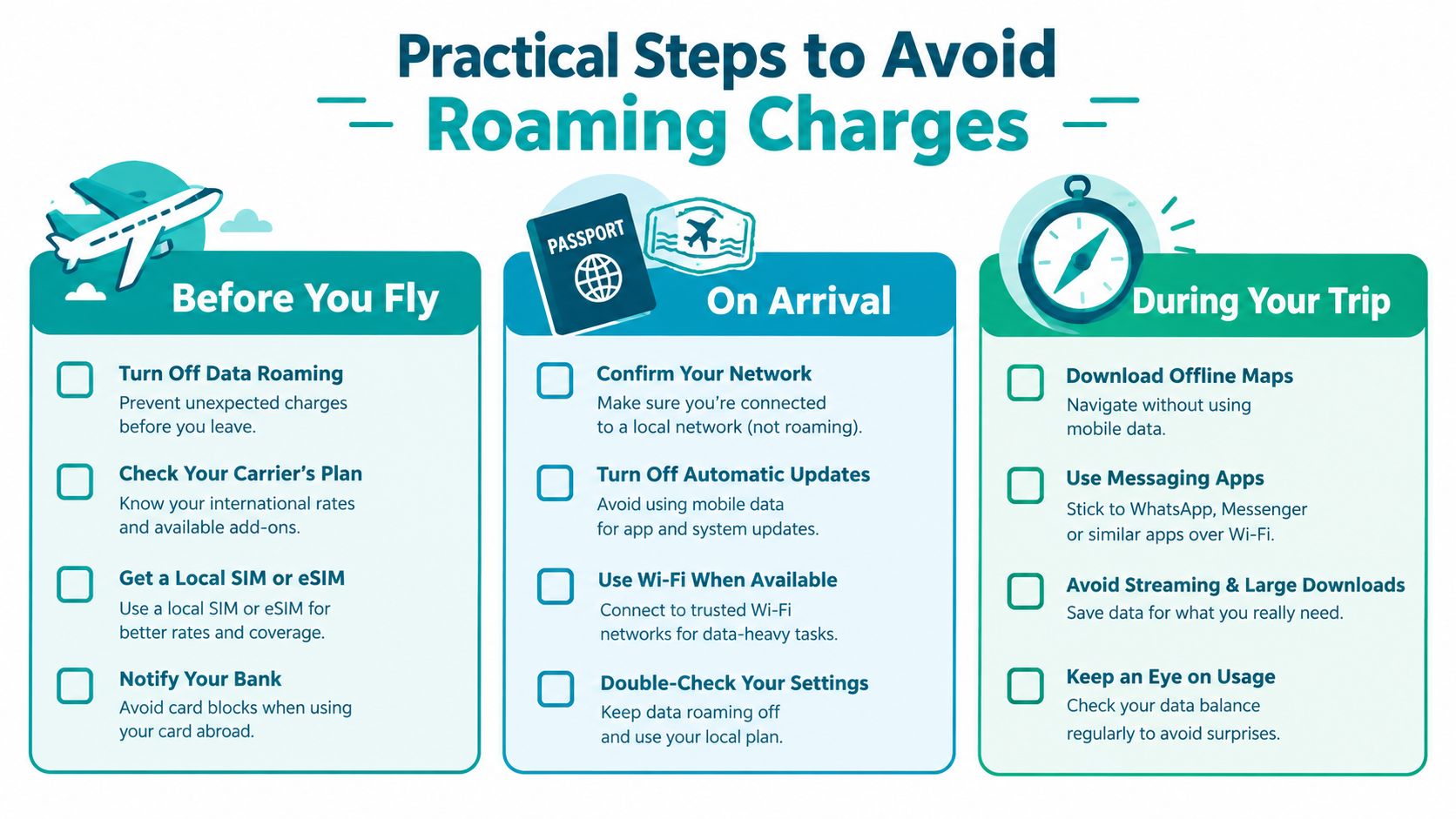
A short setup check prevents most accidental roaming.
The first few minutes matter most because that's when your phone tries to catch up on everything it missed.
If your trip includes a border crossing, treat network selection like navigation. Automatic isn't always safer.
A few habits keep roaming charges international from creeping back in.
Don't ignore it and hope it sorts itself out.
Take screenshots of network names, travel times, and device settings. Keep boarding passes if an inflight connection is involved. Roaming disputes often depend less on broad arguments and more on whether you can show exactly when and where the connection likely happened.
That evidence is boring to collect and very useful to have.
The simplest way to choose is to match your setup to the shape of your trip.
If you're taking a short visit to one country and want the least effort, a carrier add-on may be enough. If you're staying longer in one place, a local SIM can still make sense. If you're crossing borders, want prepaid control, and don't want to remove your main SIM, a travel eSIM is often the neatest fit. If you barely need mobile access, Wi-Fi only can work, but only if you accept the trade-off.
The big takeaway is that roaming charges international aren't mysterious. They come from a visible pattern once you know where to look. Your phone borrows another network. That network charges your carrier. Your carrier passes the cost through under its own rules. The risk goes up when your trip includes border crossings, flights, ferries, or multiple countries with different partner arrangements.
For your next trip, decide three things before you leave:
If you want a planning shortcut, compare your trip profile against options like local SIMs, carrier passes, and prepaid eSIMs, then review a destination-specific guide such as this breakdown of the best phone plan for international travel.
A calm travel setup usually beats a technically perfect one. If your phone connects the way you expected, and your bill looks the way you expected, that's the win.
Simsima offers prepaid travel eSIM data plans for 190+ countries, plus regional plans for trips that cross borders, so you can set up data before departure and avoid traditional roaming surprises. If you want a digital option that keeps your regular number available for calls and SMS on your main line, take a look at Simsima.

Founder of Simsima. A passionate traveler based in Barcelona, he helps travelers stay connected without breaking the bank on roaming fees.
LinkedIn