Guides & news
Blog
Discover our latest guides, travel tips, and mobile tech news.
How it works
Learn how to install and use your travel eSIM in a few steps.
Loading...
Guides & news
Blog
Discover our latest guides, travel tips, and mobile tech news.
How it works
Learn how to install and use your travel eSIM in a few steps.
eSIM for 190+ destinations
Online when you land · 14-day refund if not activated
eSIM for 190+ destinations
Travel eSIM
Verizon TravelPass cost is $12 per day abroad and $6 in Canada and Mexico. See 7- and 14-day totals, data limits and cheaper options.
 Dimitri MorvanNovember 16, 202616 min
Verizon TravelPass costs $12 per line for each 24-hour session abroad, or $6 in Canada and Mexico, so seven days of use costs $84 at the standard rate or $42 in Canada or Mexico before taxes and fees. Your actual bill can be lower if you don't use the line every day or your domestic plan already includes roaming benefits.
The more revealing question is how much usable high-speed data you're buying. A daily roaming fee can look manageable until you multiply it by the trip length, the number of phones, and any extra data needed for work. For travelers who use a laptop hotspot or join video meetings abroad, the headline daily price isn't a complete budget.
A 14-day trip at the standard rate produces a $168 TravelPass charge per line before taxes and fees, and that is only the base figure. Verizon's published international pricing lists $12 per line per session in standard participating destinations and $6 in Canada and Mexico on its international travel page. Confirm the current rates there before departure, since carrier pricing changes.
TravelPass cost by trip length and rate
| Trip length | Standard rate ($12 per day) | Canada or Mexico ($6 per day) |
|---|---|---|
| 1 day | $12 | $6 |
| 3 days | $36 | $18 |
| 7 days | $84 | $42 |
| 10 days | $120 | $60 |
| 14 days | $168 | $84 |
These are maximum base TravelPass charges per line for the stated number of active sessions, assuming the phone is used every day. They aren't an all-in ceiling: taxes, fees, and optional high-speed-data purchases can increase the bill, while plan benefits can reduce it.
A day without chargeable cellular activity doesn't create a TravelPass charge. Days spent in the United States don't incur TravelPass charges either, so don't automatically multiply the fee by every date on your vacation calendar.
The daily fee also offers different value depending on the traveler. Two lines paying the same $84 for a week can end up with very different amounts of usable high-speed data, which is why the honest comparison is cost per gigabyte you need rather than cost per day.
For a hypothetical family of four whose phones are all active throughout a week in a standard destination, the arithmetic is four lines × seven sessions × the standard daily rate = $336 before taxes and extras. That's a household calculation, not a family package price. The same math at the Canada or Mexico rate comes to $168, and stretching the trip to 14 days doubles both figures.
The useful distinction is between trip days and active sessions. A departure day spent on airport Wi-Fi doesn't belong in the calculation unless the line starts a paid session abroad.
Similarly, a traveler who uses only a travel eSIM for data may still trigger Verizon billing through a qualifying call or text. Choosing a different data connection doesn't automatically make the regular line free to use.
Budgeting rule: Count the active sessions abroad for each line, multiply by the applicable destination rate, then adjust for included benefits and extra data.
Treat the table as your starting budget. Check the exact domestic plan attached to each traveling line rather than assuming everyone on the account has identical international benefits, because a single included line can shift the household total by a full $84 or $168.
TravelPass bills for usage-triggered sessions, not individual minutes, messages, or megabytes. According to Verizon's TravelPass FAQs, making or answering a call, sending a text, or using cellular data starts a 24-hour session in a participating destination.
Say you land, connect to a local network, and leave your phone untouched while using airport Wi-Fi. Connecting to the foreign network alone isn't the chargeable action. Opening a navigation app that uses Verizon cellular data, however, starts the session.
The activation flow is illustrated below.
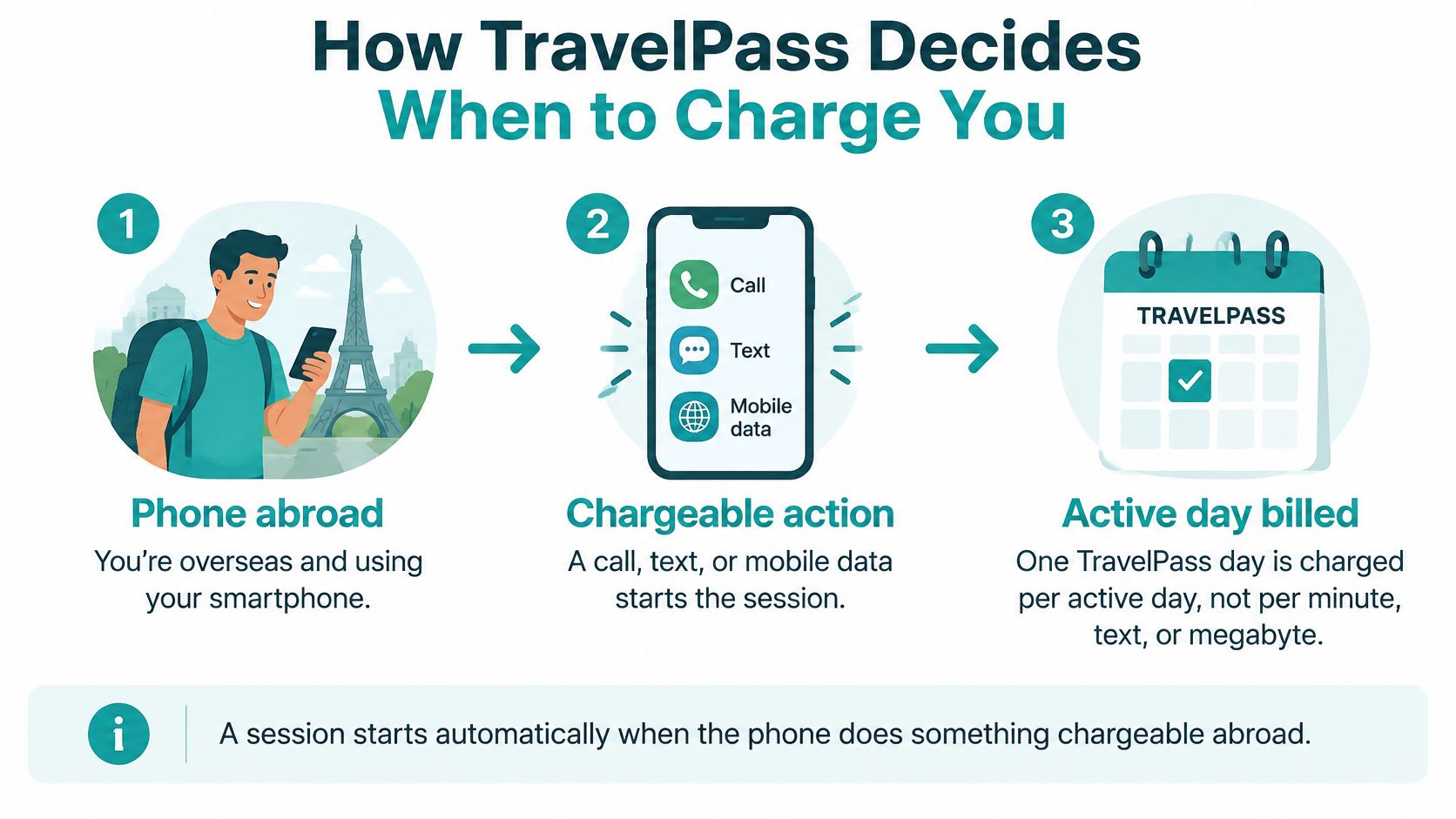
This matters when you're planning occasional use. If you activate service late in the afternoon, you shouldn't assume the benefit ends when that calendar date changes.
For a hypothetical traveler using the phone during five distinct standard-rate sessions, the base calculation is $60. The traveler doesn't pay for unused travel days because TravelPass remains available on the line.
Canada and Mexico need a separate plan check. The lower TravelPass rate applies when your domestic plan doesn't already include the relevant roaming benefits.
Some Verizon Unlimited plans already include calling, texting, and data in those countries. For covered use, the additional roaming cost can therefore be zero, rather than the lower daily TravelPass charge.
For another explanation of the service, watch this overview.
On days you don't need Verizon cellular service, turn off cellular data and data roaming for that line to prevent background-data activation. That doesn't block every possible trigger: making or answering calls and sending texts can still start a session.
If your goal is to prevent all Verizon cellular use, disable the Verizon line or use airplane mode with Wi-Fi enabled. Don't confuse removing a roaming feature with blocking roaming usage, because the latter is what controls whether the phone can generate charges.
Unlimited data doesn't mean unlimited high-speed data. The Verizon TravelPass perk page specifies 5 GB of high-speed data per 24-hour session, followed by data at 3G speeds; consuming the full allowance at the standard daily rate implies $2.40 per included high-speed gigabyte, although calls and texts are also included.
That per-gigabyte figure is the headline. A traveler who burns through the allowance early effectively pays the same daily fee for a slower connection.
The allowance and slowdown are illustrated below.
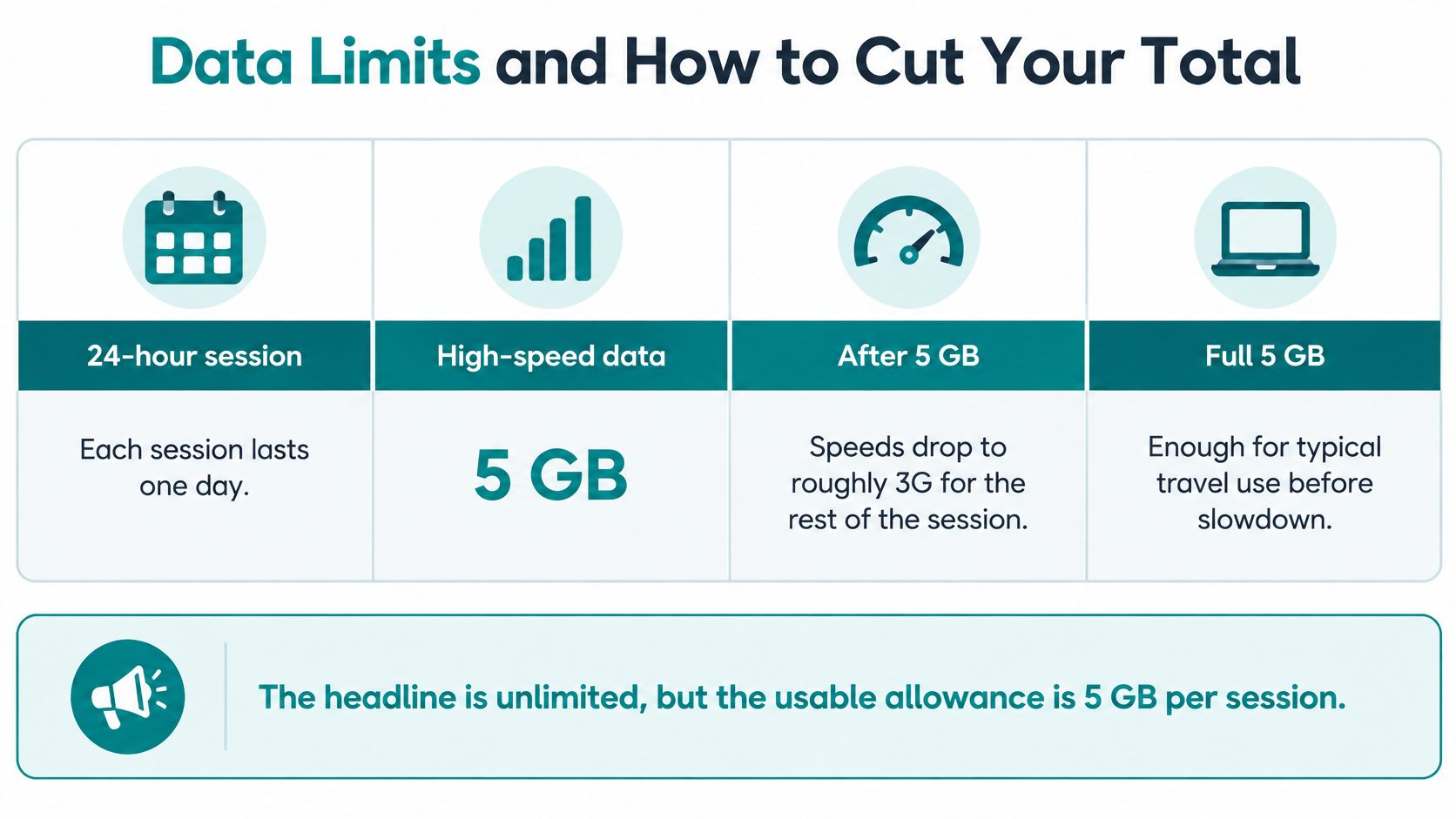
Navigation, messaging, email, and light browsing may remain usable after the slowdown. Video meetings, cloud synchronization, laptop tethering, and high-resolution media are more demanding, so don't budget for work on the assumption that reduced-speed data will feel equivalent.
Verizon's TravelPass service page lists additional high-speed data at $5 in Canada and Mexico or $10 in other TravelPass countries. Confirm current additional high-speed data pricing and purchase-block size on Verizon's official site before buying, since the purchase price alone tells you nothing until you know how much data each block supplies.
A remote worker using up the allowance daily during a standard-rate working trip should treat the base fee as the minimum connectivity budget. Every gigabyte beyond the daily cap either slows to 3G or adds a purchase charge, so the honest trip total is the session fees plus whatever top-ups your workload demands.
A full-trip allowance sounds more generous than it is when you need high-speed service every working day. Using the daily fee and per-session allowance described in Verizon's international travel FAQs, seven standard-rate sessions cost $84 and provide up to 35 GB of high-speed data across those sessions; fourteen cost $168 and provide up to 70 GB, before taxes and optional purchases.
Divide the session charge by the allowance and both trip lengths land near $2.40 per usable high-speed gigabyte. That ratio only holds if you spend the full daily allowance. A traveler who exhausts it by midday and crawls along at reduced speed for the rest of the session paid the same fee for less usable data.
Carrier rates and allowances change, so confirm the applicable terms on Verizon's official site before departure.
Take a remote worker who needs 8 GB daily throughout a 14-session trip in a standard destination. The included high-speed allowance covers 5 GB per session, leaving 3 GB each day at reduced speed unless the traveler buys more high-speed data. Across the fortnight that gap adds up to roughly 42 GB sitting outside the $168 base charge.
The important issue isn't whether the trip-wide allowance looks large. It's whether the worker can complete each day's workload without purchasing more capacity.
Use this calculation:
Full TravelPass budget = base session charges + required high-speed-data purchases + applicable taxes and fees.
Don't assume that a single extra-data purchase will cover the daily shortfall. Confirm the purchase block's current size and terms, then work out how many blocks your workload requires.
A trip-wide data total isn't a promise that you can use that entire amount whenever you want. For remote work, the daily limit matters as much as the total.
Two travelers on separate lines over the same fortnight face a $336 standard-rate base charge before taxes and extras. Each line carries its own daily allowance, and one person's unused high-speed data doesn't pool for the household. A partner who mostly sends messages can't subsidize the other connecting a laptop all day, so calculate each line's requirements independently rather than splitting combined usage evenly.
Planning resources such as international travel advice from MaxiJournal can help organize the itinerary, and connectivity deserves its own line in the budget next to accommodation, transportation, and work commitments.
If your daily needs fit inside the included high-speed allowance, the base daily fee is a useful guide. If they consistently exceed it, compare the full Verizon total with a prepaid plan that supplies enough usable data, supports your required hotspot use, and remains valid throughout the trip.
Verizon TravelPass can work in European destinations, but you must confirm your specific country on Verizon's official destination list before flying. Verizon's broad international coverage claim isn't a guarantee that every stop on a European itinerary qualifies.
The country count describes the overall footprint, not a single Europe-wide entitlement. A trip involving several countries needs a destination-by-destination check, including brief stops where you expect to use cellular service.
If a destination isn't included, cellular usage can fall under pay-as-you-go international rates, not the standard TravelPass daily fee. Don't use the trip-cost table as a budget for an unconfirmed country.
The Canada and Mexico discount doesn't extend to European destinations. Geographic proximity within Europe also doesn't establish identical eligibility or benefits.
Before boarding: Save the official destination page and record when you checked it. Keep the confirmation with your travel documents so you aren't reconstructing your plan after arrival.
For phone-setting preparation and regional considerations, consult our guide to roaming in Europe. Treat regional advice as preparation, while Verizon's current country list remains the authority for your line's coverage.
Finally, distinguish eligible service from guaranteed performance. Being able to use TravelPass in a country doesn't establish that every hotel, train route, or rural work location will support your intended workload. If connectivity is essential, plan a Wi-Fi fallback rather than relying solely on a coverage label.
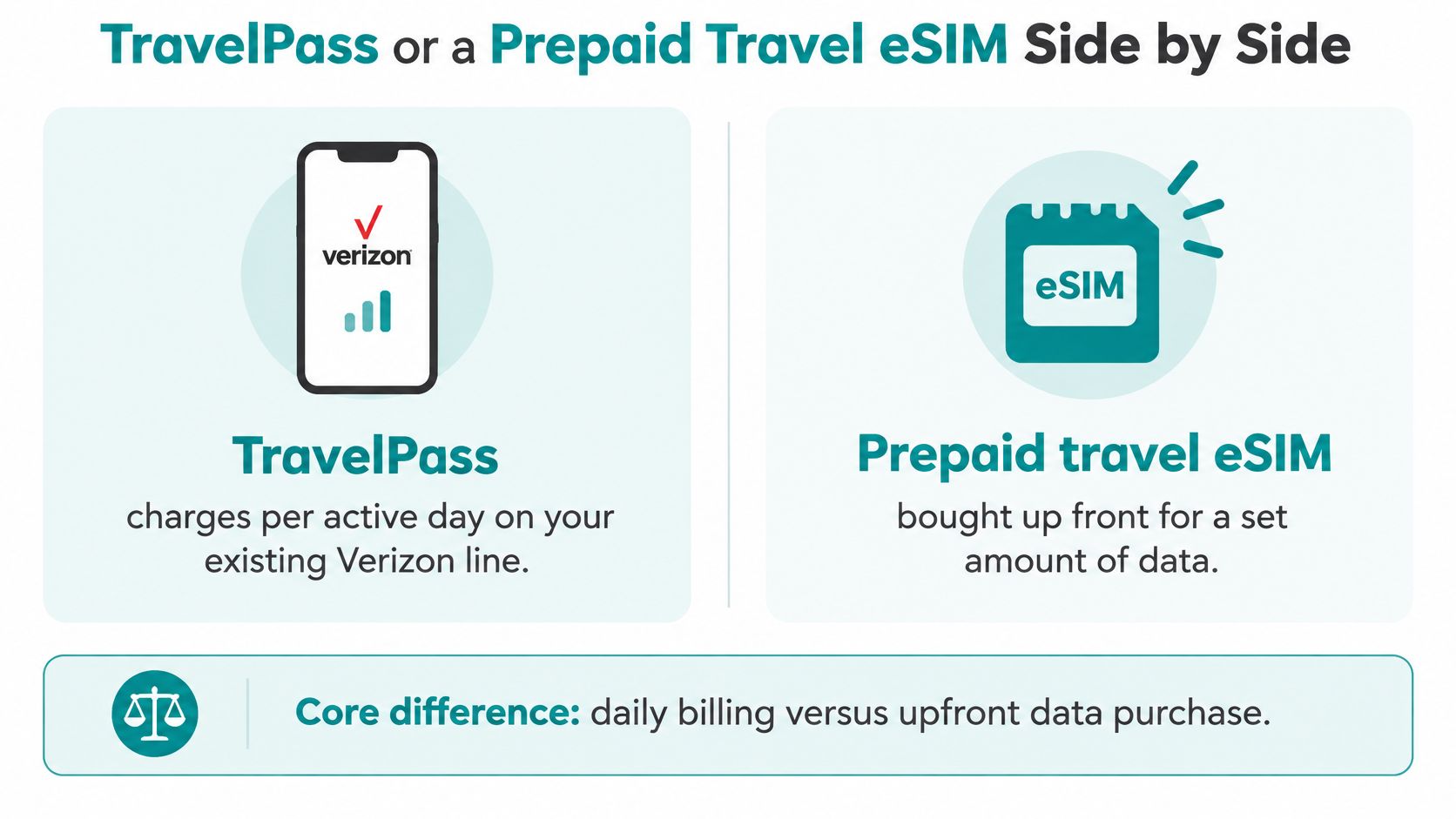
The core difference is daily billing on your existing line versus buying a data allowance up front. TravelPass prioritizes continuity with your Verizon service; a prepaid travel eSIM lets you choose data and validity around the itinerary.
TravelPass and prepaid travel eSIM compared on cost and use
| Factor | Verizon TravelPass | Prepaid travel eSIM |
|---|---|---|
| How you pay | Per active session on your Verizon line | Prepaid plan bought before the trip |
| Data included | Defined high-speed allowance per session, then reduced speeds | Set data amount for the plan's validity |
| Cost predictability | Total follows the number of active sessions and extras | Initial plan cost is known before travel |
| Calls and texts | Included on the Verizon line, subject to destination and calling terms | Usually data-only; your regular number retains calls and texts |
| Setup | Uses your existing Verizon line | QR code or one-tap installation on an eSIM-compatible phone |
| Best fit | Short trips, lighter use, and plans with included destination benefits | Longer stays, substantial data needs, and travelers seeking a prepaid budget |
A small prepaid allowance isn't equivalent to a large daily roaming allowance merely because its total price is lower. Compare enough data for your actual activities, valid for your entire stay, with the hotspot permissions and destinations you need.
Conversely, don't assign value to high-speed data you won't consume. If most work happens on hotel Wi-Fi, paying repeatedly for a large cellular allowance may buy capacity you never use.
This graphic summarizes the purchasing models.
At Simsima, we offer a data calculator that estimates your needs from travel habits and activities. We offer travel eSIM data plans in 210 destinations, with local plans in 198 countries, plus regional and multi-country options.
Prepaid travel eSIMs are usually data-only. Your regular number remains attached to the Verizon line, but keeping that line available doesn't make its calls and texts free abroad.
On a compatible dual-SIM phone, select the travel eSIM for mobile data and disable automatic data switching to Verizon. Review how you'll handle ordinary calls before departure, particularly if clients or family must reach your US number.
Our prepaid eSIM guide for travelers explains the purchasing model. If you're evaluating installation and account-management workflows, DBotMaker's eSIM app rankings provide another resource for considering the interface, without replacing a destination-specific plan check.
For a prepaid alternative, consider a Simsima travel eSIM and check current destinations, allowances, and validity on the travel eSIM product page. Install through the supplied QR code or one-tap Smart Link on a compatible phone, and check the plan's activation instructions before departure.
Choose based on your itinerary and workload, not the daily headline. For a short Canada or Mexico trip on a domestic plan that already includes the relevant service, an additional data purchase may be unnecessary.
For a longer standard-destination trip with substantial cellular use, compare complete budgets. A prepaid allowance can be easier to plan around, but it's cheaper only when its current price, usable data, and validity satisfy the same needs as the Verizon option.
Families should calculate line by line. Multi-country travelers should verify every stop, whether they choose carrier roaming or a regional eSIM.
The strongest reason to keep TravelPass is convenience when your regular line matters and your usage fits the included benefits. The strongest reason to consider prepaid data is control over a clearly defined travel-data purchase.
Neither choice removes the need to manage the phone. A prepaid eSIM won't prevent Verizon charges if you continue using chargeable services on the Verizon line, and a daily pass won't provide unlimited full-speed capacity.
The cheaper option depends on the days and data you use. Complete the arithmetic before you leave, while you can still change the plan and test the settings.
Simsima offers prepaid travel eSIM data plans, regional options, and a data calculator to help match your purchase to your itinerary. Visit Simsima to estimate your data needs and compare a destination plan with your full TravelPass budget before departure.
Founder of Simsima. A passionate traveler based in Barcelona, he helps travelers stay connected without breaking the bank on roaming fees.
LinkedIn