-5% on your 1st eSIMuntil October 31
July and August bring typical daytime temperatures of 18°C to 28°C, but they aren't automatically the best months for every Swiss trip. For broad city and valley travel, choose May to October; for skiing and snow-based travel, choose November to April, with May, June, September, and October offering the strongest balance of access, comfort, and quieter conditions.
The counterintuitive truth is that Switzerland isn't one climate zone. A warm afternoon beside Lake Geneva tells you very little about conditions on a high Alpine trail, and a snowy resort in January doesn't represent the weather in Basel or Ticino. The right answer to “when to visit Switzerland” depends on your altitude, your activities, and how much operational uncertainty you're willing to accept.
Most travelers should start with September for a mixed city, rail, and mountain itinerary. Choose October if you care more about autumn scenery, lakeside towns, vineyards, and urban culture than high-altitude infrastructure. Choose July or August when long daylight, warmth, and the widest choice of mountain excursions matter more than crowds and peak-season pricing.
Why the Standard Summer Winter Binary Fails
Altitude decides Switzerland's season more reliably than the calendar. Zurich, Zermatt, Lake Lugano, and a 2,500-metre mountain pass can have entirely different conditions on the same day. A useful itinerary starts with your planned elevation and activities, then uses the month to refine the choice.
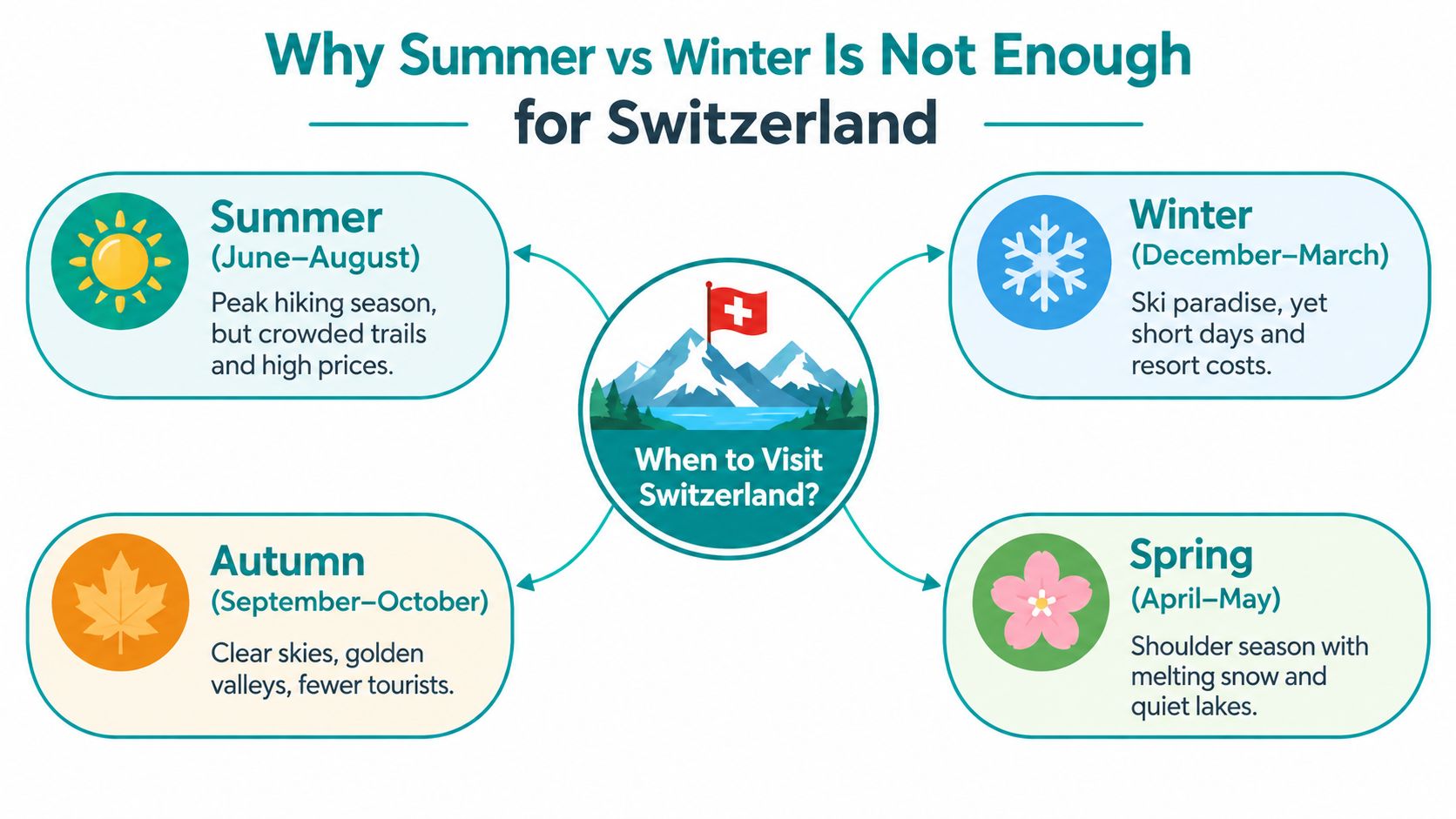
Switzerland's official tourism classification divides the year into a summer season from May through October and a winter season from November through April. That framework helps with broad accommodation and transport planning, but it cannot confirm whether a particular trail is open, a resort has dependable snow, or a mountain cable car runs on your chosen date. The official Swiss climate overview also links travel conditions to altitude and purpose, which makes it more useful than a simple summer or winter label.
Switzerland is a vertical country
Switzerland functions like several destinations stacked above one another. Lowland cities can suit walking and sightseeing in spring or autumn, while a high resort may still have winter conditions. A valley excursion can be green and accessible while a high pass remains closed.
Broad advice such as “summer is for hiking” misses that altitude changes the timetable. Lower paths and lakeside routes may work well in late spring, while high trails retain snow or face seasonal closures. In winter, a high resort can deliver a convincing snow experience while a low or medium-altitude destination receives rain. Choose the elevation that matches the experience you want, rather than assuming the whole country follows one seasonal pattern.
Match the month to the experience
Use the calendar as a starting point, then apply an altitude filter:
- May and June: Choose these months for cities, lakes, scenic rail travel, and lower-elevation walks. Higher trails may still face seasonal limitations.
- July and August: Choose them for the broadest general access, long days, and warmth. Typical daytime temperatures range from 18°C to 28°C, according to the Swiss climate facts. Expect stronger demand and peak-season conditions.
- September: Make it the default for many first-time visitors combining rail travel, cities, and mountains. It offers a strong balance between access and manageable crowds.
- October: Prioritize foliage, vineyards, lakeside towns, and urban culture. Do not build the trip around every high-altitude facility operating.
- November through April: Reserve this window for snow-based travel, after checking the destination's elevation and live conditions.
For wider European comparisons, consult this guide to the best time to visit Europe. Switzerland requires a sharper rule: plan by elevation first, month second.
Understanding Altitude and Regional Climate Realities
Altitude sets Switzerland's weather more reliably than the month on your calendar. At about 1,500 metres, average temperatures sit near -5°C in January and 11°C in July, and winter precipitation commonly falls as snow. On the Central Plateau, January averages about 1°C and July about 17°C, while Ticino is generally 2°C to 3°C warmer. These figures from the Swiss Confederation show why one national forecast cannot plan an entire Swiss itinerary.
Read Switzerland in three practical zones
Lowlands and cities include Geneva, Basel, Zurich, Lausanne, and much of southern Ticino. Choose this zone for museums, restaurants, lakefront walks, historic centres, and rail travel through spring, summer, and autumn. Snow is uncommon around low-lying Geneva and Basel, and southern Ticino cannot reliably provide a winter snow setting. If your priority is urban sightseeing with easy transport, lower elevations offer the most dependable access.
Valleys and mid-altitude resorts demand closer attention. They work well for village visits, lower hiking routes, scenic rail journeys, and mountain views without committing every day to high terrain. Conditions can change quickly, however. Rain may fall in a medium-elevation resort while snow covers the peaks above it. In spring, green valley meadows and blooming flowers do not confirm that nearby high trails are open.
Book this zone when you want mountain scenery with practical alternatives below the snowline. It gives you more ways to salvage a day affected by rain, cloud, or a closed lift.
High Alpine resorts and passes follow their own operating calendar. They can retain snow while cities feel warm, but access depends on lifts, roads, trails, and current weather. A high viewpoint may be fully accessible in summer yet still require warm layers, sturdy footwear, and flexibility. In winter, this is the zone to choose for reliable snow conditions, provided you check the exact resort rather than relying on a city forecast.
Practical rule: Choose the experience first, identify its elevation second, then check the forecast and operating calendar for that exact destination.
Why altitude matters more than a city forecast
A forecast for Lucerne cannot confirm whether a high trail in the surrounding mountains is clear. Geneva's conditions say little about fresh snow at an Alpine ski area. Check the weather at the actual viewpoint, pass, resort, or trailhead, and review the local lift, road, and trail status before setting out.
Build flexibility into the route. Pair a high-altitude day with a city, museum, lake, or valley option. If cloud or rain closes the mountain, move down the vertical map instead of losing the day. That altitude-based approach gives you a clearer answer to when to visit Switzerland than a simple summer or winter label.
Evaluating Summer Versus Shoulder Season Options
A July hike near Zermatt feels very different from a September hike on the same trail. The route may be identical, but snow, lift schedules, temperature, and visitor numbers change the decision. Switzerland's best travel window depends on altitude and activity, not the calendar alone.
July and August remain the safest recommendation for travelers who want long days, warm valleys, scenic rail journeys, lakes, and several mountain excursions. The cost is higher demand, busier transport, fuller accommodation, and less room to change plans at short notice.
The Swiss tourism seasonal classification places general summer travel from May through October and winter tourism from November through April. Use that framework as a planning guide, then adjust it for elevation. Summer offers the strongest general access, while the shoulder months usually provide the better balance.
Summer suits access-heavy itineraries
July or August is the right choice when your plans depend on multiple high-altitude excursions, long days outdoors, or several mountain and rail experiences with little flexibility for cancellations. Typical daytime temperatures of 18°C to 28°C suit many city and valley activities, although conditions become markedly colder higher in the Alps.
Summer also reduces the need to track every operating calendar. More mountain transport and visitor infrastructure is likely to be running than during transitional months. That makes it easier to combine lake towns, urban walks, lower-elevation hikes, and mountain viewpoints in one trip.
The trade-offs are clear:
- More access: A better chance that mountain transport and high trails fit your itinerary.
- More pressure: Popular routes and accommodation need earlier planning.
- Less flexibility: A missed connection or weather cancellation is harder to absorb during busy periods.
Shoulder months offer a better balance
May, June, September, and early October suit travelers who prefer moderate temperatures, calmer towns, and a less rigid daily schedule. Typical spring and autumn daytime temperatures are roughly 8°C to 15°C, according to the official Swiss climate information. That range often makes city walking more comfortable than midsummer heat.
May and June work well for lakes, rail journeys, flowering scenery, and lower-elevation touring. High trails require closer checking. Summer-like conditions can arrive by May, yet snow and winter weather may still affect upper routes, so build a valley or city alternative into the itinerary.
September is the strongest shoulder-season choice for a mixed trip. It supports mountain days while keeping cities, lakes, and scenic trains practical. October is more selective. It suits urban culture, vineyards, foliage, and valley travel, but mountain facilities may begin closing and rain can interrupt high viewpoints.
| Your priority | Best choice | Main compromise |
|---|---|---|
| Broad mountain access | July or August | Busier travel conditions |
| Comfortable city walking | May, June, September, or October | Less certainty at high altitude |
| Scenic rail and lakes | June through September | Peak demand in midsummer |
| Lower-elevation hiking | May through October | Weather still changes quickly |
| Snow-based travel | November through April | Snow reliability varies by elevation |
Choose September unless July or August serves a specific purpose. It gives most travelers the strongest mix of mountain access, comfortable temperatures, and manageable crowds. Choose May or June when green valleys and quieter cities matter more than dependable access to the highest trails.
Why Autumn Is the Strategic Sweet Spot
Autumn rewards travelers who plan by altitude instead of by calendar alone. September and October offer different advantages, and treating them as interchangeable creates avoidable problems. September keeps more mountain options open, while October shifts the trip toward valleys, cities, vineyards, and seasonal atmosphere.
September favors mountain-led itineraries
Choose September when panoramic rail routes, high viewpoints, or hiking above the valleys sit at the center of your plans. Conditions are generally cooler than in midsummer, and mountain access is more likely to fit alongside city visits. You can schedule a high-altitude day first, then use Lucerne, Bern, Zurich, a lake excursion, or a scenic train when conditions change.
That itinerary is more resilient than assigning every day to one summit. A closed lift or cloud-covered viewpoint becomes a change of plan rather than a ruined holiday.
September also suits photographers and walkers who dislike hot urban afternoons. Valleys begin to take on autumn color while transport, attractions, and towns retain much of their summer operating rhythm. The trade-off is straightforward: higher access is more plausible than in October, but it still requires checking current lift and trail information.
September is the month for travelers who want the Alps to remain central, but don't want midsummer to dominate the trip.
October favors lower elevations and atmosphere
Choose October for vineyards, lakeside towns, museums, food, architecture, and autumn foliage. As noted in the climate overview above, autumn runs from September to November in Switzerland.
Do not book October expecting every cable car, high trail, or mountain restaurant to follow a summer schedule. Make lower-elevation experiences the backbone of the itinerary. Select mountain excursions individually, confirm opening dates with operators, and keep a city or valley alternative ready.
The recommendation changes by region:
- High Alps: Prefer September, then verify lift, trail, and transport operations before committing.
- Central Plateau cities: September and October both suit walking, museums, and cultural visits.
- Lakes and vineyards: October is the stronger choice when foliage and quieter shorelines matter.
- Ticino and southern valleys: Check local forecasts instead of applying one national autumn assumption.
Autumn remains a substantial travel period rather than a dead zone after August. The Swiss Federal Statistical Office recorded 25.1 million overnight stays from May through October 2025, including 13.4 million from foreign visitors, in its 2025 tourism results. Those figures do not guarantee that every attraction will operate fully, but they confirm continued demand across the broader period.
Plan September around mountain days with cultural backups. Plan October around culture, food, lakes, and valleys, then add only the mountain excursions whose facilities and weather align. That distinction prevents a common autumn mistake: building an itinerary around high-altitude services that have already reduced their schedules.
Golden valleys, wood-clad villages, and high peaks give October a visual character that summer cannot replicate. This video offers another view of the season before you decide how much of the trip should sit above the valleys.
Planning Your Trip Around Ski and Snow Conditions
Elevation determines whether a Swiss ski trip delivers powder, firm pistes, or rain. December through February remains the safer conventional window for resort skiing, but altitude, exposure, and current operating conditions matter more than the month alone. A prestigious resort at modest elevation can offer less dependable snow than a less famous high-altitude domain.
As noted in the snowpack analysis above, Alpine snow seasons have started later, ended earlier, and reached lower maximum depths over time. Earlier spring disappearance is a major reason to treat altitude as a planning factor rather than a detail to check after booking. For the full climate overview, see the earlier section on regional conditions.
Use a four-part snow test
Choose altitude before resort prestige. Higher domains provide a stronger basis for snow-dependent travel. Medium-altitude areas face greater exposure to rain and shortened coverage, particularly during warm spells.
Favor the core winter months. December through February is safer for conventional resort skiing than late March or April, especially at lower elevations. Christmas and New Year bring a festive atmosphere, but they also demand early planning and leave less room for spontaneous changes.
Check live conditions immediately before departure. Review snow depth, open terrain, lift status, webcams, and the resort's operating notices. A famous name does not guarantee skiable terrain on your dates. Check the specific sector you intend to use, because conditions can differ across one resort area.
Treat late-season skiing as a specialist choice. Warming projections point to less winter snow cover and fewer snowfall days at lower and mid-range elevations. As noted in the snowpack analysis above, that trend makes high-altitude selection more important, while late March and April require current reports and realistic expectations.
If you are comparing destinations beyond Switzerland, a guide to top international ski resorts puts Swiss options into a broader context. For an itinerary combining skiing with cities or neighboring countries, limit transfers and group activities by snow reliability. This multi-destination trip planning guide helps structure that route without collecting resorts at the expense of time on the slopes.
Travelers seeking green valleys, waterfalls, and hiking should choose June through September, while checking high-pass and trail access for the exact route. Weather in the nearest town is not enough. Confirm the mountain transport, trail status, and conditions at the elevation where you plan to spend the day.
Practical Logistics and Travel Hacks
Choose the altitude and month first. Then build transport and accommodation around activities with the fewest alternatives.
Book around fixed infrastructure
Reserve accommodation early for peak summer and the main ski months, especially near a particular lift, station, or mountain gateway. Shoulder-season travelers should keep plans flexible. A cancellable room allows a switch from a high resort to a city or valley when the forecast turns.
Use Switzerland's rail network as the itinerary's backbone, but leave space for weather-sensitive excursions. Schedule the most important mountain day before the final day of the trip. Cloud can cancel a cable-car ride or viewpoint, and an earlier booking gives you time to reschedule.
Pack for the vertical range
Pack for the lowest city, the wettest forecast, and the coldest planned altitude. Switzerland can hold mild valley weather and freezing mountain conditions on the same day.
- Layer properly: Bring a breathable base, an insulating layer, and a waterproof outer shell.
- Protect your feet: Choose footwear for wet pavements, uneven trails, and changing ground conditions.
- Carry sun protection: Higher elevations can feel bright and exposed even when valley temperatures are mild.
- Keep a flexible day kit: A compact rain layer, water, and a charged phone are more useful than an overloaded suitcase.
Spring and autumn need particular care because conditions can change quickly. Summer also deserves a rain plan. Check the forecast at your planned elevation, not only in the nearest town, and confirm mountain transport and trail access before setting out.
Stay connected without overcomplicating the trip
Mobile data supports live weather checks, rail updates, digital tickets, trail maps, and operating notices. Before departure, compare the best eSIM options for Switzerland and confirm that your phone supports eSIM service.
Travelers bringing an animal should check documentation and routing requirements well before booking. The guide to pet travel from the United States provides a starting point for that preparation.
Set one primary plan and one lower-altitude backup. Choose September for a mountain-led itinerary, October for valleys and culture, and July or August when maximum access matters more than peak-season pressure.
Simsima offers prepaid travel eSIM data for Switzerland, Europe, and more than 190 countries, with one-tap installation or QR delivery and no physical SIM required. Compare a plan that fits your itinerary at Simsima.
#visit Switzerland#Switzerland travel#Switzerland seasons#best time Switzerland#Switzerland itinerary

Dimitri MorvanFounder
Founder of Simsima. A passionate traveler based in Barcelona, he helps travelers stay connected without breaking the bank on roaming fees.
LinkedIn