-5% on your 1st eSIMuntil October 31
In Ecuador, 4G holds along the Pan-American Highway and in every coastal town, then disappears on Galapagos boat days and deep in Cuyabeno, so the right plan depends on how much of your trip sits off the mainland grid. Ecuador packs an outsized amount of variety into a compact country: the colonial old town of Quito at 2,850 meters, the volcanic Avenue of the Volcanoes, Amazon lodges reachable from Coca and Lago Agrio, the surf breaks of Montañita, and the Galapagos Islands 1,000 kilometers offshore. Getting a working mobile connection across all of that used to mean queuing at an airport counter for a Claro or Movistar tourist SIM, showing your passport, and hoping the staff activated data correctly. An eSIM removes every step of that: install it before you leave home, and your phone connects to a local network the moment you clear customs in Quito (UIO) or Guayaquil (GYE).
Key takeaways
- Movistar ranked first in the nPerf 2026 mobile barometer for Ecuador, narrowly ahead of CNT and Claro
- Simsima offers capped GB packs and unlimited Ecuador eSIM plans on the local networks listed in each plan's details
- eSIMs install before you fly and activate on arrival — no airport SIM counter, no passport photocopy, no roaming charges from your home carrier
- 4G coverage is strong across Quito, Guayaquil, Cuenca and the Pan-American Highway; expect reduced or 3G-only signal in the Amazon (Cuyabeno, Yasuní) and parts of the Andes
- Galapagos has patchy coverage — Santa Cruz (Puerto Ayora) and San Cristóbal (Puerto Baquerizo Moreno) get workable 4G near the towns; Isabela is weaker and boat crossings are usually offline
Movistar, CNT or Claro: nPerf's 2026 ranking for Ecuador
Ecuador has three national mobile operators: Claro (América Móvil), Movistar and the state-owned CNT. Movistar changed hands recently: Millicom, the group behind the Tigo brand, completed its US$380 million purchase of Telefónica's Ecuador operations in October 2025.
The three networks are close in practice. The nPerf 2026 barometer for Ecuador, covering July 2025 to June 2026, puts Movistar first with 44,711 nPoints and an average download speed of 24.2 Mbps, CNT second with 43,797 nPoints and the fastest average download at 25.4 Mbps, and Claro third with 41,682 nPoints and 21.9 Mbps. Claro has the largest customer base and a wide footprint along the Pan-American Highway and in the Amazon towns. The networks used by each Simsima Ecuador plan are listed in its details; a plan with two networks gives you a fallback on long road trips.
Where signal ends: Galápagos boats, Cuyabeno and the high Andes
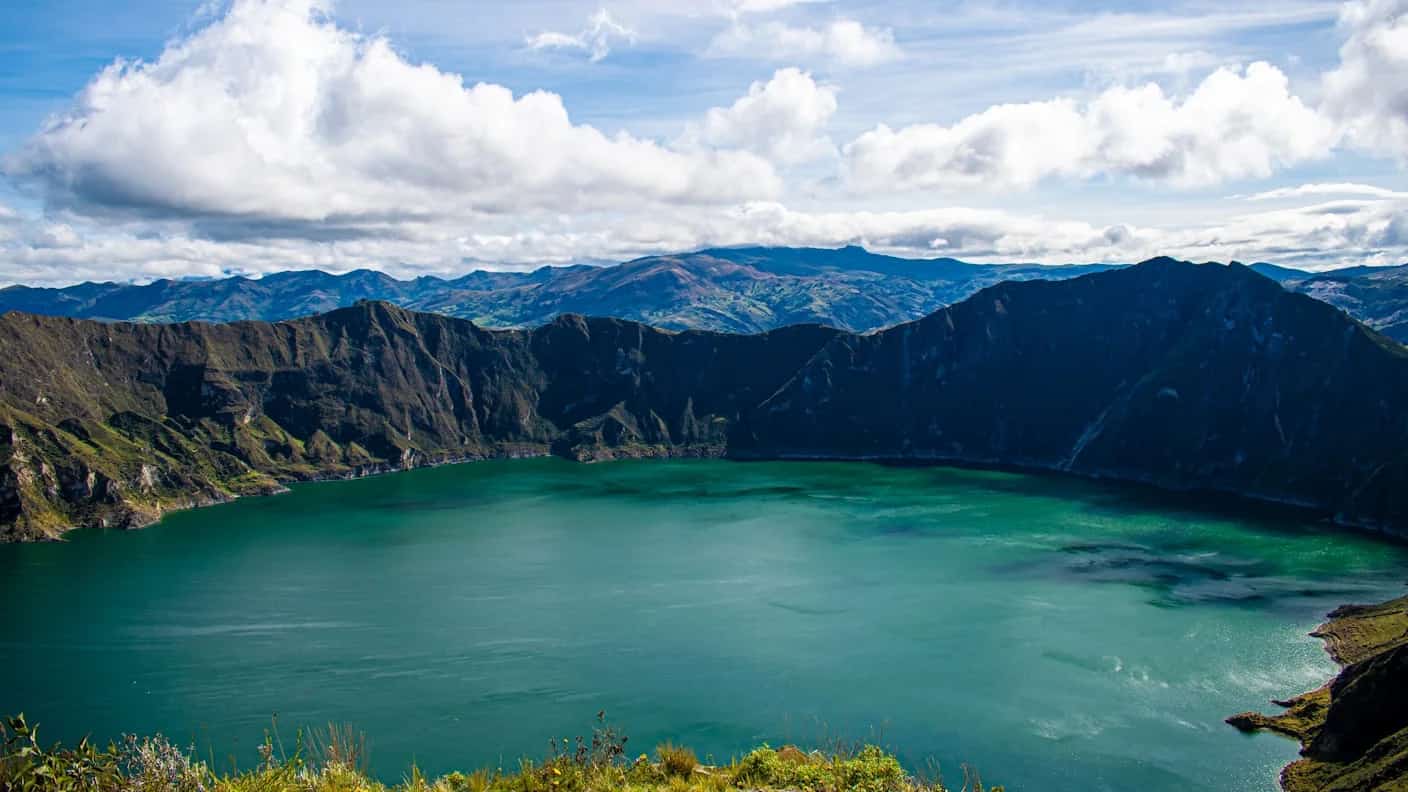
Quito, Guayaquil and Cuenca have 4G on all three networks, from La Mariscal and the historic center of Quito to the Guayaquil Malecón and Cuenca's El Centro. The Pan-American Highway from Otavalo south through Latacunga, Ambato and Riobamba is covered for almost the whole drive, and Baños has strong signal in town and along the Ruta de las Cascadas. Coverage drops as you climb: the Cotopaxi park road is patchy, the José Ribas refuge is essentially offline and the Quilotoa rim gets a slow signal.
In the Amazon, Coca, Lago Agrio, Tena and Puyo have 4G, but lodges in the Cuyabeno reserve and along the Napo inside Yasuní rely on satellite Wi-Fi. In the Galápagos, Puerto Ayora on Santa Cruz and Puerto Baquerizo Moreno on San Cristóbal have workable 4G near town, Puerto Villamil on Isabela is weaker, and boats, snorkeling trips, Los Túneles and Tortuga Bay are usually out of range. Download maps, tickets and boarding passes before every boat day.
Claro and Movistar SIM cards at Quito and Guayaquil
A local prepaid SIM from Claro or Movistar is easy to find in operator stores and shopping malls in Quito, Guayaquil and Cuenca. You need your passport, since every line is registered to an identity, and prices are in US dollars because Ecuador uses the dollar as its currency. Data is often sold as short top-ups that expire within days, which suits light use but means topping up again and again on a long trip.
A local SIM is worth it if you need an Ecuadorian number, for example to book a Galápagos day tour by phone or to receive codes from a local bank. Otherwise, a travel eSIM installed at home is online as you clear customs, and the tables below show what each provider charges today.
Ecuador eSIM Plans Compared (2026)
Here is a comparison of the main Ecuador eSIM plans against the leading international providers. Simsima offers plans on the local networks, with transparent pricing.
Unlimited data plans
- SimsimaBest priceUnlimited · 3 days$18.01
- AiraloUnlimited · 3 days$18.38
- GigskyUnlimited · 3 days$18.99
- AlosimUnlimited · 3 days$19.95
- TruelyUnlimited · 3 days$20.89
- SimsimaBest priceUnlimited · 5 days$26.28
- AiraloUnlimited · 5 days$27.30
- AlosimUnlimited · 5 days$29.40
- TruelyUnlimited · 5 days$29.90
- GigskyUnlimited · 5 days$31.49
- SimsimaBest priceUnlimited · 7 days$35.38
- AlosimUnlimited · 7 days$35.70
- TruelyUnlimited · 7 days$36.93
- Esim4travelUnlimited · 7 days$56.55
- SimsimaBest priceUnlimited · 10 days$46.11
- GigskyUnlimited · 10 days$55.99
- Esim4travelUnlimited · 10 days$80.42
- SimsimaBest priceUnlimited · 30 days$111.22
- Esim4travelUnlimited · 30 days$271.01
Prices last updated: October 19, 2026
Capped data plans
- SimsimaBest price1 GB · 7 days$4.90
- Orange Travel1 GB · 7 days$5.24
- Saily1 GB · 7 days$5.99
- Alosim1 GB · 7 days$6.30
- Voye Global1 GB · 7 days$7.35
- SimsimaBest price3 GB · 30 days$13.12
- Alosim3 GB · 30 days$13.65
- Roamless3 GB · 30 days$13.95
- Saily3 GB · 30 days$15.99
- Ubigi3 GB · 30 days$19.95
- SimsimaBest price5 GB · 30 days$14.99
- Nomad5 GB · 30 days$14.99
- Gigsky5 GB · 30 days$14.99
- Bnesim5 GB · 30 days$18.89
- Alosim5 GB · 30 days$19.95
- SimsimaBest price10 GB · 30 days$28.87
- Ubigi10 GB · 30 days$29.40
- Sim Local10 GB · 30 days$31.24
- Airalo10 GB · 30 days$34.13
- Roamless10 GB · 30 days$34.95
- SimsimaBest price20 GB · 30 days$46.30
- Airalo20 GB · 30 days$47.25
- Roamless20 GB · 30 days$48.95
- Alosim20 GB · 30 days$50.40
- Esim4travel20 GB · 30 days$53.89
Prices last updated: October 19, 2026
Prices shift between providers over time, so read the tables above on the day you buy. Simsima Ecuador plans start when they first connect to an Ecuadorian network, not when you install them.
Data for 12 days: Quito, the Avenue of the Volcanoes and the Galápagos
A popular two-week shape: three days in Quito with a day trip to Otavalo market, the drive south past Cotopaxi to Baños for two nights, a flight from Quito or Guayaquil to the Galápagos for four nights split between Santa Cruz and Isabela, and two final nights in Guayaquil.
- Cabify or Uber rides in Quito and Guayaquil, and maps for the Andes drive: about 1 GB
- WhatsApp with guides, drivers and Galápagos tour operators, plus photo uploads from the islands while in town: 2 to 4 GB
- Streaming and video calls in the evenings on the mainland, where hotel Wi-Fi is uneven: 2 to 3 GB
Around 5 to 8 GB covers that trip, since Galápagos boat days are offline anyway. Pick a capped plan in that range from the table, or unlimited if you will work remotely from Quito or Cuenca.
Installing and activating your Ecuador eSIM
eSIM installation is a two-minute process, but timing matters. Install the eSIM at home on your own Wi-Fi, before you fly. There is nothing to activate by hand: the eSIM activates on its own when the profile registers on an Ecuadorian network on arrival, which is when most travel eSIMs start their validity clock.
- On your home Wi-Fi, open the eSIM email and scan the QR code from your phone's camera or settings
- When prompted, name the line something you will recognize ("Ecuador") so you can toggle it later
- Leave data roaming ON for the Ecuador line and OFF for your home line to avoid accidental home-carrier charges
- Keep your home line active for SMS-based two-factor codes but disable its cellular data
- On landing at UIO or GYE, switch cellular data to the Ecuador line — you should see 4G within a minute of leaving airplane mode
Cabify, Uber and staying safe on the mainland
Ecuador's security situation has changed noticeably since 2023, especially in Guayaquil, Esmeraldas and parts of Manabí, and visitors are commonly advised to book rides through an app rather than hail taxis on the street. Cabify, Uber and InDrive all operate in Quito and Guayaquil, and live data lets you share your trip with a travel partner and check your government's advice before changing plans.
- Cabify, Uber or InDrive for rides in Quito, Guayaquil and Cuenca, with the driver and fare shown in the app
- WhatsApp, which hostels, tour operators and Galápagos boat agencies use to confirm bookings
- Offline maps of the Quilotoa loop, Cotopaxi and the Galápagos towns, downloaded before you leave Wi-Fi
- Ecuador's single emergency number is 911, which works from your home line
Ecuador eSIM downsides, from Cuyabeno to Isabela
- No Ecuadorian number: the eSIM is data only, so tour agencies that only call or text Ecuadorian lines will need your WhatsApp or home number
- Coverage is out of your hands on Galápagos boats, in Cuyabeno and Yasuní, and above the Cotopaxi refuge, whichever network the plan uses
- Hotspot sharing depends on the plan, which matters for digital nomads in Cuenca or Vilcabamba working from a laptop
- Your phone must support eSIM and be carrier-unlocked before you fly
Continuing to Peru or Colombia
Overland travelers often cross north to Colombia at Rumichaca, near Tulcán, or south to Peru via Huaquillas or Macará. A plan for Ecuador alone stops at the border. For two countries, buy one plan each; for a longer Andes route across Colombia, Ecuador, Peru and Bolivia, the Latin America guide below compares multi-country options.
eSIM for Latin America: One Plan From Mexico to Patagonia
Ecuador eSIM FAQ
One that runs on a network covering your route and matches your trip length. Movistar ranked first in nPerf's 2026 barometer for Ecuador, with CNT close behind and Claro third; the tables above compare current plans from several providers, and each Simsima plan lists its networks.
An Ecuador plan covers the islands too, since the Galápagos are part of Ecuador. Expect 4G in Puerto Ayora and Puerto Baquerizo Moreno, weaker service on Isabela and no signal on boats.
You get no Ecuadorian number, Galápagos boat days and deep-Amazon lodges are offline on every network, and hotspot use depends on the plan. The phone also has to support eSIM and be carrier-unlocked.
Yes, if it supports eSIM and is unlocked: add a travel eSIM for data and keep your US line for calls and texts, with roaming switched off on it. Ecuador uses US dollars, so prices in shops and for local SIMs are in USD.
A Claro or Movistar prepaid SIM can be cheap for long stays, but you need your passport, a store visit and repeated short top-ups. Compare the counter price with the tables above for your trip length.
Only at the edges. Coca, Lago Agrio, Tena and Puyo have 4G, but lodges deep in Cuyabeno or Yasuní have no cellular signal, only limited satellite Wi-Fi.
About 5 to 8 GB covers Quito, the Andes and four days on the islands with rides, messaging and photos. Choose unlimited if you work remotely or stream every evening.
Traveling beyond Ecuador?
Get a multi-country plan and save on your mobile data.




Ecuador eSIM plans — Browse and compare all available Ecuador eSIM plans on Simsima
eSIM-compatible devices — Check whether your phone supports eSIM before you buy an Ecuador plan
How Simsima eSIMs work — Understand installation, activation and coverage before your Ecuador trip
#Ecuador#South America#Travel#eSIM

Dimitri MorvanFounder
Founder of Simsima. A passionate traveler based in Barcelona, he helps travelers stay connected without breaking the bank on roaming fees.
LinkedIn