-5% on your 1st eSIM
WELCOME5
Loading...
Find the best time to visit Croatia with our season-by-season guide on weather, crowds, prices, events, and the right regions for your trip style.
 Dimitri Morvan
July and August alone accounted for 54.5% of Croatia's overnight stays in 2025, so the best time to visit Croatia for most travelers is May, June, September, or early October, when the weather remains inviting without the full summer squeeze. Choose July or August only if warm sea temperatures, long beach days, and peak-season energy matter more to you than price and space.
That concentration changes the planning question. Croatia isn't one uniform summer destination, and the right month depends on whether you're visiting the Adriatic coast, hiking inland, sailing between islands, or taking a city break in Zagreb. My direct recommendation is simple: choose May for the best all-round trip, September for warm-water beach travel, and April or October for the strongest value.
Croatia's tourism calendar is unusually compressed. Eurostat reported that 54.5% of all overnight stays in 2025 fell in July and August, the highest share in the European Union. In the same analysis, Croatia's busiest month recorded 41.1 times more overnight stays than January in 2025, compared with 45.7 times more in 2024. The pattern is unmistakable: demand surges sharply into midsummer rather than spreading evenly through the year. (Eurostat's 2025 tourism analysis)
That matters most if your trip centers on Split, Dubrovnik, Hvar, Brač, or another popular coastal base. In July and August, travelers compete for rooms, restaurant tables, parking, ferry seats, and access to the same beaches. You can still have a wonderful trip, but spontaneity becomes expensive and inconvenient.
Croatia recorded 20.7 million tourist arrivals and 94.8 million overnight stays in commercial accommodation in 2025. The Adriatic Region accounted for 89.4 million nights, or 94.3% of the national total, which explains why generic Croatia advice often feels like advice for the Dalmatian coast alone. (Croatian Bureau of Statistics tourism data)
The practical consequence is that inland travel offers a different calendar. Zagreb, Plitvice Lakes, Istria's hill towns, and inland wine areas don't depend on swimming conditions in the same way as Hvar or Dubrovnik. Late spring and early autumn let you explore these places with a better balance of access, walking weather, and lower pressure.
My rule: If the coast is the priority, avoid the late-July to mid-August core unless you're prepared to book well ahead. If the country itself is the priority, travel in May, June, September, or October and build the route around more than beaches.
| Period | Share of 2025 overnight stays | Coastal pricing versus shoulder baseline | Booking lead time recommended |
|---|---|---|---|
| July and August | 54.5% combined | Highest pressure and least flexibility | Reserve key stays and ferries early |
| May, June, September | Not specified in verified data | Better balance than peak summer | Book popular bases ahead |
| April and October | Not specified in verified data | Stronger value and easier access | Moderate planning is usually enough |
| November to March | Not specified in verified data | Lowest seasonal demand in many coastal areas | Check opening dates and transport |
The strongest conclusion isn't that summer is bad. July and August deliver Croatia's most reliable beach atmosphere, warmest sea, and fullest event calendar. The problem is that more than half of the year's overnight demand is packed into those two months, so travelers who want value, quiet streets, and flexible island-hopping should move their dates outward.
Croatia has several climate zones, and the coast changes noticeably from Istria and Kvarner to central Dalmatia and Dubrovnik. The useful distinction isn't just “hot summer, cold winter.” It's how air temperature, sea temperature, rain, daylight, and ferry operations combine for the kind of trip you want.
Independent travel guidance identifies May and September as favored months for sailors and hikers, while June through August remains the true peak season. Responsible Travel describes May, June, and September as bringing pleasant temperatures of roughly 23°C to 27°C, with fewer crowds than midsummer. (Lonely Planet's Croatia timing guide)
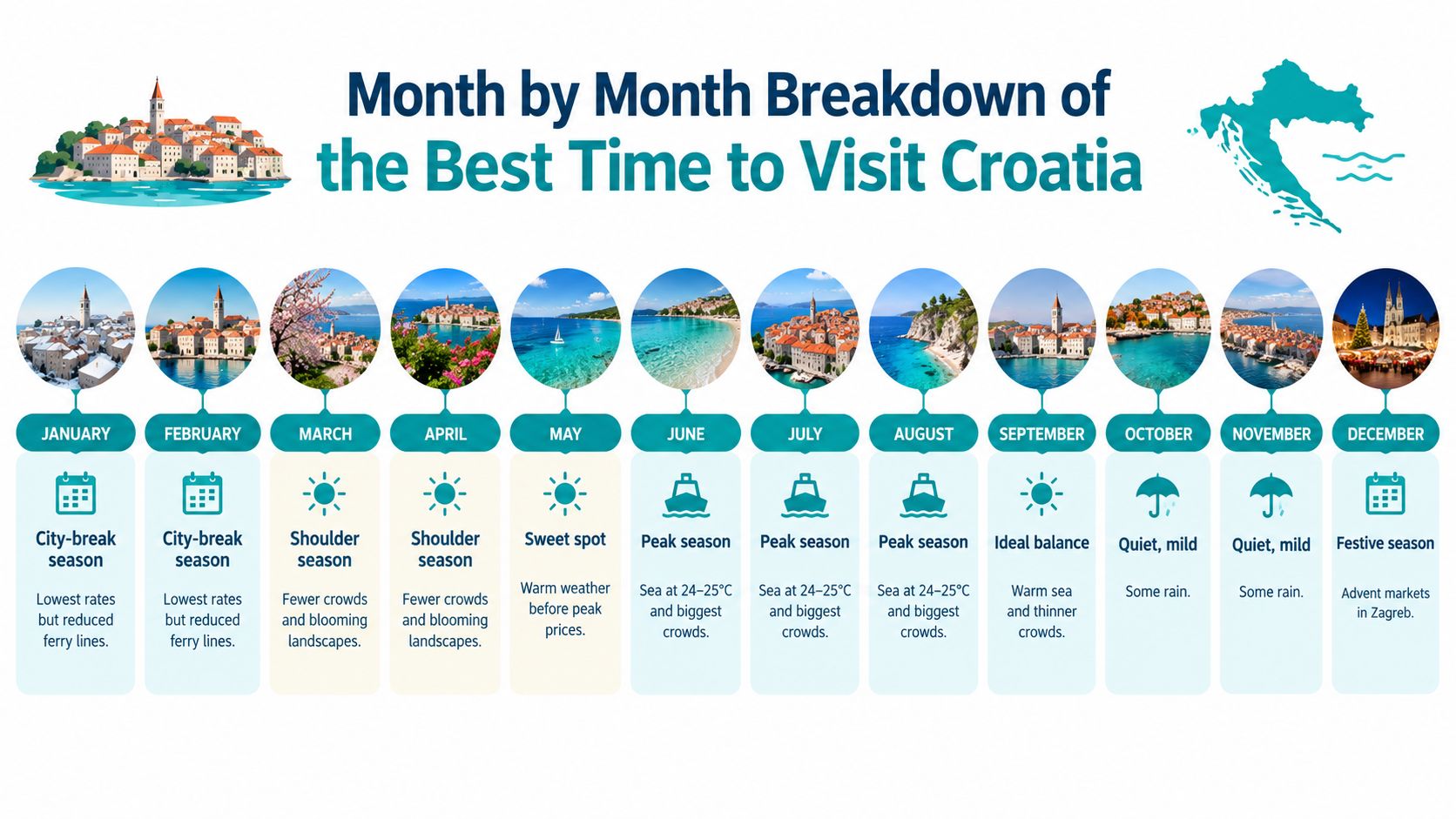
April and May are the most versatile spring months. Coastal weather becomes comfortable for walking, inland scenery turns vivid, and the sea begins to move from chilly toward swimmable. May is particularly strong for a first trip because you can combine old towns, national parks, boat excursions, and outdoor dining without committing to the intensity of high summer.
For coast-focused travelers, sea temperatures rise from about 19.4°C in May to roughly 24.4°C in June, according to independent coastal climate data. Rainfall also drops sharply into summer, with one monthly dataset reporting around 44 mm in June. (Croatia Frontier weather guidance)
June through September is the practical beach window, with sea temperatures around 21°C to 26°C in climate-based guidance. July and August maximize warm-water swimming and long daylight, but they also bring the most crowded ferries, busiest historic centers, and strongest accommodation pressure.
June is my preferred summer compromise. The sea is close to full summer warmth, the coast has long days, and the market hasn't reached its maximum intensity. August is better only if your first priority is the warmest possible water and a full festival atmosphere.
September holds summer warmth particularly well, making it the best month for travelers who want a beach trip without the full family-holiday rush. October is cooler and wetter, but it remains excellent for food, wine, walking, and quieter towns.
Winter suits Zagreb and selected city breaks more than a classic island itinerary. The coast is calmer and many seasonal businesses close, while inland destinations can feel more local and less tourism-driven. For a broader European planning comparison, this guide to the best time to visit Europe is useful when you're weighing Croatia against neighboring destinations.
There's no universally perfect month, but each one makes some Croatian experiences easier and others less practical. Use this calendar to choose deliberately rather than defaulting to July.
Choose these months for Zagreb museums, cafés, architecture, and cultural travel, not for island-hopping. Coastal tourism is quiet, seasonal restaurants may close, and ferry options can be reduced. The reward is a slower, more local rhythm and easier access to city attractions.
March is a useful early-season choice for Zagreb and inland travel. Walking conditions often improve, and you can visit major sights without the summer intensity. It's still too early to assume every coastal service or island connection will operate at its peak schedule.
April is one of Croatia's most overlooked months. The coast is comfortable for sightseeing, Plitvice and other inland areas are especially rewarding, and outdoor activities become practical without summer heat. Swimming remains for hardy travelers, but the month works exceptionally well for road trips and national parks.
May is my top overall recommendation. You get warm days, a more open tourism infrastructure, better flexibility, and a coast that feels inviting before peak-season pressure arrives. Sailors, hikers, photographers, and travelers combining Zagreb with the Adriatic all benefit from the balance.
June is the bridge between shoulder season and high season. The sea becomes reliably attractive for swimming, boat trips become central to the itinerary, and the coast still feels more manageable than July and August. Late June can become noticeably busier as school holidays begin.
These are Croatia's headline beach months. The water is at its warmest, the days are long, nightlife and festivals are fully active, and every major coastal destination is operating at maximum capacity.
The trade-off is severe. July alone produced 25.0 million overnight stays in 2025, while August produced 26.7 million, and August hotel permanent-bed occupancy reached 97.3%. (Croatia Week's report on 2025 tourism)
September is the best beach month for many experienced visitors. The sea remains warm, families begin to leave, and restaurants and excursions still operate broadly. It isn't empty, though, so reserve popular coastal bases rather than expecting a last-minute bargain.
October is a smart choice for food, wine, hiking, and quiet coastal towns. Early October can still support swimming, while later weeks are better suited to walking, markets, national parks, and Istrian cuisine. Check transport schedules before building an island-heavy route.
November favors Zagreb, museums, galleries, cafés, and cultural events. Much of the coast becomes quiet, and travelers who want Croatia without beach crowds should consider it seriously.
December is strongest for festive city travel, especially Zagreb's Advent season. It's not the month for a classic island holiday, but it can deliver a memorable urban break if you value food, lights, markets, and historic streets over swimming.
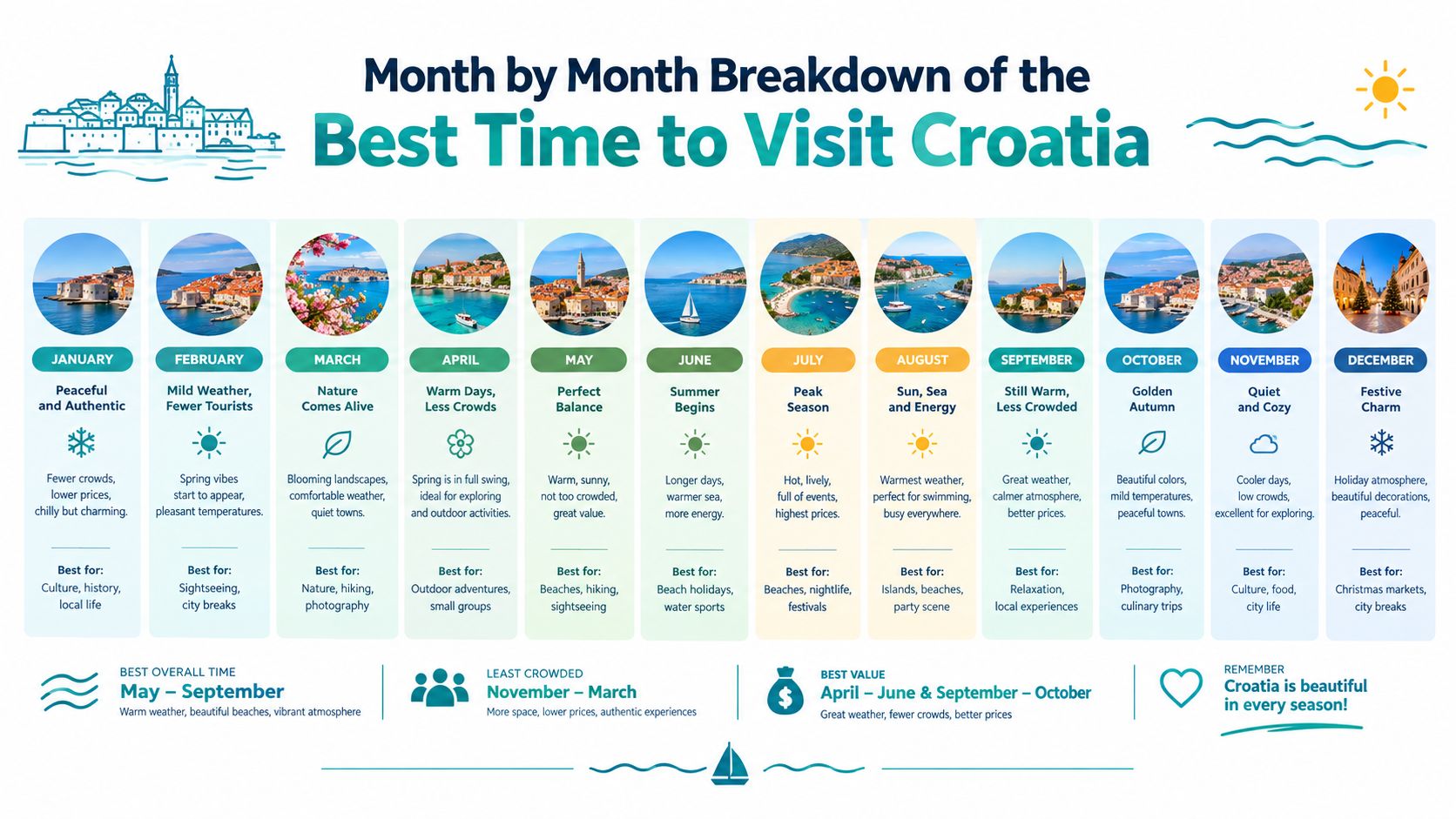
The best month depends less on Croatia's general reputation than on what you'll do each day. A family beach holiday, a sailing week, and a Plitvice hiking trip need different conditions.
Families with young children should choose June or early September. The sea is comfortable, beach infrastructure is active, and you avoid the most compressed part of the school-holiday rush. Pick September if you want a calmer atmosphere, June if longer daylight and early-summer energy matter more.
Couples should choose May, late September, or October. These months make it easier to find a quiet table, walk old towns without constant congestion, and enjoy places such as Split, Rovinj, or Dubrovnik at a more relaxed pace.
Sailors should target mid-May to mid-June or the first half of September. You'll generally find more manageable marina conditions and less competition than in the core summer weeks. If you're comparing routes and boat types, start with a practical guide to finding Croatia boat rentals.
Hikers should choose April, May, or October. Paklenica, Velebit, Mljet, and inland trails are much more pleasant when heat isn't dominating the day. Spring adds fresh scenery, while autumn brings a quieter, more settled atmosphere.
Budget travelers should look first at April, early May, or late October. The critical saving comes from avoiding the period when demand is concentrated, not from finding a clever deal after arriving.
City-break visitors can travel in March, May, or November. Zagreb works particularly well outside the beach season, and Dubrovnik's museums, walls, and architecture remain worthwhile when swimming isn't the central objective.
| Traveler type | Best season | Why it works | Crowd level | Average daily budget |
|---|---|---|---|---|
| Families | June or early September | Warm water and active services without the tightest peak | Moderate | Not specified |
| Couples | May, late September, or October | Quieter dining and more relaxed walking | Low to moderate | Not specified |
| Sailors | Mid-May to mid-June or early September | Better balance of sea conditions and marina access | Moderate | Not specified |
| Hikers | April, May, or October | Cooler trails and stronger inland appeal | Low to moderate | Not specified |
| Budget travelers | April, early May, or late October | Lower seasonal pressure and better flexibility | Low | Not specified |
| City breakers | March, May, or November | Culture takes priority over beach operations | Low | Not specified |
The table's budget column is intentionally qualitative. Prices vary by destination, accommodation type, transport, and booking date, so a single daily figure would create false precision.
The usual advice says “visit in shoulder season,” but that phrase is too broad now. September may offer excellent weather, yet it isn't automatically a low-demand month, particularly in the most popular coastal destinations. If value is your main concern, move farther from the July and August center.
The clearest evidence is capacity. Croatia reached a record 110.1 million overnight stays and 21.8 million arrivals in 2025, while August hotel permanent-bed occupancy reached 97.3%. That combination means the most desirable rooms and transport connections can disappear before travelers expect the season to be fully active. (Croatia Week's 2025 tourism report)
For budget travelers, I'd rank the periods this way:
Do not confuse a lower seasonal rate with a complete trip economy. A cheaper room in a remote location can create extra car, taxi, or ferry costs. The best value usually comes from selecting a destination that matches the season, not just choosing the cheapest available date.
| Month or period | Crowd score from 1 to 10 | Price versus May | Value rating |
|---|---|---|---|
| January to February | Not quantified | Lower seasonal demand | Strong for city breaks |
| March | Not quantified | Lower seasonal demand | Strong for culture |
| April | Not quantified | Lower seasonal demand | Excellent for value |
| May | Not quantified | Baseline | Excellent overall |
| June | Not quantified | Rising toward peak | Very good |
| July to August | Not quantified | Highest seasonal pressure | Best only for peak beach conditions |
| September | Not quantified | Moderate to high in popular areas | Very good for beaches |
| October | Not quantified | Lower seasonal demand | Excellent for value |
| November to December | Not quantified | Lower seasonal demand | Strong for cities and festivals |
The verified data supports a firm conclusion, but not invented hotel price benchmarks: travelers seeking value should look beyond the standard “May or September” formula and consider April or October, especially if they're willing to prioritize inland travel, food, hiking, or city culture over guaranteed beach weather.
The easiest way to understand Croatia's timing trade-offs is to see how the route changes with the season. A strong itinerary doesn't force the same coast-and-islands template into every month.
Start with two nights in Zagreb, using the time for museums, architecture, markets, and an unhurried first look at Croatian food. Drive or arrange transport to Plitvice Lakes for a full day among the lakes and waterfalls, then continue south.
Finish with three nights in Split, leaving one day for the old city and one for a boat trip to Hvar or Brač if operating schedules suit your dates. Spring rewards travelers who mix inland scenery with the coast rather than treating the sea as the only attraction.
For July or August, keep the route focused. Base yourself in Split, then move through Vis, Korčula, and Mljet before ending in Dubrovnik. Avoid trying to add every famous island. Each transfer consumes time and becomes more exposed to crowded transport.
Book accommodation, ferries, popular restaurants, and major guided experiences before arrival. In peak season, your itinerary should include buffer time because a missed or full connection can disrupt the next island reservation.
Begin in Istria, using Rovinj as a base for old-town walks, olive oil, truffles, wine, and nearby hill towns. The region is especially rewarding when your trip revolves around food and scenery rather than swimming.
Move south for Dubrovnik and use the final days for the city walls, museums, views, and late-season coastal walks. Early autumn can still support sea time, while the broader advantage is that the city feels easier to explore than during the most concentrated summer weeks.
A multi-stop trip needs the same discipline as a multi-island route. Before reserving separate hotels and transfers, use this guide to planning a multi-destination trip to test whether the route leaves enough recovery time between moves.
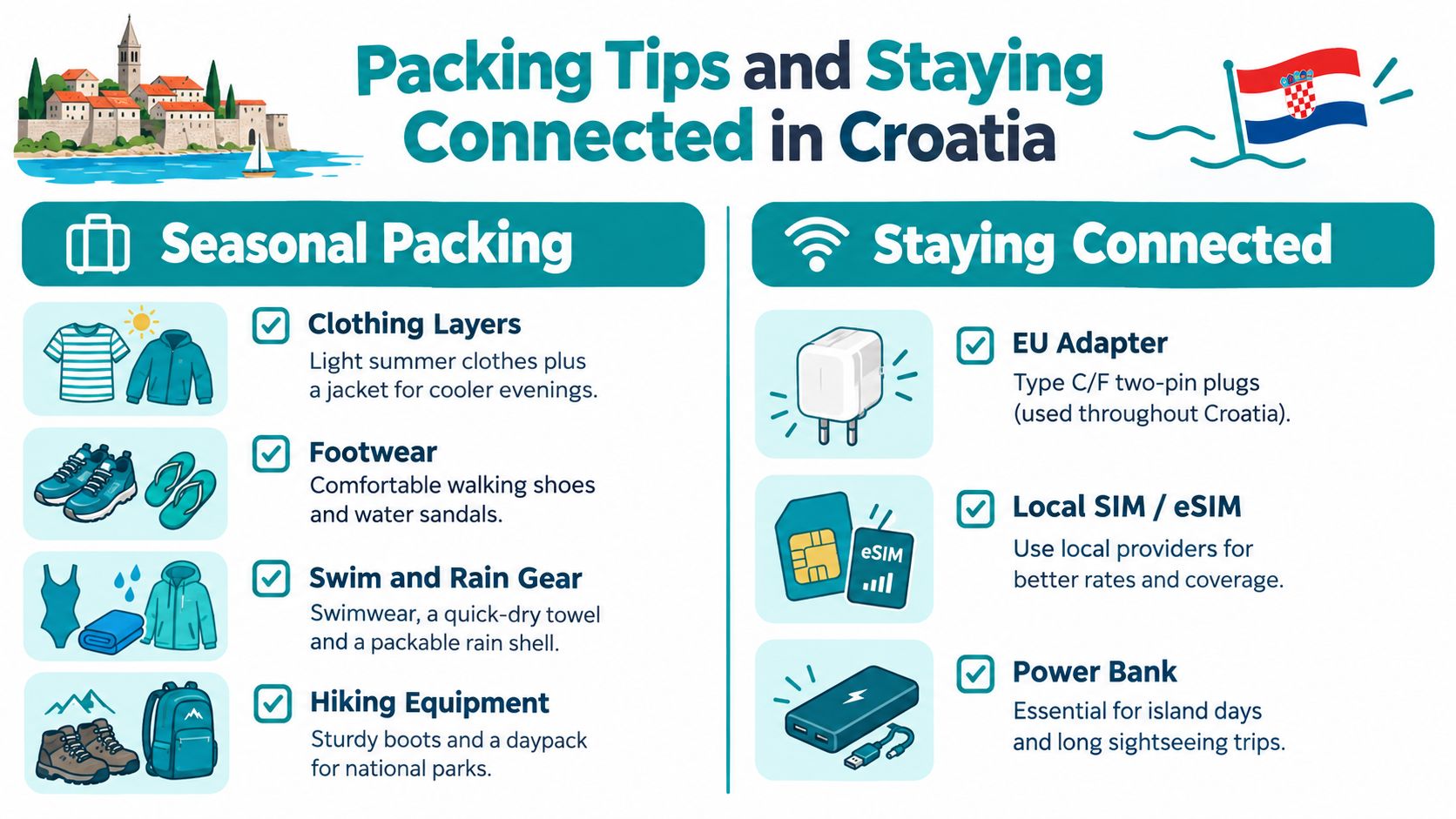
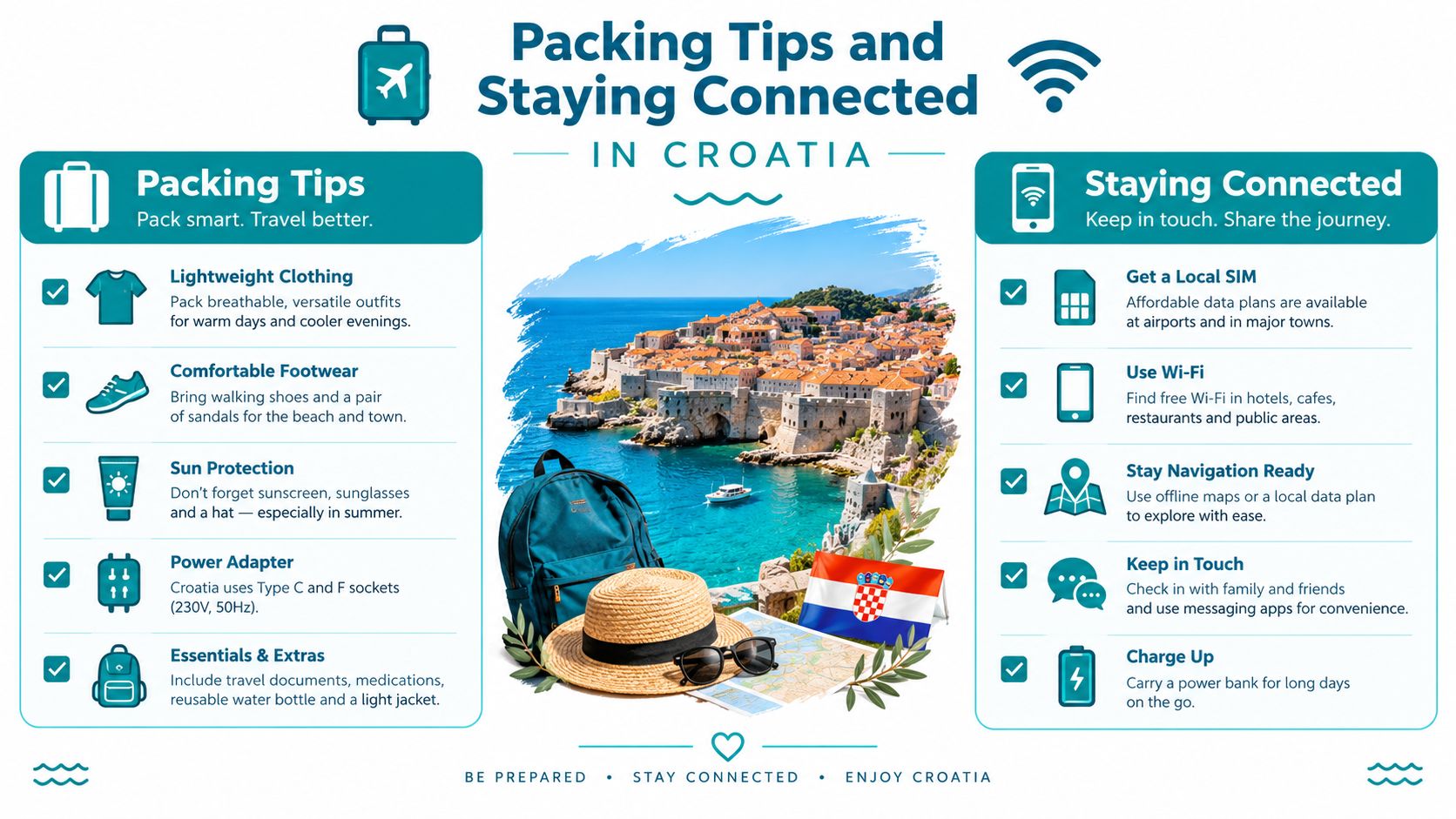
Pack for the activities your month supports, not the image you have of Croatia. A summer coast trip still needs a light layer for evenings and sturdy shoes for old-town streets. An April or October itinerary needs more flexibility because walking weather can change faster than beach conditions.
Croatia uses 230V electricity and Type C/F plugs, so travelers from North America and other regions with different standards should pack a suitable adapter. Download offline maps for Split, Dubrovnik, and Plitvice before leaving, and save ferry information while you still have reliable Wi-Fi.
Travelers from outside the European Union should compare an eSIM before departure rather than relying on expensive roaming. EU residents can generally use their domestic plans under applicable roaming rules, but you should confirm the terms with your operator before travel.
For a practical overview of installation, compatibility, and Croatia-specific options, see this guide to the best eSIM for Croatia. An eSIM is particularly useful on a route that combines Zagreb, national parks, coastal cities, and islands, where you'll want maps, ferry updates, restaurant bookings, and translation access without searching for a physical SIM.
My final recommendation is to choose May for the best all-purpose Croatia trip, September for warm coastal travel with fewer peak pressures, and April or October for value and inland exploration. If your dates are fixed in July or August, reserve the most important accommodation and transport first, then build the itinerary around what's available.
Simsima offers prepaid travel eSIM data plans for 190+ countries, with one-tap Smart Link installation, no physical SIM, no ID or KYC, and 24/7 support. Before you fly to Croatia, compare a destination or regional Europe plan and visit Simsima to stay connected from your first ferry booking to your final airport transfer.

Founder of Simsima. A passionate traveler based in Barcelona, he helps travelers stay connected without breaking the bank on roaming fees.
LinkedIn