Guides & news
Blog
Discover our latest guides, travel tips, and mobile tech news.
How it works
Learn how to install and use your travel eSIM in a few steps.
Loading...
Guides & news
Blog
Discover our latest guides, travel tips, and mobile tech news.
How it works
Learn how to install and use your travel eSIM in a few steps.
How much does a trip to Australia cost? See budget and mid-range totals for 10 and 14 days, with daily costs, park fees and phone data.
 Dimitri MorvanNovember 14, 202616 min
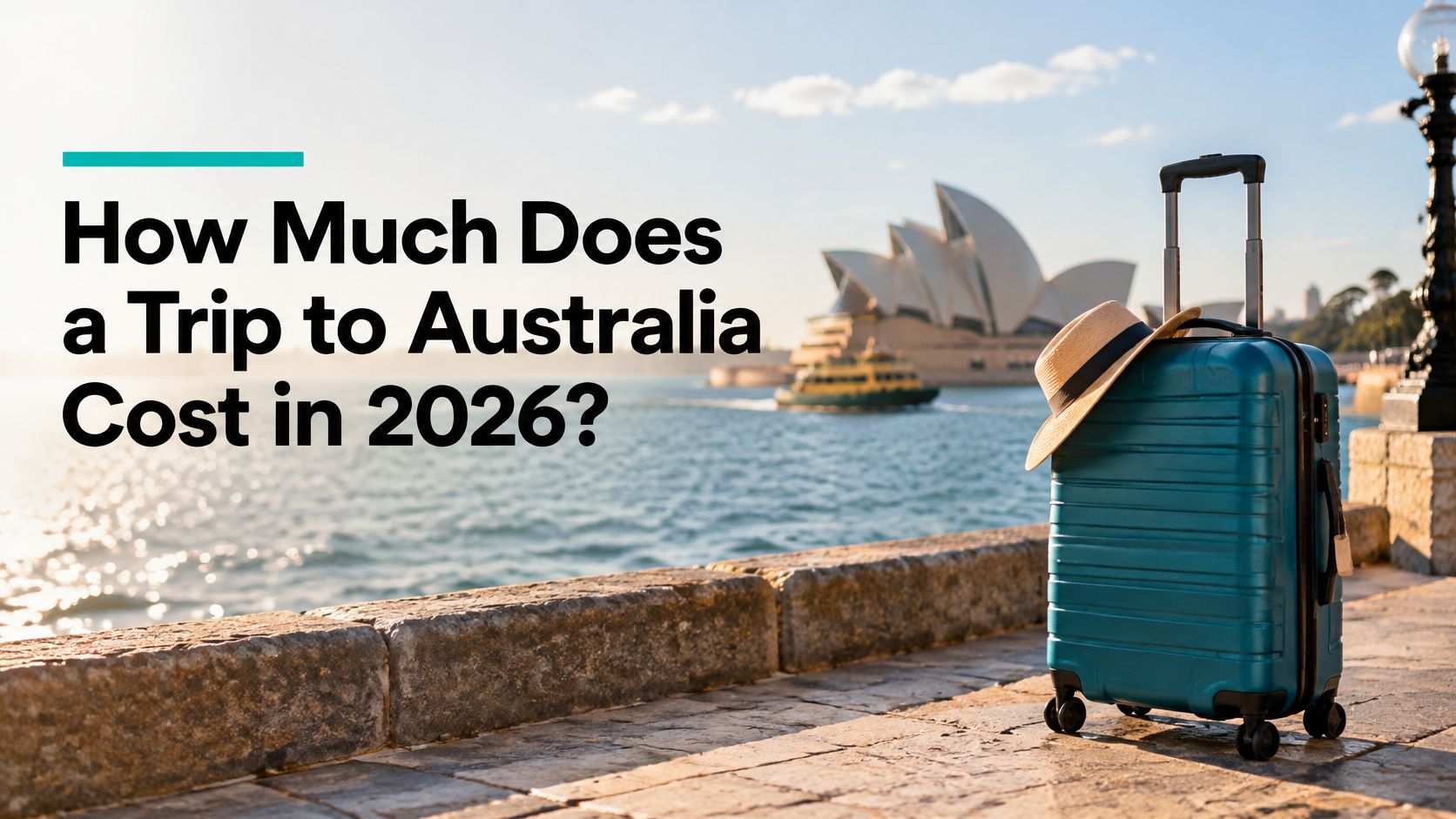
A 10-day trip to Australia runs about AUD 1,500 to 2,500 per person for a budget traveler and AUD 3,000 to 4,500 for a mid-range one, with international airfare excluded. On a 14-day trip, the same two styles land at AUD 2,100 to 3,500 and AUD 4,200 to 6,300.
Those figures cover what you spend after you clear customs. What you spend before you leave home is a separate ledger, and it keeps growing. International tourism consumption in Australia totaled A$42.3 billion in the 2024-25 financial year, rising 10.1% in current prices, according to the Australian Bureau of Statistics.
Two travelers can follow identical routes and report costs thousands of dollars apart because one quotes in-country spending and the other quotes the entire door-to-door bill, airfare included. The number below your name on the booking confirmation reflects the second amount. Distinguishing between these two is essential to building a budget that holds up against a real itinerary.
A 10-day Australia trip can cost AUD 1,500 to 2,500 per person on a budget or AUD 3,000 to 4,500 at a mid-range level, excluding airfare. The estimates below cover spending inside Australia.
| Travel style and length | Total (AUD) | Average per day (AUD) | What it assumes |
|---|---|---|---|
| Budget, 10 days | 1,500 to 2,500 | 150 to 250 | Dorms or basic hotels, self-catering, public transport |
| Budget, 14 days | 2,100 to 3,500 | 150 to 250 | Same style as the 10-day budget, scaled by nights |
| Mid-range, 10 days | 3,000 to 4,500 | 300 to 450 | Private rooms, restaurant meals, one or two paid excursions |
| Mid-range, 14 days | 4,200 to 6,300 | 300 to 450 | Same style as the 10-day mid-range, scaled by nights |
Budget travel here means dormitory beds or basic hotel rooms, groceries and self-catering for most meals, public transport, and few paid tours. Mid-range assumes a private room each night, a mix of restaurant and casual meals, one or two paid excursions across the trip, and occasional rideshares.
National totals offer a broad comparison. For the year ending June 2024, Australia recorded 7.353 million international visitors, who stayed an average of 37.8 nights and generated A$31.713 billion in overnight visitor expenditure. Dividing that expenditure by the visitor count gives roughly A$4,313 per visitor for the trip, according to Tourism and Events Queensland's June 2024 international snapshot.
That average combines business trips, family visits, backpackers, and luxury tours, so it is a reference point, not a price for a particular itinerary. Spending also varies by state. A Sydney-only week and a four-city month therefore need separate budgets.
Keep the door-to-door total distinct. The figures in the table cover spending inside Australia. International airfare, visa or authorization fees, and domestic flights sit outside them; on a long-haul trip, airfare alone can rival in-country spending.
Convert AUD to USD using an exchange rate recorded with the date checked, then check it again before booking. On a four-figure budget, currency movement can affect the total more than a single museum ticket.
A 14-night trip can cost far more than a 10-night trip, even when the airfare stays the same. Accommodation, meals, local transport, domestic flights and excursions add costs with each extra day; airfare, travel insurance and visa or authorization fees are generally paid once.
A Tourism Research Australia report for the June quarter of 2026 gives a useful benchmark for trip length and spending. It reports an average overnight trip of 3.4 nights and average spending of AUD 945, or about AUD 278 per night. Its longer-holiday figures are 16.6 nights and AUD 523 per night for international outbound holidays, compared with 3.6 nights and AUD 332 per night for domestic overnight holidays.
These figures describe different traveler groups, not a typical inbound tourist's nightly budget. Use them as context, not as a price quote. At AUD 523 per night, 14 nights would come to about AUD 7,322 in destination spending before airfare. A traveler staying in dorms and preparing meals can spend much less.
The daily ranges show what four additional nights can add:
| Style | Extra cost of moving from 10 to 14 days |
|---|---|
| Budget | AUD 600 to 1,000 (4 days at AUD 150 to 250) |
| Mid-range | AUD 1,200 to 1,800 (4 days at AUD 300 to 450) |
The airfare is spread across more days on a longer trip, reducing its share of the daily total. That can make extending a trip more economical per day, even though the overall cost rises.
Route choice also changes the budget. A Sydney stay keeps transport needs different from a Sydney, Melbourne, Cairns and Uluru loop, which adds domestic flights and long transfers. Price each domestic leg on the airline's official site when planning, and record when you checked, since fares change. The multi-destination trip planning guide explains how to sequence stops. The Ireland trip cost breakdown applies the same cost method to another destination.
A budget day in Australia splits into four lines: AUD 35 to 60 for a hostel bed or basic hotel room, AUD 35 to 60 for food, AUD 10 to 25 for local transport, and AUD 15 to 40 for sightseeing and incidentals. Add them up and a day costs AUD 95 to 185 before anything extra.
That daily model is the building block every figure in this article rests on.
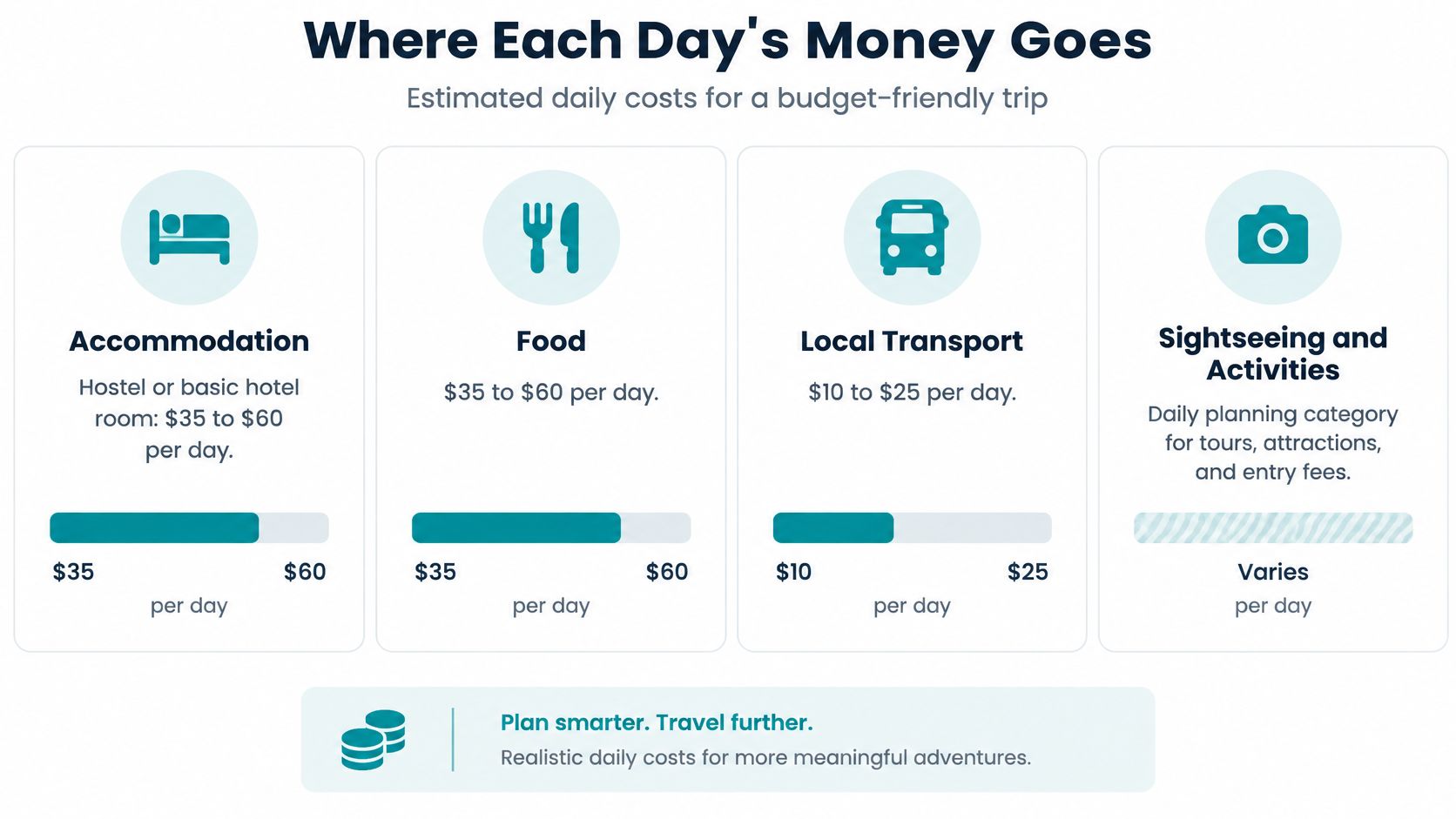
Over 10 days it produces AUD 950 to 1,850; over 14 days, AUD 1,330 to 2,590.
| Category | 10 days (AUD) | Notes |
|---|---|---|
| Budget accommodation | 350 to 600 | Hostel or basic hotel at AUD 35 to 60 per night |
| Budget food | 350 to 600 | Self-catering versus restaurant meals |
| Budget local transport | 100 to 250 | Fare caps versus taxis and rideshares |
| Budget sightseeing and incidentals | 150 to 400 | Paid tours, park entry and shopping |
| Budget subtotal before extras | 950 to 1,850 | Excludes intercity travel, insurance and phone data |
| Mid-range lodging | 1,000 to 2,000 | Private rooms at AUD 100 to 200 per night |
Australia's official statistics draw the same line this table does. In the year ending September 2024, international visitors spent A$10.7 billion inside Australia, a figure 4% above September 2019 levels, while total international visitor spending was A$48.4 billion, because total spend also carries overseas purchases like international airfares and stopovers, according to Tourism Research Australia's international results. Visitors from the U.S. made 656,000 trips and spent AUD 2.0 billion in the country on that measure.
A budget subtotal of AUD 950 to 1,850 doesn't yet match the AUD 1,500 to 2,500 headline. The gap is the reserve line, and it's AUD 550 to 650:
That lands inside the range. Price it line by line and you can see exactly which choice pushed you to the top of it.
For mid-range, start from the private room at AUD 100 to 200 per night and price one sample week: AUD 700 to 1,400 on lodging, AUD 490 to 770 on food at AUD 70 to 110 a day, AUD 210 to 350 on local transport at AUD 30 to 50 a day, and AUD 490 to 630 on excursions and incidentals at AUD 70 to 90 a day. That's AUD 1,890 to 3,150 for seven days, or roughly AUD 270 to 450 daily, which is why the mid-range band sits where it does once intercity legs and insurance join the sheet.
Put each category on its own line and never merge them into one "spending money" pot. The line that drives your total is the one you can change, and you can't see it in a lump sum. Apply the same four-category method to a Thailand trip budget and the daily figures shrink fast, which is a useful reminder that Australia's cost is structural, not a matter of bad planning.
Lodging creates the widest day-to-day swing in this budget. Tourism Australia's visitor economy benchmark report puts hostel dormitory beds at roughly AUD 20 to 85 per person, last-minute hotels at AUD 100 to 200 per night, and boutique hotels around AUD 250 per night. A hotel room can therefore add roughly AUD 80 to 230 per night compared with a dorm bed.
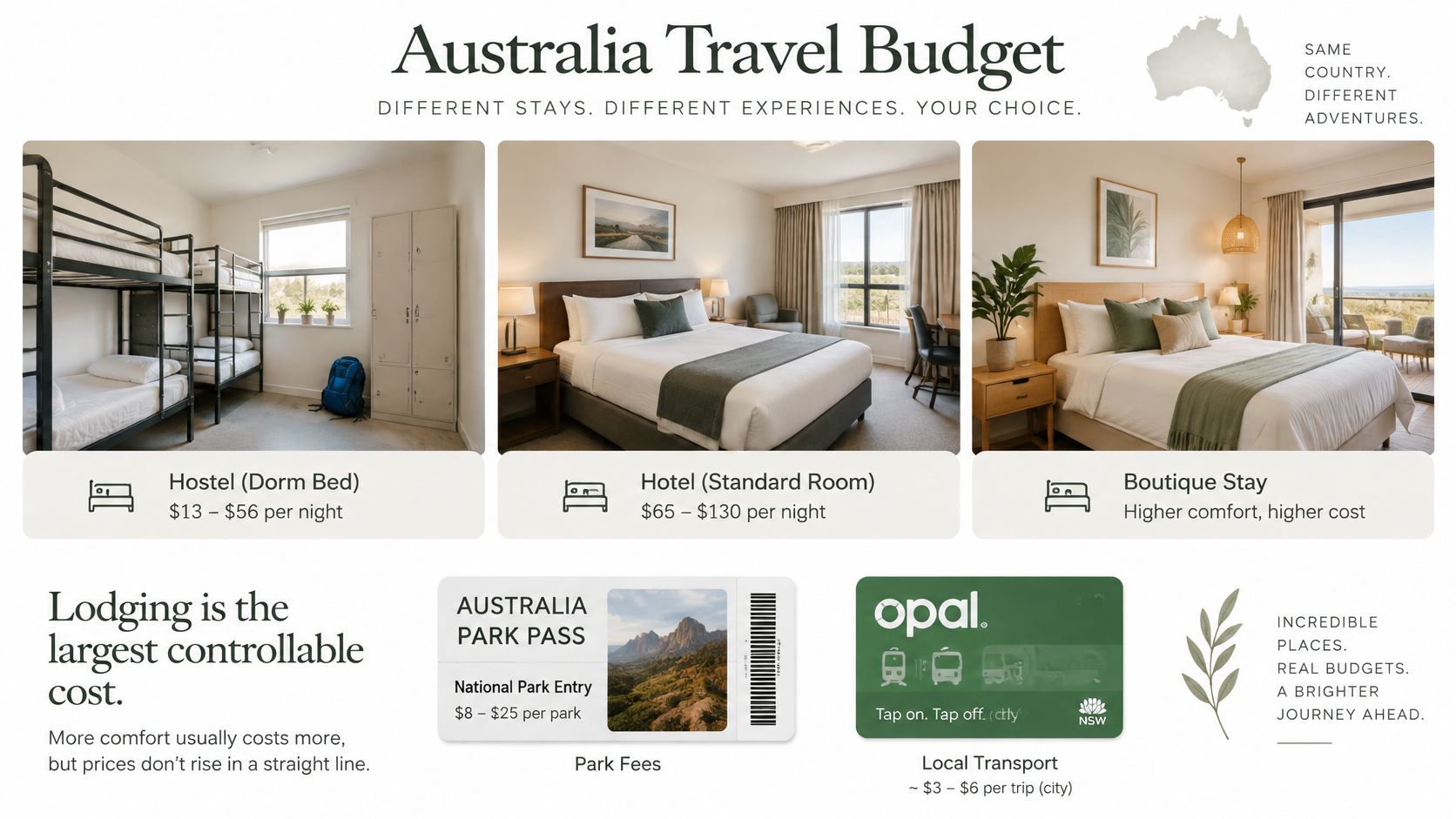
Over 12 nights, those lodging choices range from about AUD 240 in dorms to AUD 3,000 in boutique hotels. The difference is AUD 2,760, before meals, transfers or attractions.
Public transport fare caps can keep daily city travel costs low, while taxis and rental cars cost considerably more. The actual fare depends on the city, route and travel choices, so compare current fares with your itinerary rather than applying one daily figure across Australia.
| Option | Typical price (AUD) | Watch for |
|---|---|---|
| Hostel dormitory bed | 20 to 85 per person per night | Shared bathrooms; prices vary by city and season |
| Last-minute hotel | 100 to 200 per night | Late booking raises the price; compare with dorms first |
| Boutique hotel | About 250 per night | Adds about 80 to 230 per night over a hostel |
| Public transport | Fare caps keep daily costs low | Caps and fares vary by city; check current rates |
| Taxi or rideshare | Considerably more than public transport | Cost depends on route and journey |
| Rental vehicle | Considerably more per day than public transport | Add fuel, parking, insurance and tolls |
A rental car is most useful for regional segments where it provides access to places beyond the public transport network. Account for the full cost, including fuel, parking, insurance and tolls, and avoid paying for a car on days spent in a city.
Park entry is another budget line that can be missed when costs are grouped into a general sightseeing allowance. In New South Wales, vehicle entry charges apply at 45 of more than 890 national parks and reserves. The fee is charged per vehicle rather than per person, while visitors who walk or cycle enter free, according to the NSW National Parks fee-collecting parks page. Royal National Park charges AUD 12 per vehicle per day; single-day vehicle fees across the state are commonly AUD 4, AUD 8 or AUD 12, depending on the park.
For a 10-day itinerary with a rental car entering Royal National Park on two days, the park fees total AUD 24, or AUD 12 per person for a couple. Four paid vehicle-entry days on a 14-day trip would cost the same couple AUD 48 at that rate. Check the official park authority for each planned excursion, since fee rules differ by state and park.
Keep accommodation, transport and park entry as separate budget lines. Staying near a transit stop can reduce the need for taxis, while hiring a car only for regional days avoids paying its daily costs throughout a city stay.
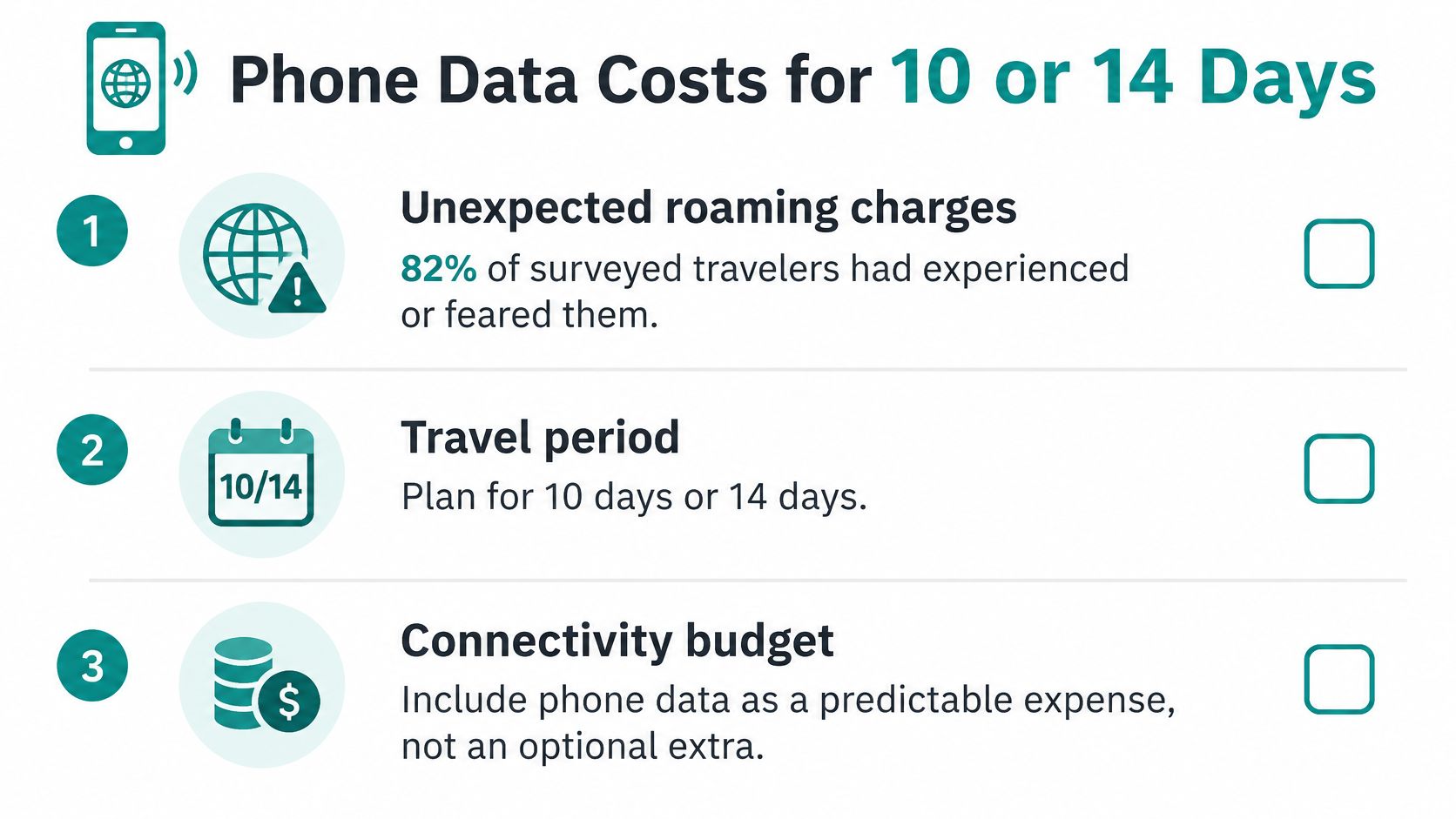
Phone data belongs in the trip budget alongside transport and park entry. A 10-day or 14-day trip can fit within a single 28-day prepaid plan, but the total depends on its activation price and included data, not validity alone.
In a June 2025 survey of 1,035 Australians who had traveled internationally, 82% said they had experienced or feared unexpected roaming bill shock, according to Optus. The survey covered Australians traveling abroad, not inbound visitors to Australia, but it highlights why roaming charges should be checked before departure.
Australia's distances make a working connection useful for maps, bookings, rideshare pickups and route updates. Budget for the data you expect to use, especially if your itinerary includes long drives or frequent hotspot use.
| Option | Activation price | Check before buying |
|---|---|---|
| Carrier prepaid traveller plan, such as Telstra's traveller offer | Current price on the Telstra traveller prepaid page | Included data, expiry date and recharge price after promotional terms |
| Carrier prepaid offer, such as Optus's | Current price on Optus's prepaid offers page | Introductory allowance versus ongoing recharge inclusions |
| Travel eSIM for Australia | Price varies by plan and data amount | Data allowance, validity, hotspot support and whether your home number stays active |
| International roaming on your home plan | Price depends on your home carrier's daily or usage-based rates | Roaming rates and potential charges for your expected use |
Telstra's traveller plan and Optus's listed prepaid offers have 28-day validity, so either period covers a 10-day or 14-day holiday. Compare the activation price with the included gigabytes, then check what a recharge costs if you need more data. Carrier prices and promotions can change, so use the current figures on each provider's page when setting your budget.
A data-only travel eSIM can keep your regular number available for calls and texts on a dual-SIM phone. Simsima's Australia travel eSIM is another option to compare with local carrier plans. Simsima lets customers top up existing data plans, and its app supports Apple Pay and Google Pay. For a wider comparison, see this guide to the best eSIM options for Australia; travelers whose phones cannot use an eSIM can also compare best SIM cards for international travel.
Before paying, confirm that your phone is compatible with the chosen carrier or eSIM. Download offline maps before departure, and allow for extra data if you plan to make video calls, use a hotspot or work remotely.
Geography, not daily spending, decides whether you land inside your target range. Attraction costs can stay modest for self-guided outdoor days and then jump the moment you add paid tours, internal flights or a rental car. New South Wales illustrates the trade-off in its annual park pass information: a one-year Multi Park Pass costs AUD 65 and covers fee-collecting parks except Kosciuszko National Park, while the All Parks Pass costs AUD 190. On a short holiday those passes are hard to justify unless the route touches many fee-collecting parks, since a traveler paying a per-vehicle day fee needs several qualifying visits before a pass breaks even. On a two-week road trip with a full car, the calculation can flip.
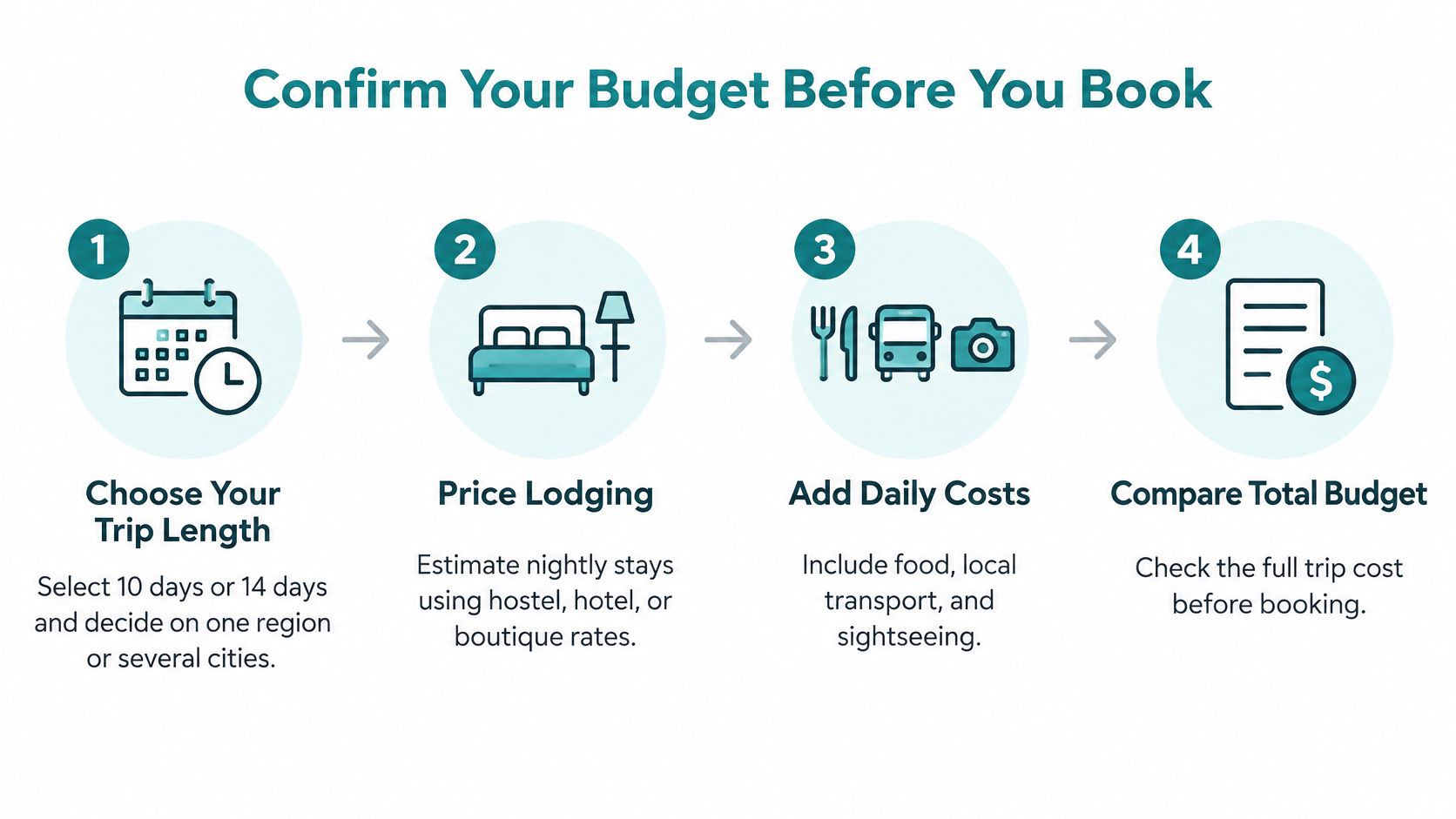
Run this sequence with your own dates and your own route.
A worked check: a 14-day budget trip starts at AUD 2,100 to 3,500 in-country before airfare, phone data and insurance. If your separate lines total inside that band with the contingency line still intact, the numbers hold together. If lodging alone eats most of it, the route is the problem, not the daily spending.
Decision rule: book when your separate lines total inside your target range and the contingency line is still visible. Hold when the only way to hit the number is to delete a line you know you'll spend anyway.
If you'd rather have software track the lines while you travel, this guide to AI personal finance assistants covers how category-level tracking works in practice. A spreadsheet does the same job, as long as lodging, food, transport, park entry, data, airfare and insurance each get their own row.
Before you lock in the airfare, sort out the smallest line that causes the most trouble on the road. Simsima sells prepaid Australia data plans that install in about a minute with a one-tap Smart Link or a QR code, with no physical SIM and no app to download, so your regular number stays free for calls and texts. Check the plan against your trip length, keep the top-up option in mind for a longer stay, and you can stop treating connectivity as a surprise charge.
Founder of Simsima. A passionate traveler based in Barcelona, he helps travelers stay connected without breaking the bank on roaming fees.
LinkedIn