-5% on your 1st eSIMuntil October 31

You've got fourteen days, a flight into one city, a possible return from another, and a route map that seems to demand everything at once: Dubrovnik's walls, Split's palace, Hvar's harbour, Plitvice's lakes, and perhaps a quieter island before the ferry home. The hard part isn't finding places worth visiting. It's avoiding a plan that turns your holiday into a sequence of checkouts, luggage transfers, and missed sailings.
Croatia rewards deliberate routing. Its coast is long, its islands are scattered, and summer demand can make a route that looks effortless on a map surprisingly awkward on the ground. A good 2 weeks in Croatia itinerary leaves room for swimming, late lunches, and weather changes, while still making smart use of one-way flights, ferries, buses, and mobile data.
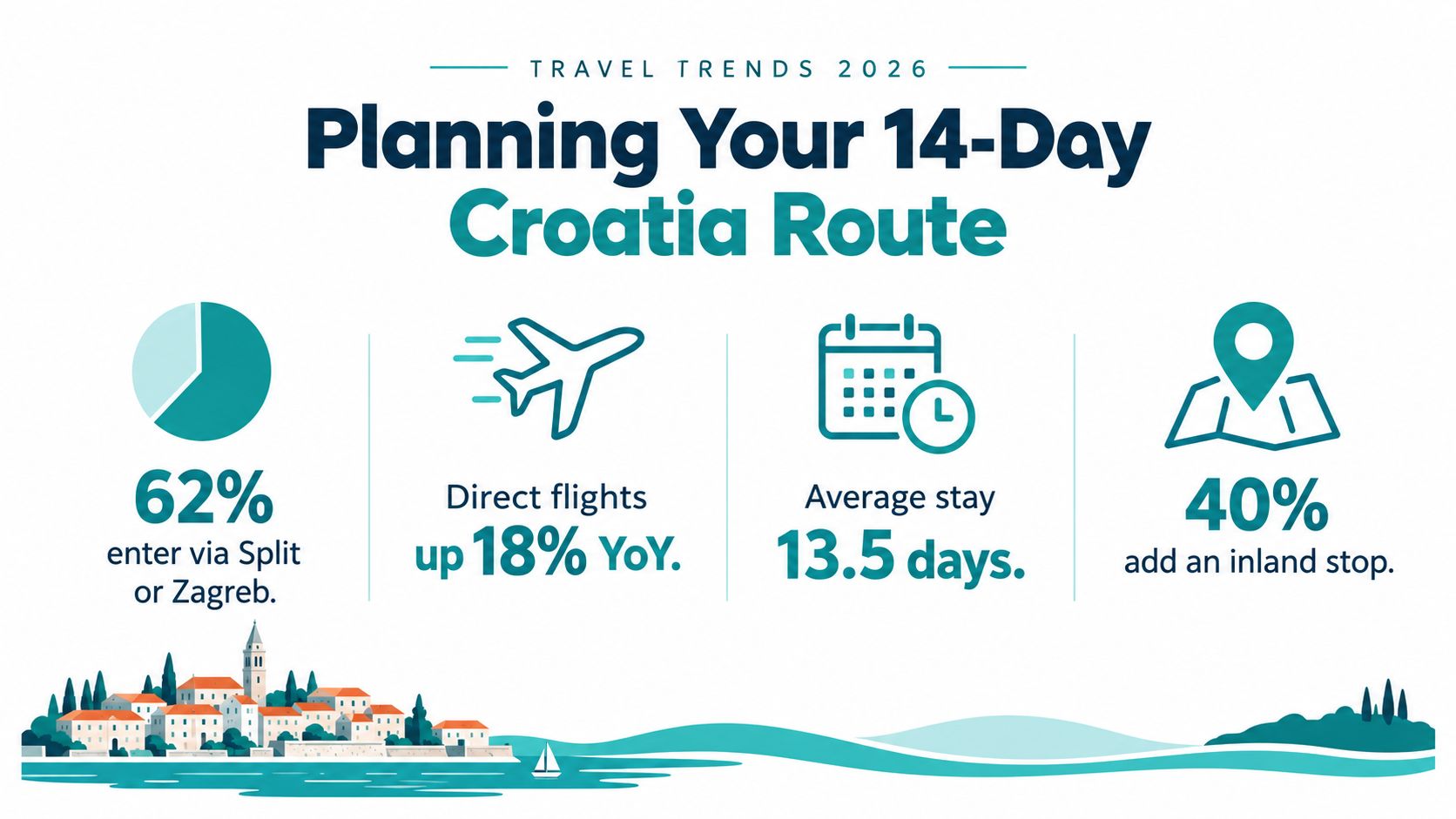
Planning Your 14-Day Croatia Route
A 2026 itinerary needs room for later bookings, shorter stays, and seasonal changes. A Zagreb to Plitvice to Split and Dubrovnik route still works, particularly with a rental car, but it can create unnecessary backtracking if flights, ferries, or hotel availability do not align. Official 2026 reporting recorded softer June demand while the first half of the year remained slightly ahead overall, so schedules and availability may not match a fixed midsummer plan. Croatia's official tourism statistics provide the relevant context.
For a first visit, the coast usually deserves the largest share of the trip. Croatia recorded 20.2 million tourist arrivals and 93.7 million tourist nights in commercial accommodation in 2024. Seaside resorts accounted for 86.4 million nights, or 92.2% of all commercial overnight stays, while foreign visitors contributed 17.4 million arrivals and 85.0 million nights. The Croatian Bureau of Statistics explains why coastal hotels, ferries, and buses are designed around concentrated leisure demand rather than consistent year-round traffic.
Start with the route shape
Croatia had 428 thousand rooms, apartments, and camping sites available in August 2024, alongside 1.1 million permanent beds. Capacity is substantial, yet popular bases and ferry departures can fill together when dates are fixed. Book the route shape before choosing individual hotels, especially if your trip falls near the busiest summer period.
Choose according to the experience you want:
- Coastal emphasis: Prioritise Dubrovnik, Split, Zadar, and perhaps Makarska. Buses make this the simplest option, but the route passes through busy urban and cruise-port areas.
- Island emphasis: Use Split or Zadar as a gateway and stay on one or two islands. You gain more Adriatic atmosphere, while accepting fewer departures, wind-related disruption, and potentially higher ferry costs.
- Balanced route: Combine the coast with Plitvice, Zagreb, Istria, or another inland stop. The result has more varied scenery and less ferry dependence, but fewer days for swimming and island stays.
Islands deserve planned overnight time rather than a token excursion. Standard two-week plans often list Hvar as a day trip from Split, leaving no time for the harbour evenings that make an overnight worthwhile. Croatia has more than 1,100 islands and islets, around 1,800 kilometres of coastline, and 48 inhabited islands, according to geographic listings cited by Britannica's Croatia overview. Islands, islets, and the Pelješac peninsula also recorded 3.7 million arrivals and 22.6 million nights in 2024, with Krk alone accounting for 913 thousand arrivals and 5.0 million nights. That demand supports island-based travel, but it also makes early route planning more important.
Before booking accommodation, map the number of overnight bases with the multi-destination planning guide from Simsima. Keep hotel changes limited, then check ferry and bus connections against both arrival and departure airports.
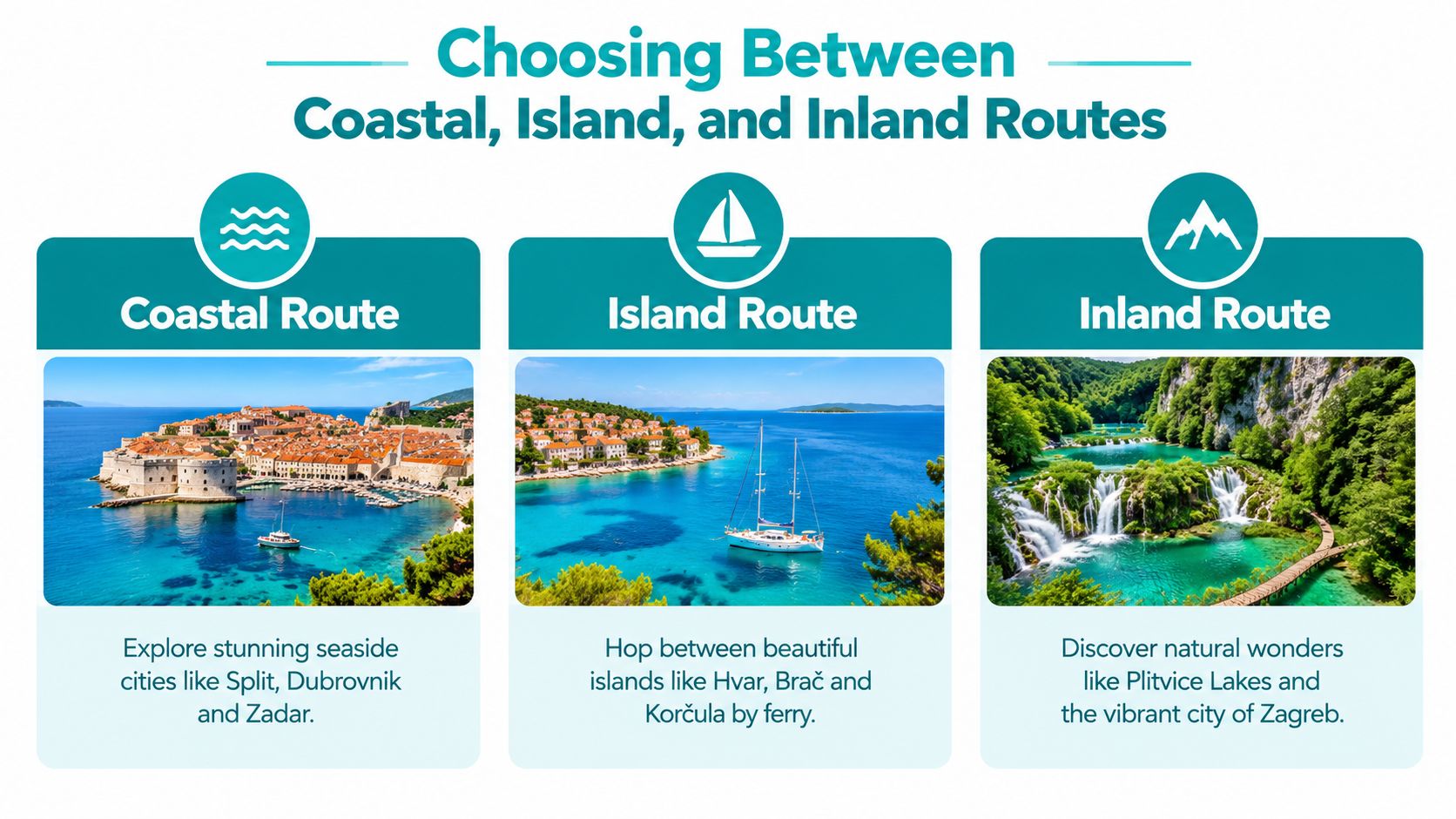
Choosing Between Coastal, Island, and Inland Routes
The right route depends less on how many attractions you can list than on how much transport uncertainty you'll tolerate. A coastal itinerary gives you the most forgiving connections. An island itinerary gives you the strongest Adriatic atmosphere, but it becomes vulnerable to limited departures and bad weather. An inland route reduces ferry dependence and changes the trip from a beach holiday into a broader Croatian journey.
Coastal route
A classic coastal route might run Dubrovnik, Makarska, Split, Zadar, with a short island day trip. It works well for travellers who want historic centres, swimming, restaurants, and straightforward ground transport. Buses connect the major mainland towns, and you can use ferries selectively rather than making every hotel change depend on a sailing.
The trade-off is crowd exposure. Dubrovnik and Split are high-demand bases, and a coast-only route can feel repetitive if every day follows the same pattern of old town, waterfront, and beach. It also requires careful north-south planning, preferably with an open-jaw flight arrangement so you don't spend the final day reversing direction.
Island route
An island-focused plan starts in Split or Zadar and uses one or two overnight islands, such as Hvar, Brač, Korčula, or Pag. Croatia had 226 nautical ports in 2024, including 85 marinas and 19,073 moorings, a useful indication of how important boating and coastal transfers are to the country's travel network. The Croatian Bureau of Statistics provides that port data.
This route suits travellers who value coves, harbour evenings, and a slower rhythm. It's less suitable if you want a tightly controlled timetable. You may need to choose between a fast passenger catamaran and a car ferry, and a departure that looks convenient may operate only on selected dates. Sleeping on Hvar or Korčula usually feels more rewarding than visiting both in a single compressed day, but every additional island adds another point of failure.
Inland route
The inland option pairs cities such as Zagreb and Split with Plitvice Lakes, then finishes on the southern coast. It's the best choice for travellers who enjoy national parks, food, architecture, and road travel as much as beaches. A car is more useful here than on an island-heavy itinerary, especially when you want to set your own departure time.
Its weakness is emotional rather than logistical. You'll give up some relaxed Adriatic days, and a long inland-to-coast transfer can feel like a reset midway through the holiday. For a first visit, the combined route works best when you select one inland highlight rather than trying to include every region.
Route rule: If missing one ferry would force you to lose a hotel night or an international flight, your itinerary has too many tightly connected moving parts.
Day-by-Day Itinerary for a Coastal and Island Route
The following structure works for travellers who want major coastal cities plus meaningful island time without changing hotels every night. It assumes an arrival in Split and a departure from Dubrovnik, though reversing the direction is equally sensible when flight schedules make it easier.
Days 1 and 2 in Split
Arrive in Split and stay within walking distance of the old town or Riva. Use the first afternoon for Diocletian's Palace, the waterfront, and a low-effort dinner. Split is compact enough that you don't need to schedule every sight, and keeping the arrival day light protects you from flight delays.
Use the second day for Marjan Hill, the old town's narrower lanes, and a swim near the city if the weather cooperates. Don't rent a car for these days. Parking and traffic add friction without improving your experience.
Days 3 and 4 on Brač
Take a passenger ferry or car ferry to Brač, then base yourself in either Supetar or Bol depending on your onward connection and preferred atmosphere. Supetar is practical for the mainland link. Bol gives you easier access to Zlatni Rat and a more distinctly island-based stay.
Spend the first day settling in and the second exploring the coast at an unhurried pace. Brač works as an overnight island because you aren't forced to return to Split after the last beach stop. Check the return sailing before booking accommodation, since a beautiful island base becomes inconvenient if the next connection departs from the opposite side of the island.
Days 5 and 6 on Hvar
Move from Brač toward Hvar, using the available passenger connection where possible. Hvar Town is convenient for ferries, restaurants, and historic sights, while Stari Grad offers a calmer base and better access to inland areas.
Use one day for Hvar Town and the fortress. Reserve the other for a boat outing, a quieter village, or a beach reached by local transport. Hvar is a poor place to over-schedule. Its value comes from staying long enough to let the harbour, swimming spots, and evening promenade set the pace.
Days 7 and 8 in Makarska
Return to the mainland and continue to Makarska by bus or rental car. This stop breaks up the journey south and gives you two nights beside the Biokovo mountain range. Use the first evening for the waterfront and the second day for swimming, a coastal walk, or a mountain excursion suited to the weather.
Makarska is also a useful pressure-release valve. If the islands have involved delayed departures or crowded boats, two nights on the mainland restore flexibility before Dubrovnik.
Days 9 and 10 in Dubrovnik
Continue south by bus or car, allowing more time than the map suggests if you're travelling in peak season. Check in outside the busiest old-town lanes if you want easier access and a quieter evening.
Explore the walls early, then visit the old town's churches, alleys, and harbour. The following day can go to Lokrum, a nearby beach, or Mount Srđ, depending on weather and energy. Dubrovnik rewards early starts because the old town feels dramatically different before the main daytime crowds arrive.
A short video can help you visualise the pacing and geography before you commit to the route:
Days 11 and 12 for a flexible southern base
Keep these nights flexible. You can remain in Dubrovnik for more swimming and historic sightseeing, move to Cavtat for a quieter coastal base, or use one day for a carefully checked excursion. Avoid crossing an international border unless you've verified vehicle permissions, insurance, and the time required at crossings.
The best choice depends on your departure airport. If you fly from Dubrovnik, staying nearby is safer than adding a final long transfer. If you're leaving from Split, use these days to work north only when the transport schedule leaves a generous buffer.
Days 13 and 14 for departure protection
Keep the last full day close to your departure point. This isn't wasted time. It protects the trip from ferry cancellations, traffic, and the simple fatigue that follows several transfers.
For a departure from Dubrovnik, sleep in Dubrovnik or nearby. For a departure from Split, don't assume a same-day island ferry will line up perfectly with your flight. A relaxed final base is more valuable than one last ambitious stop.
Ferry Costs, Seasonality, and Transport Realities
Island hopping becomes expensive when travellers treat every transfer as a minor detail. The fare itself may be manageable, but the total grows when you add a vehicle, parking, a taxi to a different harbour, and a replacement booking after a missed departure.
Publicly available 2025 ferry examples show that a one-way crossing for two adults and a car can range from roughly €21.60 to €45.70, depending on the route and island. Main-season pricing can be about 20% higher than low-season pricing. The published Croatia ferry timetable and pricing examples are useful for building a realistic transport budget, but confirm the current fare and vehicle rules directly before purchase.
Decide whether the car earns its place
A car makes sense on the mainland when you want Plitvice, smaller coastal towns, inland viewpoints, or flexible beach access. It becomes less attractive when your plan centres on passenger ferries and walkable island towns. You may pay to transport the car, queue to board, search for parking, and then leave it unused for most of the day.
Use this decision test:
- Keep the car on the mainland if your route includes rural accommodation, national parks, or several stops without direct bus links.
- Return the car before island time if you'll stay in Hvar Town, Korčula Town, or another compact harbour base.
- Take the car across only when it gives you access to multiple parts of a larger island and the extra fare is cheaper than repeated taxis or tours.
- Avoid same-day ferry chains when the next sailing is essential. A missed connection can erase the apparent time savings.
Croatia's 19,073 moorings and 226 nautical ports reflect the scale of maritime travel, but they don't mean every route runs frequently enough for spontaneous connections. The official port statistics support the broader point, boating is central to the system, but availability still varies by route, date, and season.
Plan for the shoulder season honestly
Shoulder-season travel can reduce crowd pressure and make a two-week route more comfortable, but services may be less frequent and some seasonal businesses may close. The 2026 demand data shows why timing now deserves more attention than a generic “visit in summer” recommendation. Compare dates, accommodation cancellation rules, and the operating calendars of ferries and attractions using Simsima's Croatia timing guide, then confirm transport with the operator.
Transport reality: The cheapest route on paper is often the one with the most transfers. Count your time, luggage handling, and failure risk, not just the ticket price.
Staying Connected with the Right eSIM Plan
A missed ferry, a dark rural road, or an apartment host waiting at the wrong entrance can turn weak mobile data into a practical problem. In Croatia, connectivity supports the route itself. Use it to check changed departures, locate terminals, download maps before signal drops, and message hosts between island bases.
First check where your SIM was issued. EU or EEA plans usually allow roaming in Croatia under roam-like-at-home rules, but unlimited domestic plans often apply a fair-use cap of around 15 to 25 GB per month. This Croatia SIM and eSIM guide explains the distinction and gives a useful planning range: 5 to 10 GB is typically enough for a fourteen-day trip focused on maps, messaging, and social media, provided you do not stream video constantly.
Use a simple eligibility check
- Confirm the issuing country. An EU or EEA-issued SIM may be covered by roaming rules. A tourist SIM bought in another country may not be.
- Read the fair-use clause. Check the roaming allowance, throttling terms, and surcharge after the allowance ends.
- Estimate daily use. Ferry searches, navigation, messaging, and occasional uploads usually require less data than video streaming.
- Compare the billing model. Daily-fee roaming can cost more than a local data product over 7 to 14 days, especially when data is active every day.
Croatia-only tourist SIMs need closer checking if the itinerary crosses a border. If your route continues from Dubrovnik into Montenegro or Bosnia for a day trip, a Croatia-only plan may stop working at the crossing. A regional Europe eSIM keeps maps and messaging available across that border, although a Croatia-only plan can be the simpler choice for a country-focused route.
Choose for coverage, not just price
Summer congestion matters around ports, ferry queues, and popular islands. HAKOM-referenced reporting recorded 438.3 million minutes of international roaming traffic in Q3 2025, up 108.1% from Q2, while data-roaming revenue reached EUR 33.9 million, up 174.6% quarter over quarter. The referenced Croatian telecom market analysis shows why a plan that performs well in a city may feel slower on a crowded island or coastal road.
The same reporting describes Hrvatski Telekom as leading coverage experience with a score of 8.4 out of 10, ahead of A1 and Telemach. It also places 5G speeds in major cities such as Zagreb, Split, Rijeka, and Zadar at roughly 20 to 80 Mbps, with coastal 4G more often in the 10 to 30 Mbps range. Treat those figures as network context, not a promise for a specific beach, ferry, or mountain road.
Simsima's Croatia eSIM guide can help compare regional and local plans. Download ferry confirmations, accommodation addresses, and offline maps before leaving each base. Keep your primary SIM available for calls if your phone supports dual SIM.
Packing, Safety, and Practical Trip Essentials
Pack for movement, not for an imagined resort week. Two weeks in Croatia may involve stone lanes, ferry ramps, rocky beaches, hot pavement, wind on an exposed deck, and a sudden change from city walking to a national-park trail.
A compact setup works best:
- Footwear: Bring supportive walking shoes and lightweight water shoes. Smooth stone near the water can be awkward, and flip-flops are poor protection on long old-town walks.
- Clothing: Choose breathable layers rather than a large wardrobe. A light overshirt protects against sun, while a compact layer helps on windy ferry crossings.
- Beach equipment: Use a quick-drying towel, reusable bottle, sun protection, and a small dry bag for electronics.
- Luggage: A soft-sided bag is easier than a rigid suitcase on buses, stairs, and ferry boarding ramps.
- Family planning: If children are travelling, the practical family vacation packing tips from Global Vacation Rentals can help you organise shared beach, clothing, and comfort items without overpacking.
Protect the itinerary from small failures
Keep your passport, payment cards, accommodation details, and ferry confirmations in more than one place. Crowded terminals and busy waterfronts are easier to manage when your documents are accessible but not all stored in one open bag.
Carry some cash for small purchases and transport contingencies, but don't build the entire trip around cash. Save offline maps for every base, especially if your route includes islands, national parks, or mountain roads. Your phone may show a signal in town and then lose useful service on the next stretch of coast.
Match safety habits to the season
Heat changes how much ground you can cover. Start demanding walks early, carry water, and avoid scheduling a fortress climb immediately after a ferry arrival. In high season, reserve accommodation and essential ferry legs earlier than you would for a flexible city break. In the shoulder season, check whether restaurants, tours, and less frequent island services are still operating before choosing a remote base.
Finally, build one buffer into the route. Don't place your only international flight connection after a chain of ferries, buses, and taxis. The most memorable Croatia itinerary usually isn't the one with the highest attraction count. It's the one that leaves enough space for a swim, a delayed boat, and an evening you didn't plan.
For a two-week Croatia trip, Simsima offers Croatia and broader Europe eSIM data plans with digital delivery, one-tap Smart Link installation or QR setup, and no physical SIM required. Compare the available options and prepare your connection before departure by visiting Simsima.
#croatia itinerary#2 weeks in croatia#croatia travel guide#croatia island hopping#croatia trip planning

Dimitri MorvanFounder
Founder of Simsima. A passionate traveler based in Barcelona, he helps travelers stay connected without breaking the bank on roaming fees.
LinkedIn