-5% on your 1st eSIM
WELCOME5
Loading...
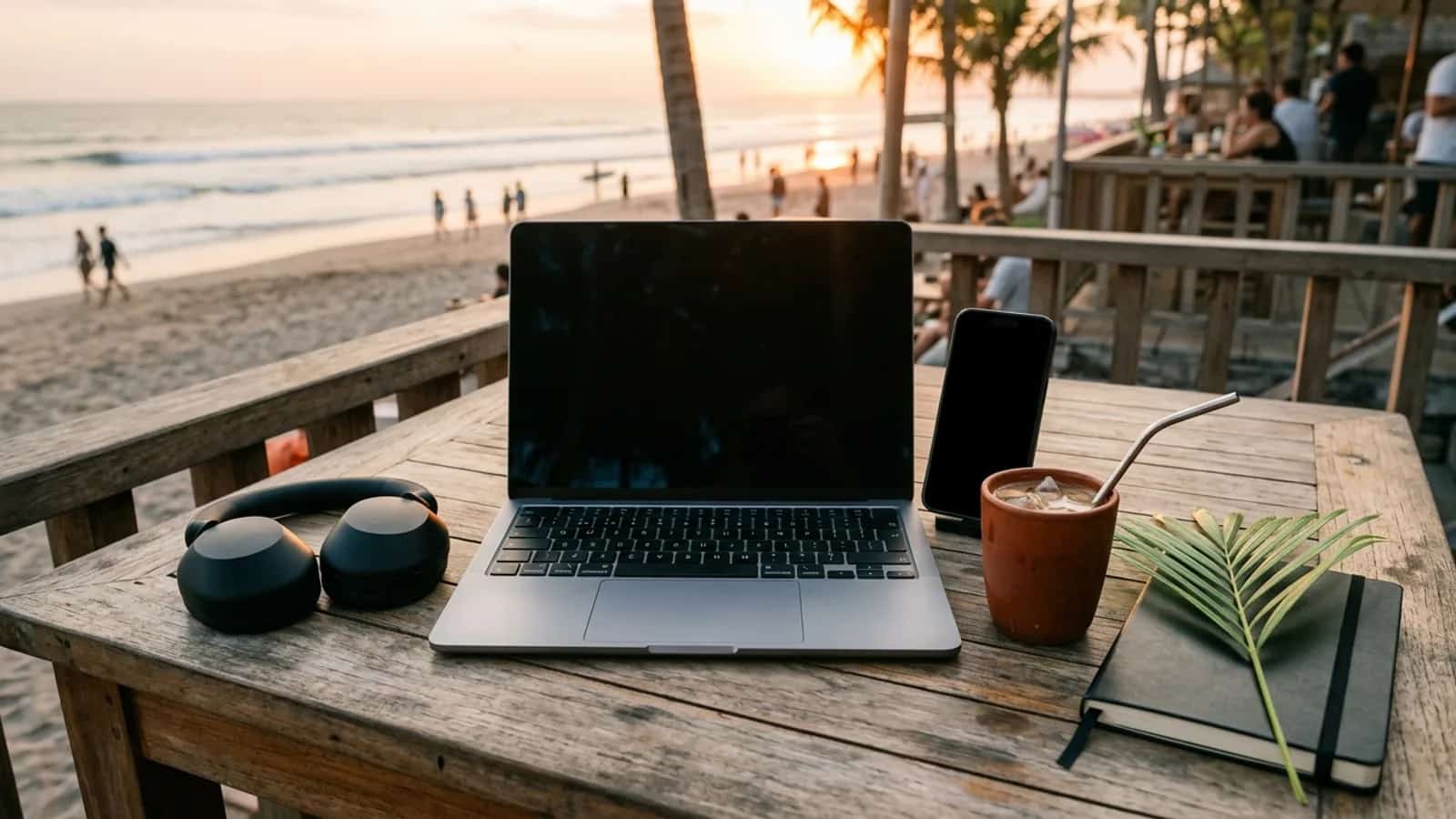
Tourist eSIM plans break down the moment you start running Zoom calls from Bali or shipping code from Lisbon. Here is how to pick a connectivity setup that actually holds up to a nomadic working life — long validities, multi-country coverage, 5G upload, hotspot, and a backup line for when things go sideways.
 Dimitri Morvan
If you have been on the road long enough to know what tethering off a hostel router feels like at 9pm UTC, you have probably already outgrown tourist eSIM plans. A 1 GB / 7-day profile that works fine for a beach week falls apart the moment your week turns into three months, your meetings run on European hours from Chiang Mai, and your client expects a screen share that does not freeze every twelve seconds. Choosing the best eSIM for digital nomads is less about chasing the lowest price per gigabyte and more about building a connectivity stack that survives time zones, customs lines, and a thirty-day stay that quietly turns into ninety.
Travel eSIMs are usually marketed to vacationers: a week in Lisbon, ten days in Tokyo, a long weekend in Mexico City. Those plans are tuned for low data, short validity, and the assumption that you will be back home before anything goes wrong. As a remote worker, almost none of those assumptions hold for you.
You are staying longer. You are using more data per day — a single hour of Zoom in HD eats roughly 1 to 1.5 GB, and a backup video call from a coworking space is the moment you do not want to be rationing megabytes. You also tend to move between countries on shorter notice, which makes the friction of buying, installing, and configuring a new eSIM at every border worth avoiding. The right plan, in other words, is one that you barely have to think about for weeks at a time.
The first filter is validity. Tourist plans cap at 7 to 15 days because that is how long a holiday lasts. Nomad-grade plans give you a 30-day window minimum, and ideally let you stack or top up without re-buying from scratch. Re-buying means a new ICCID, new profile to install, new APN to verify — small enough on day one, painful on day ninety when it happens between two client calls.
Most nomads do not stay in one country. They orbit a region: Bangkok to Bali to Ho Chi Minh, or Lisbon to Madrid to Tbilisi, or Mexico City to Medellín to Buenos Aires. A regional eSIM that follows you across that orbit is worth more than a country plan that forces a new install at every border. Check the country list carefully — some 'Europe' plans skip Georgia or the UK, and some 'Asia' plans skip Indonesia or Vietnam, which is precisely where you are likely to be.
If you are running video calls, syncing design files, or shipping builds, plan for 30 to 50 GB per month minimum. Power users hit 80 GB without trying. Unlimited plans usually fair-use throttle past a threshold, which is fine for most workdays but worth understanding before you commit. Always read the throttle clause; a plan that goes from 5G to 256 kbps after 20 GB will not get you through a deploy window.
Most providers advertise download speeds. Remote workers care about upload. Zoom, Google Meet, Loom, Figma multiplayer, large Git pushes — every tool you use treats upload as a first-class signal. 5G plans give you headroom on both sides, while 3G-only fallback plans (still common in some countries) will leave your camera frozen even when the speedtest looks acceptable. Confirm the technology before you buy.
Your phone is rarely the device you work on. You need to tether to your laptop, and sometimes to an iPad or a second monitor over USB-C. Some providers cap hotspot data, some quietly block it after a threshold, and a few do not allow it at all. Simsima's plans allow hotspot use, which is the assumption every nomad should be making before a plan even enters the shortlist.
A network that works perfectly in Canggu may have a dead zone in Ubud. The eSIMs that hold up over a long stay are the ones that connect to more than one local carrier, so your phone can fail over when the primary network drops. Look for providers that publish their network partners per country — it is a good proxy for resilience.
Almost no experienced nomad relies on a single line. The standard setup is two: a dormant home number (US, UK, EU, wherever your bank and tax authority live) parked on a low-cost plan or a cheap virtual SIM, and a travel eSIM that does the daily work. The home number is your identity layer — banking 2FA, government services, the doctor who only sends SMS appointment reminders. The travel eSIM is your bandwidth layer.
Keeping these separate matters for three reasons. First, your home number stays out of the data plan, so a single eSIM expiration does not lock you out of your bank. Second, your travel eSIM can be swapped per region without renumbering yourself everywhere. Third, when one fails — and one will — the other is your fallback. Run them both. Configure your phone so the travel eSIM handles all data and the home SIM stays on voice and SMS only, with data roaming disabled to avoid surprise charges.
Browse Simsima eSIM plans — instant activation, local Tier-1 networks, no contract.
Coverage varies more than the marketing maps suggest. A quick read on the major working hubs:
For stays under 90 days, an eSIM is almost always the right call. You skip the registration paperwork some countries impose on physical SIMs, you avoid the local-language carrier shop, and you keep your home number active in the same phone. The flexibility is worth the small premium over a deeply local plan.
Past 90 days in a single country, the math shifts. A local postpaid plan with unlimited data, a local phone number for delivery apps and government services, and access to in-country promotions usually beats a stacked eSIM. The right move is hybrid: arrive on an eSIM, settle in for the first month, then evaluate whether you are staying long enough to justify a local SIM. Many nomads keep the eSIM as a backup line even after switching to local — for the day the local network has an outage, or you cross a border for a quick visa run.
A practical regulatory note: a handful of countries technically require foreigners to register a local SIM after a certain stay length. Enforcement is rare for short-term workers, but if you are planning a 6 to 12-month stay, check the local rules — particularly in parts of Southeast Asia and the Gulf.
Tourist eSIM comparisons obsess over price per gigabyte. For a working nomad, that is the wrong metric. A 2 USD per GB plan that drops mid-meeting costs you a real client conversation. A 5 USD per GB plan that holds through your full call window pays for itself in not having to rejoin Zoom from your phone hotspot while apologizing in chat. Optimize the stack for stability first, price second.
Practically, that means choosing providers that publish their network partners, offer customer support across multiple time zones, and have a track record of honoring their plan terms. It also means keeping a small monthly buffer of data on a second profile — a global eSIM, a low-cost regional plan, anything — that you can fall back to without leaving your seat.
Simsima is built for travelers who actually use their connection, not just for postcards. Plans span over 200 countries with country-specific options for individual stays and multi-country trip packs for nomads working across a region. Hotspot is allowed across the catalog, so your laptop, tablet, and second phone all share the same profile. Smart Link installation means the eSIM lands in your inbox and installs in one tap — useful when you are reinstalling at 6am after a redeye and have no patience for QR codes.
Two features matter more for a working nomad than for a vacationer: free unlimited reinstallation, which protects you if you accidentally delete a profile while managing several at once, and 24/7 live chat support, which means a 3am bug in Bali still gets answered. Neither feature shows up on a per-gigabyte spreadsheet, and both pay off the first time you actually need them.
Connectivity is only half of the stack. The other half is knowing where you are going and having that survive a dead zone. Wanderlog is the trip planner most of the nomads we talk to end up on: you build a day-by-day itinerary, drop in flights and accommodation bookings, and it stays available offline once downloaded, which matters on the leg between landing and getting a profile installed. If you are moving with other people, they can edit the same plan with you in real time and leave notes on it. Free to use, with a paid tier for offline maps.
On a 4G or 5G network with good signal, yes. Both Zoom and Google Meet need roughly 3 to 4 Mbps upload for HD video, which a healthy eSIM connection delivers comfortably. The two things that break video calls are weak signal in your specific room (try moving closer to a window) and shared coworking Wi-Fi during peak hours, which is often slower than your eSIM. Many nomads tether off their eSIM instead of using cafe Wi-Fi for important meetings.
Light users (mostly Slack, email, occasional calls) can get by on 15 to 20 GB. Standard remote work with daily video meetings typically lands around 30 to 50 GB. Heavy users — full-day video calls, large file uploads, streaming on a second screen — easily hit 80 to 100 GB. Build a buffer: it is better to have headroom than to throttle on a deploy day.
Yes. Modern eSIM-compatible phones support dual SIM, so your home line stays active for SMS-based 2FA, banking codes, and calls, while the eSIM handles all data. Turn off data roaming on the home SIM to avoid carrier charges, and set the eSIM as the default data line in your phone's cellular settings.
Using an eSIM has no direct tax consequences — it is just a data connection. Your tax obligations depend on your visa status, how long you stay, and the country's residency rules. Some countries treat anyone present for 183 days a year as a tax resident regardless of visa. If you are spending serious time in one place, talk to an accountant familiar with cross-border remote work.
Not in itself — the same amount of data is sent or received regardless of which device is using it. What changes is your usage pattern: a laptop tends to consume more (background syncs, large file downloads, automatic backups, multi-tab browsing) than a phone. Disable cloud sync over cellular on your laptop and pause large downloads while you are on eSIM data.
A country-specific eSIM stops working when you leave its coverage zone. A regional eSIM keeps working as long as the new country is on the plan's country list. This is why nomads working across a region tend to start with a regional plan: you keep one profile installed and your phone reconnects to a new local network automatically when you cross.
Yes. Most modern iPhones can store eight or more eSIM profiles, with two active at any time. Android support varies by manufacturer but is generally similar. You can keep a primary travel eSIM, a regional backup, and your home line all installed, and switch the active data line from your cellular settings without reinstalling anything.
eSIM for international travel guide — Foundational guide covering eSIM basics, device compatibility, and travel setup for travelers who are newer to the format
Asia regional eSIM guide — For nomads orbiting Bali, Bangkok, Chiang Mai, and the rest of the Southeast Asian working belt
Multi-country trip packs — Regional bundles built for nomads moving across borders without changing profiles

Founder of Simsima. A passionate traveler based in Barcelona, he helps travelers stay connected without breaking the bank on roaming fees.
LinkedIn