-5% on your 1st eSIM
WELCOME5
Loading...
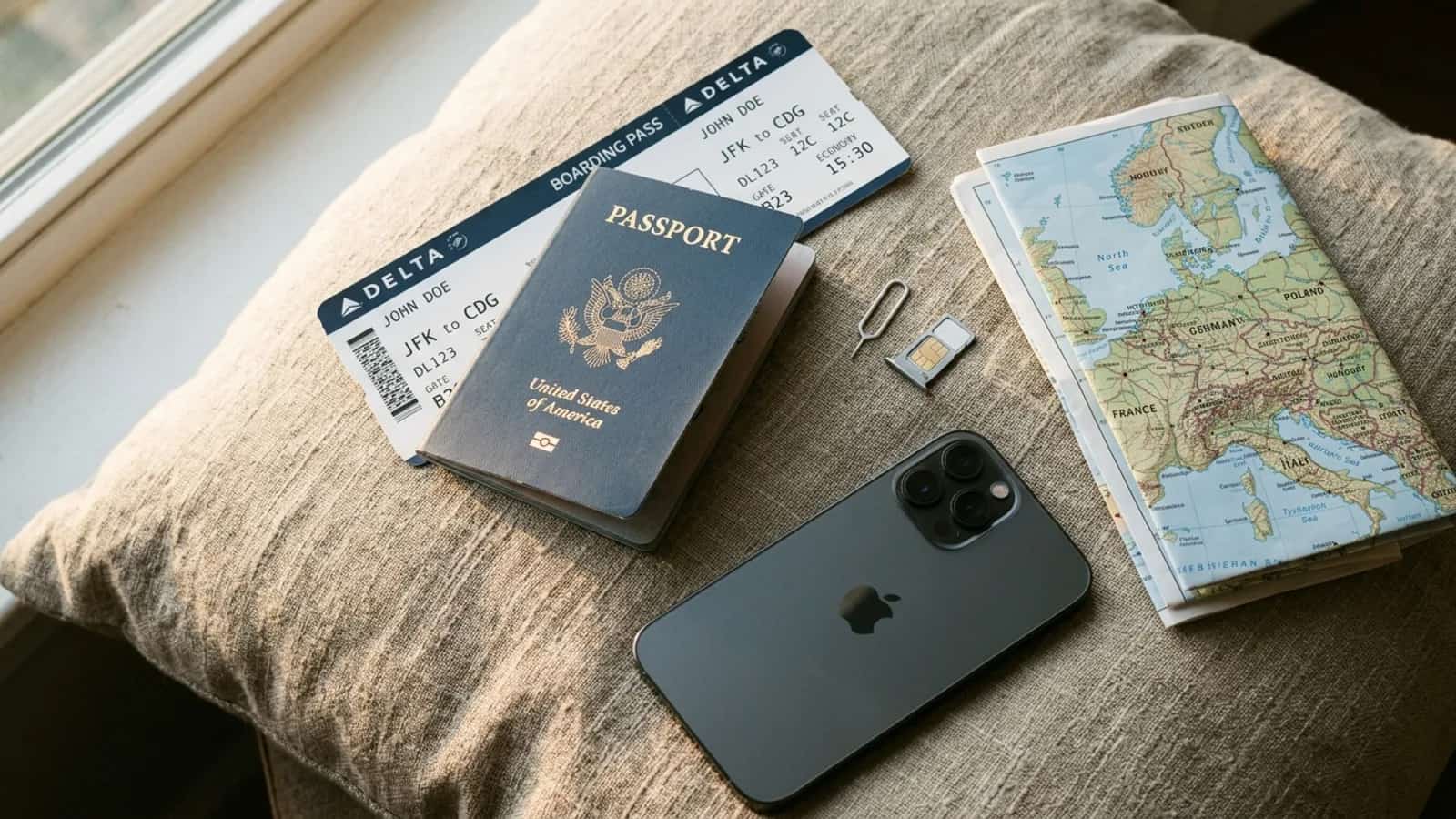
You searched for the best international travel SIM card. Here is the honest answer: for most modern phones, a travel eSIM is now the better option than a physical SIM. This guide compares both, by traveler profile, with no marketing fluff.
 Dimitri Morvan
You typed "best international travel SIM card" into a search bar, and that phrasing is doing some heavy lifting. For decades, getting connected abroad meant one thing: buy a plastic SIM card, slide it into your phone, hope it works. That world still exists, but it is shrinking fast. In 2026, the honest answer to your question depends on one thing: how old your phone is. For most modern devices, the best international travel "SIM card" is no longer a card at all — it is a travel eSIM, downloaded in minutes before you board. For older phones, a physical international SIM is still a legitimate, sometimes better, choice. This guide lays it all out without overselling either side.
Before recommending anything, it helps to be clear about what each option actually is. An international travel SIM card is a physical plastic chip you slide into your phone's SIM tray. Brands like OneSimCard and KnowRoaming sell these online, ship them to your home before your trip, and give you data and sometimes a phone number across many countries. A travel eSIM does the same job — connecting your phone to a local network abroad — but lives as a digital profile inside your device. You buy it online, receive a QR code or activation link, and install it without anything physical changing hands.
Both deliver real connectivity on the same underlying carrier networks. The differences are practical, not technical. A physical SIM has to be shipped, which means planning ahead and worrying about a piece of plastic that fits inside a fingernail. An eSIM activates in minutes from anywhere, but it requires a phone that supports it — typically a model released in 2018 or later, with the SIM lock removed. Cost per gigabyte usually favors eSIM, partly because providers do not carry the logistics overhead of mailing cards. Physical SIMs hold one advantage worth taking seriously: they can be removed and dropped into a backup phone in seconds, which matters if your main device breaks or gets stolen. There is no single "better" answer — there is only the right answer for your specific situation.
If you own an iPhone XS or newer, a Pixel 3 or newer, a Samsung Galaxy S20 or newer, or most flagship Android phones from the last six years, stop reading other categories and buy a travel eSIM. Providers like Simsima, Airalo, Saily, Nomad, and Holafly all sell data plans you can install before you leave home. You will pay less per gigabyte than you would for a roaming pack from your home carrier, you will skip the airport SIM kiosk entirely, and you will land already connected. There is no scenario in which a physical international SIM beats this experience for a modern, unlocked phone.
If your phone predates 2018 — an iPhone 8, a Galaxy S8, anything in that era — eSIM simply is not an option. The hardware does not support it. In that case, a physical international travel SIM from OneSimCard, KnowRoaming, or a local carrier prepaid SIM at your destination is your best bet. Order it online before you fly so it arrives in time, or plan to buy a local SIM at the airport on arrival. Local prepaid SIMs are almost always the cheapest option per gigabyte if you are staying in one country for a longer period and do not mind the airport detour.
If your trip covers more than two countries — a Europe rail loop, a Southeast Asia backpacking route, a Latin America road trip — a regional eSIM plan is the cleanest solution. Providers sell single plans that cover entire regions, so you do not start over each time you cross a border. Simsima, Airalo, and Nomad all offer regional packages for Europe, Asia, the Americas, and beyond. With a physical SIM, you would either pay roaming premiums or buy a new card in every country, which gets tedious fast. With one regional eSIM, the network just switches and you keep going.
Even committed eSIM users should consider carrying a physical international SIM as an emergency backup. eSIM activation occasionally fails — a profile gets corrupted, a phone needs a reset, a region has unreliable activation servers. If your only connectivity option is the eSIM and something goes wrong, you are stuck looking for Wi-Fi to fix it. A cheap physical SIM tucked in your wallet, ready to drop into your phone (or an old spare phone), is the kind of redundancy that costs almost nothing and occasionally saves a trip. OneSimCard, KnowRoaming, or even just a SIM from a previous trip will do.
Instant activation, local Tier-1 networks, transparent pricing across 200+ countries and regions.
Apple has leaned harder into eSIM than any other manufacturer. iPhones sold in the United States from the iPhone 14 onward have no SIM tray at all — eSIM is the only option. Every iPhone from the XS forward worldwide supports eSIM alongside a physical SIM, and most iPhone owners arriving at this question already have a device built for the eSIM era. A travel eSIM installs in under five minutes, runs alongside your home carrier line for calls and texts, and lets you keep receiving two-factor codes on your home number while using cheap local data. There is no comparable physical-SIM workflow that matches this.
If you are squeezing every dollar, the cheapest connection abroad is usually a local prepaid SIM bought at the destination — a Vodafone SIM in Italy, a Vietnamobile SIM in Vietnam, a Claro SIM in Mexico. Local carriers price for their home market, not for tourists, so per-gigabyte costs can be a fraction of any international plan. The trade-off is friction: airport kiosk, ID requirements in some countries, possible language barrier, and you may need to repeat the process if you cross borders. Regional travel eSIMs land in the middle — more expensive than a local SIM, much cheaper than home-carrier roaming, and zero hassle. Run the actual numbers for your itinerary before deciding.
Generic top-ten lists hide the fact that the right SIM depends heavily on who you are and where you are going. Here are three concrete examples to anchor the framework.
The right answer is a travel eSIM. The iPhone 14 supports eSIM natively, Japan has excellent eSIM carrier coverage, and a one-week data plan from a provider like Simsima, Airalo, or Nomad will cost less than a single day of roaming on most US or European home carriers. Install the eSIM the night before your flight, switch it on as the wheels touch down at Narita, and you have Google Maps before you reach the train ticket machine.
The right answer is a regional eSIM with a top-up plan. A Southeast Asia regional eSIM from Simsima, Nomad, or Airalo covers Thailand, Vietnam, Indonesia, the Philippines, Malaysia, and more under one plan. You can top up data as you go instead of committing to a giant pre-paid bucket. For a trip that long, you might also pick up a local SIM in your main hub country (say, Bangkok) for extra-cheap data in your home base, and use the regional eSIM during travel days and side trips.
The right answer is a physical international SIM. The iPhone 8 does not support eSIM, full stop. Order a physical SIM from OneSimCard or KnowRoaming a couple of weeks before the trip, or plan to buy a local prepaid SIM on arrival. If your partner can borrow a newer phone or upgrade before the trip, the calculus changes — but with the iPhone 8, physical is the only road.
Here is a tactic seasoned travelers use that most guides skip. Before buying a 30-day plan with 20 GB of data, buy the smallest, cheapest starter plan that provider sells — a 1 GB, 3-day plan, often under five dollars. Install it, activate it at your actual destination, and use it for a day. You will learn quickly whether the carrier the provider partners with gives you strong coverage at your specific neighborhood, whether speeds are usable for the things you need (maps, video calls, food delivery apps), and whether the customer support actually responds. If everything works, top up or buy the larger plan. If it does not, you are out a few dollars instead of fifty. This applies equally to eSIMs and to ordering a physical SIM — start small, validate, then commit.
The travel SIM and eSIM markets have a lot of solid providers and a long tail of dodgy ones. A few warning signs to scan for before handing over a credit card.
The best international travel SIM is the one that matches your phone, your trip, and your tolerance for hassle. Buy small, test on the ground, then scale up. That single habit saves more money and more bad days than any provider comparison.
Instant activation, local Tier-1 networks, transparent pricing across 200+ countries and regions.
For phones made after 2018 and unlocked from a carrier, yes — almost always. eSIM activates in minutes, costs less per gigabyte, and avoids airport kiosks. For older phones or as a backup, physical SIMs still have a real place.
A physical international SIM from a provider like OneSimCard or KnowRoaming, or a local prepaid SIM bought on arrival. Local prepaid is usually cheapest if you stay in one country; an international SIM is more convenient for multi-country trips.
Yes. Regional eSIM plans (Europe, Asia, the Americas) cover many countries under one plan. International physical SIMs from OneSimCard and similar providers do the same but at a higher cost per gigabyte and with shipping delays.
Most travelers use between 3 and 10 GB per week, depending on whether they rely on cellular for navigation, video calls, and social media. Start with a smaller plan and top up if needed rather than overbuying.
Technically yes — most home carriers offer international roaming, but rates are often punishing. Roaming day passes from major US carriers run $10–15 per day, which is more than a full week of eSIM data.
Yes, in most cases. A carrier-locked phone may refuse eSIM profiles from third-party providers. Phones bought directly from Apple, Google, or Samsung are usually unlocked. If you bought yours through a US carrier contract, request an unlock before traveling.
Most reputable providers offer free reinstallation and 24/7 chat support. As a fallback, having a small backup — either airport Wi-Fi long enough to message support, or a cheap backup physical SIM — saves a lot of stress.
Yes, if your phone supports dual SIM. Most modern phones can run an eSIM and a physical SIM at the same time. Keep your home number on one line for texts and 2FA codes, and use the travel eSIM or physical travel SIM for data.
From established providers, yes. Stick to brands with public refund policies, transparent carrier partnerships, and reviews on independent platforms like Trustpilot or Reddit. Avoid no-name listings on marketplaces.
the full eSIM vs physical SIM breakdown — Deeper side-by-side comparison of the two technologies, including activation, security, and environmental impact
the international travel eSIM guide — Step-by-step playbook for picking and using an eSIM on overseas trips
Simsima's full eSIM catalog — Browse travel eSIM plans for 200+ destinations, including regional packs

Founder of Simsima. A passionate traveler based in Barcelona, he helps travelers stay connected without breaking the bank on roaming fees.
LinkedIn Comparisons
 Comparisons
 Comparisons