-5% on your order in the app
Straight Talk's international calling perk doesn't keep your phone working abroad, while the 7-Day International Roaming perk gives 5 GB of data, 300 voice minutes and unlimited messaging for seven days in more than 140 destinations. Buying something labeled “international” isn't enough, you need the product that matches where you'll use your phone.
The common advice to “just add international calling before you fly” solves the wrong problem. For a traveler, the useful comparison is between calling overseas from home, using your Straight Talk line abroad, and buying a separate travel data connection.
Which Straight Talk International Option Fits Your Trip
Start with the location of your phone, not the country you're calling. A calling benefit handles overseas contacts from home; a roaming benefit connects your existing line while you travel.
Straight Talk's roaming destination FAQ lists more than 140 destinations, but you still need to check every country on your itinerary. A country count doesn't establish coverage for your particular trip.
Straight Talk International options compared
| Option | Works while you are abroad | What it covers | Duration | Best for |
|---|---|---|---|---|
| Unlimited International Calling perk | No | Calls and texts from the US or Puerto Rico to 200+ destinations, with landlines and mobiles included only where marked | Per 30-day cycle, with an active 30-day plan required | Calling family or contacts overseas from home |
| 7-Day International Roaming perk | Yes | 140+ destinations; 5 GB data, 300 voice minutes, unlimited messaging | Seven consecutive days once service starts | Short trips to one or a few countries with light data use |
| Travel eSIM, bought separately | Yes, in covered destinations on a compatible phone | Prepaid data allowance; voice and text are determined by the plan | Set by the plan you buy | Longer stays, several countries, or heavier data needs |
Pick by the job you need done:
- Calling family from home: Choose the calling perk after checking the destination and number type.
- Taking a short trip with light data use: Consider the roaming perk.
- Staying longer, crossing borders, or working online: Compare a travel eSIM with enough data and validity.
Build the connectivity choice around your actual route. For a Spain itinerary, Northern Spain Travel's tailor-made journey planning ideas can help you identify the stops and travel days you'll need to cover.
No price is quoted here because plan prices change and taxes and fees can apply. Confirm current terms on Straight Talk's official site, and record the month and year you checked rather than relying on an old search result.
Find the row that matches your trip and write down the one limit most likely to break it: unsupported destination, insufficient data, or an expiry date before your flight home.
Why Calling Home Works and Where It Stops
International calling and international roaming aren't the same product. The calling perk is like posting a letter from home; roaming is like bringing your phone line into a foreign city.
The distinction is easier to remember visually.
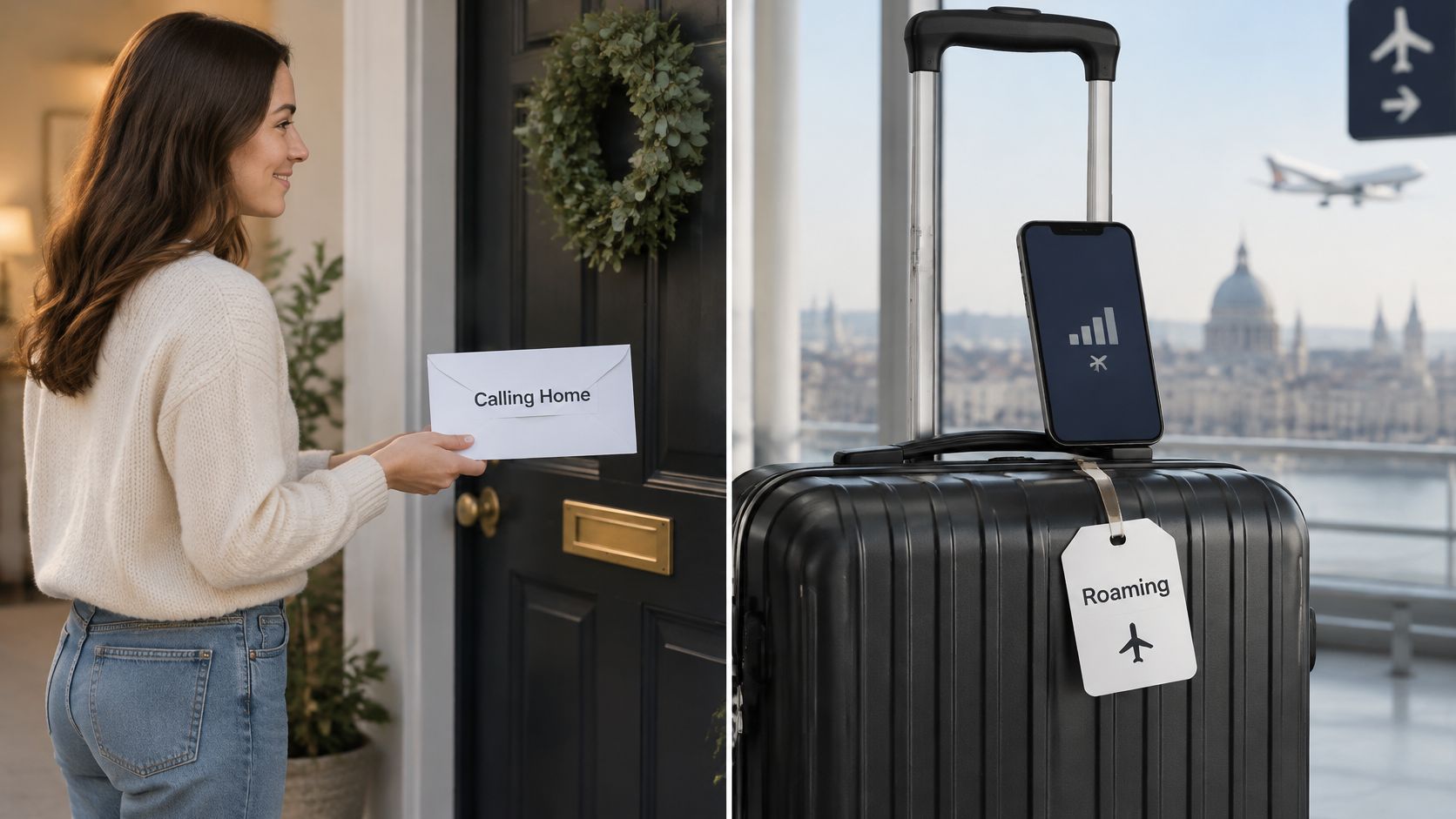
Calling goes out from home; roaming keeps you connected where you are.
Calling routes voice from the US network to foreign telephone networks. Roaming also needs a partner-network agreement, subscriber authentication, radio access, and data-session billing in the visited country.
Say you're heading to Lisbon and buy the calling perk before departure. That purchase alone won't give you mobile data for maps or ride apps when you land.
The calling rules that matter
Straight Talk's international calling destination terms cover more than 200 destinations and require calls to originate in the United States or Puerto Rico. Its international long-distance terms also specify the enrollment, contact, and plan restrictions below.
- Call from home territory. Your departure changes which service you need; the calling perk isn't overseas access.
- Check the destination. Broad international coverage doesn't mean every number type is eligible.
- Enroll once per line per plan cycle. Don't assume you can repeatedly enroll to bypass restrictions.
- Keep the contact list manageable. The maximum is 20 unique international numbers per 30-day cycle, resetting with the next cycle.
- Maintain an eligible base plan. An active 30-day plan or longer is required.
- Allow for taxes and fees. Compare the checkout total, not just a headline amount.
The number type deserves special attention. Straight Talk's plans and services support information excludes mobile numbers unless mobile access is explicitly included, and identifies eligible landlines with “Land Line” or “LL”; its Global Calling Card also requires a separate Straight Talk service plan.
For example, when checking Portugal, inspect the landline and mobile entries separately. Eligibility for a hotel landline wouldn't establish eligibility for a guide's mobile.
For a visual companion to the calling-versus-roaming distinction:
Before buying, ask where you'll use the phone, whom you need to call, and how much data you need. The calling perk suits families with a short overseas contact list and travelers contacting people overseas before or after a trip, while they're back on the domestic network.
What the 7-Day Roaming Perk Includes
Straight Talk's 7-Day International Roaming perk provides seven consecutive days in more than 140 destinations, including 5 GB of data, 300 voice minutes, and unlimited messaging. The allowance is fixed. Once you exhaust the data or voice allotment, that benefit stops until you buy another perk, and a depleted data balance does not convert into a slower, unlimited connection.
Activation starts the clock
According to Straight Talk's general information support guidance, the perk starts when you enter a roaming country and begin using data, messaging, or voice. The service days then run consecutively, with no option to pause.
That matters on a mixed itinerary. Use service once during a stopover and the clock is already running, even if you spend the next two days on hotel Wi-Fi and barely touch mobile data again.
Practical rule: Plan around the first use abroad, not the day you reach your final destination.
Longer trips need a second decision
A ten-day itinerary outlasts a single perk. The first purchase covers the opening week; the remaining three days require a second one. Whether you can stack perks, how many your line allows per plan cycle, and whether a new perk starts immediately or queues behind the expiring one all depend on your plan, so confirm the purchase rules shown in your account before counting on a repeat buy. A gap between perks means a gap in service.
Canada and Mexico sit under separate plan-level rules. Some plans already include a roaming allowance for those destinations, while others leave you to buy coverage separately. The brand name alone doesn't tell you what you've already purchased, so check the terms attached to your specific plan before paying for a perk you may not need.
Before departure, verify these details in your account:
- Destination coverage: Confirm each country on the itinerary, including any stopover where you'll use service.
- Validity trigger: Know what starts activation and when the window closes.
- Remaining quota: Check data and voice balances separately, since they deplete independently.
- Tethering terms: Establish whether laptop use over hotspot is permitted before relying on it.
- Repeat purchase: Confirm a second perk is available on your plan and when it would take effect.
The advantage is keeping travel service on your existing number with a single purchase. The trade-off is a fixed validity window and defined allowances that may not match a longer or heavier-use itinerary.
How to Turn On Roaming Before You Land
Prepare the account before departure, then test the connection after arrival. Buying a perk and enabling the correct phone setting are separate tasks.
Use this checklist alongside your booking documents.
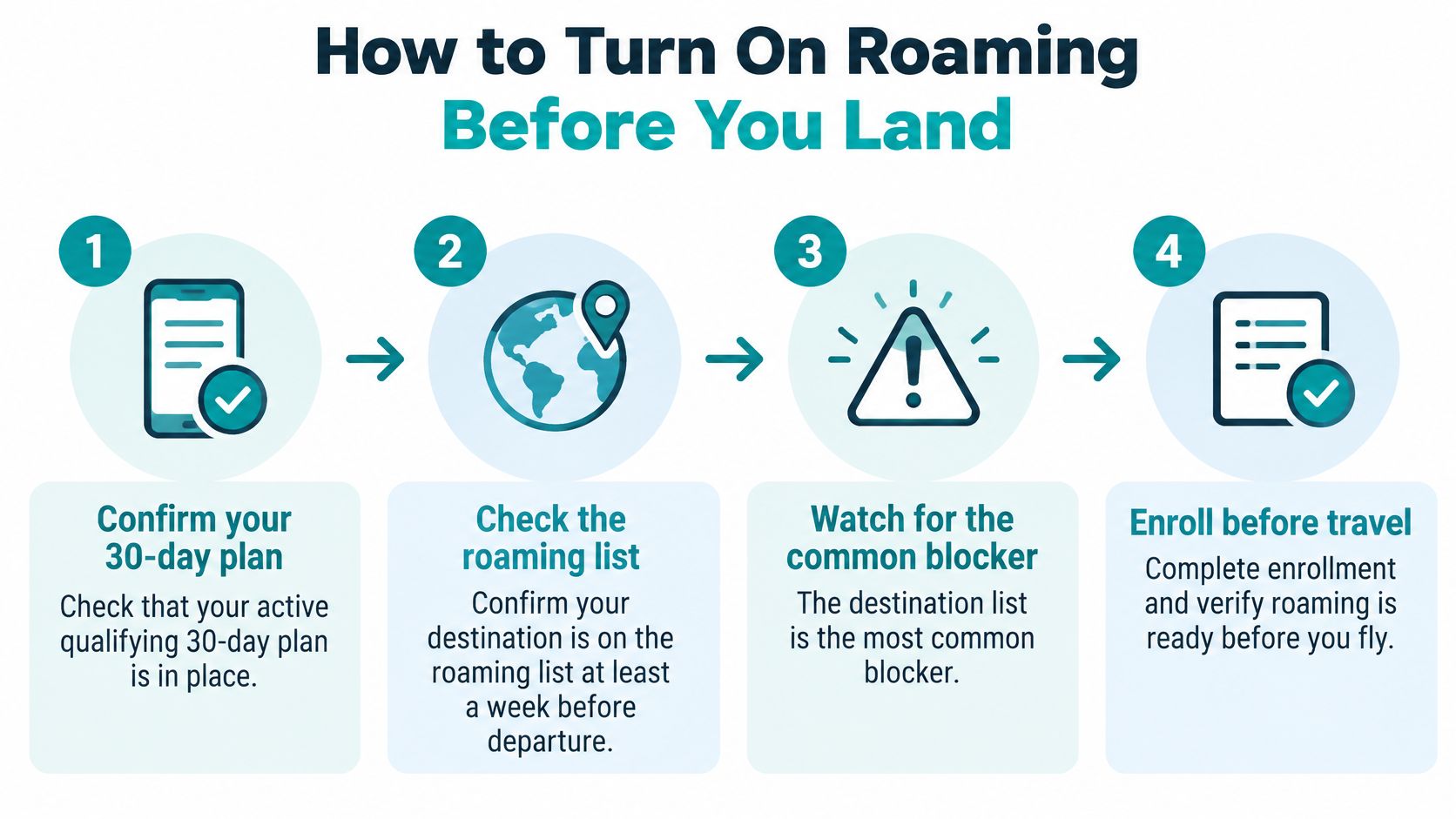
Set up the account and phone
Confirm eligibility early. I recommend checking your active qualifying plan and destination list at least a week before departure. An unsupported destination is a hard blocker; a common slip is checking the country you're calling rather than the country you're visiting.
Enroll before leaving. Complete the purchase through your account and save the confirmation. Enrollment doesn't itself consume the travel window under the activation rule, but assuming a perk is attached without checking the receipt can leave you troubleshooting at the airport.
Check device compatibility and lock status. Verify that your phone supports the networks used at your destination. Unlocking is especially important for a separate travel eSIM; don't confuse that requirement with a blanket rule that a locked Straight Talk phone can't use authorized Straight Talk roaming.
Enable Data Roaming on arrival. Open your phone's cellular settings, select the intended line, and initially allow automatic network selection. A missed roaming toggle can look like absent coverage; on a dual-SIM phone, changing the wrong line is another easy mistake.
Test messaging and data separately. Send a text and load a fresh web page with Wi-Fi disabled. A cached page or an internet messaging app isn't proof that cellular texting works.
Check the account allowance. Confirm that usage appears against the intended travel benefit. Don't wait for a failed connection to discover that background downloads have consumed your data.
Make connectivity part of departure planning
We provide guidance on enabling data roaming, including choosing the right line for travel data. Save setup instructions offline so you can read them without a connection.
For a family service trip, HeyLocals' guidance on preparing for family volunteering abroad is a useful companion to your phone checklist. Keep host contacts and arrival instructions available offline, too.
If the test text fails, restart the phone and reselect the network before contacting support.
How Far 5 GB Goes on a 7-Day Trip
Spread evenly across its service window, the roaming allowance works out to about 0.71 GB a day. Treat that as a planning budget, not a daily cap or a promise that every travel day will use the same amount.
Messaging, navigation, and email are easier to accommodate than video meetings or laptop backups. Attachments, autoplay, streaming quality, and background synchronization can change the result substantially.
Approximate data use by activity against a 5 GB allowance
The numerical rates below are hypothetical budgeting assumptions, not measured app benchmarks. Use your phone's cellular usage screen to replace them with your own consumption before buying.
| Activity | Approximate data use | How long 5 GB lasts |
|---|---|---|
| Messaging and email | Low for text; attachments increase use | Most of a seven-day trip with text-focused use |
| Maps and ride-hailing | Lower with downloaded maps; higher with live map loading | Many hours of daily use if other consumption stays low |
| Social feeds and browsing | Assume about 100–300 MB per hour for a budgeting scenario | About 17–50 hours under that assumption |
| Music streaming | Set by audio quality and listening time; offline downloads avoid mobile use | Divide the allowance by the app's measured hourly use |
| Standard video streaming | Assume about 1 GB per hour for a budgeting scenario | About 5 hours under that assumption |
| HD video streaming | Assume about 3 GB per hour for a budgeting scenario | Under 2 hours under that assumption |
| Video calls | Assume about 0.5–1.7 GB per hour for a budgeting scenario | About 3–10 hours under that assumption |
| Laptop hotspot for work | Low for text documents; high for video and cloud synchronization | Until combined laptop and phone usage exhausts the allowance |
A day focused on short messages, downloaded maps, and text email should consume a relatively small share. An hour of HD video, by contrast, could consume a substantial part of the entire travel allowance, not merely the daily planning budget.
Stretch the allowance deliberately
- Download maps before departure. Save the areas around your accommodation, stations, and planned day trips.
- Move large transfers to Wi-Fi. Use a trusted hotel or café connection for backups and software downloads.
- Lower streaming quality. Disable autoplay as well as changing the playback setting.
- Pause background updates. Check app updates, photo uploads, and laptop cloud folders before enabling a hotspot.
For a device-based estimate, use our guide to how much travel data you need alongside your phone's usage history.
Work-trip threshold: If video calls or laptop tethering are routine, choose a larger travel allowance rather than hoping light sightseeing days will compensate.
Continuous hotspot use can drain data quickly because the laptop may download files without an obvious prompt. Check tethering permission before departure and monitor combined usage, not just the apps on your phone.
What Each Option Costs and How to Check It
Compare total trip cost, not the price of a single add-on. The relevant total includes any required base service, travel purchases, taxes, fees, and additional coverage needed before you return.
No carrier prices are quoted because a checkout amount needs a current official check. Recording a price without its eligibility conditions can make an apparently cheap option unusable.
Count purchases before comparing totals
A roaming perk is a separate purchase on top of a qualifying domestic plan. For a trip extending beyond its validity, budget for an additional purchase rather than spreading the initial charge across the whole stay.
In the hypothetical ten-day itinerary, that means two perk charges, not one prorated charge. Also check whether a domestic plan renewal falls during the trip and whether it affects your ability to purchase more travel service.
The calling perk has a different cost basis: its plan-cycle benefit doesn't replace overseas data. Adding it to a travel budget only makes sense if you also need its domestic-origin calling function.
A prepaid travel eSIM is priced by the package you select. Compare destination coverage, usable data, validity, and top-up terms before comparing the checkout totals.
Record a usable cost check
- For Straight Talk: Confirm current eligibility, perk terms, taxes, and fees on the official site. Save the checkout total and the month and year checked.
- For a travel eSIM: Record the package's data amount, destination list, validity trigger, and current terms on its product page, with the month and year checked.
- For your trip budget: Separate connectivity from other expenses rather than leaving it inside an undefined contingency.
Passport Premiere's guide to budget smarter with Passport Premiere offers broader travel-budget context. Our explanation of international roaming charges helps identify the mobile-service costs worth checking.
Write down your travel days, countries, and expected daily usage. Then compare the total purchases needed to cover that itinerary without an expiry or data gap.
When a Travel eSIM Fits Better
A travel eSIM fits better when its destination coverage, data allowance, and validity match your itinerary more closely than the carrier perk. Multi-country branding alone isn't enough; inspect the actual countries and package conditions.
Check the device first. Your phone must support eSIM and permit the separate provider's profile, and dual-SIM capabilities determine how you can keep your Straight Talk line available alongside travel data.
The comparison is about the functions you need, not buying another connection.
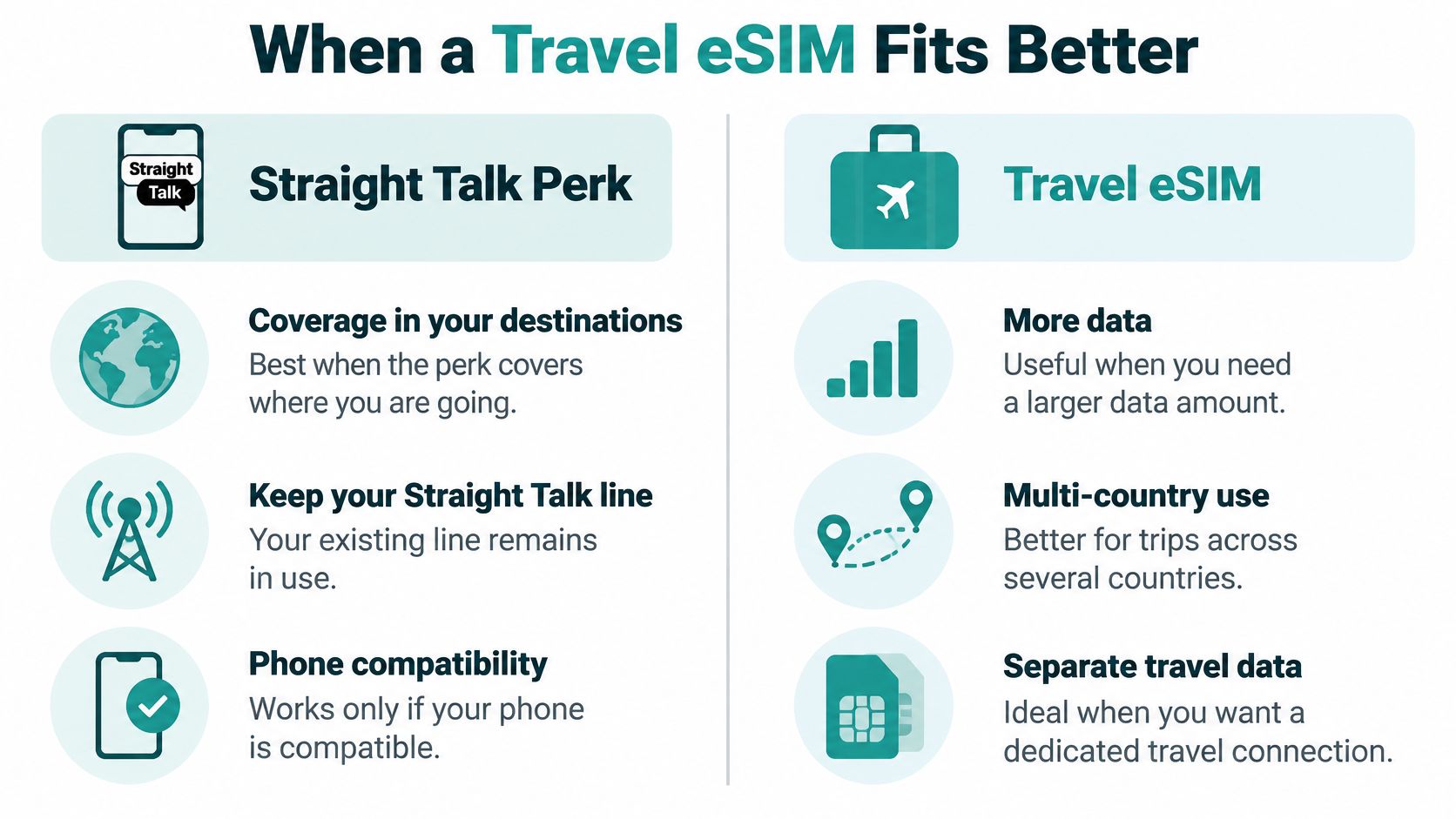
Separate travel data from phone-number access
We offer travel eSIM data plans in 210 destinations, with local plans in 198 countries. I would consider a Simsima travel eSIM when a separate prepaid data allowance better matches the trip, and install it before departure after checking the package's activation terms.
Our eSIMs are data-only: they don't support SMS, voice calls, or bank verification codes by text. Internet calling and messaging apps can use mobile data, but they don't turn a data-only connection into your regular cellular number.
If bank texts or incoming calls matter, plan that access separately. Keeping your Straight Talk line enabled doesn't by itself establish overseas eligibility or eliminate potential charges.
Check the connection you'll actually use
- Coverage: Verify every destination and any transit stop where you'll need data.
- Data: Choose an allowance around working days and uploads, not just sightseeing.
- Line settings: Select the travel connection for mobile data and disable unintended cellular-data switching.
- Compatibility: Confirm eSIM support and device status before purchase.
Our guide to eSIMs for international travel explains the setup considerations. For a wider cost comparison, use the guide to cheapest international roaming options.
Check current terms on the official product page and note the month and year you checked. Pick the opening-table row that matches your trip, confirm its limiting condition, and set up the connection before your flight.
Simsima offers prepaid travel data for travelers who need a separate connection abroad rather than an international-calling benefit. Visit Simsima to compare coverage and data allowances for your itinerary, check your phone's compatibility, and install your chosen eSIM before departure.


#Straight Talk International#Straight Talk roaming#international calling plan#travel eSIM#prepaid roaming data

Dimitri MorvanFounder
Founder of Simsima. A passionate traveler based in Barcelona, he helps travelers stay connected without breaking the bank on roaming fees.
LinkedIn