-5% on your 1st eSIMuntil October 31

Bali doesn't have one universally “best” month. The popular advice to visit between April and October is useful, but it's too blunt to plan a good trip. July may deliver the classic dry-season experience, yet it also brings the island's clearest demand peak. December can be just as busy for a completely different reason, despite falling within the wetter part of the year.
The smarter question is when to visit Bali for your specific itinerary. A beach holiday, a Nusa Penida diving trip, a Mount Batur sunrise hike, a wellness retreat, and a month of remote work all need different conditions. Match the month to your activities, your tolerance for rain, and your appetite for crowds, then choose the region that fits.
Why the Standard Bali Travel Advice Falls Short
“Visit Bali between April and October” is useful shorthand, but poor trip planning. It treats dry weather as the winner and ignores whether the month suits your route, activities, and tolerance for crowds. Demand, regional weather, transport reliability, and your planned activities all affect the quality of a Bali trip.
July is the island's clearest demand peak, but that does not make it the best month for most itineraries. Research covering foreign arrivals from 2015 through 2019 found that July was consistently the peak month, with arrivals rising sharply from June before easing toward the quieter period. The Ministry of Tourism study also found a relatively even arrival pattern across the year. Its seasonal ratios ranged from 1.16 to 1.27. In practical terms, peak demand was about 16% to 27% higher than in the quietest periods, not several times higher. The Ministry of Tourism study on Bali's arrival seasonality supports a useful conclusion: July brings pressure, while shoulder months can deliver similar conditions with fewer competing visitors.
BMKG rainfall data reinforces the problem with calendar-only advice. Rainfall varies by location and by day, so a wet-season month can still produce workable beach, cultural, or wellness itineraries when you build in flexibility. A dry-season month can also disappoint if your schedule depends on one ferry, dive day, or sunrise hike.
Recent arrivals make “quiet season” claims even less dependable. Bali recorded 6,948,754 direct foreign arrivals in 2025, and December received 572,668 visitors. The 2025 arrival report from Antara shows why wet-season travel is not automatically quiet. Christmas and New Year demand can crowd accommodation, roads, restaurants, and boat connections, even when rain is part of the forecast.
The useful planning question
Ask these questions before choosing a month:
- What must work? Diving, hiking, ferry crossings, beach days, or reliable video calls?
- How much weather flexibility do you have? A two-week holiday can absorb a wet afternoon. A short trip built around one boat departure cannot.
- Where will you stay? Ubud, the south coast, the Bukit, and the islands experience different conditions.
- Which crowds bother you? Canggu, Seminyak, and famous temples can feel packed even when island-wide demand is moderate.
Choose May, June, or September for the strongest all-round balance. Choose July or August when outdoor reliability matters more than crowds. Choose the wet season for a flexible schedule, greener scenery, or a wellness-focused trip where perfect beach weather is not the priority.
How Bali's Seasons Actually Work
Bali has a broad wet-season pattern and a broad dry-season pattern, but neither behaves like a switch that flips across the entire island. Rainfall is influenced by monsoonal circulation, elevation, coastline, and local geography. The result is a travel calendar with useful tendencies, not guarantees.
The wetter period generally runs from November through March, with the strongest wet-season conditions typically concentrated from December through February. The drier period generally runs from April through October, with the clearest dry-season peak from June through August. These labels help you compare months, but they don't tell you whether your specific beach, trail, or ferry route will stay dry on a particular day.
BMKG-derived classification divides Bali into 20 seasonal zones, because the onset and duration of seasonal conditions vary by location. This BMKG-based analysis of Bali's seasonal patterns explains why a forecast for inland Bali shouldn't be treated as a forecast for the southern coast. It also describes BMKG's operational definition of dry-season onset, which requires a sustained period of low rainfall rather than a simple calendar date.
Rainfall is local, not uniform
January illustrates the problem. Reported monthly rainfall totals in January 2026 ranged from 123.5 millimetres to 932.0 millimetres across Bali. Northern and central Bangli recorded the highest total, alongside 24 rainy days, while northern Tabanan recorded a maximum single-day rainfall of 203.0 millimetres. This Bali rainfall summary using BMKG information shows why “Bali weather” is too broad a phrase for itinerary planning.
August is usually much drier, but it still isn't guaranteed to be rain-free. BMKG's August 2025 analysis recorded monthly totals from 0.0 millimetres to 231.5 millimetres, with the highest total in southern Karangasem and 11 rainy days. A heavy daily total of 385.5 millimetres was also recorded on September 10, 2025, a useful reminder that unusual downpours can occur outside the conventional wet-season window.
What the seasons mean for travellers
For beach days, diving, outdoor excursions, and boat transfers, May through September is the safer planning window. June through August aligns most closely with the dry-season peak, while April, May, September, and October can offer a better balance between weather and demand.
Wet-season travel still works. Plan shorter outdoor sessions, keep one or two flexible days, and avoid placing a non-refundable boat departure immediately after a long cross-island transfer. The best Bali itinerary has breathing room because local showers can disrupt roads, marine crossings, and mountain activities even when the rest of the island looks sunny.
Month-by-Month Breakdown of Weather and Crowds
Bali's calendar is easier to use when you stop calling months just “good” or “bad.” January and February are wet but can suit flexible travellers. July and August are dependable for outdoor plans but expensive in attention and availability. September is often the month I recommend first to friends who want sunshine without the full pressure of the mid-year rush.
The rainfall figures below come from independent climate data. It reports approximately 328 millimetres in January, 261 millimetres in February, 90 millimetres in June, 53 millimetres in August, and 116 millimetres in September. Rainy days also fall from 20 in January and 18 in February to 5 in June, 1 in August, and 1 in September. The Bali climate data from Weather2Travel is more useful than a simple dry-season label because it shows how sharply conditions can change within the broad seasonal windows.
| Month | Avg Rainfall (mm) | Crowd Level | Villa Rate Index |
|---|---|---|---|
| January | About 328 | Holiday spillover early in the month, then generally lighter | Often more flexible after the holiday period |
| February | About 261 | Moderate, with demand varying around public holidays | Generally favourable outside busy dates |
| March | Seasonal transition | Moderate and uneven | Usually more negotiable than peak months |
| April | Transitioning toward drier conditions | Moderate, with holiday-related spikes possible | Good value if booked carefully |
| May | Generally drier | Comfortable shoulder-season demand | Strong value and availability |
| June | About 90 | Rising demand | Increasing pressure as peak season approaches |
| July | Dry-season peak | High | Tight availability and stronger pricing |
| August | About 53 | High | Peak-season pricing posture |
| September | About 116 | Easing from the mid-year peak | One of the best value-to-weather balances |
| October | Transition period | Moderate | Often flexible, especially outside weekends |
| November | Rain becomes more frequent | Generally moderate | More choice, with weather trade-offs |
| December | Wet-season conditions, with local variation | High around year-end holidays | Holiday premium, then softer after the peak |
January and February
Expect frequent showers, humidity, and sudden changes rather than uninterrupted rain all day. These months work well for travellers who can shift activities between mornings and afternoons, especially those prioritising Ubud culture, spa time, food, yoga, or a slower itinerary.
They aren't my choice for a short trip built around one dive day or a tightly scheduled island transfer. They are reasonable for longer stays because a flexible calendar lets you use sunny intervals rather than fighting the forecast.
March through May
March is a transition month. Conditions can improve, but the island doesn't change uniformly, so keep flexibility for wet days. April and May are better bets for travellers who want a drier feel without committing to the busiest part of the year.
May is the standout. It usually offers a convincing dry-season experience, greener scenery than the later peak months, and more manageable demand. If you're unsure when to visit Bali and your itinerary includes beaches, temples, rice terraces, and a few day trips, start with May.
For broader trip-planning ideas beyond Indonesia, this month-by-month guide to visiting Vietnam is a useful comparison.
June through August
This is Bali's familiar postcard window. Outdoor plans are easier to protect, skies are often more cooperative, and the island's nightlife and beach businesses operate at full intensity. The cost is pressure, not just money. Popular villas, restaurants, beach clubs, drivers, and boats need earlier planning, particularly in July and August.
July is the most obvious high-season month. August is usually the drier choice, but it doesn't automatically feel quieter or calmer. If you can travel in June, you'll often keep much of the favourable weather while avoiding the centre of the international summer surge.
September through December
September is my favourite month for a classic Bali trip. It retains a strong outdoor profile while demand begins to ease. October is another smart compromise, especially for travellers willing to accept occasional showers in exchange for better availability.
November marks a clearer move toward wetter conditions. December is a split decision. Early and mid-month travel can work for flexible visitors, but year-end holidays bring a separate demand peak, so don't assume wet-season timing guarantees a cheap or quiet island.
High Season Versus Shoulder Months Versus Wet Season
Bali's three travel windows should be judged by cost per experience, not by whether a guide labels one “best” and another “worst.”
High season is the easiest choice for weather-sensitive travellers. June through August generally provides the strongest dry-season alignment, but demand rises with it. In July 2025, Bali recorded 697,107 direct international arrivals, an increase of 11.42% year over year and 9.29% from June. The July 2025 arrival report confirms that the island's busiest month can bring excellent conditions and intense competition for the places everyone wants.
Shoulder months are a smarter default for many travelers. April, May, September, and October can preserve good outdoor conditions while reducing some of the pressure found in July and August. They won't make southern Bali empty. Popular areas can still clog on weekends, during school holidays, and around major events, but the planning experience is usually less punishing.
Wet-season travel is unfairly dismissed. January through March can deliver sunny stretches between showers, lush scenery, and more choice for travellers who don't need every day to be beach-perfect. The main sacrifice is reliability. Marine activities, mountain hikes, and long road journeys need backup plans.
| Window | Crowd Level | Avg Villa Rate (USD/night) | Monthly Rainfall (mm) | Best For |
|---|---|---|---|---|
| High season | High, especially in July and August | Higher and less flexible | Generally lower, with local variation | Beaches, outdoor touring, nightlife, first-time trips with fixed dates |
| Shoulder season | Moderate, though hotspots remain busy | More negotiable | Transitional or moderate | Balanced itineraries, couples, value-conscious travellers |
| Wet season | Variable, with holiday peaks | Often more flexible outside holidays | Higher and more changeable | Wellness, culture, longer stays, flexible remote work |
My practical rule: If your trip is short and weather-sensitive, choose June, July, August, or September. If your trip is flexible, choose May or September and spend the difference on better accommodation, a private driver, or an extra night.
Best Time to Visit Bali by Activity
Choose the activity first, then choose the month. A traveller chasing clean surf needs a different calendar from someone who wants green rice terraces, reliable ferry crossings, or quiet mornings in a yoga studio.
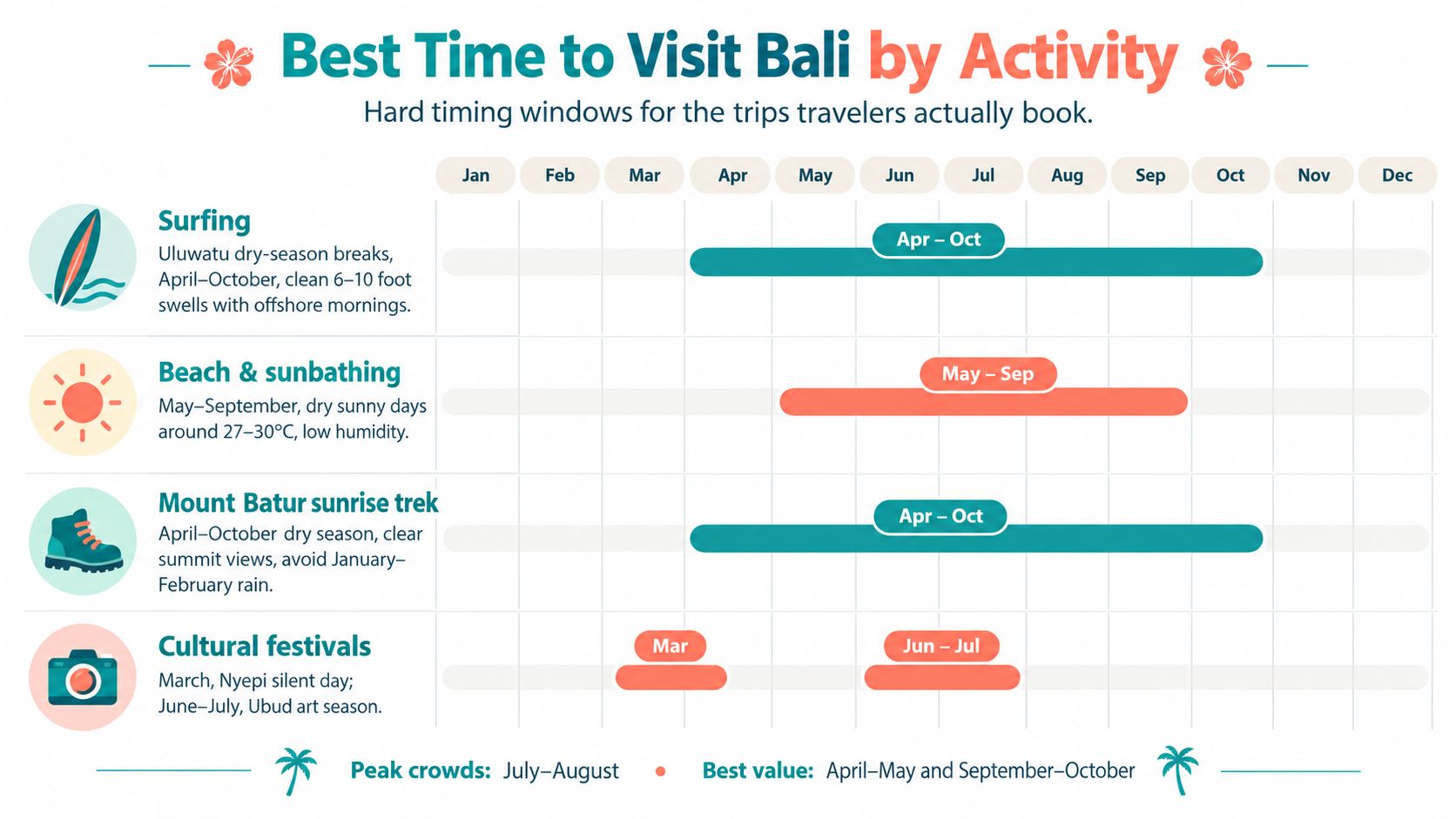
Surfing
For Uluwatu and the Bukit's west-facing reefs, April through October is the obvious window. Dry-season conditions are generally more favourable for clean, organised breaks, while June through August is the strongest choice for experienced surfers targeting the south-west coast.
Canggu is more forgiving. You can surf there throughout the year, but wet-season conditions tend to produce a different experience, with smaller or less consistent beach breaks and more weather disruption. Beginners should prioritise lessons and manageable conditions over chasing a specific month.
Diving and island trips
Plan Nusa Penida diving from April through November, with July through September the strongest period for travellers who want to maximise the chance of cooperative sea conditions. The Gili Islands are most attractive from May through September, when boat and snorkelling plans are easier to protect.
Don't build a multi-island itinerary around a single connection. Use a buffer day before or after a fast boat, particularly outside the more reliable dry-season window.
Hiking and scenery
Mount Batur sunrise hikes are best scheduled from April through October, with June through September the safer choice for dry trails and clearer summit views. April and May are particularly good for travellers who want a compromise between scenery, trail conditions, and crowd pressure.
Rice terraces and waterfalls can look especially rewarding during wetter periods, but paths may be slippery and heavy rain can affect access. If waterfalls are a priority, schedule them early in the day and keep an alternative cultural activity available.
Wellness and culture
Ubud works in every season, but April, May, September, and October are my preferred months for a wellness-focused stay. Mornings are more comfortable than the hotter, busier peak period, and you can combine yoga, galleries, temples, cooking classes, and walks without making every day dependent on a beach forecast.
Cultural travel also makes wet-season days useful. A shower is far less disruptive when your plan is a temple visit, a long lunch, a massage, or a workshop rather than a boat crossing.
The video below provides another visual way to think about activity timing.
Regional Timing Differences Across Bali
“Bali in July” doesn't describe one uniform experience. Ubud's inland setting, the south-coast tourism belt, the Bukit surf coast, and the offshore islands respond differently to rainfall, wind, sea conditions, and transport disruption.
Ubud is the best base for culture, wellness, food, rice terraces, and central excursions. It tends to feel cooler and wetter than the coast, particularly during the wet season. Choose May or September if you want comfortable walking conditions and lush scenery without making every outdoor plan a gamble.
Seminyak and Canggu suit travellers who want restaurants, cafés, nightlife, beach clubs, and easy access to the airport. They work throughout the year, but wet-season visitors should expect sudden showers, slippery streets, and traffic that can make short distances surprisingly slow. May, June, and September offer the strongest overall balance.
| Region | Micro-climate Zone | Best Months | Key Timing Factor |
|---|---|---|---|
| Ubud | Inland and elevated | May to September | Cooler conditions, greener scenery, and better trail reliability in the drier window |
| Seminyak | Southern coastal tourism belt | May to October, with year-round access | Beach and nightlife access, balanced against rising peak demand |
| Canggu | Southern coastal zone | May to October | Surf, cafés, and social life, but congestion can remain intense |
| Nusa Penida | Drier offshore island environment | April to October | Sea conditions and boat reliability matter as much as sunshine |
| Gili Islands | Offshore islands east of Bali | May to September | Calm marine conditions are more important than mainland forecasts |
| Bukit Peninsula | Exposed south-western coast | June to September for surf | Stronger surf and ocean exposure make it better for surfers than casual swimmers |
Nusa Penida and the Gilis require stricter weather discipline than a mainland villa holiday. A shower in Seminyak may delay a beach walk. Rough seas can delay or cancel an island transfer, so check the forecast for the departure coast and the destination, not just Bali as a whole.
The Bukit is another example of itinerary matching. Uluwatu, Bingin, and Padang Padang are excellent choices for surf-focused travellers during the dry-season swell window. They are less suitable for a visitor whose priority is a calm, easy-entry swimming beach.
Booking Strategies and Practical Travel Tips
My strongest booking advice is to protect flexibility where weather can affect the plan. Use refundable accommodation when possible, especially if your itinerary includes ferries, diving, volcano hikes, or long drives. A cheap non-refundable room is not a bargain if one disrupted connection forces you to lose a night.
Book the most weather-sensitive parts first. Secure island transport and popular activities before filling every day with fixed reservations. For a shoulder-season or wet-season trip, leave open space for a revised route rather than trying to force the original plan through a storm.
Make arrival and connectivity boring
Arrange your airport transfer before landing. Bali traffic can turn an arrival day into a long one, and negotiating transport while tired is unnecessary friction. Use a reliable local forecast for the exact coast or inland area during the final 7 to 10 days, then reassess boat, diving, and mountain plans as the departure date approaches. The 2025 tourism and planning guidance also supports building buffers around weather-sensitive transport.
Download offline maps, keep some cash for smaller businesses and villages, and carry a light waterproof layer during the wetter months. Reef-safe sunscreen is a practical choice for marine excursions, while a power bank matters if you spend a full day away from your base.
If you're working remotely, arrange mobile data before you leave rather than relying on airport Wi-Fi or a last-minute shop. This guide to buying an eSIM explains the setup process, which is especially useful when you need maps, messaging, ride bookings, and weather updates from the moment you arrive.
Choosing Your Perfect Bali Window
Use this decision rule:
- Choose May, June, or September for the best all-round combination of outdoor conditions, availability, and manageable demand.
- Choose July or August if beach days, diving, surfing, and hiking matter more than crowds.
- Choose April or October for a flexible shoulder-season trip with a little more weather variation.
- Choose January through March for wellness, culture, longer stays, and lower weather sensitivity.
- Choose March or April if your priority is Bali's cultural calendar and you're prepared to plan around local ceremonies.
Match the region too. Base yourself in Ubud for culture and inland scenery, the south coast for nightlife and convenience, the Bukit for surf, and the Gilis or Nusa Penida for marine activities during their more reliable windows. For your arrival-day setup and trip connectivity, review the Indonesia eSIM options before departure.
Simsima offers prepaid travel eSIMs for Indonesia with one-tap installation, instant delivery, and no physical SIM or app required, so you can check forecasts, message drivers, and book transport as soon as you land. Visit Simsima to compare Indonesia data plans and keep your Bali itinerary flexible in every season.


#when to visit bali#bali weather by month#best time bali#bali travel guide#bali dry season

Dimitri MorvanFounder
Founder of Simsima. A passionate traveler based in Barcelona, he helps travelers stay connected without breaking the bank on roaming fees.
LinkedIn