-5% on your 1st eSIMuntil October 31
Morocco's best window is split between March to May and September to November. The right month still depends on whether you're pairing Marrakech with Fes, pushing into the Sahara, or staying on the Atlantic coast.
The old advice, “just go in spring or autumn,” is too blunt now. Morocco isn't one climate, it's several routes with very different weather, crowd, and booking realities, and that matters more than ever when trips are being built around exact regions and activities.
Why the Old Best Time to Visit Morocco No Longer Holds
The lazy answer used to work because Morocco felt seasonally simple. Go in spring or autumn, avoid the hottest weeks, and you were fine. That logic breaks down now, because Morocco pulled in 19.8 million arrivals in 2025, up 14% year over year according to Reuters, and the pressure is no longer confined to a single short peak window. Reuters reported the 2025 arrivals record, and the practical effect is obvious to anyone trying to book a riad in Marrakech or a desert camp on a popular circuit.
Morocco now rewards route planning, not generic timing
Morocco's climate still splits cleanly between shoulder seasons and hotter or wetter stretches, but the country itself doesn't behave like one destination. The coast stays tempered by Atlantic air, inland cities heat up fast, and desert transfers punish bad timing much more than a casual city break does. Climate references still point to March to May and September to November as the most comfortable travel periods, with milder weather and lower rainfall than summer or winter Climates to Travel, but that's only the starting point.
What has changed is congestion. A route that used to feel pleasantly busy in April can now feel fully booked, especially if it lines up with school holidays or a long weekend in Europe. That's why the key question isn't “when is Morocco best?” It's “when is my route best, and how early do I need to lock it in?”
Practical rule: if your trip includes Marrakech, Fes, and the Sahara, stop thinking in national seasons and start thinking in corridor timing.
Morocco's Four Travel Seasons Explained
Spring suits city and mountain combinations
Spring is not automatically Morocco's best season. It is the strongest fit for a route that combines Marrakech, Fes, and the Atlas foothills, because daytime conditions support long walks, while mountain trails are more practical than they become in midsummer. Typical spring averages sit around 20°C highs and 11°C lows, making the imperial cities comfortable for full days on foot Climates to Travel.
That comfort now comes with a booking requirement. Morocco recorded 19.8M tourist arrivals in 2025, so popular riads, guided treks, and desert camps can fill during the periods travelers traditionally target. Spring works well, but it no longer guarantees a quiet or flexible trip.
Summer belongs on the coast
June to August is a poor choice for an inland circuit built around Marrakech, Fes, and long road transfers. Interior temperatures can climb above 38°C, turning a medina visit or a desert crossing into a schedule shaped by shade, water, and early starts Intrepid Travel.
Use summer for an Atlantic itinerary instead. Essaouira, Agadir, and other coastal stops benefit from sea breezes, and beach time gives the heat a purpose. If you must include inland cities, keep those visits short and treat the hottest transfer days as transport days rather than sightseeing days.
Autumn restores mixed-route flexibility
September to November is the most adaptable season for travelers who want cities, a desert night, and some coast without building the itinerary around extreme heat. September can still feel hot inland, while October and November make long walks and desert drives easier. Autumn also suits travelers who prefer later departures than spring allows, although popular routes remain busy after the surge in arrivals.
Winter needs more selective planning. December to February can deliver mild, bright days along the coast and in lower-altitude cities, while the Atlas brings snow and desert nights can become sharply cold. Choose winter for surf, culture, and flexible city breaks. Add a desert camp only when you are prepared for cold after sunset, and check mountain access before committing to an Atlas route.
| Season | Conditions | Crowd and price pattern | Best routes |
|---|---|---|---|
| Spring | Mild cities, workable foothill weather | High demand and firmer prices | Marrakech, Fes, imperial cities, Atlas foothills |
| Summer | Hot inland, moderated coast | Lower inland demand, stronger coast demand | Atlantic coast, beach stays, short city stops |
| Autumn | Warm days, cooler nights | High demand on established circuits | Desert loops, city combinations, coast and interior |
| Winter | Mild coast, cold mountains and desert nights | Often easier value, with weather limits | Surf coast, culture trips, selective desert travel |
Use a simple route rule: book spring for Marrakech, Fes, and one desert night; choose summer for a coast-first trip with limited inland time; choose winter for culture or surf with no fixed mountain plan.
Month by Month Climate Guide by Region
Morocco has no single best month. Choose the route first, then match the climate to it. Marrakech, Fes, the Sahara, and the Atlantic coast peak at different times, and 2025's record 19.8 million tourist arrivals means shoulder-season advice alone no longer guarantees quiet streets or easy availability. Northern Morocco has a summer dry season from May to October, while the rainy season generally runs from November through March Weather2Travel.
How the calendar works in practice
January and February suit city breaks, clear desert scenery, and travelers who accept cool nights. Keep long mountain hikes and warm desert evenings out of the plan. March and April are the strongest all-purpose months for imperial cities, Marrakech, and manageable Sahara trips, though popular routes can book quickly. May and June shift the advantage toward the Atlantic coast, where breezes make beach time more comfortable than inland sightseeing.
July and August are poor choices for long inland circuits. Use them for Essaouira, Agadir, or another coast-first itinerary, or spend more time in higher mountain areas and less time crossing hot plains. September and October restore the best balance for combined city, desert, and coast routes. November is the wettest month at 40.6 mm of rainfall, while July averages 10.8 hours of sunshine per day [Weather2Travel]. Those figures reinforce the main planning point: Morocco needs regional timing, not a single national answer.
December works for festive medinas and lower-altitude city travel, provided you are not building the trip around mountain hiking or warm desert nights. The practical habit is simple: when one region is peaking, another is slipping into its weakest form, so build the route around the strongest region for your dates. Choose April or October for the most balanced itinerary, June to September for beach time, and late winter or early spring for clearer desert visibility without the worst heat.
| Month | Marrakech | Fes | Sahara | Atlantic Coast |
|---|---|---|---|---|
| January | Mild days, cool nights | Cool, walkable | Clear but cold at night | Mild, sometimes wet |
| February | Good city weather | Good city weather | Better than summer | Mild, surf-friendly |
| March | Excellent | Excellent | Strong desert choice | Improving |
| April | Prime | Prime | Prime | Good |
| May | Warm, still workable | Warm, still workable | Heating up | Excellent |
| June | Hotter inland | Hotter inland | Too hot for comfort | Strong coast month |
| July | Very hot | Very hot | Harsh | Best for beach focus |
| August | Very hot | Very hot | Harsh | Best for beach focus |
| September | Excellent again | Excellent again | Excellent again | Still strong |
| October | Prime | Prime | Prime | Good |
| November | Cooling, wetter late | Cooling, wetter late | Good early, less stable late | Mixed, surf season begins |
| December | Mild by day | Mild by day | Cold nights | Mild, variable |
Best Time for Trekking, Desert, Beach, and Festivals
Trekking, desert travel, beach breaks, and festival chasing all want different months. That's the part most “when to visit Morocco” guides flatten, and it's why travelers end up in the wrong place at the wrong time.
Match the month to the activity
For the Atlas and Rif, the sweet spots are April, late September, and October. Daytime highs are still manageable in the 20s°C, snowmelt isn't overwhelming, and you're not fighting the punishing conditions that arrive at altitude in midsummer. July and August are the months I'd avoid for serious trekking above 2,500m, because the effort-to-reward ratio gets ugly fast.
For the Sahara, the best windows are October to mid-November and March to early May. That's when overnight temperatures are more tolerable and the desert feels dramatic without being miserable. Summer desert travel can be brutal, and sandstorm risk is a real operational problem, not a travel-romance detail.
Beach travel is different. The Atlantic coast, including Essaouira, Taghazout, and Agadir, runs best from late May through September, while the Mediterranean coast near Al Hoceima peaks in July and August. For beach-focused travelers, summer is not a compromise, it's the point. If your trip is coast-first, don't let generic spring advice bully you into the wrong season.
If you're packing for surf, sand, and a long day on the water, a practical bag matters as much as timing. This tote bag buyer's guide from Urban Totes is useful for choosing something that handles towels, sunscreen, and wet gear without falling apart.
Rule of thumb: if your itinerary is mostly coast, summer works. If it's mostly medinas and desert, stay in the shoulder months.
| Activity | Ideal Months | Secondary Months | Avoid | Key Factor |
|---|---|---|---|---|
| Trekking | April, late September, October | March, November | July, August | Daytime heat and altitude |
| Desert tours | October to mid-November, March to early May | Late February, late November | Peak summer | Night temperatures and wind |
| Beach time | Late May through September | October on warm years | Deep winter for swimming | Water and air warmth |
| City sightseeing | March to May, September to November | December, February | Peak summer inland | Walkability and heat load |
| Festivals | June, July, date-specific religious periods | Early autumn | Depends on event timing | Event calendar and crowds |
Crowds, Prices, and How 2025's Record Tourism Reshapes Timing
Morocco no longer has one reliable “best time.” Your route determines the booking pressure. In 2025, the country recorded 19.8 million arrivals, putting Marrakech, Fes, and the Merzouga desert circuits under heavier demand Reuters. Travelers planning those routes should book around availability, not weather alone.
What the booking calendar looks like now
Treat Easter, late October half-term, and Christmas-New Year as high season. Expect higher rates, fewer room choices, and limited flexibility at popular riads and desert camps. For Easter and October half-term, reserve Merzouga camps 4 to 6 months out. For mid-November, 6 to 8 weeks is usually enough unless you need a specific luxury camp or tightly timed route.
For Marrakech and Fes, secure well-reviewed riads before booking trains or domestic transfers. A single sold-out night can force an awkward change to your itinerary, especially when your desert departure has a fixed date. Late September and April remain strong choices for travelers who want manageable sightseeing conditions, but availability still matters more than a generic shoulder-season label.
January and February suit value-focused travelers who accept cooler nights, shorter days, and a stronger emphasis on cities or the Atlantic coast. Mid-summer can also work for travelers comfortable with inland heat, particularly when better city availability matters more than daytime walking conditions.
Simsima offers a Morocco eSIM that can be installed before departure and activated on arrival, keeping maps, reservations, and transport updates accessible while you move between booked regions. For broader route planning, this Europe timing guide helps compare Morocco with neighboring destinations.
Packing, Health, and Seasonal Preparation
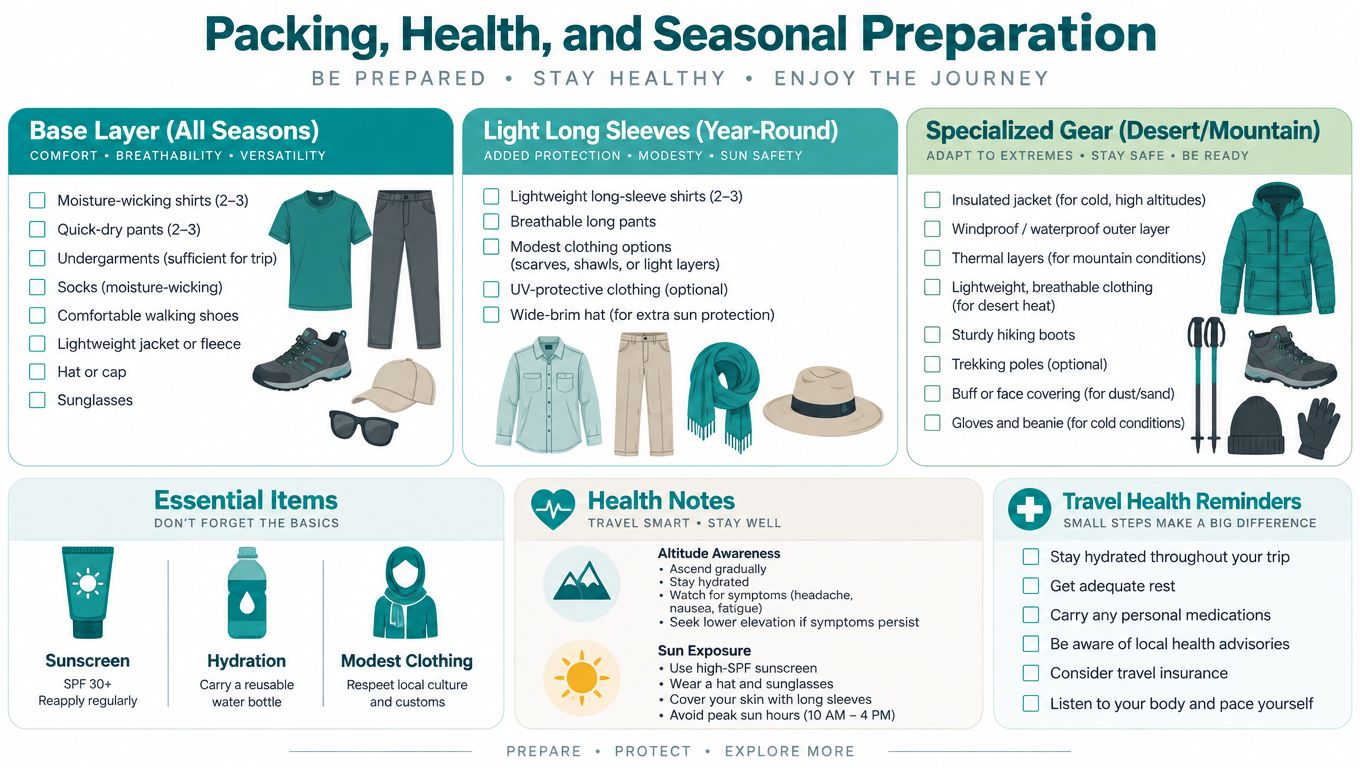
Morocco does not need one national packing list. Your route decides what belongs in the bag, and that matters even more after the country recorded 19.8M tourist arrivals in 2025. A coastal city break, Atlas trek, and desert camp can share one itinerary while demanding completely different layers.
What belongs in the bag
Start with a base layer and light long sleeves in every season. They work for mosques, air-conditioned restaurants, and medina evenings, which can feel cooler than expected. Add a mid-layer fleece for Atlas routes in spring or autumn, since higher areas can fall below 10°C at night.
A windbreaker earns its place when your itinerary includes the coast or desert. For July and August, choose linen and strong sun protection. For December and February, pack a proper coat if you will cross Atlas passes or visit Ifrane. Desert travelers should also carry a headscarf, lip balm, and a buff to protect against sand and dry air.
Health supplies matter most when the nearest pharmacy is far away. Carry reef-safe sunscreen, oral rehydration salts for summer, hand sanitizer, a basic first-aid kit, and copies of your prescriptions. If you're trekking above 2,500m, pace the day for altitude rather than treating it like a city walk. Travel insurance should cover emergency medical evacuation when you sleep in remote desert areas.
During Ramadan, avoid eating or drinking in public from sunrise to sunset, and keep snacks in your day bag. For mobile data and maps, how many GBs you need depends on your navigation and messaging habits, but weak connectivity can disrupt a tightly timed route. The rule that prevents the most discomfort is simple: dress for the coldest part of the day you will be in, not the warmest hour on the forecast.
Itinerary, Transit, and Connectivity Planning
Build around the route, not a list of destinations. Morocco's geography punishes rushed planning, especially on city-to-desert itineraries. With 2025's record 19.8 million tourist arrivals, shoulder season no longer guarantees quiet roads, available riads, or flexible desert transfers. Match the route to the season and leave room between major moves.
A route that actually works
For seven days, use a focused loop of Marrakech, Ait Bouguemez, Merzouga, and Fes. It is ambitious, so schedule the longest transfers carefully and avoid adding another major stop. With ten days, add Essaouira and give the coast its own time rather than squeezing it between the desert and Marrakech.
Choose transport by route. ONCF rail works well between major cities, grand taxis suit shared mountain connections, and Supratours is the bus network I would choose for direct Sahara links. Use the train where rail is practical, the bus where a desert gateway is better served, and a private transfer when a fixed arrival matters more than the fare.
If time is tight, decide early whether to fly between hubs or accept a slower rhythm with rail and road travel. That choice affects how much of the itinerary remains enjoyable, not just how quickly you reach the next destination.
Carry enough dirhams for remote stretches, since card payments are inconsistent outside established hotels and restaurants. French helps in cities, Arabic helps throughout the country, and Berber is especially useful in mountain and rural areas. Keep small notes available for tipping at riads, camps, and roadside stops.
Connectivity that won't slow the trip down
An eSIM is the simplest data option for a compatible phone. Review this eSIM guide for Morocco before departure if you want to compare setup options. Airport kiosks at CMN, RAK, and AGA remain useful for travelers who prefer a physical SIM or need assistance on arrival.
Coverage becomes less consistent in remote mountains and desert areas, so install maps, save accommodation details, and arrange key transfers before leaving major cities. Connection planning belongs in the itinerary, not as an afterthought at the airport.
Choosing the Right Window for Your 2026 Morocco Trip
Use four questions. How fixed are your dates, which regions anchor the trip, what activity matters most, and how price-sensitive are you? If the answer is “I want Marrakech, Fes, and the desert in one trip,” choose spring. If the answer is “I want desert plus coast,” choose autumn. If the answer is “I care about surf and lower prices,” choose winter. If the answer is “I'm coast-first,” summer is fine.
Ramadan 2026 runs February 18 to March 19, and Easter falls on March 29, so March and April will be especially pressure-heavy for city itineraries and accommodation planning. Booking desert camps and riads 4 to 6 months ahead is no longer aggressive, it's normal.
For a trip advisor who wants the route to fit the season instead of forcing the season to fit the route, that's the right lens. Morocco rewards travelers who match month, geography, and activity instead of chasing a single national answer.
Simsima gives travelers a straightforward way to stay connected in Morocco with prepaid eSIM data plans you can install before you fly and activate on arrival. If you're planning routes across cities, desert, and coast, visit Simsima and choose the data setup that fits your itinerary before you leave.
#when to visit morocco#morocco weather#morocco travel#morocco seasons#morocco itinerary

Dimitri MorvanFounder
Founder of Simsima. A passionate traveler based in Barcelona, he helps travelers stay connected without breaking the bank on roaming fees.
LinkedIn