-5% on your 1st eSIMuntil October 31
Most travel advice gives you a tidy answer to when to visit Spain: choose spring or autumn, avoid summer, and expect quiet streets. That advice is now too simplistic. Spain's tourism calendar has stretched beyond July and August, so the key question isn't whether a season is “low.” It's which region, which month, and which kind of trip will give you tolerable heat, manageable crowds, and the experience you want.
My recommendation is direct. Choose late April through June for city touring and mixed itineraries, or September through October for the strongest overall balance. Choose July or August only when dependable beach weather matters more than heat, queues, and peak demand. For a quieter trip, look beyond famous destinations and avoid major festival dates rather than trusting a season label.
The Myth of the Empty Shoulder Season
Spring and autumn are no longer Spain's secret seasons. They're better than July and August for many travelers, but they aren't automatically quiet, cheap, or effortless. Major cities, cultural routes, islands, and coastal resorts can remain busy well after summer's traditional peak.
Spain recorded 25.6 million international visitors from January through April 2025, up 7.1% year over year, according to CaixaBank Research's tourism outlook. The same outlook identifies a continuing move toward lower seasonality and anticipates comparatively stronger growth from October through December. That changes how you should interpret “shoulder season.” October can offer more comfortable sightseeing, but it may still bring full trains, busy museums, and limited accommodation in popular neighborhoods.
The broader shift is substantial. Spain received approximately 47 million international tourists in 1999, compared with 93.7 million in the 12 months through November 2024, roughly double the earlier total, as CaixaBank Research explains in its analysis of Spanish tourism seasonality. July and August accounted for 28.5% of international arrivals in 1999, but their combined share fell to 23.2% in the 12 months through November 2024. Demand has spread across spring, autumn, and winter, rather than disappearing.
What this means for your booking strategy
Treat April, May, September, and October as high-value planning windows, not guaranteed low seasons. They often improve walking conditions and distribute demand more comfortably, but famous sites and desirable hotels can still fill quickly.
Practical rule: Book the fixed parts of your itinerary early, then use flexible day plans to escape the busiest districts.
The same principle applies if you're comparing Spain with neighboring destinations. A useful guide to when to visit Portugal can help if your route includes both countries, but don't assume the same month produces the same conditions everywhere. Spain's inland plateau, Mediterranean coast, Atlantic north, and Andalusian cities all behave differently.
The smarter question is not “Which season is empty?” Ask instead:
- Where will crowds concentrate? Major cities, islands, beaches, and festival towns can stay busy after summer.
- What will you do during the day? A museum-heavy Madrid trip tolerates different weather from a walking route through Seville.
- How fixed is your itinerary? A multi-city rail trip needs earlier transport planning than a loose coastal stay.
- Which events overlap your dates? A festival can overwhelm an otherwise moderate travel period.
Spain still rewards shoulder-season travel. It rewards specific planning, not outdated assumptions.
Decoding Spain's Regional Climate Zones
Spain doesn't have one best travel month because it doesn't have one climate. Andalusia can be punishingly hot while northern Atlantic destinations feel cool and wet. Madrid brings dry, intense summer heat and more changeable spring conditions. The Mediterranean coast offers reliable summer sunshine, but its heat remains significant.
At Seville Airport, the average temperature rises from 10.9°C in January to 28.2°C in July, while the average July maximum reaches 36.0°C and the average minimum is 20.3°C, according to AEMET's official climate normals for Seville. July rainfall averages just 2 mm, compared with 66 mm in January, and July records about 354 sunshine hours, versus 183 in January.
That makes July attractive for dry beach-oriented plans, but difficult for long afternoon walks through Seville, Córdoba, or inland Andalusia. April and May are more sensible for architecture, food, and outdoor sightseeing, especially if you want to stay active during daylight hours.
Match the region to the month
| Destination | Avg Max Temp, July/August | Avg Rainfall, July/August |
|---|---|---|
| Seville | 36.0°C in July | 2 mm in July |
| Alicante | 30.3°C in July, 30.8°C in August | 4 mm in July, 7 mm in August |
| Madrid | 32.1°C in July, based on July normals | 10–12 mm in July–August |
| Northern Atlantic regions | Cooler and wetter than inland and southern Spain | More variable and often wetter |
Alicante's official normals show average temperatures of 25.5°C in July and 26.0°C in August, with average maximums of 30.3°C and 30.8°C, as recorded by AEMET's climate data. July and August rainfall averages only 4 mm and 7 mm, so the Mediterranean coast is a strong choice when dry beach weather is the priority.
Madrid needs a different approach. Spring supports comfortable city exploration, while summer is dry but much hotter. Northern destinations, including Atlantic-facing parts of the country, are typically better suited to travelers who prefer moderate temperatures and don't mind a greater chance of rain.
Use a regional heat-and-crowd matrix
| Region | Best practical window | Heat and crowd guidance |
|---|---|---|
| Andalusia | April–May, late September–October | Avoid making midday sightseeing the centerpiece in July and August |
| Mediterranean coast | June or September | July and August favor beach trips, but demand is concentrated |
| Madrid and central plateau | April–June, September–October | April is cooler and wetter, June is warmer and more reliable |
| Northern Atlantic Spain | Late spring through early autumn | Expect cooler conditions and more variable rainfall |
| Islands and major coastal resorts | June or September | Shoulder dates can still be busy, so reserve popular stays early |
If your trip involves relocating, working remotely, or considering a longer stay, weather is only one planning factor. Housing and legal logistics matter too, so expats evaluating property options may find a Spain home loan for expats resource useful alongside their travel research.
For broader comparisons across neighboring destinations, see this guide to the best time to visit Europe. Use it as a starting point, then check destination-specific AEMET normals before finalizing a route.
Peak Summer Versus the New Shoulder Reality
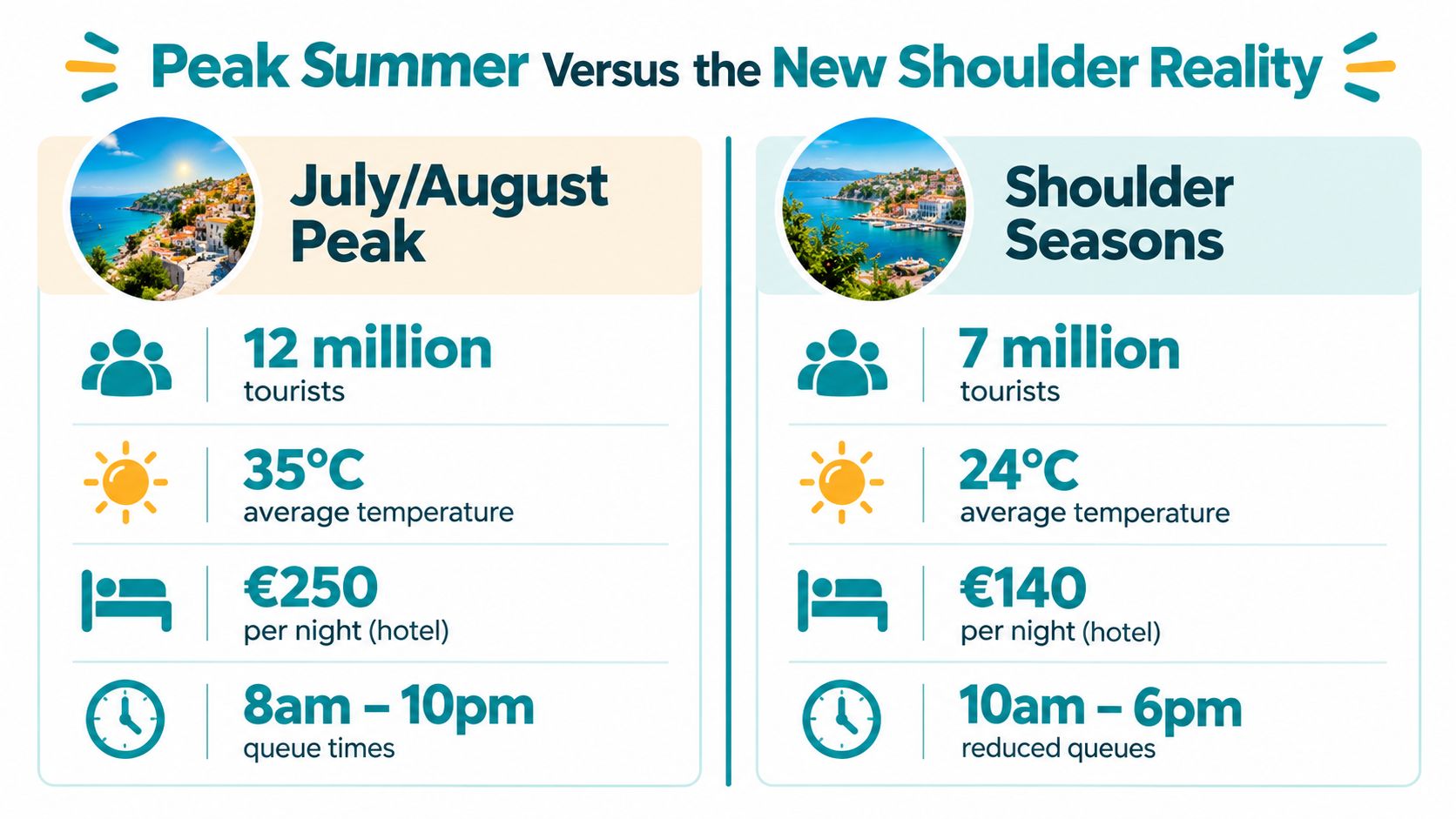
The old advice that spring and autumn are empty is no longer reliable. Spain's shoulder seasons offer better conditions for walking and sightseeing, but popular cities, islands, and coastal resorts can still be busy. Choose based on the heat-and-crowd trade-off, not a single national “best month.”
July and August remain Spain's classic beach months, yet they bring high visitor volume, intense heat, and higher spending together. Spain received 11.0 million international tourists in July 2025 and a record 11.3 million in August. July visitor spending reached €16.39 billion, with average daily spending at €198, according to Idealista's report on Spain's summer tourism. Peak summer costs more because demand is strongest, not merely because the weather is attractive.
Pick the trade-off you can tolerate
Choose July and August when:
- Beach reliability comes first: Mediterranean destinations are exceptionally dry.
- Your schedule favors evenings: Walk early, stay indoors during the hottest hours, and dine late.
- A summer festival is the priority: Transport and accommodation may require earlier booking.
- You are staying on the coast: Resorts are built for high summer demand, even when inland cities feel oppressive.
Choose April through June or September through October when:
- You will walk extensively: City breaks, historic centers, and rail itineraries are easier in moderate conditions.
- You are visiting inland Spain: Madrid and Andalusia are more manageable when the harshest afternoon heat is absent.
- You want longer usable days: Cooler mornings and evenings make museums, neighborhoods, and restaurants easier to combine.
- You accept some residual demand: Shoulder travel is more comfortable, but it is not automatically uncrowded.
Spain's shoulder demand has clearly strengthened. Arrivals in October, November, and December 2023 were 10%, 16%, and 25% higher, respectively, than in the comparable pre-pandemic period, according to the Bank of Spain's tourism seasonality analysis. October can suit cultural travel, but it should not be treated as a deserted month.
For beaches, accept summer's crowds and cost. For architecture, food, museums, and long walking days, choose late spring or early autumn, then reserve popular hotels and experiences before arrival.
Tailored Timing for Every Traveler Profile
The best month depends on what you want your days to feel like. A beach traveler needs dry conditions and warm water, while a museum traveler needs tolerable streets between indoor visits. A remote worker needs stable connectivity and a schedule that won't force every productive hour into the hottest part of the day.
For beach-focused travelers
Choose June or September for a practical coastal compromise. July and August offer the most dependable dry beach conditions, particularly on the Mediterranean coast, but they also bring the strongest concentration of visitors. September is especially useful if you want warm coastal conditions while reducing reliance on the traditional peak window.
Pick Alicante, the Costa del Sol, or the Balearic Islands for a classic Mediterranean plan. If you prefer cooler Atlantic scenery and seafood-focused travel, look north, but accept more variable weather.
For culture and museum travelers
Choose April, May, late September, or October. These windows suit travelers who want to walk historic centers, visit museums, and combine cities with inland excursions. Seville's spring normals show average temperatures of 17.3°C in April and 20.7°C in May, with average maximums of 23.4°C and 27.2°C, according to AEMET's Seville climate data.
Madrid is particularly straightforward to plan around. Its average maximum rises from 18.2°C in April to 28.2°C in June and 32.1°C in July, while rainfall falls from 45 mm in April to 21 mm in June and 10–12 mm in July and August, based on AEMET's Madrid normals. April gives you cooler walking conditions with more rain risk. June gives you greater weather reliability but more heat.
For budget travelers
Look beyond the simple “spring or autumn” formula. Late autumn and winter can offer more flexibility in cities, while January through March may suit travelers who prioritize indoor culture and a looser itinerary. Don't assume every coastal town operates at full capacity outside summer, however. Seasonal closures can affect dining and accommodation choices.
For remote workers and multi-city travelers
Choose a period that lets you move between regions without building your workday around heat avoidance. Late April to June works well for a route combining Madrid, Barcelona, and northern or inland destinations. September to October is stronger for coastal stays combined with city travel.
Plan fewer long relocation days and verify your accommodation's workspace before booking. For an itinerary crossing several regions, connectivity should be arranged before departure, not after you land.
Navigating Major Festivals and Cultural Events
Spain's festival calendar can override the normal logic of weather and seasonality. A city that would be manageable in a quiet week can become difficult during a major religious celebration, parade, running event, or food festival. Decide first whether the event is the reason for your trip. If it isn't, check the local calendar before booking.

When the event is the destination
Semana Santa can transform Seville and other cities with processions, restricted movement, and dense crowds. Feria de Abril brings another major surge to Seville shortly afterward. These are excellent dates for travelers who want an immersive cultural experience, but poor dates for anyone expecting relaxed sightseeing.
Las Fallas makes Valencia a deliberate event trip rather than a casual city break. San Fermín turns Pamplona into a global festival destination. La Tomatina draws visitors to Buñol for a highly specific experience. Each event changes the practical value of nearby accommodation, local transport, restaurant availability, and walking routes.
The same applies to smaller celebrations. A local festival can be more rewarding than a famous one, but you'll need to check exact dates because many events move with religious or civic calendars.
Book the festival, not just the flight. Accommodation near the event area disappears first, and transport becomes less forgiving as the date approaches.
When you want to avoid the disruption
Stay outside the host city, shift your route to another region, or move your dates by a few days. Don't rely on staying “just outside” the center without checking transport. Festival traffic can make a short geographic distance feel much longer.
Pamplona travelers who need flexible local transport can also research options to find cheap rentals in Pamplona, especially when their plans include surrounding towns rather than only the festival route.
For event-focused trips, reserve accommodation and intercity transport before locking in sightseeing reservations. For event-avoidance trips, check the calendar at the destination level, not just the national holiday level. A regional festival may be invisible in a general Spain itinerary but decisive once you arrive.
Staying Connected Across Regions and Seasons
Spain's seasonality has changed, and your connectivity plan should reflect that. Summer brings heavier visitor spending, while spring, autumn, and winter still attract travelers across cities, coasts, and business routes. A connection that depends on finding a shop after landing adds avoidable friction to the first day.
Connectivity matters most on itineraries that cross Spain's regional climate zones. You may leave a cool northern city, reach a hot inland destination, and finish on a Mediterranean island, all while relying on maps, translation tools, booking confirmations, work platforms, and transport updates. Plan mobile access before departure rather than treating it as an arrival-day errand.

Why an eSIM fits a multi-region itinerary
A travel eSIM lets you arrange mobile data before departure without removing your physical SIM. On a route through Madrid, Seville, Barcelona, and the coast, navigation and booking tools can work as soon as your phone connects to a local network.
Regional plans suit trips that combine Spain with other European countries. You can avoid buying a separate physical SIM at each border and keep your regular number available for calls or messages if your phone supports dual-SIM use.
Check these four details before buying:
- Device compatibility: Confirm that your phone supports eSIM and has no carrier restriction.
- Coverage needs: Match the plan to cities, islands, rural roads, or longer road trips.
- Data habits: Navigation and messaging use less data than video calls, remote work, or streaming.
- Activation timing: Install the eSIM before departure, then activate it according to the plan's instructions.
Use Simsima's Spain eSIM guide to compare setup options. Simsima lists prepaid data plans for Spain and regional Europe, including Smart Link installation or QR-code setup, no app requirement, and data-only options that let you retain your usual number.
Choose a plan based on your regions, trip length, and expected data use. That calculation matters in October or winter just as much as during August, especially when your route includes rural stops or remote work.
Finalizing Your Spain Travel Strategy
The “best time to visit Spain” does not exist nationally. Choose activity first, region second, and crowd tolerance third. That order prevents a common mistake: booking a supposedly ideal season, then finding oppressive heat, unsuitable weather, or a festival that has filled your destination.

Use this decision matrix
| Your priority | Recommended timing | Planning emphasis |
|---|---|---|
| Mediterranean beach days | June or September | Reserve coastal accommodation and check local demand |
| City walking and culture | April–May or September–October | Plan around heat, rain, and attraction availability |
| Inland Spain with outdoor activity | Late spring or early autumn | Compare regional climate normals |
| Festival attendance | Exact event dates | Book transport and accommodation early |
| Flexible, lower-demand city travel | Winter or late autumn | Check seasonal openings before committing |
Treat spring and autumn as busy shoulder seasons, not empty ones. October through December can offer cooler conditions for city travel, yet popular routes and major urban attractions still need advance planning. Crowds vary sharply by region: September can suit Mediterranean beaches, while inland cities may remain hot; late autumn improves walking conditions but brings shorter days and more seasonal closures.
Lock in the practical details
- Reserve fixed transport first: High-speed rail and festival travel become harder to change once demand rises.
- Choose accommodation by climate: Air conditioning matters during hot inland months. Heating and comfortable indoor space matter in cooler periods.
- Pack for regional changes: Lightweight layers suit itineraries crossing the coast, plateau, and north better than one heavy outfit.
- Check the local calendar: Festivals, school holidays, and long weekends can override normal seasonal patterns.
- Arrange connectivity before landing: Install your eSIM and save essential bookings offline.
- Review travel protection: Read the Bsure Health Brokers insurance guide to assess travel medical coverage before departure.
My recommendation is direct. Choose late April through June for a broad sightseeing route, September through October for the strongest balance of comfort and demand, and July or August only when beach time justifies higher heat and heavier crowds. Match those windows to your actual regions rather than applying one national rule.
Simsima offers prepaid Spain and Europe eSIM data plans with digital delivery, one-tap Smart Link installation, and no physical SIM or app requirement. Before departure, compare a plan that matches your regions and trip length, then visit Simsima to arrange connectivity for your Spain itinerary.
#when to visit spain#spain travel guide#spain weather#spain festivals#travel esim spain

Dimitri MorvanFounder
Founder of Simsima. A passionate traveler based in Barcelona, he helps travelers stay connected without breaking the bank on roaming fees.
LinkedIn